Five Year TCO Explained: Epic vs. Cerner for U.S. Hospitals
Five Year TCO Explained: Epic vs. Cerner for U.S. Hospitals
Epic generally wins the fit test for large, complex academic medical centers and integrated delivery networks that need deep specialty coverage and a dominant regional referral network. Oracle Health, running on the legacy Cerner Millennium core, tends to land on shortlists for budget-conscious hospitals and systems that prioritize open architecture over an all-in-one build. The real deciding factors are regional interoperability, specialty depth, and five-year total cost of ownership, which we break down below alongside a shortlist you can act on today.
TL;DR:
- Regional interoperability favors Epic if most hospitals in your area already use it, especially for network effects like Care Everywhere.
- Native specialty templates are deeper and require less customization on Epic, while Cerner often relies on third-party tools to fill specialty gaps.
- Vendor-neutral analytics and AI support are crucial for cross-system data pipelines and initial proof-of-concept projects, especially after mergers.
- Long-term costs depend heavily on interface fees, customization, data migration, and ongoing support, not just licensing fees.
- Implementation timelines vary from months for small clinics to over two years for large academic centers, emphasizing careful planning over software features alone.
Table of Contents
- Epic vs. Cerner Shortlist: Who Should Shortlist Whom
- Clinical Documentation and Specialty Support: What Clinicians Actually Feel
- Epic vs. Cerner Interoperability: Networks, FHIR, and the Fine Print
- Analytics, AI, and Population-Health Tools Compared
- MyChart vs. Oracle Health Portal: Patient and Clinician Tools
- Revenue Cycle Management: Epic vs. Cerner Impact on Billing
- Implementation Timelines and the Real Five-Year TCO
- How to Extract and Integrate Clinical Data From Either Platform
- Security, Compliance, and Contract Red Flags to Watch
- Decision Checklist: Scoring Your Shortlist Before the RFP
- Case Studies: How Epic and Cerner Implementations Actually Played Out
- When Vendor-Neutral AI and Integration Support Actually Pays Off
- How Arosplatforms Supports EHR Selection and Integration
- Sources
- FAQ
Epic vs. Cerner Shortlist: Who Should Shortlist Whom
Most procurement teams don’t need forty pages of feature comparison to build a first-round vendor list. They need three or four decision rules and a compact reference table.
Shortlist Epic if you’re a multi-hospital system with 15+ specialties, an academic research mission, or a service area where most competing hospitals already run Epic (regional network effects compound fast with Care Everywhere). Shortlist Cerner or Oracle Health if your priority is a lower entry cost, you want more flexibility to bolt on third-party best-of-breed tools, or you’re a government-affiliated facility where Oracle Health already has a federal foothold. Shortlist both, in parallel, if you’re an ambulatory-heavy system under 300 beds where the pricing gap and implementation timeline will likely decide the outcome more than any feature checklist.
| Dimension | Epic EHR | Cerner (Oracle Health) |
|---|---|---|
| Best for | Large academic and multi-hospital IDNs | Budget-conscious, open-architecture-focused systems |
| Deployment model | Primarily hosted/cloud with on-premise legacy options | Cloud-native shift underway via Oracle Cloud Infrastructure |
| Pricing/TCO shape | Higher upfront, steep but front-loaded implementation cost | Lower entry cost, cost curve depends on integration count |
| Specialty module depth | Broad and deep across most specialties | Solid core, narrower in niche specialties |
| Interoperability | Care Everywhere network, strong regional pull | CommonWell co-founder, more open third-party integration |
Clinical Documentation and Specialty Support: What Clinicians Actually Feel
The documentation experience is where clinician satisfaction gets made or broken, and usability research consistently ties EHR success to how much friction shows up in daily charting. Epic’s SmartTools (SmartPhrases, SmartLists, SmartLinks) let clinicians build reusable, auto-populating templates, and the platform’s specialty modules go deep. Orthopedics, oncology, and transplant programs, in particular, tend to get more built-out workflows out of the box.
Cerner’s documentation tools, built around PowerChart, cover the same core ground but with a leaner starting toolkit; many organizations lean on third-party add-ons to close specialty gaps rather than waiting on native Oracle Health builds. That flexibility cuts both ways: cheaper to start, but it shifts customization work onto your IT team or an integration partner.
A few things worth knowing before you commit either direction:
- Clinician documentation burden is a proven driver of EHR satisfaction and turnover risk, not a soft “nice to have” metric.
- Epic generally ships deeper native specialty templates; Cerner generally requires more third-party or custom builds to match that depth.
- Training investment tends to run longer for Epic given its module breadth, but organizations report fewer post-go-live workflow gaps as a result.
- Neither platform’s out-of-the-box documentation tools eliminate the need for specialty-specific customization during implementation.
Epic vs. Cerner Interoperability: Networks, FHIR, and the Fine Print
Interoperability is where the Epic vs. Cerner decision gets genuinely technical, and it’s the section most RFPs underweight. Epic’s Care Everywhere network benefits from sheer density: if most hospitals in your referral area already run Epic, patient records move with less friction than almost any interface project could achieve. Cerner co-founded CommonWell Health Alliance, which pushes toward a more vendor-agnostic exchange model, and that matters more once TEFCA-driven nationwide exchange becomes the default expectation rather than the exception.
Three practical steps for evaluating interoperability during procurement:
- Ask each vendor to demonstrate FHIR Bulk Export performance on a dataset sized like your actual patient population, not a demo sandbox.
- Confirm rate limits and throttling behavior for real-time HL7 v2 ADT feeds, since both platforms handle bulk versus real-time exchange differently and that gap shows up in production, not in sales demos.
- Get written commitments on per-interface fees before signing, since interoperability costs are where budgets quietly balloon after go-live.
Pro Tip: Have your integration engineers, not just your CIO, sit in on the technical demo. Vendors answer differently when the audience knows how to ask about bulk export throttling and interface fee structures.
Analytics, AI, and Population-Health Tools Compared
Epic’s Cosmos platform aggregates de-identified data across participating health systems into one of the largest research-scale clinical datasets in the country, giving academic and research-focused systems a meaningful edge for population-level studies. Oracle Health counters with Oracle Cloud Infrastructure and its enterprise analytics stack, which appeals to systems already standardized on Oracle for other operational data.
Both vendors are building AI assistants into clinical workflows, but neither has reached full parity with a purpose-built, vendor-neutral analytics layer.
- Epic Cosmos is strongest for research and multi-site population studies; it requires participation and data-sharing agreements to access full value.
- Oracle Health’s analytics leans on cloud infrastructure your team may already operate, which can shorten setup time for IT-savvy systems.
- Vendor-neutral data warehousing remains the more flexible option when your analytics needs span multiple EHRs or non-clinical data sources.
- Neither vendor’s native AI tooling replaces the need for a dedicated data governance and quality-measurement pipeline.
MyChart vs. Oracle Health Portal: Patient and Clinician Tools
MyChart has the adoption advantage. Patients already know it from other health systems, which lowers onboarding friction and tends to boost portal activation rates. Oracle Health’s patient portal covers the same core functions (scheduling, messaging, results) but with a smaller existing user base walking in the door already familiar with it.
On the clinician side, Epic’s Haiku and Canto mobile apps generally get praised for smoother chart review on the go, while PowerChart Touch covers core mobile documentation needs but with narrower feature depth in some reported clinician feedback.
- MyChart’s higher name recognition often translates into faster patient adoption post-launch.
- Telehealth and self-scheduling features on both portals directly affect no-show rates when patients can reschedule without calling.
- PowerChart Touch works well for quick chart review but may require more taps for complex documentation tasks.
- Portal adoption numbers are a legitimate KPI to request from either vendor during reference calls.
Revenue Cycle Management: Epic vs. Cerner Impact on Billing
Epic tends to integrate revenue cycle functions more tightly into the clinical workflow itself, meaning charge capture and coding prompts often surface at the point of care rather than after the fact. Cerner’s RCM tools historically relied more on separate modules, though Oracle Health’s cloud integration is narrowing that gap.
- Tighter clinical-to-billing integration on Epic can reduce charge lag and improve claims accuracy when configured well.
- Cerner’s more modular RCM setup gives flexibility to swap in third-party billing tools, useful for systems with existing RCM vendor relationships.
- Either platform can underperform on revenue capture if optimization and staff training get shortchanged during go-live.
- Expect dedicated RCM analyst staffing regardless of vendor. Neither system runs itself.
Implementation Timelines and the Real Five-Year TCO
A single-specialty ambulatory clinic can go live on either platform in a few months. A full academic medical center migration routinely runs 18 to 24 months or longer, and the timeline stretches further when legacy data migration, specialty customization, and interface testing pile up simultaneously. Federal guidance on EHR costs makes clear that licensing is only one line item in a much longer cost model.
Here’s the checklist that actually determines your five-year number:
- Software licensing and hosting fees, whether cloud subscription or on-premise
- Implementation and configuration services, typically the largest single upfront cost
- Interface and integration fees, charged per connection by many vendors
- Training hours across every clinical and administrative role
- Ongoing support, upgrades, and optimization staffing after go-live
- Hardware refresh cycles for mobile carts, workstations, and scanners
- Data migration and legacy system decommissioning costs
Statistic Callout: Market analysis consistently shows Epic commanding a wider footprint among large systems while Cerner and Oracle Health compete on lower entry pricing and open architecture, a trade-off that plays out directly in your TCO curve depending on how many interfaces and specialty modules you eventually add.
How to Extract and Integrate Clinical Data From Either Platform
Analytics teams building pipelines against Epic or Cerner need to pick the right extraction method for the job, not default to whatever the vendor demos first.
- Use FHIR Bulk Export for population-level extracts feeding research or quality dashboards, since it’s built for volume rather than single-patient lookups.
- Use HL7 v2 feeds for real-time ADT events where latency matters, such as census tracking or care coordination alerts.
- Use direct reporting database extracts when you need historical depth that Bulk Export doesn’t cover well, but expect heavier vendor coordination.
- Budget extra QA time for cross-EHR normalization if your system runs both platforms after a merger or acquisition, since field mappings rarely match cleanly.
Rate limits and bulk export timing windows are the most common pipeline failure point, and both vendors handle these differently in ways that rarely show up until you’re running production loads.
Pro Tip: Stage all incoming data in a normalized landing zone before it touches your analytics warehouse. It’s far easier to fix a mapping error in staging than to unwind a corrupted quality measure that already fed a leadership dashboard.
Security, Compliance, and Contract Red Flags to Watch
Both vendors provide baseline technical safeguards: encryption at rest and in transit, audit logging, and role-based access controls. What remains squarely on your organization is the Business Associate Agreement negotiation, ongoing access monitoring, and breach-response readiness, none of which the vendor manages for you by default.
Watch for three contract red flags during procurement: restrictive data export terms that make it costly to leave later, per-interface fees that aren’t disclosed until after signing, and vague service-level agreements that don’t specify uptime penalties. Push every vendor for written audit-logging specifications and a clear data-ownership clause before you sign anything.
Decision Checklist: Scoring Your Shortlist Before the RFP
Score each vendor against five weighted categories before you write a single RFP question: organization size and complexity, specialty mix, analytics maturity needs, integration count, and total budget ceiling including five-year TCO.
Minimum demo questions to require from either vendor:
- Show a live FHIR Bulk Export running against a dataset your size, not a curated demo file.
- Walk through per-interface pricing for the five integrations you use most today.
- Demonstrate specialty-specific documentation templates for your two highest-volume service lines.
- Provide reference customers matching your bed count and specialty mix, not just your region.
- Detail the data migration process and typical downtime window for a system your size.
Require a scoped pilot or proof-of-concept whenever the vendor can’t answer question one convincingly. Define success criteria in writing before the pilot starts, covering data completeness, interface latency, and clinician usability scores, so you’re not negotiating the definition of “success” after the fact.
Case Studies: How Epic and Cerner Implementations Actually Played Out
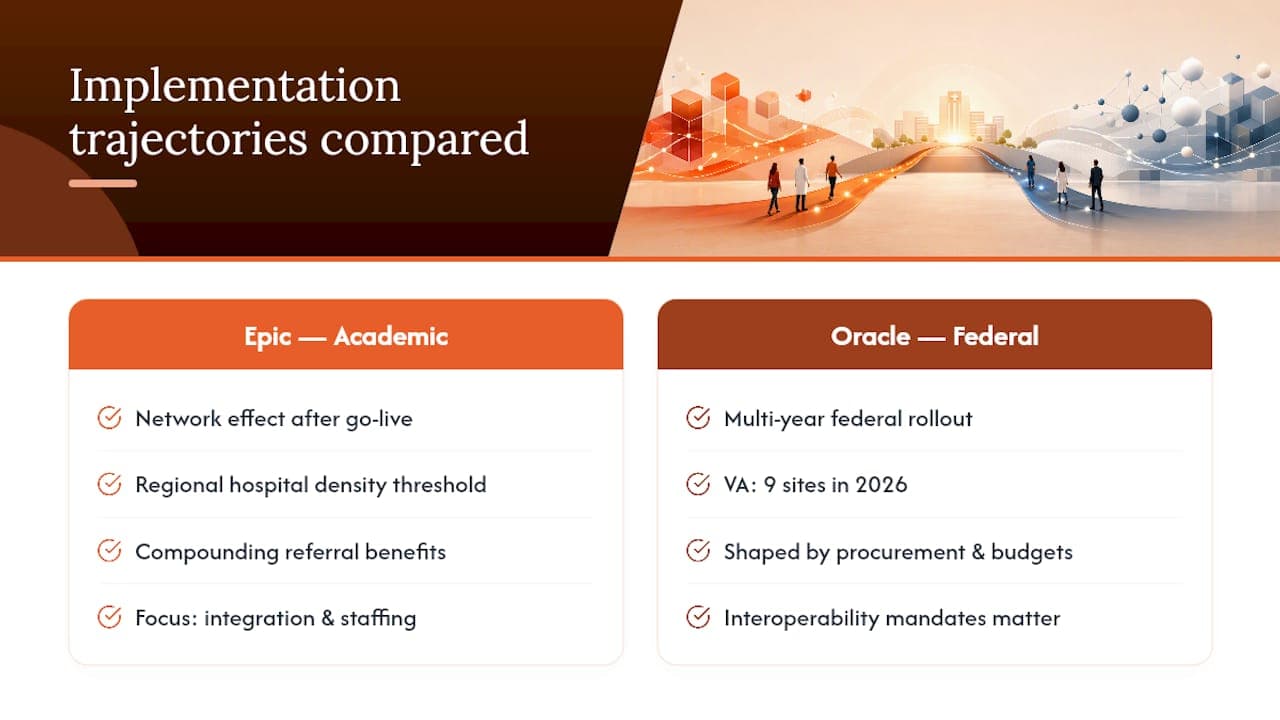
Large academic systems that migrated to Epic often cite the network effect as the deciding factor after go-live, not before. Once a regional hospital density of Epic users passes a certain threshold, Care Everywhere referral data starts moving with genuinely less friction, and that benefit compounds every year more hospitals in the area join the same platform.
On the federal side, Oracle Health’s continued rollout illustrates a different kind of long-term commitment. The VA is completing federal EHR deployment at nine additional sites in 2026, a multi-year rollout that reflects how government and defense-affiliated systems evaluate EHR selection differently than private academic medical centers. Budget cycles, procurement rules, and interoperability mandates specific to federal agencies shape that timeline more than clinical feature comparisons do.
Both trajectories point to the same lesson for any health system evaluating either vendor: the implementation outcome depends less on the software itself and more on how well the organization scoped its integration needs, staffed its go-live support, and planned for the years after launch rather than just the weeks around it. Reference calls with organizations matching your size and specialty mix remain more useful than any published case study, including this one.
When Vendor-Neutral AI and Integration Support Actually Pays Off
Neither Epic nor Oracle Health natively covers every analytics or ambient documentation use case a health system eventually wants. Vendor-neutral support tends to earn its keep during two moments: standing up an ambient documentation proof-of-concept that runs alongside the incumbent EHR, and building analytics pipelines that need to span multiple systems after a merger. Budget for that partner during procurement, not after the contract’s signed.
How Arosplatforms Supports EHR Selection and Integration
Choosing between Epic and Oracle Health is only step one. The harder, longer work is getting AI and analytics tools to actually function inside whichever EHR you pick, without your team getting locked into a single vendor’s roadmap. Arosplatforms works alongside hospitals and health systems as a vendor-neutral partner: a readiness assessment to evaluate your data, staffing, and governance gaps before any AI project starts, followed by scoped proof-of-concept work on ambient documentation, prior authorization automation, or population-health analytics that sits on top of your existing EHR investment.
The engagement model is fixed-scope and transparent, and every system Arosplatforms builds stays owned by your organization, not locked to a consultancy’s platform. If your procurement team is weighing Epic against Cerner and wondering how AI enablement fits into either path, start with a healthcare AI readiness assessment before you finalize the RFP.
Sources
- EHR Data Integration Architecture | mdatool
- Epic Cosmos makes big-data research possible — sidekick AI makes it practical | UTMB News (2025)
- VA to complete federal EHR deployment at nine additional sites in 2026 | U.S. Department of Veterans Affairs
- Epic vs Cerner: Which EHR Is Right for Your Practice? | Forbes Advisor (2023)
FAQ
Why Is Epic Considered Better Than Cerner by Many Systems?
Epic tends to score higher on clinician satisfaction and specialty depth, and its Care Everywhere network creates a regional advantage that grows as more nearby hospitals adopt the same platform, though Cerner’s open architecture and lower entry cost remain a genuine draw for budget-driven organizations.
What Are the Top EHR Systems Hospitals Use Today?
Epic and Oracle Health (formerly Cerner) hold the largest combined share among large hospitals and health systems, with MEDITECH also maintaining a meaningful presence in community and smaller hospital settings.
Why Are Some Hospitals Moving Away From Cerner?
Some hospitals cite integration complexity and the transition period as Oracle absorbs Cerner Millennium into its cloud-native stack, though many organizations with existing Millennium installations continue phased migrations rather than full vendor switches.
Who Competes Most Directly With Cerner (Oracle Health)?
Epic is Oracle Health’s most direct competitor at the large hospital and health system level, while MEDITECH competes more in the community hospital segment.
Can a Vendor-Neutral Partner Help During an Epic or Cerner Migration?
Yes. A readiness assessment and scoped proof-of-concept from a partner like Arosplatforms can validate AI and analytics use cases before or during an EHR transition, independent of which vendor you select.