5 Step HIPAA Compliant AI Playbook for U.S. Health IT
5 Step HIPAA Compliant AI Playbook for U.S. Health IT
No AI model or app is automatically HIPAA-compliant. Compliance gets produced by the contract you sign, the architecture you deploy, and the operational controls wrapped around the model, not by a vendor’s marketing page. The two levers that matter most are an unbroken Business Associate Agreement chain and a deployment that keeps protected health information inside a boundary you’ve already secured. Everything below walks through the architectures, the contract language, and the go-live checklist that turn “eligible” into actually compliant.
TL;DR:
- AI models or applications cannot be inherently HIPAA-compliant; compliance depends on proper contracts, architecture, and operational controls, not marketing claims.
- Deployments using cloud provider endpoints under a BAA or vendor BAA are generally lower effort, but require correct configuration and scope verification to ensure actual compliance.
- Running open-weights models in a private cloud offers maximum data control but shifts security responsibilities entirely onto your organization, including encryption and audit logging.
- Contracts must specify scope, data retention, subprocessor transparency, breach notification timelines, and audit rights; a signed BAA alone does not guarantee compliance.
- Continuous monitoring, prompt governance, detailed audit logs, and strict access controls are essential operational practices to maintain compliance during daily AI deployment.
Table of Contents
- What HIPAA Requires for AI Systems Handling PHI
- Which Architectures Actually Work for HIPAA-Compliant AI?
- What Should Be in the BAA and Vendor Contract?
- Which Engineering Controls Actually Produce Compliance?
- Common Pitfalls That Trigger Breaches or Noncompliance
- Step-by-Step Checklist for Procurement Through Go-Live
- What Regulatory Changes Should Compliance Officers Track?
- Real Deployments: What Compliant AI Looks Like in Practice
- How De-Identification and Anonymization Work With AI
- Incident Response and Breach Notification for AI-Related PHI Exposure
- Who’s Responsible: Covered Entities vs. Business Associates in AI Deployments
- Patient Consent and Transparency When AI Touches PHI
- Arosplatforms’ Take: Governance Beats Marketing Claims
- How Arosplatforms Helps Healthcare Teams Deploy Compliant AI
- Sources
- FAQ
What HIPAA Requires for AI Systems Handling PHI
HIPAA applies the moment a system touches protected health information, or PHI: any data that identifies a patient and relates to their health status, treatment, or payment. That trigger doesn’t care whether a human or a language model reads the data. The instant you paste a clinical note into a chatbot, feed patient records into a summarization tool, or let an AI agent query your EHR, you’re inside HIPAA’s jurisdiction.
Two rules do the heavy lifting. The Privacy Rule governs who can access PHI and for what purpose, which for AI means restricting prompts and outputs to people with a legitimate clinical or operational reason to see them. The Security Rule governs how PHI gets protected technically and administratively, and this is where most AI deployments succeed or fail.
Applied to AI infrastructure, the Security Rule breaks into four practical demands:
- Access control: every human and every service account that can send a prompt containing PHI needs unique authentication, not a shared API key sitting in a config file.
- Encryption: PHI needs encryption in transit and at rest, including in whatever vector database or cache your retrieval system uses.
- Audit controls: you need a record of who prompted what, when, and what the model returned. This isn’t optional logging hygiene. It’s the mechanism examiners and your own compliance team will ask for first.
- Integrity controls: safeguards that prevent PHI from being altered or destroyed improperly, which matters more than people expect once AI starts writing back to clinical systems.
Layered on top of all four is the minimum necessary principle. It applies to AI in three distinct places: the prompt (don’t send an entire chart when a single field would do), the training or fine-tuning dataset (don’t retain more PHI than the use case requires), and the output (don’t let a model surface fields nobody asked for). Teams that skip this step often build technically secure systems that are still overexposed by design.
Finally, a Business Associate Agreement, or BAA, becomes mandatory the moment any third party, including an AI vendor, creates, receives, maintains, or transmits PHI on your behalf. If your cloud provider, your LLM vendor, or a subprocessor either of them uses touches PHI without a signed BAA in that exact link of the chain, you have a compliance gap regardless of how good the underlying model is.
Which Architectures Actually Work for HIPAA-Compliant AI?
There isn’t one correct way to deploy AI on PHI. There are four workable patterns, and each shifts responsibility differently between you, your cloud provider, and your model vendor.
- Cloud model endpoints under your cloud provider’s BAA. Services like Amazon Bedrock, Azure OpenAI, or Google’s covered AI offerings run inside infrastructure your cloud provider already covers under a signed BAA. This is the lowest operational burden of the four, since patching, physical security, and much of the encryption stack are handled upstream. You still have to configure the endpoint correctly. AWS is explicit that using a HIPAA-eligible service doesn’t automatically make your specific configuration compliant; you have to enable the right settings and stay within the BAA’s covered service list.
- Vendor model or API with a signed BAA. Here the AI vendor itself, not just your cloud host, signs a BAA and becomes a business associate. This works well for specialized clinical AI tools, but watch closely for feature limits: some vendors exclude certain plugins, browsing features, or third-party connectors from BAA coverage even though they sit right next to the covered functionality in the same product.
- Self-hosted open-weights models inside your own virtual private cloud. Running an open-weights model on infrastructure you control gives you the strongest data control of the four options, since PHI never leaves your environment to reach a model vendor. But it shifts the entire Security Rule burden onto you: encryption, access control, audit logging, and patching all become your responsibility rather than a vendor’s. If you’re running that VPC on AWS, Azure, or Google Cloud, you still need that cloud provider’s BAA, because the underlying infrastructure is still a business associate even when the model weights are yours.
- True on-premises GPU hosting. This is the only architecture that requires no third-party BAA at all, because no outside party touches PHI. It also carries the highest cost and the heaviest operational responsibility. Few healthcare organizations choose this path unless they’re already running substantial on-prem infrastructure for other reasons.
For each architecture, ask the same four questions before you commit: who legally holds the BAA, where exactly does the prompt get processed, what’s your logging and data-residency setup, and what’s the typical failure mode. The most common failure mode across all four isn’t a broken contract. It’s a config drift, where someone flips on a feature the BAA never covered.
Pro Tip: Treat the cloud account or data center you already audit as your compliance boundary. Every time you add a new third-party service to the PHI path, whether it’s a plugin, a connector, or a “helpful” integration, you’re adding a new party that needs its own BAA. Resist adding parties to that path unless they’re contractually covered first.
What Should Be in the BAA and Vendor Contract?
A signed BAA is necessary, but treating it as sufficient is exactly the mistake that gets healthcare organizations in trouble. Compliance depends on deployment, contracts, and operational controls together, not on a signature alone, according to a detailed breakdown of HIPAA-compliant AI deployment patterns. Before PHI touches any AI tool, procurement and legal teams should demand specific language, not general assurances.
Here’s what the contract actually needs to spell out:
- Covered services list: the BAA must name exactly which product tiers and features are covered. A BAA that covers the enterprise API but not the consumer chat interface protects you only if you never touch the consumer interface.
- No-training and retention terms in writing: a verbal assurance that “we don’t train on your data” is worthless. The BAA or an accompanying data processing addendum needs explicit retention windows and a written no-training guarantee.
- Subprocessor roster and change-notice rights: you need to know every subprocessor touching PHI downstream of your vendor, and you need contractual notice before the vendor adds a new one.
- Breach notification timelines: HIPAA sets its own outer bound, but your contract should specify a tighter internal timeline so you’re not the last to know.
- Audit and attestation rights: the right to request SOC 2 or HITRUST reports, penetration test summaries, and, where feasible, sample audit logs.
One statistic worth sitting with: peer-reviewed analysis of AI chatbot deployments in healthcare settings has repeatedly flagged that privacy risk assessments are inconsistent across vendors, which means the burden of due diligence falls on you, not on the vendor’s compliance page.
Beyond the paper contract, ask for operational evidence. A vendor that can produce a SOC 2 Type II report, a recent penetration test summary, and an architecture diagram showing exactly where PHI flows is giving you something you can verify. A vendor that can only point you to a compliance FAQ page is asking you to trust their word. Request sample audit log output before signing, not after, so you know whether their logging actually captures per-request detail or just aggregate usage metrics. Get SLAs in writing for patching cadence and incident response times too. A vendor with a six-week patch cycle on a system touching PHI is a different risk profile than one with a 72-hour cycle, and that difference belongs in the contract, not a verbal promise during the sales call.
Which Engineering Controls Actually Produce Compliance?
Contracts and architecture set the boundary. Engineering controls are what keep you inside it day to day.
Start with prompt governance. Rather than trusting every developer or clinician to remember the minimum necessary principle, build a semantic layer that redacts or tokenizes PHI before it reaches the model, then reinserts identifiers only where the workflow requires them. Parameterized prompts, where the template is fixed and only sanctioned fields get filled in, close off the accidental oversharing that free-text prompts invite.
Audit logging needs to capture more than “user X made a request.” For every PHI-bearing interaction, teams should capture:
- The identity of the human or service account initiating the request
- A timestamp and the specific endpoint or model version used
- What data was included in the prompt (or a reference to it)
- What the model returned
- Retention duration and where the log itself is stored
That level of detail is what lets you answer the question that actually matters during an audit or breach investigation: who prompted what, when, and what came back. Operational guidance on HIPAA-compliant LLM deployment patterns treats this per-request traceability as a non-negotiable artifact, not a nice-to-have.
No-training guarantees need enforcement mechanics, not just contract language. For cloud endpoints, that usually means confirming the specific API tier you’re using has training disabled by default, and verifying it hasn’t silently changed after a vendor update. For self-hosted models, the question doesn’t apply the same way since you control the weights, but retention of prompt logs still needs a hard deletion schedule.
Identity and access management should separate human users from service accounts entirely, with service accounts scoped to the narrowest permission set the workflow needs. Integrating with your existing SSO or Azure AD setup means access revocation for a departing employee happens in one place instead of three.
Pro Tip: Build automated red-team testing into your release cycle, not just your initial launch. Models get updated by vendors on their own schedule, and a prompt injection vulnerability that didn’t exist at go-live can appear after a silent model version bump you never approved.
Common Pitfalls That Trigger Breaches or Noncompliance
Most HIPAA violations involving AI don’t come from a dramatic hack. They come from a handful of recurring, boring mistakes.
- Eligible vs. compliant confusion: assuming that because a service has a BAA, your specific deployment of it is automatically covered. An eligible service becomes part of a compliant deployment only when configured and used exactly as the BAA terms specify, a distinction frequently missed in practice.
- Feature drift: an engineer enables a plugin, browser extension, or third-party connector that sits outside the BAA’s covered scope. This tends to happen quietly, often because the feature looked like a small convenience improvement rather than a compliance decision.
- Wrong product tier: using a free or consumer-plus tier of a mainstream AI chatbot because it’s faster to access than the enterprise version, when only the enterprise tier carries BAA coverage.
- Hidden subprocessors: a vendor with a signed BAA quietly relies on a downstream service that never got its own BAA, breaking the chain without anyone noticing until an incident forces a review.
- Log retention gaps: developer consoles and test environments that touch real PHI during testing but don’t get the same logging and retention discipline as production.
The fix for all five is the same principle: enforce allowed surfaces in code and continuous integration checks, not in a policy document nobody rereads after onboarding.
Step-by-Step Checklist for Procurement Through Go-Live
Sequencing matters. Skipping a step, or doing it out of order, is how organizations end up retrofitting compliance after PHI has already touched an uncovered system.
- Pre-procurement: map exactly which workflows will touch PHI, run a risk analysis on those flows, and assign a named owner for the decision, not a committee.
- Contract negotiation: negotiate the BAA scope, get no-training and retention guarantees in writing, confirm subprocessor terms, and request the evidence artifacts (SOC 2, HITRUST, pen test summaries) before signing.
- Deployment configuration: configure the endpoint or environment, scope IAM permissions to the narrowest set needed, and turn on audit logging before the first real request touches the system.
- Go-live validation: run acceptance tests against real workflows, complete a red-team or penetration test pass, train staff on what they can and cannot input, and schedule your first internal audit date before launch, not after.
- Ongoing operations: reassess the deployment on a fixed schedule, require vendor change-control notices for any update to covered services, and run periodic incident response drills so your team isn’t improvising during a real breach.
Each stage has a different owner. Compliance and legal drive stages one and two. IT security and engineering drive stages three and four. Compliance takes back the lead for stage five, since ongoing reassessment is a governance function, not an engineering one.
What Regulatory Changes Should Compliance Officers Track?
The regulatory ground under AI and HIPAA has been shifting, and the shifts are worth watching closely rather than treating as background noise.
HHS has moved on Security Rule modernization. A 2025 Federal Register notice pushes forward stronger cybersecurity expectations for electronic PHI, reinforcing exactly the kind of technical controls, encryption, access management, audit logging, that AI deployments already need to get right.
The NIST AI Risk Management Framework gives compliance teams a structured way to map AI-specific risks, like model drift or prompt injection, onto controls that overlap heavily with existing Security Rule requirements. It’s not a HIPAA regulation itself, but it’s become the reference framework auditors and security teams increasingly expect organizations to reference.
When a vendor claims SOC 2 or HITRUST attestation, read the report scope carefully. A SOC 2 report can cover narrow trust service criteria that say nothing about AI-specific risks like training data retention. HITRUST’s CSF is more comprehensive for healthcare specifically, but neither substitutes for a signed BAA covering your exact use case.
Keep a standing watchlist: HHS Office for Civil Rights enforcement actions, Federal Register notices tagged to the Security Rule, and updates to NIST’s AI guidance. Enforcement patterns shift faster than most compliance calendars account for.
Real Deployments: What Compliant AI Looks Like in Practice
Compliant AI deployments in healthcare tend to share a pattern regardless of the clinical use case: a narrow scope, a covered architecture, and heavy investment in the audit trail before the tool ever reaches a clinician’s desktop.
Clinical documentation assistants that summarize physician notes generally run on vendor APIs covered by a BAA, with the vendor explicitly excluding training on customer data and restricting the tool to a defined set of note types. The narrow scope matters. A documentation tool built to summarize discharge notes and nothing else is far easier to audit and control than a general-purpose assistant that clinicians might paste anything into.
Administrative automation, things like insurance verification, appointment scheduling, and prior authorization drafting, tends to run well on cloud model endpoints under the provider’s BAA, since these workflows often involve structured data that’s easier to redact and log than free-text clinical notes.
Voice AI in clinical settings deserves its own mention, since audio introduces PHI risks text-based systems don’t have: recorded conversations, patient names captured in ambient noise, and transcription pipelines that need their own BAA coverage. Detailed guidance on voice AI deployments in healthcare walks through the telephony-specific considerations that a text-only compliance checklist would miss entirely.
The common thread across all three patterns: none of them started by dropping an AI tool into an existing workflow and hoping the BAA covered whatever happened next. Each one scoped the use case first, then chose the architecture to match.
How De-Identification and Anonymization Work With AI
De-identifying data before it reaches an AI system is one of the few moves that can take a dataset outside HIPAA’s scope entirely, but it has to be done correctly, and “correctly” is a higher bar than most teams assume.
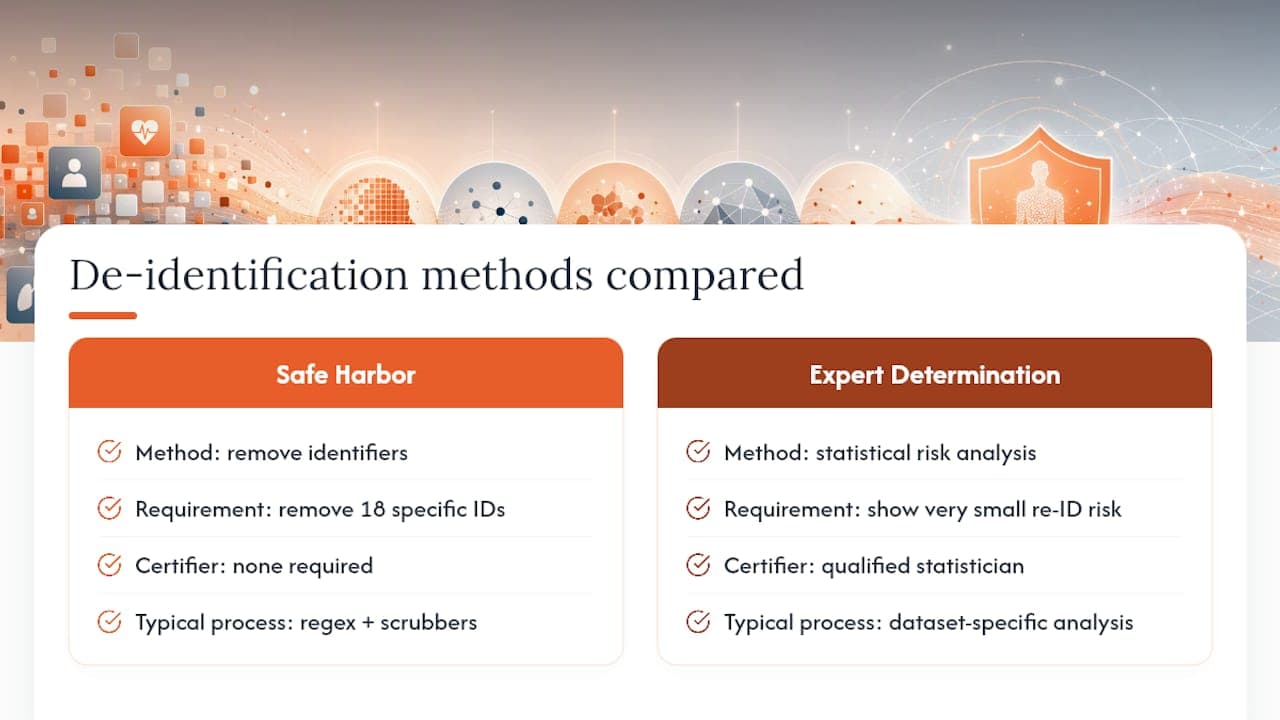
HIPAA recognizes two de-identification methods. The Safe Harbor method requires removing eighteen specific identifiers, names, dates more precise than year, geographic subdivisions smaller than a state, and so on, from the dataset. The Expert Determination method relies on a qualified statistician certifying that re-identification risk is very small, given the specific dataset and its likely recipients.
AI complicates de-identification because large language models are good at re-identifying data through inference, not just direct lookup. A note that mentions “the 84-year-old veteran who ran the hardware store on Fifth Street for forty years” can be re-identifiable in a small community even after the eighteen Safe Harbor identifiers are technically stripped, because the surrounding narrative detail does the identifying work instead. This is why de-identification pipelines feeding AI training or fine-tuning need review beyond a simple regex-based identifier scrubber. Teams doing this at scale should combine automated identifier removal with a human review pass on a sample, particularly for narrative clinical text where context itself can be the identifying feature.
Fully de-identified data isn’t PHI, which means it falls outside HIPAA’s BAA requirements. But the moment any of the eighteen identifiers or a plausible re-identification path remains, you’re back inside HIPAA’s full scope, contracts and all.
Incident Response and Breach Notification for AI-Related PHI Exposure
An AI-related PHI exposure follows the same HIPAA breach notification clock as any other exposure, but the investigation itself looks different because the failure point is often invisible until someone checks the logs.
The breach notification rule requires notifying affected individuals within 60 days of discovery, notifying HHS, and, for breaches affecting 500 or more individuals, notifying media outlets in the affected area. That timeline starts at discovery, not at the moment the exposure actually occurred, which is exactly why audit logging matters so much for AI systems specifically: without per-request logs, you may not discover an exposure until long after it happened.
Incident response for AI-specific exposure needs a few things a generic breach playbook doesn’t automatically include. First, the ability to query exactly which prompts and outputs touched a given patient’s data during the exposure window, which is only possible if your audit logging captured that detail from day one. Second, a fast path to disable a specific model endpoint or feature without taking down the entire system, since the exposure is often isolated to one integration or one enabled feature rather than the whole platform. Third, a clear chain of who at the vendor needs to be notified, and how fast, per the BAA’s breach notification clause, since your own 60-day clock depends on how quickly your business associate tells you something went wrong on their end.
Run a tabletop drill specifically for an AI-related incident at least annually. Most breach drills assume a stolen laptop or a phishing email. Very few rehearse “a fine-tuned model started returning another patient’s data in a summary,” and that scenario needs its own runbook.
Who’s Responsible: Covered Entities vs. Business Associates in AI Deployments
The covered entity, your hospital, clinic, or health plan, remains legally responsible for PHI regardless of how many AI vendors sit in the workflow. That responsibility doesn’t transfer to the AI vendor just because a BAA exists. It gets shared, with specific obligations attached to each party.
As the covered entity, you’re responsible for the risk analysis, for choosing which workflows are appropriate for AI at all, for training staff on what can and can’t be entered into a system, and for verifying, not just trusting, that your business associates are meeting their contractual obligations. That verification duty is often skipped. Signing a BAA and never requesting an attestation report afterward is a common gap.
The AI vendor, once it signs a BAA, becomes a business associate with direct HIPAA obligations of its own, including implementing Security Rule safeguards, reporting breaches within the contracted timeline, and not using PHI beyond what the BAA permits. If that vendor uses subprocessors, cloud infrastructure, a transcription API, a logging service, each subprocessor needs its own downstream BAA, and the primary vendor is responsible for securing those agreements.
Where this gets murky is with in-house AI tools built on top of a covered cloud service. If your own team builds a documentation assistant on Azure OpenAI, your organization is simultaneously the covered entity and, in effect, taking on business-associate-level technical responsibilities for how that specific tool handles PHI, even without a separate BAA needed for an internal build. The BAA still runs to the cloud provider. The operational responsibility for how you configured and used the service runs entirely to you.
Patient Consent and Transparency When AI Touches PHI
HIPAA’s existing consent and disclosure framework applies to AI use of PHI, but it doesn’t currently require a separate, AI-specific consent form in most treatment, payment, and operations contexts. That said, transparency has become a practical and reputational necessity even where it isn’t strictly mandated.
Patients generally don’t need to give special authorization for AI use of their PHI when that use falls under treatment, payment, or healthcare operations, the same categories that already permit provider access without individual authorization for each use. A documentation assistant summarizing a physician’s notes for that physician’s own use typically falls squarely inside this category.
Where it gets more nuanced is disclosure to third parties or novel uses, like using de-identified patient data to train a model that will serve other healthcare organizations. That kind of secondary use often requires either a valid de-identification process or explicit authorization, depending on how the data will be used downstream.
Many healthcare organizations are choosing to disclose AI use in patient-facing communications even where it isn’t strictly required, updating Notice of Privacy Practices documents to mention AI-assisted documentation or scheduling tools, and training front-line staff to answer patient questions about it honestly. This isn’t just good ethics. It reduces the reputational fallout if an AI-related incident does occur, since patients who were told AI might be involved in their care documentation are less likely to feel blindsided than patients discovering it for the first time during a breach notification letter.
Arosplatforms’ Take: Governance Beats Marketing Claims
Every AI vendor claims to be “HIPAA-ready.” Almost none of them can tell you who prompted what, when, and what came back for a specific patient record six months ago. That gap between marketing language and operational reality is where Arosplatforms spends most of its time with healthcare clients.
Our approach starts with governance and ownership, not a pre-built tool. We build the AI operating system to match your organization’s actual risk profile, whether that’s a cloud endpoint under an existing BAA, a self-hosted model in your own VPC, or a hybrid of both, rather than pushing every client toward the same architecture because it’s easier to sell.
Clients typically see faster turnaround on the workflows we automate and a compliance posture that holds up under audit because the logging and access controls were designed in from day one, not bolted on after a near-miss. We’re also building out detailed case studies of these healthcare deployments, and they’ll be published here as they clear client review.
The uncomfortable truth is that most compliance failures in AI aren’t caused by bad models. They’re caused by good models deployed carelessly.
— arosplatforms team
How Arosplatforms Helps Healthcare Teams Deploy Compliant AI
Arosplatforms is the alternative to piecing together a vendor tool and hoping the BAA covers your actual use case. We embed directly inside your operations to build an AI system matched to your risk profile from the start, not a generic chatbot with a compliance disclaimer attached.
That work spans AI governance and compliance program design, managed deployment and monitoring, and secure infrastructure and MLOps for teams choosing self-hosted or hybrid architectures. Clients typically see returns within a year and faster turnaround on the workflows we automate, because the system is built to be owned and run by your own team, not locked to ours.
If you’re weighing which architecture fits your organization, start with an AI-readiness conversation for U.S. healthcare teams and we’ll walk through where your current setup stands and what a compliant path forward actually looks like.
Sources
- PMC article on LLM hosting and HIPAA responsibilities
- NIST AI Risk Management Framework
- Federal Register: HIPAA Security Rule modernization notice (2025)
This article is general information, not a substitute for advice from a qualified doctor. Consult a qualified healthcare professional about your own circumstances before acting on anything here.
FAQ
Is There Any AI That Is HIPAA Compliant?
No AI tool is inherently HIPAA-compliant on its own. Compliance comes from a signed BAA, a properly configured covered architecture, and operational controls like audit logging, all working together, not from any single product’s certification claim.
Can ChatGPT Be HIPAA Compliant?
The enterprise or API tier of ChatGPT can be part of a compliant deployment only if OpenAI signs a BAA covering that exact tier and you configure it correctly. The free or consumer-plus tiers never carry BAA coverage, so PHI should never touch them.
Is GPT-5 HIPAA Compliant?
No model, including GPT-5, is HIPAA-compliant by itself. Compliance depends on whether the specific deployment tier is covered under a signed BAA and configured according to that agreement’s terms, the same standard that applies to every AI model.
Is AI Prohibited Under HIPAA?
AI isn’t prohibited under HIPAA. HIPAA is technology-neutral and applies the same Privacy Rule and Security Rule standards to AI systems handling PHI that it applies to any other system, which means AI use is permitted when the contract and controls meet those standards.
Who Needs to Sign a BAA for an AI Deployment?
Any third party that creates, receives, maintains, or transmits PHI on your behalf needs a signed BAA, including your cloud provider, your AI model vendor, and any subprocessor either of them relies on for that specific service.