The Role of AI in Secure Health Records for Healthcare IT
The Role of AI in Secure Health Records for Healthcare IT
AI’s primary role in secure health records is dual and inseparable: it strengthens defenses through anomaly detection and cryptographic automation while simultaneously opening new attack surfaces that traditional HIPAA-era security models were never built to catch. Treat any vendor pitch that promises one side of that equation without the other with suspicion.
If you’re building or auditing an AI-enabled electronic health record (EHR) system this year, start here:
- Verify, don’t just certify. A model that passes a compliance checklist can still leak patient data through its outputs. Test for that directly.
- Map your data flows before you map your models. Know exactly where structured, semi-structured, and unstructured patient data enters any AI pipeline.
- Assign an owner for AI-specific incidents. Your existing breach response plan probably doesn’t cover model inversion or data poisoning.
Pro Tip: Compliance and privacy are not the same thing. A HIPAA-compliant system can still be vulnerable to membership inference attacks that expose whether a specific patient’s data trained a model, so build privacy verification into testing regardless of what your compliance checklist says.
Key Takeaways
AI secures health records only when paired with privacy-preserving techniques, layered cryptography, and continuous model monitoring, not compliance checklists alone.
| Point | Details |
|---|---|
| Verification beats certification | Test models directly for leakage and membership inference rather than relying on compliance sign-off alone. |
| Match privacy technique to deployment | Use federated learning for cross-institution training and differential privacy for local inference to balance accuracy and risk. |
| Layer your defenses | Combine blockchain-based audit trails, AI anomaly detection, and encryption rather than depending on one control. |
| Govern the full model lifecycle | Track data provenance, validate before deployment, and monitor continuously since models degrade over time. |
| Map risks to regulations early | Connect specific AI threats like model leakage to HIPAA breach rules and FDA device reporting before an incident forces the issue. |
| Red-team before production | Run extraction, poisoning, and membership inference tests as a standing practice, not a one-time launch gate. |
This article is general information, not a substitute for advice from a qualified doctor. Consult a qualified healthcare professional about your own circumstances before acting on anything here.
Table of Contents
- How AI Powers Secure Electronic Health Records Today
- What Security Threats Does AI Introduce to Patient Data?
- Privacy-Preserving Machine Learning: Your Options Compared
- Which Technical Controls Actually Protect EHR + AI Systems?
- How Do You Govern AI Models Throughout Their Lifecycle?
- What Regulations Govern AI in Health Records?
- A Step-by-Step Path to Deploying AI Safely
- Real-World Lessons From AI and Health Record Security
- What Are the Current Limits of AI in Health Record Security?
- Where This Goes From Here
- Sources
- FAQ
How AI Powers Secure Electronic Health Records Today
Clinical teams already lean on AI for risk stratification, flagging patients likely to be readmitted or to develop sepsis before the chart shows an obvious trend. Documentation generation tools listen to patient encounters and draft notes directly into the EHR, cutting the keyboard time that drives physician burnout. Automated coding engines translate clinical narrative into billing codes, and predictive alert systems watch vitals feeds for early deterioration signals. Patient triage models sort intake queues by acuity, and increasingly, systems ingest patient-generated health data (PGHD) from wearables and home monitoring devices to fill gaps between office visits.
None of this works on a single data format, and that’s exactly where security complexity multiplies.
Structured data (lab values, vitals, medication codes) is the easiest for AI to consume and the easiest to secure with field-level encryption and access controls. Semi-structured data (HL7 messages, FHIR resources) requires parsing logic that itself becomes an attack surface if poorly validated. Unstructured data (clinical notes, radiology images, PGHD text) carries the highest privacy risk because it often contains identifiers embedded in free text that structured-field redaction misses entirely.
A typical data flow looks like this: a wearable device or home monitor captures PGHD, which gets ingested through an API gateway, normalized into the EHR’s data model, then fed to an AI model for scoring or classification, which produces a decision or alert routed back to a clinician. Every hop in that chain is a place data can leak, get tampered with, or get intercepted, and every hop needs its own access controls rather than relying on perimeter security alone.

The operational payoff is real. Prospective validation studies of AI-driven risk stratification tools show measurable reductions in preventable readmissions when the models are properly monitored, and automated coding shortens the revenue cycle significantly compared to manual chart review. But the review of the health data life cycle from primary care to research networks makes clear that expanding data types and expanding data uses expand risk in tandem, not in isolation. A tool that touches PGHD, EHR records, and third-party analytics platforms inherits the security posture of the weakest link in that chain.
Health data generation now happens well outside hospital walls too. Smartphones and consumer wearables have pushed the health data lifecycle beyond institutional boundaries, which means governance frameworks written for hospital-owned systems no longer cover where the data actually originates. If your organization is evaluating AI solutions for clinical assistants and records intelligence, this is the first question worth asking any vendor: where does PGHD enter your pipeline, and who audits that entry point?
What Security Threats Does AI Introduce to Patient Data?
AI doesn’t just add a new tool to the health IT stack. It adds a new class of attack that most security teams haven’t trained for.
- Data and model poisoning: Attackers inject corrupted training data or manipulate feedback loops so the model learns the wrong pattern, potentially causing it to miss deterioration signals or misclassify risk.
- Model inversion and extraction: Adversaries query a deployed model repeatedly to reconstruct training data or replicate the model’s logic, effectively stealing intellectual property or exposing patient records the model was trained on.
- Membership inference: An attacker determines whether a specific patient’s data was used to train a model, which by itself can reveal a diagnosis or condition even without accessing the underlying record.
- Supply-chain attacks: Compromised third-party libraries, pretrained models, or vendor APIs introduce vulnerabilities that never touch your own codebase directly.
- API and automation misuse: Poorly secured integration points let attackers trigger unauthorized data exports or manipulate automated clinical workflows.
- Incidental disclosure through LLMs: Large language models used for documentation or clinical support can leak fragments of training data or prior session content in their outputs.
The consequences aren’t theoretical. Membership inference attacks can succeed even against datasets that have already gone through de-identification, and research shows these attacks disproportionately affect underrepresented groups whose smaller representation in training data makes their records statistically easier to isolate. That’s a patient-safety and equity problem wrapped inside a security problem.
Foundation models used in clinical settings raise the stakes further. Leakage risk depends heavily on deployment pathway. A model run locally on a hospital’s own infrastructure carries different exposure than the same model accessed through a public API, and privacy risk should be treated as continuous rather than binary, meaning “compliant” doesn’t mean “safe” at every point along that spectrum.
A narrative review of AI-induced cybersecurity risk in clinical settings argues that healthcare organizations need to shift from reactive incident response toward proactive, blockchain-enabled traceability that can detect algorithmic and IT vulnerabilities before they cause patient harm, rather than discovering them during an audit months later.
The narrative review of blockchain-based solutions within a clinical risk management framework documents cases where model-mediated leakage went undetected for extended periods precisely because standard compliance audits weren’t designed to catch it. The remediation lesson consistently points back to embedding verification, not just documentation, into how models get approved and monitored.
Privacy-Preserving Machine Learning: Your Options Compared
You don’t have to choose between using AI on patient data and protecting that data. Several techniques let you extract clinical value without exposing raw protected health information (PHI) to the model or the people running it.
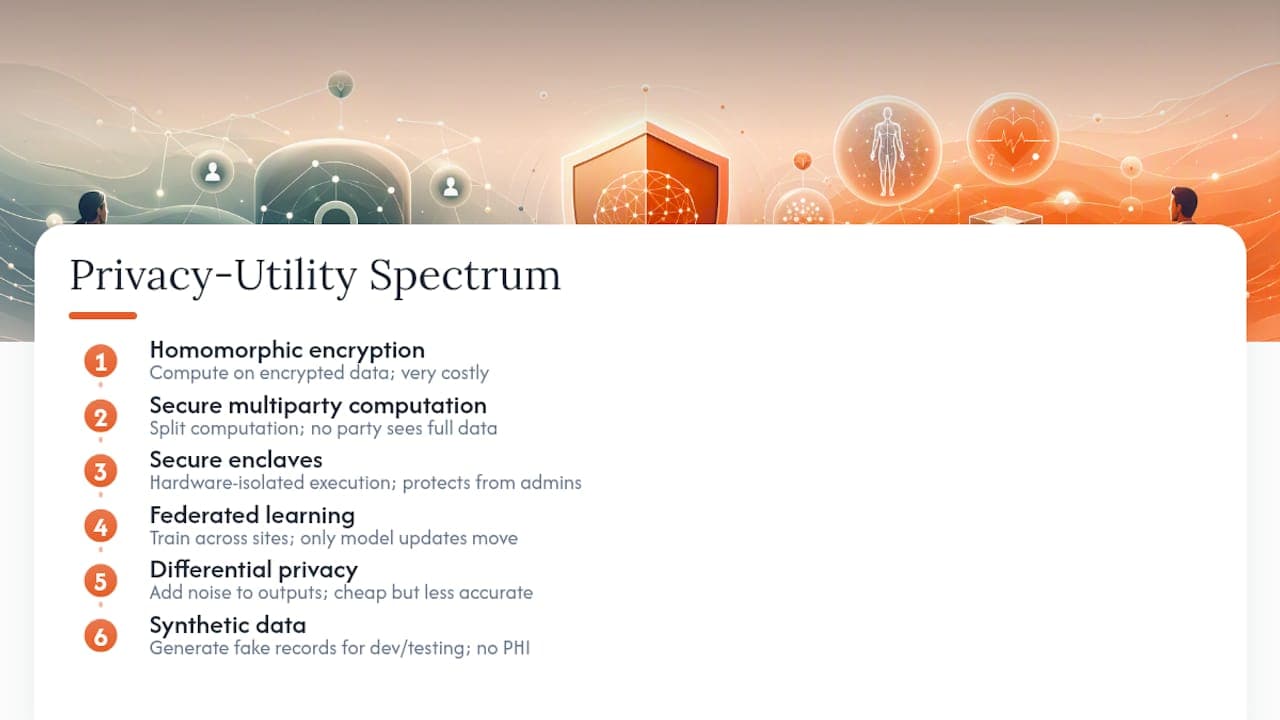
Federated learning trains a model across multiple hospital systems without any single system’s raw data leaving its own servers. Only model updates, not patient records, move between institutions. It works well for multi-site risk prediction models but adds coordination overhead and can slow training cycles.
Differential privacy adds calibrated statistical noise to data or model outputs so no single patient’s record can be reverse-engineered from results, while aggregate patterns remain usable. It’s computationally cheap but can reduce model accuracy on rare conditions where every data point matters.
Homomorphic encryption allows computation directly on encrypted data, so the model never sees plaintext PHI. It’s the strongest privacy guarantee on this list and also the most computationally expensive, often impractical for real-time clinical alerts.
Secure multiparty computation (SMC) splits computation across parties so no single party ever sees the complete dataset, useful for cross-institution research collaborations where no partner is willing to be the data custodian.
Secure enclaves (trusted execution environments) isolate computation in hardware, protecting data even from the system administrators of the machine running the model.
Synthetic data generates statistically realistic but fake patient records for model development and testing, sidestepping PHI exposure entirely during early development stages.
The Annual Reviews analysis of privacy across the health data life cycle frames these as a spectrum of privacy-utility trade-offs rather than a single best answer. Every technique costs you something in accuracy, latency, or engineering complexity, and there’s no universal right choice.
Pro Tip: Match the technique to the deployment context, not the marketing pitch. Local inference on a single hospital’s infrastructure often works fine with differential privacy alone. Cross-institution model training that never centralizes raw data usually calls for federated learning. Reserve homomorphic encryption for high-stakes, low-frequency use cases where the computational cost is acceptable.
Which Technical Controls Actually Protect EHR + AI Systems?
Privacy-preserving ML handles the data side. You still need infrastructure controls around the systems that store, move, and serve that data, and this is where a lot of AI deployments quietly fail.

Start with the fundamentals that predate AI but matter more with it: encryption at rest and in transit for every data store the model touches, identity and access management built on least-privilege principles with mandatory multifactor authentication for anyone who can query a model or its training data, and tokenization that replaces direct identifiers with reference tokens wherever the AI pipeline doesn’t strictly need the real value.
Beyond the basics, AI-specific systems need a few things classic EHR security didn’t:
- Secure oracles for any system that bridges on-chain and off-chain data, verifying that data fed into a model hasn’t been tampered with in transit.
- Immutable audit trails that log every model query, input, and output, not just user logins and record access.
- Layered cryptographic defenses that don’t rely on a single control failing gracefully.
- Quantum-resistant primitives for any data with a multi-decade retention requirement, since today’s encryption may not hold against tomorrow’s decryption capability.
A recent framework proposes exactly this kind of layering: combining blockchain-based trust validation, AI-driven anomaly detection, and advanced encryption to defend cloud-hosted health data against AI-accelerated attacks and zero-day vulnerabilities that single-layer perimeter defenses routinely miss. The logic is straightforward. If attackers are using AI to automate and adapt their attacks, your detection layer needs AI too, but it can’t be your only layer.
Practitioner guidance increasingly points toward abandoning perimeter-only thinking altogether. Recommendations for data-centric governance using Multi-Authority Attribute-Based Encryption (MA-ABE) and quantum-resistant encryption argue that protecting the network boundary matters less than protecting the data itself, wherever it travels. For monitoring, track access audit patterns, model input and output drift over time, and anomalous query volumes that might signal an extraction attempt in progress. If you’re building this out, MLOps and infrastructure services designed for healthcare typically bake these signals directly into deployment pipelines rather than bolting them on after launch.
Pro Tip: Feed AI-specific telemetry, like model query rates and output drift scores, into your existing SIEM rather than building a parallel monitoring system. Security teams already trust their SIEM workflows; a second dashboard nobody checks daily is worse than no dashboard at all.
How Do You Govern AI Models Throughout Their Lifecycle?
A model that was safe at launch isn’t automatically safe eighteen months later. Patient populations shift, clinical protocols change, and the data feeding the model drifts from what it was trained on. Governance has to be continuous, not a one-time approval gate.
A working lifecycle checklist covers four stages. Data provenance and cataloging means knowing exactly where every training dataset came from and whether it was properly consented and de-identified. Model validation before deployment should include both clinical accuracy testing and adversarial testing for the threats covered earlier. Continuous performance and fairness monitoring tracks whether the model’s accuracy holds steady across different patient demographics, not just in aggregate. Scheduled retraining or retirement acknowledges that models degrade and need a defined end-of-life plan rather than running indefinitely on outdated assumptions.
Systematic reviews of AI cybersecurity risk in clinical settings now argue that verifiable risk mitigation, like formal differential privacy guarantees, needs to be built into the development lifecycle rather than checked at the end as a compliance formality.
When something does go wrong, your incident response playbook needs steps specific to AI failures: detection (often through drift or anomaly alerts rather than a help desk ticket), containment (which may mean pulling a model from production, not just isolating a server), patient-safety assessment (did any clinical decision rely on compromised output), notification obligations, root-cause analysis distinguishing an attack from a data quality failure, and remediation.
Ownership matters as much as process. Clinical owners sign off on whether a model’s outputs are safe to act on. Data scientists own model performance and retraining cadence. Security teams own the adversarial testing and monitoring. Privacy and legal counsel own regulatory interpretation and breach notification decisions. Operations owns the deployment pipeline and rollback capability. Skip any one of these and incidents take longer to resolve, if a strategy and advisory partner hasn’t already helped define the RACI matrix before deployment.
What Regulations Govern AI in Health Records?
The regulatory landscape for AI touching health records isn’t a single rulebook. It’s several frameworks that overlap, and where they overlap is exactly where organizations get caught unprepared.
HIPAA and HHS guidance still govern the baseline for PHI handling, but HIPAA was written before generative AI existed, and enforcement is increasingly interpreting AI-specific incidents (like model inversion exposing patient data) as reportable breaches under existing rules. FDA guidance applies specifically where AI functions as or within Software as a Medical Device (SaMD), meaning a diagnostic or clinical decision support tool may need premarket clearance and ongoing safety reporting. NIST’s AI Risk Management Framework offers a voluntary but increasingly referenced structure for documenting AI risk assessment, useful as an audit trail even where it’s not legally mandated. For organizations with cross-border data flows, EU frameworks add another layer entirely.
The risk-to-consequence mapping matters more than the framework names themselves. Model leakage that exposes PHI triggers breach notification obligations under HIPAA regardless of whether the leakage came from a hacker or a poorly designed model output. Unsafe model decisions in a device context can trigger FDA adverse event reporting requirements. The chapter on medical device cybersecurity explains how the EU’s AI Act and NIS2 directive now interact with existing Medical Device Regulation (MDR) and GDPR obligations, creating compliance overlap that didn’t exist five years ago for any device using AI-based diagnostics.
Practical compliance work comes down to a short list: documentation standards that record how a model was trained and validated, expert determination methodology for de-identification (not just Safe Harbor removal of eighteen identifiers), audit logging that captures model-specific events, and data processing agreements with any AI vendor that explicitly address model training rights over your patient data.
A Step-by-Step Path to Deploying AI Safely
Moving from pilot to production without a patient-safety incident along the way follows a sequence, not a checklist you complete in any order.
- Run a readiness assessment. Understand your current data governance maturity before evaluating any AI tool.
- Establish data governance first. Know your data lineage, consent status, and classification before a model ever touches production data.
- Pilot with privacy-preserving ML. Test on synthetic or federated data before exposing real PHI to a new model.
- Get independent model validation. Internal teams that built the model shouldn’t be the only ones testing it.
- Monitor continuously and red-team regularly. Treat model security testing as an ongoing practice, not a launch gate.
- Roll out in phases. Expand from a single department or use case before organization-wide deployment.
A red-teaming checklist worth borrowing from adversarial ML research: threat modeling specific to your deployment architecture, model extraction tests simulating an attacker querying the model repeatedly, membership inference checks against your actual training data, and poisoning-resilience tests that verify the model degrades gracefully rather than catastrophically when fed corrupted inputs. Formal AI security and red teaming services built for healthcare typically run these tests before a model ever reaches a production patient.
Pro Tip: Negotiate explicit SLAs for model behavior with any vendor, not just uptime SLAs. Define acceptable accuracy drift thresholds and require notification if the vendor retrains the underlying model. Avoid vendor lock-in by insisting on data and model portability from day one, since switching costs balloon fast once a model is embedded in clinical workflow.
Real-World Lessons From AI and Health Record Security
- EHR-integrated PGHD for risk stratification: Hospitals combining wearable telemetry with EHR data for early deterioration alerts have found that data quality from consumer devices varies enough to introduce false alerts, pushing teams toward stricter validation of PGHD before it reaches clinical models. The lesson maps to an operational control: normalize and validate PGHD at ingestion, not after it’s already influenced a clinical decision.
- IoMT device compromise: Connected medical devices remain a documented attack vector, since compromised device firmware can feed manipulated data into downstream AI models undetected. The control lesson: treat every connected device as a potential poisoning source and monitor its output for statistical anomalies, not just connectivity status.
- Blockchain-plus-AI pilot architecture: A prototype combining blockchain, decentralized storage, and off-chain AI for patient-centric records, PolyMed, showed workable latency and model performance in testing, but researchers flagged governance and scalability as the harder unsolved problems compared to the underlying cryptography. The lesson: proving technical feasibility is easier than proving organizational scalability.
What Are the Current Limits of AI in Health Record Security?
No current approach solves everything, and pretending otherwise sets teams up for disappointment. Data quality remains the most persistent limitation. Interpretability still lags, meaning clinicians often can’t fully explain why a model flagged a specific patient. Distributional shift causes accuracy to erode as patient populations and clinical practice evolve away from training data. Membership inference risk isn’t evenly distributed, and it disproportionately affects underrepresented groups whose smaller data footprint makes them statistically easier to isolate. Privacy-preserving ML techniques, while effective, often don’t scale cleanly to the size and speed of enterprise-level EHR deployments.
Watch for standardized privacy metrics that let organizations compare model risk objectively rather than relying on vendor claims, verifiable computation methods that prove a model behaved correctly without exposing its internals, and cryptographic oracles that validate data integrity across on-chain and off-chain systems. The interaction between the EU AI Act and NIS2 will likely set precedent that other regions follow, even outside direct jurisdiction. Track progress through concrete metrics: model drift rates, time-to-detect for adversarial queries, and the gap between overall model accuracy and accuracy for underrepresented subgroups specifically.
Where This Goes From Here
We think the organizations that get this right treat AI security as a design constraint from day one, not a bolt-on audit before launch. Pilot validation and continuous monitoring matter more than any single cryptographic technique, because a well-monitored simple system beats an unmonitored sophisticated one every time.
This also isn’t a problem security teams or clinical teams solve alone. It takes both, plus legal and data science, working from the same threat model. If your organization is weighing where to start, that cross-disciplinary conversation is worth having before the technical one.
Sources
- AI-Induced Cybersecurity Risks in Healthcare: A Narrative Review of Blockchain-Based Solutions Within a Clinical Risk Management Framework - PMC
- Privacy and Security Throughout the Health Data Life Cycle: From Primary Care to Research Networks | Annual Reviews
- Medical devices and AI cybersecurity chapter
FAQ
What is the main role of AI in securing health records?
AI’s main role is dual: it strengthens security through anomaly detection and automated monitoring while also introducing new risks like model inversion and data poisoning that require dedicated controls to manage.
Can AI models leak patient data even after de-identification?
Yes. Membership inference attacks can determine whether a specific patient’s data trained a model even on de-identified datasets, and this risk disproportionately affects underrepresented groups.
What is the difference between federated learning and differential privacy?
Federated learning trains models across institutions without sharing raw data, while differential privacy adds statistical noise to protect individual records within a single dataset or model output.
Does HIPAA compliance guarantee an AI system is secure?
No. A system can pass HIPAA compliance checks and still be vulnerable to AI-specific threats like model extraction or membership inference, which is why verification testing matters beyond compliance documentation.
How often should AI models used on health records be revalidated?
There’s no universal schedule, but continuous performance and fairness monitoring, paired with scheduled retraining or retirement, works better than a fixed annual review cycle since model drift can happen faster than that.