AI Integration Healthcare Operations Guide for Leaders
AI Integration Healthcare Operations Guide for Leaders

For U.S. healthcare operational leaders who need governed automation without a multi-year implementation slog, Arosplatforms’ custom AI operating system is the most direct path to measurable ROI — HIPAA-aligned, audit-ready, and built around your specific workflows rather than a generic platform template.
TL;DR
- Top use cases to start: documentation automation (ambient scribe/voice-to-text), billing and coding, and claims-denial remediation
- Expected time-to-value: most organizations see measurable returns within twelve months; pilot results typically visible within 3–6 months
- Governance controls to require: PHI segmentation, role-based IAM, audit trails, human-in-the-loop gates for low-confidence outputs, and a signed BAA with liability language tied to automation errors
ROI signal: Generative AI and ambient scribe tools can reduce documentation time by 21–30%, saving roughly 95–134 hours per clinician per year. Revenue cycle AI can cut RCM staff time by 41%–50% across billing stages. Those two use cases alone justify a pilot.
Table of Contents
- What can AI actually do for healthcare operations right now?
- What compliance and risk controls does your vendor need to prove?
- What does a production-ready AI architecture look like for healthcare?
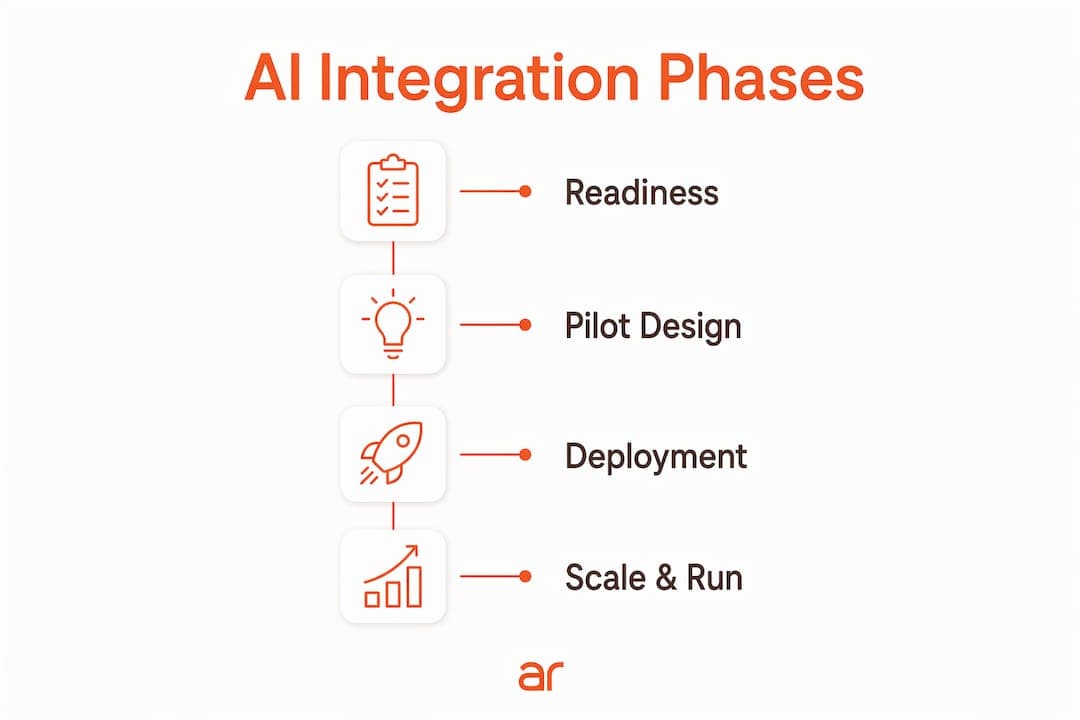
- How do you implement AI in healthcare operations, phase by phase?
- How do you evaluate and select an AI consultancy for this work?
- Why Arosplatforms delivers for healthcare operations
- Key Takeaways
- What healthcare AI deployments actually teach you
- Arosplatforms can start your pilot this quarter
- FAQ
What can AI actually do for healthcare operations right now?
The administrative side of healthcare is where AI delivers the fastest, most defensible ROI. Clinical AI carries a different risk profile and regulatory burden; start there only after administrative workflows are stable and governed.
High-value administrative use cases:
| Use Case | Efficiency Gain | Human-in-the-Loop Requirement |
|---|---|---|
| Documentation automation (ambient scribe, voice-to-text) | 21–30% reduction in documentation time | Review flagged low-confidence transcriptions |
| Billing and coding automation | 41–50% reduction in processing time for revenue cycle professionals; fastest-growing AI use case in 2026 | Human review for codes below confidence threshold |
| Claims processing and denial remediation | — | Escalation gate for complex denial appeals |
| Scheduling and patient communications | Reduced no-shows, automated reminders | Minimal; rule-based workflows |
| Staff rostering and bed management | Improved throughput and resource allocation | Supervisor approval for edge cases |
| Supply chain and inventory | Predictive restocking, reduced waste | Threshold alerts reviewed by operations |
The prioritization rule is straightforward: high volume plus low decision complexity equals the best pilot candidate. Billing, scheduling, and documentation all qualify. AI agents for healthcare workflows can orchestrate eligibility checks, coding validation, and denial remediation across fragmented systems in ways that manual processes simply cannot match at scale.
One boundary worth drawing explicitly: when administrative output directly influences a care decision (for example, an automated triage message or a discharge summary that drives a clinical handoff), that workflow crosses into clinical-adjacent territory. Those outputs need stricter oversight, defined liability, and a documented escalation path before they go live.
What compliance and risk controls does your vendor need to prove?
AI in hospital administration raises legal and ethical considerations including bias, data privacy, consent, and liability. Procurement teams need a checklist, not a general assurance.
HIPAA and HHS compliance checklist:
- Minimum necessary access enforced at the data layer, not just the application layer
- Encryption at rest and in transit for all PHI
- Role-based identity and access management (IAM) with documented provisioning and deprovisioning
- Immutable audit trails for every automated decision touching PHI
- Breach notification obligations defined in the BAA with timelines matching HHS requirements
- Documented model provenance: what training data was used, when the model was last retrained, and what drift monitoring is in place
Contract clauses to require:
- SLA for PHI data handling with financial penalties for breach
- Liability and indemnity language explicitly covering automation errors (not just infrastructure failures)
- Right to audit model behavior and data lineage at any time
- Reversion and escape clauses if a model is recalled or materially changed
- Training-data commitments: vendor must confirm your PHI was not used to train shared models
For HIPAA-specific AI controls, the key principle is that governance must be an architectural requirement, not a final review step. That means identity controls, prompt-engineering standards, and retrieval policies are baked into the platform from day one.
Pro Tip: Ask every vendor candidate directly: “If your model produces an incorrect billing code that causes a claim denial or a compliance finding, who bears the financial liability?” A vendor unwilling to put indemnity language in writing is signaling that the risk lands entirely on you.
For high-consequence outputs (a denial appeal letter, a prior authorization recommendation), require a documented escalation gate: outputs below an agreed confidence score route to a human reviewer before submission, with a logged approval timestamp.
Pair your vendor security review with current AI vulnerability detection practices to cover model-level attack surfaces that standard IT security audits often miss.
What does a production-ready AI architecture look like for healthcare?
A custom AI operating system for healthcare operations has four layers. Procurement teams should evaluate each one separately.
| Layer | Components | Acceptance Criteria |
|---|---|---|
| Integration / data ingestion | EHR connectors, ERP feeds, claims APIs, PHI segmentation | API-first, no screen scraping, data contracts documented |
| Knowledge and analytics | Governed feature store, vector database for semantic retrieval | Retrieval quality metrics, PHI access controls on vector DB |
| AI execution | LLMs, task-specific models, RAG pipelines, orchestration | Hallucination monitoring, model versioning, latency SLAs |
| Experience and action | Copilots, dashboards, automated workflow triggers | Audit trail per action, human-in-the-loop hooks configurable |

Enterprise AI architecture for healthcare must be API-first and cloud-native, with governed data pipelines, vector databases for semantic retrieval, and MLOps/observability to be production-ready. That last point matters: observability is not optional. You need model versioning, retrieval quality metrics, hallucination monitoring, and latency tracking tied to operational KPIs — otherwise, you cannot tell whether the system is degrading until a billing error surfaces.
AI infrastructure and MLOps built specifically for healthcare must also account for EHR-specific data quality constraints. Standard ML pipelines frequently break on HL7/FHIR inconsistencies, missing fields, and legacy system exports. A layered operating platform that standardizes ingestion and governance before the AI execution layer is the architecture that actually ships to production.
Modern cloud security approaches are also directly relevant here: PHI in cloud-native AI pipelines requires zero-trust network controls and continuous posture monitoring, not just perimeter firewalls.
How do you implement AI in healthcare operations, phase by phase?
Phase 0: Readiness assessment (weeks 1–4) Inventory your data sources, document EHR integration constraints, identify governance gaps, and map change-management needs. An AI readiness assessment at this stage prevents expensive pivots later.
Phase 1: Pilot design (weeks 4–8) Select one or two workflows: billing automation and documentation are the standard starting pair. Define success metrics before you build: target a specific reduction in processing time, a clean-claim rate improvement, and a user adoption threshold.
Phase 2: Pilot deployment (months 2–6) Build RAG pipelines, configure human-in-the-loop gates, deploy integration adapters, and run training and go-live support. Typical pilot timeline is 3–6 months to measurable KPI results.
Phase 3: Scale and run (months 6–12+) Build reusable services (document ingestion, semantic retrieval, orchestration templates), formalize the operating model, and embed continuous improvement cycles with quarterly model reviews.
| Phase | Timeline | Owner | Success Metric |
|---|---|---|---|
| Readiness assessment | Weeks 1–4 | CIO / IT + Vendor | Gaps documented, governance baseline set |
| Pilot design | Weeks 4–8 | COO + Revenue Cycle lead | KPIs defined, workflows selected |
| Pilot deployment | Months 2–6 | IT + Vendor + Operations | KPI thresholds met, user adoption confirmed |
| Scale and run | Months 6–12+ | IT + Operations + Compliance | Reusable services live, continuous improvement active |
How do you evaluate and select an AI consultancy for this work?
Procurement scoring weights that reflect actual delivery risk: governance and compliance (30%), integration capability (25%), time-to-value evidence (20%), support and training (15%), and price (10%). Price is last because a cheap vendor that cannot handle PHI or EHR integration will cost far more in remediation.
| Evaluation Dimension | What to Ask | Red Flag |
|---|---|---|
| Healthcare MLOps | Can you show model versioning and drift monitoring in a live deployment? | No observability hooks; “we monitor manually” |
| HIPAA alignment | Provide your BAA template and describe your PHI segmentation approach | Generic BAA with no liability language |
| EHR integration | Which EHRs have you integrated, and how do you handle HL7/FHIR edge cases? | Screen scraping or RPA-based EHR access |
| Time-to-value evidence | Share a pilot plan with KPIs and a realistic timeline | Vague promises; no reference clients |
| Post-delivery ownership | Who owns model ops after delivery? Can we retrain without you? | Vendor lock-in on model retraining |
| Claims automation capability | Describe your denial remediation workflow and confidence thresholds | No human-in-the-loop strategy for sensitive outputs |
Why Arosplatforms delivers for healthcare operations
Arosplatforms builds custom AI operating systems from the ground up for healthcare clients, embedding directly in your operations rather than deploying a generic platform. The engagement model is project-based: no SaaS subscription, no perpetual license dependency. You own the system.
Typical pilot scope covers a readiness assessment, two prioritized workflows (usually billing automation and documentation), KPI tracking, and a scale plan. Clients report a significant improvement in turnaround for key operational tasks — for example, published research shows generative AI and ambient scribe tools typically reduce documentation time by 21–30%, while revenue cycle AI can cut billing staff time by 41–50%.
Arosplatforms services for healthcare operations:
- AI readiness assessments and AI strategy and advisory
- AI infrastructure, MLOps, and observability
- AI governance and compliance aligned to HIPAA and HHS expectations
- AI agents and workflow automation for billing, documentation, scheduling, and claims
- Managed AI services for post-deployment operations
The ownership model is a genuine differentiator. Arosplatforms delivers retrainable components, documented data lineage, and MLOps infrastructure your team can operate or have managed. That means no vendor lock-in on model updates, and no surprise costs when you need to retrain on new data.
Key Takeaways
Custom AI operating systems for healthcare operations deliver measurable ROI when built on governed architecture, piloted on high-volume administrative workflows, and deployed with clear human-in-the-loop controls from day one.
| Point | Details |
|---|---|
| Start with administrative AI | Documentation and billing automation deliver the fastest ROI, typically reducing documentation time by 21–30% and billing staff time by 41–50%. |
| Require governance by design | Mandate PHI segmentation, audit trails, and role-based IAM before any pilot goes live. |
| Pilot timeline is 3–6 months | Measurable KPI results are achievable within a 3–6 month pilot; full ROI typically within twelve months. |
| Score vendors on governance first | Weight governance and compliance at 30% in your procurement scoring — above integration and price. |
| Arosplatforms as your implementation partner | Arosplatforms builds owned, HIPAA-aligned AI operating systems with 82% faster task turnaround and no vendor lock-in. |
What healthcare AI deployments actually teach you
The most common failure mode is not a technical one. Teams pick a strong pilot workflow, build a working model, and then discover that the downstream process was never updated to consume the output. A billing automation tool that flags clean claims faster does nothing if the submission queue is still manually reviewed on a two-day lag. Fix the workflow, not just the model.
Pro Tip: Before finalizing your pilot scope, map the full downstream workflow. If the AI output does not change a human decision or a system action within 24 hours, the pilot will not produce the KPI movement you need to justify scale.
Data quality is the second consistent problem. EHR exports arrive with missing fields, inconsistent coding, and legacy formatting that breaks standard ML pipelines. The teams that succeed treat data contracts as a first-class deliverable in Phase 0, not a cleanup task for Phase 2.
Pro Tip: Require your vendor to produce a written data contract for every ingestion source before the pilot build begins. It forces both sides to confront data quality problems early, when they are cheap to fix.
On change management: resistance to AI tools in clinical and administrative staff is almost always about trust, not capability. Staff who understand what the model does, where it can be wrong, and how to override it adopt faster than those handed a tool with no explanation. Build a short training module that covers exactly those three points.
Arosplatforms can start your pilot this quarter
Healthcare operational leaders who want a governed, owned AI operating system without a multi-year build have a direct path with Arosplatforms. The pilot engagement covers a readiness assessment, two prioritized workflow builds, KPI tracking, and a scale plan — all delivered on a project basis with no ongoing subscription required.

PHI handling is HIPAA-aligned from day one: signed BAA, PHI segmentation, encrypted pipelines, and audit trails included in every engagement. Post-deployment, you can operate the system independently or move to managed AI services for ongoing support.
U.S. healthcare organizations ready to move from assessment to pilot can start the conversation here and get a scoped proposal within days, not weeks.
FAQ
What are the best first AI use cases for healthcare operations?
Documentation automation (ambient scribe/voice-to-text) and billing and coding automation are the standard starting pair. Both are high-volume, lower-risk administrative workflows where AI can reduce processing time by 21–30% and 41–50% respectively, based on published research.
How long does an AI pilot take in a healthcare setting?
A well-scoped pilot covering one or two workflows typically runs 3–6 months from deployment to measurable KPI results, with full ROI achievable within twelve months for most organizations.
What HIPAA controls must an AI vendor demonstrate before procurement?
Require a signed BAA, PHI segmentation at the data layer, encryption at rest and in transit, role-based IAM, immutable audit trails, and documented breach notification obligations tied to HHS timelines.
How does Arosplatforms avoid vendor lock-in for healthcare clients?
Arosplatforms delivers retrainable model components, documented data lineage, and MLOps infrastructure the client can operate independently or under a managed services arrangement, with no dependency on Arosplatforms for routine model updates.
What is a realistic budget approach for AI integration in healthcare operations?
Costs vary by scope, but the project-based model Arosplatforms uses means you pay for defined deliverables rather than open-ended subscriptions. Prioritize governance and integration capability in your budget before price, since remediation costs for a poorly governed deployment consistently exceed the savings from a cheaper vendor.