Patient Data Integration Best Practices for Healthcare IT
Patient Data Integration Best Practices for Healthcare IT
Eight things separate a resilient patient data integration program from one that breaks every quarter: a centralized integration layer, FHIR-first standards with HL7 v2 kept where legacy demands it, terminology normalization (SNOMED CT, LOINC, RxNorm), security controls built in from day one, a master patient index with human review workflows, continuous data quality monitoring, documented governance and stewardship roles, and tested recovery procedures. Skip any one of these and the program tends to degrade into brittle point-to-point connections that nobody fully understands two years later.
Here’s the one-line version of each: centralize integrations through a mediation layer using FHIR where you can and HL7 v2 where legacy systems force your hand; assign data stewards before you write a single interface spec; standardize terminology mappings against SNOMED CT, LOINC, and RxNorm rather than inventing local codes; enforce TLS 1.3, encryption at rest, and role-based access from the first sprint; deploy a probabilistic-matching master patient index (MPI) with a defined human review queue; track duplicate-record and interface-error rates weekly, not quarterly; document who owns which data domain and what happens when a mapping conflict shows up; and run quarterly failover drills so nobody discovers your recovery plan doesn’t work during an actual outage.
If your team needs a starting point this week, work through this short list first:
- Inventory every source system currently sending or receiving patient data, including shadow interfaces IT doesn’t officially support.
- Identify which interfaces are still point-to-point and flag them for consolidation into a central integration engine.
- Confirm a business associate agreement exists for every vendor touching protected health information.
- Assign one named owner for patient identity matching and one for terminology mapping quality.
Key Takeaways
Reliable patient data integration depends on centralized architecture, standardized terminology, embedded security, and identity matching working together, not any single practice in isolation.
| Point | Details |
|---|---|
| Centralize the integration layer | Route new interfaces through a mediation layer using FHIR, keeping HL7 v2 for legacy feeds; owner: integration architecture lead; metric: reduction in point-to-point connections. |
| Standardize terminology mapping | Enforce SNOMED CT, LOINC, and RxNorm through a shared terminology service; owner: data stewardship team; metric: mapping-review backlog size. |
| Deploy MPI with human review | Implement probabilistic patient matching with a defined escalation queue for ambiguous matches; owner: identity management lead; metric: duplicate-record rate. |
| Build monitoring and recovery into operations | Track queue depth, failed-message rate, and data drift weekly, and run recovery drills quarterly; owner: operations/SRE team; metric: mean time to resolve interface errors. |
| Bring in specialist support for complex harmonization | Arosplatforms embeds within existing systems to build AI-assisted mapping and governance without vendor lock-in. |
Table of Contents
- Patient Data Integration Best Practices Start With a Clear Definition
- Why Integrated Patient Data Improves Care and Cuts Operational Waste
- Data Types and Integration Scenarios: Real-Time vs. Batch Trade-Offs
- Standards, Terminologies, and Authentication Protocols to Adopt
- Building a Reference Architecture That Actually Scales
- Security, Privacy, and Compliance Controls You Need From Day One
- AI-Assisted Semantic Harmonization and Human-in-the-Loop Mapping
- Operational Governance: Stewardship, Testing, and Change Control
- A Phased Roadmap and What Drives Cost and Timeline
- Common Pitfalls in Patient Data Integration and How to Fix Them
- When In-House Teams Should Lead and When to Bring in Outside Help
- How Arosplatforms Supports Patient Data Integration Programs
- Sources
- FAQ
Patient Data Integration Best Practices Start With a Clear Definition
Patient data integration means connecting clinical, administrative, and operational systems so that a single patient record reflects consistent, current information no matter which system a clinician, biller, or analyst opens. “Integrated” doesn’t mean every system shares one database. It means downstream consumers, whether that’s an ED physician pulling up a medication list or a population health analyst building a readmission model, get the same trustworthy answer regardless of source.
That definition matters because most healthcare organizations already have some form of data exchange. The question isn’t whether systems talk to each other. It’s whether that exchange is reliable, auditable, and built to scale, or whether it’s a decade of one-off HL7 feeds nobody has fully mapped.
A few use cases illustrate the range you’re planning for. Medication reconciliation at admission requires pulling active prescriptions from an outpatient EHR, a pharmacy benefit manager, and sometimes a health information exchange, then resolving conflicting drug names into one accurate list. Cross-facility longitudinal records need to stitch together encounters from affiliated clinics, urgent care sites, and specialty practices that may run entirely different EHR vendors. Lab and imaging flows demand near-real-time delivery so a critical potassium value or a stroke-protocol CT doesn’t sit in a queue. Billing and claims integration works on a completely different cadence, often batch, and tolerates more latency in exchange for completeness. Population health and research pipelines need de-identified, structured extracts that can feed models without exposing identifiers.
The line between a simple connection and a strategic integration capability shows up when you scale past three or four systems. A hospital with two point-to-point HL7 interfaces can survive with informal documentation and a developer who remembers how it works. A health system with forty interfaces across twelve facilities cannot. At that scale, integration stops being a project and becomes infrastructure, with its own governance, testing cadence, and budget line.
Why Integrated Patient Data Improves Care and Cuts Operational Waste
Reliable integration changes clinical outcomes and operational costs at the same time, which is why it’s rarely hard to get budget approval once leadership sees the numbers laid out clearly. Fragmented records drive duplicate lab orders, delayed admissions while staff hunt for prior records, and blind spots in quality reporting that make accreditation season painful every single year.
The clinical case is straightforward. When a clinician sees a complete medication history at the point of care instead of a partial one from a single EHR, the odds of catching a dangerous interaction go up. When a longitudinal record includes specialist notes from an affiliated practice, care teams stop repeating diagnostic workups a patient already completed elsewhere. Operationally, faster admissions and transitions reduce length of stay and free up beds. Research and population health teams get datasets that don’t require months of manual cleanup before a single model can be trained.
Consider what happens without a semantics-first approach: fragmented terminology and inconsistent coding turn what should be reusable clinical knowledge into noise that analytics teams have to painstakingly reconstruct, according to a review of clinical knowledge representation. Standardized terminologies and common data models aren’t a nice-to-have layered on top of integration. They’re what makes the integrated data usable at all.
A few KPIs worth tracking as you build the business case:
- Duplicate medical record rate before and after MPI deployment.
- Percentage reduction in redundant lab or imaging orders tied to missing prior results.
- Mean time to resolve a broken interface, from alert to fix.
- Turnaround time on order reconciliation during admission.
Pro Tip: Pull baseline numbers on duplicate records and interface downtime before you start any integration project. Without a “before” snapshot, you’ll struggle to prove the program’s value in the budget review eighteen months from now.
Data Types and Integration Scenarios: Real-Time vs. Batch Trade-Offs
Every integration program touches a predictable set of data types, but the timeliness requirements for each vary enormously, and getting that mismatch wrong is one of the most common design mistakes teams make. EHR clinical events, ADT (admission, discharge, transfer) messages, lab and pathology results, imaging metadata, bedside device streams, claims data, disease registries, and increasingly patient-generated data from apps and wearables all need to move through your architecture, but not all of them need to move at the same speed.
ADT feeds and critical lab values demand near-real-time delivery because a delayed discharge notification or a missed critical value has immediate clinical consequences. Claims data, quality registry submissions, and most research extracts tolerate batch processing on a nightly or weekly cycle, which is often cheaper to build and easier to validate. Device streams sit somewhere in between, often requiring real-time ingestion but with more tolerance for eventual consistency in downstream systems.
| Scenario | Timeliness need | Common transport standard | Typical complication |
|---|---|---|---|
| ADT and bed management | Real-time | HL7 v2 (ADT) | Message ordering and duplicate transmission during network hiccups |
| Critical lab and pathology results | Real-time | HL7 v2 ORU or FHIR Observation | Alerting fatigue if thresholds aren’t tuned per unit |
| EHR-to-EHR longitudinal record exchange | Near-real-time to batch | FHIR (R4) or CDA/CCD | Divergent coding systems between vendors |
| Claims and billing | Batch | EDS, flat file, or FHIR Claim | Reconciliation lag against clinical encounter data |
| Registries and quality reporting | Batch | CDA or FHIR Bundle | Mapping drift when registry specs update annually |
| Research and analytics extracts | Batch | FHIR Bulk Data Export | De-identification and consent scope errors |
Choosing real-time when batch would do adds unnecessary infrastructure cost and monitoring overhead. Choosing batch when a clinical workflow needs real-time delivery creates patient safety gaps. Map each data type to its actual latency requirement before you pick a transport standard, not the other way around.
Standards, Terminologies, and Authentication Protocols to Adopt
You’ll be running HL7 v2, FHIR, and CDA/CCD side by side for years, and the goal isn’t replacing v2 wholesale. It’s knowing which standard fits which job. HL7 v2 remains the workhorse for ADT and lab result feeds because most legacy lab and hospital systems were built around it decades ago, and ripping it out for FHIR overnight is rarely worth the disruption. FHIR R4 is the right choice for new API-based integrations, patient-facing apps, and anywhere you need resource-level granularity instead of whole-document exchange. CDA and its Continuity of Care Document (CCD) variant still dominate document-based exchange between EHRs, particularly for transitions of care and discharge summaries.
A layered approach that keeps HL7 v2 running for legacy workflows while exposing FHIR APIs for new integrations is the pattern most production environments actually use, according to a clinical interoperability blueprint documenting end-to-end architecture design. You don’t migrate everything at once. You migrate the integrations where FHIR delivers a real advantage and leave stable v2 interfaces alone until there’s a business reason to touch them.
Terminology standardization is where most integration quality problems actually originate. Use SNOMED CT for clinical findings, diagnoses, and procedures. Use LOINC for lab and observation codes. Use RxNorm for medications, and ICD codes for billing and epidemiological reporting. A terminology service that centralizes mapping logic, rather than letting each interface team invent its own crosswalk, is what keeps these mappings consistent across dozens of integrations.
For authentication and authorization, OAuth 2.0 and OpenID Connect are the standard for API-based access control, paired with mutual TLS for system-to-system connections that need an extra layer of verification. Consent artifacts need to be machine-readable and enforceable at the API layer, not just documented in a policy binder, and every integration touching patient-facing data sharing has to account for information-blocking obligations under the 21st Century Cures Act.
- Use FHIR for new API-based builds; keep HL7 v2 for legacy ADT and lab feeds until there’s a reason to migrate.
- Use CDA/CCD for document-based transitions of care between EHR vendors.
- Centralize terminology mapping through a dedicated service rather than per-interface crosswalks.
- Enforce OAuth 2.0/OpenID Connect for API access and mutual TLS for system-to-system links.
- Build consent enforcement and information-blocking compliance into the API layer, not just policy documentation.
| Standard | Best used for |
|---|---|
| HL7 v2 | Legacy ADT, lab, and pharmacy feeds |
| FHIR (R4) | New API integrations, patient apps, resource-level exchange |
| CDA/CCD | Document-based care transitions between EHRs |
| SNOMED CT / LOINC / RxNorm | Clinical terminology, lab codes, medication normalization |
Building a Reference Architecture That Actually Scales
A working integration architecture has six logical layers, and skipping any one of them is usually where projects run into trouble later. Source systems sit at the bottom: EHRs, lab systems, pharmacy systems, imaging archives, and increasingly patient-facing apps. Above that sits the ingestion and mediation layer, typically an integration engine or iPaaS platform, responsible for routing, transformation, and initial validation. Interoperability services come next, usually a FHIR server or API gateway that exposes standardized resources to consumers. The semantic and terminology layer normalizes codes and vocabularies across everything passing through. Security and governance wrap around the whole stack, enforcing access control and audit logging at every hop. Consumer apps and analytics platforms sit at the top, drawing from the normalized, secured data beneath them.
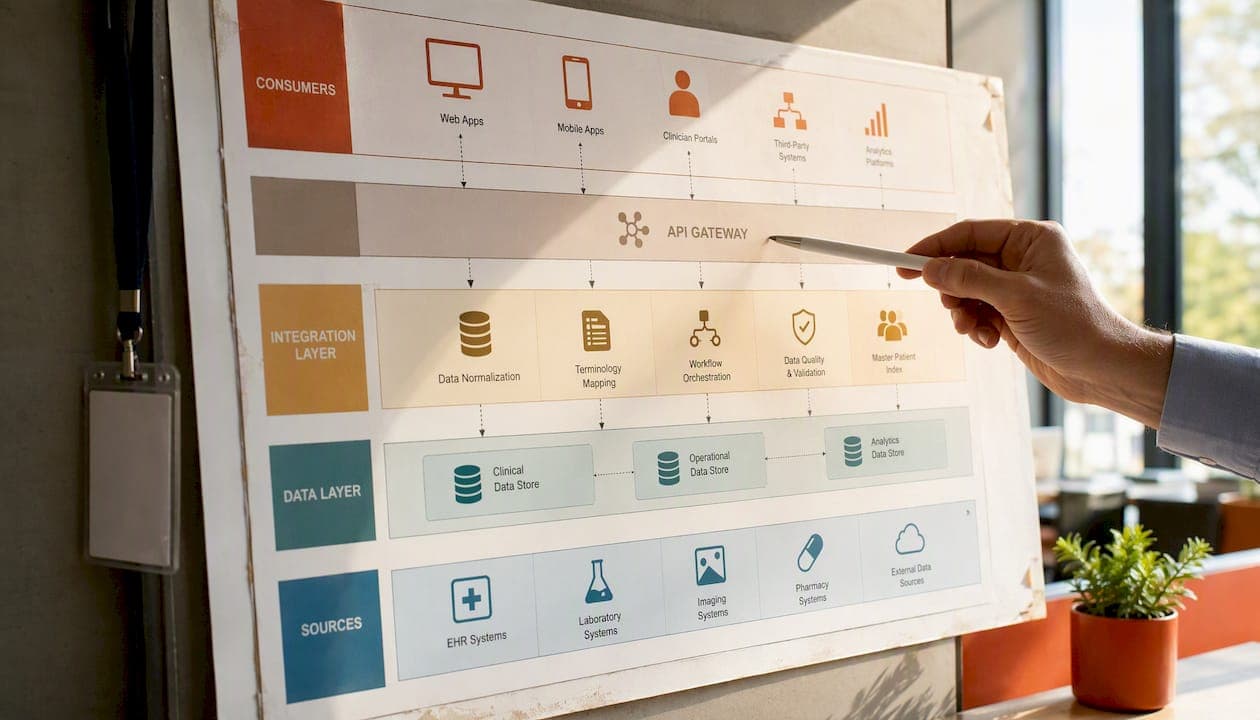
Each layer has specific responsibilities that shouldn’t leak into neighboring layers. The mediation layer handles transformation and routing logic, not terminology mapping. The semantic layer handles code normalization, not access control. Keeping these boundaries clean is what makes the architecture maintainable when three different teams are touching it simultaneously.
Resilience requirements matter as much as the logical layout. Message queuing with retry logic prevents a downstream outage from dropping data on the floor. Idempotency, ensuring the same message processed twice doesn’t create duplicate records, protects data quality during network retries. Backlog replay capability lets you reprocess a window of messages after fixing a transformation bug, which happens more often than anyone wants to admit. Recovery time objectives (RTO) and recovery point objectives (RPO) need to be defined per data type, since a lost ADT message and a lost claims batch have very different tolerances.
- Keep transformation logic in the mediation layer and terminology logic in the semantic layer.
- Build message queuing with retry and idempotency into every interface, not just the critical ones.
- Define RTO and RPO per data type rather than applying one blanket recovery standard.
- Maintain audit logging at every layer boundary, not just at the perimeter.
Practical guidance from healthcare integration specialists consistently points to centralizing connections through a mediation layer rather than letting point-to-point links multiply, since standardized, governed exchange is what keeps a growing interface count manageable over time.
Pro Tip: When migrating from HL7 v2 to FHIR, run both in parallel for at least one full reporting cycle before decommissioning the old interface. Design your mediation layer to translate between the two rather than forcing every consuming system to switch on the same day.
Security, Privacy, and Compliance Controls You Need From Day One
Security can’t be bolted on after the integration architecture is built. It has to be embedded in the mediation layer, the API gateway, and every data store from the first sprint. Required technical controls include TLS 1.3 for all data in transit, AES-256 encryption at rest, tokenization for sensitive identifiers, and a centralized key management system rather than keys scattered across individual services, following the backup and encryption standards commonly recommended for systems handling regulated data. Audit logging needs to capture every access event, feeding into a SIEM platform where anomalous patterns, like a service account suddenly querying thousands of records overnight, get flagged automatically. Role-based and attribute-based access control (RBAC/ABAC) should govern who can see what, and patient consent enforcement needs to be checked at the API layer, not assumed.
Operational controls matter just as much as technical ones. Business associate agreements need to be in place with every vendor touching protected health information, full stop, and those agreements should specify incident response SLAs, not just liability boilerplate. HHS guidance under HITECH enforcement makes clear that covered entities and business associates both carry direct compliance obligations, which means a vendor’s security posture is your risk too. Periodic penetration testing and staff training round out the operational side.
The 3-2-1 backup approach, three copies of data, on two different media types, with one copy offsite, remains a sound baseline for recovery planning, and FIDO2-compliant multi-factor authentication should be mandatory for any account with access to integration tooling or PHI stores. Eight core security practices, spanning compliance, access controls, encryption, monitoring, staff training, device management, and recovery planning, map almost directly onto what an integration program needs to reduce breach exposure while it scales. HIMSS points to the same fundamentals: physical safeguards, contingency planning, MFA, vendor BAAs, and regular staff training and drills deliver outsized risk reduction for relatively low cost.
- Enforce TLS 1.3 in transit and AES-256 at rest across every integration touchpoint.
- Route all access events through SIEM with automated anomaly alerting.
- Require FIDO2 MFA for any account touching integration infrastructure or PHI.
- Confirm BAAs with defined incident response SLAs exist before any vendor connects to your systems.
Pro Tip: Never let a team stand up a “quick” integration using a consumer-grade file-sharing or messaging tool because it’s faster than provisioning a proper interface. These tools typically lack the BAA coverage and audit logging that regulated PHI handling requires, and that shortcut becomes the incident report nobody wants to write. HIPAA-compliant vendor agreements aren’t optional convenience add-ons; they’re the contractual floor for any tool touching patient data.
AI-Assisted Semantic Harmonization and Human-in-the-Loop Mapping
Schema mapping across heterogeneous source systems used to be almost entirely manual, and it’s still the slowest part of most integration projects. Value harmonization, deciding that “MI” and “myocardial infarction” and a local billing code all mean the same clinical concept, requires either a huge library of hand-built crosswalks or a smarter approach built around a canonical schema shared across the enterprise.
A practical workflow that’s gaining traction combines automated candidate generation with human review, rather than trying to fully automate mapping or fully hand it to analysts. Here’s how the two-step process typically works:
- High-recall candidate generation. An embeddings-based or ontology cross-reference system scans incoming fields and proposes likely matches against your canonical schema or terminology standard (SNOMED CT, LOINC, RxNorm), casting a wide net rather than trying to be precise on the first pass.
- Semantic validation and human review. A rule-based or LLM-driven adjudicator scores each candidate match for confidence, auto-accepting high-confidence matches, routing mid-confidence matches to a human reviewer, and blocking low-confidence matches from moving downstream until someone resolves them manually.
This isn’t theoretical. A two-step pipeline combining candidate generation with LLM-based semantic validation reached 78% to 92% agreement with expert-built mappings across test datasets, cutting the manual review workload substantially while keeping precision high enough for production use. That’s a meaningful signal for teams drowning in mapping backlogs: automation handles the volume, humans handle the judgment calls.
Set explicit confidence thresholds rather than trusting a black-box score. A reasonable starting point: auto-accept matches scoring above 95 percent confidence, route matches between 60 and 95 percent to human review, and block anything under 60 percent entirely until a steward resolves it. Extensible, human-aware harmonization tooling with visible confidence scores is what makes automated mapping usable in a clinical setting rather than a liability, according to the BDI-Kit toolkit built specifically for biomedical data harmonization.
None of this works without provenance. Every mapping decision, whether auto-accepted or manually resolved, needs a versioned artifact showing what was mapped, by what logic, on what date, and by whom. Without that audit trail, you can’t roll back a bad transformation that’s already affected clinical decisions, and you can’t explain to an auditor why a particular data element mapped the way it did.
Pro Tip: Store every mapping specification as a versioned, reusable artifact in a shared repository, not buried in individual interface engine configurations. When the next integration project needs the same SNOMED-to-local-code mapping, your team should be able to pull it off the shelf instead of rebuilding it from scratch.
Operational Governance: Stewardship, Testing, and Change Control
Governance without named owners is just a policy document nobody reads. Data owners should be accountable for the accuracy and completeness of specific domains (medications, allergies, problem lists), while data stewards handle day-to-day mapping quality and escalations. Integration owners manage the technical pipelines themselves, and every ambiguous match or persistent error needs a clear escalation path so it doesn’t sit unresolved in someone’s inbox for three weeks.
Testing needs to happen at multiple levels, and skipping any one of them is how a mapping bug reaches production undetected.
| Test type | Purpose | Typical frequency |
|---|---|---|
| Unit testing | Validate individual transformation rules against known inputs | Every code change |
| Integration testing | Confirm data flows correctly between two connected systems | Before every interface deployment |
| End-to-end testing | Verify a full clinical workflow across all touched systems | Before major releases |
| Smoke testing | Quick sanity check that core interfaces are functioning post-deployment | After every deployment |
| Performance testing | Confirm the system handles peak message volume without latency spikes | Quarterly or before major volume changes |
Monitoring and alerting need to track metrics that actually predict problems before they become incidents: message queue depth, failed-message rate, duplicate-detection rate, data drift (when a source system silently changes its output format), and latency to delivery against your defined SLA thresholds. A queue depth that’s been quietly climbing for two weeks is a much better early warning than waiting for a clinician to complain that lab results aren’t showing up.
Change control deserves its own discipline. Mapping freeze windows during go-lives prevent someone from pushing an untested terminology update while a new interface is stabilizing. Semantic regression tests catch cases where a mapping change that fixes one field silently breaks another. Rollout canaries, deploying a new transformation to a small subset of traffic before full rollout, catch problems before they hit every patient record in the system.
- Assign named owners for each data domain before writing integration specs, not after.
- Run the full testing matrix (unit, integration, end-to-end, smoke, performance) on a defined cadence, not ad hoc.
- Track queue depth, failed-message rate, and data drift weekly as leading indicators.
- Use mapping freeze windows and canary rollouts for any change touching production terminology mappings.
A Phased Roadmap and What Drives Cost and Timeline
Most integration programs move through seven predictable phases: discovery and inventory, design and architecture, proof-of-concept, development and mapping, testing and validation, go-live and monitoring, and continuous improvement. Skipping discovery is the single most common reason a project balloons past its original estimate, because teams discover mid-build that a “simple” interface actually depends on three undocumented legacy systems.
- Discovery and inventory. Catalog every source system, existing interface, and data owner before designing anything.
- Design and architecture. Define the mediation layer, terminology strategy, and security model based on what discovery revealed.
- Proof-of-concept. Build and test one representative interface end-to-end before committing to the full scope.
- Development and mapping. Build remaining interfaces and terminology crosswalks, using the proof-of-concept patterns as a template.
- Testing and validation. Run the full testing matrix, including clinical workflow validation with actual end users.
- Go-live and monitoring. Deploy with active monitoring and a defined rollback plan for the first weeks in production.
- Continuous improvement. Review error rates, mapping drift, and stewardship escalations on a recurring cadence.
Timelines vary enormously based on scope, but the biggest cost drivers are consistent across programs: custom adapters for legacy systems that don’t speak standard protocols, the volume of custom terminology mappings needed, licensing costs for commercial terminology services, testing labor (which is almost always underestimated), and ongoing governance overhead once the program moves past initial go-live.
- Number of source systems in scope, since cost scales closer to exponentially than linearly as systems multiply.
- Whether interfaces need to be bidirectional, which roughly doubles testing and validation effort.
- Real-time versus batch SLA requirements, since real-time infrastructure carries higher operational overhead.
- Whether a dedicated terminology service is required or existing crosswalks can be reused.
Common Pitfalls in Patient Data Integration and How to Fix Them
Patient identity fragmentation is the quiet killer of integration quality. When the same patient exists as three or four slightly different records across connected systems, every downstream report, every clinical alert, and every analytics dataset inherits that error. The fix is a master patient index built on probabilistic matching rather than simple exact-match rules, paired with a defined human review workflow for matches that fall in an ambiguous confidence band. Watch for a rising duplicate-record rate as your earliest warning sign that matching logic needs attention.

Semantic heterogeneity, different systems representing the same clinical concept in incompatible ways, shows up constantly when integrating across EHR vendors or acquiring new facilities. A dedicated semantic normalization layer, backed by SNOMED CT, LOINC, and RxNorm as your canonical vocabularies, keeps this from becoming an ever-growing pile of one-off exceptions.
Fragile point-to-point integrations are what happens when every new connection gets built as a direct link between two systems instead of routing through a shared integration layer. It works fine at five interfaces. At forty, nobody can trace what breaks when one system changes its output format. Centralizing connections through a mediation layer, rather than letting direct links multiply, is the single most consistent recommendation across healthcare integration best-practice guidance.
Vendor-specific quirks, where an EHR vendor’s “standard” FHIR implementation includes subtle deviations from spec, catch teams off guard during every migration. Testing against the actual vendor sandbox early, rather than trusting documentation alone, saves weeks of debugging later. Testing gaps and maintenance debt compound over time when governance is treated as a launch-phase activity instead of an ongoing discipline; a climbing interface-error rate is usually the first visible symptom.
- Watch duplicate-record rate as an early signal of MPI matching problems.
- Watch interface-error rate as an early signal of maintenance debt or vendor drift.
- Watch mapping-review backlog size as an early signal that terminology governance needs more staffing.
When In-House Teams Should Lead and When to Bring in Outside Help
In-house IT teams almost always know their own systems and workflows better than any outside consultant walking in cold, and that local knowledge is worth protecting. They understand which clinician actually uses which workaround, which legacy interface is held together by a script one person wrote in 2014, and which political dynamics between departments will make or break adoption of a new mapping standard. That institutional memory doesn’t transfer easily, and it shouldn’t be outsourced.
Where specialist partners earn their keep is at the edges of what most internal teams do repeatedly enough to build deep expertise in: large-scale semantic harmonization across dozens of source systems, migration strategy from HL7 v2 to FHIR at enterprise scale, and independent security reviews that catch what an internal team, too close to its own architecture, tends to miss. Engagements built around these specific problems, rather than open-ended “help us with integration,” tend to produce the clearest proof of value: a defined harmonization backlog cleared, a measurable drop in interface error rates, or a security review that surfaces gaps before an auditor does.
A few red flags tend to signal it’s time to bring in outside expertise. If nobody in the organization can name the actual owner of a data domain, governance has already broken down. If the number of point-to-point interfaces has grown past what anyone can diagram from memory, the architecture needs an outside reset. And if the same category of data-quality incident, duplicate patients, dropped lab results, mismatched medication lists, keeps recurring despite fixes, that’s usually a sign the underlying mapping or matching logic needs a harder look than internal bandwidth allows.
The honest answer isn’t “always build in-house” or “always hire out.” It’s recognizing that the two modes solve different problems, and the programs that struggle most are usually the ones that never clearly decided which mode they were in.
How Arosplatforms Supports Patient Data Integration Programs
If your team is staring down a semantic harmonization backlog or a migration from HL7 v2 to FHIR that keeps slipping, Arosplatforms builds the AI-assisted harmonization workflows, integration architecture reviews, and security assessments described throughout this guide directly into your existing systems rather than replacing them wholesale. That means embedding within your operations to design mapping pipelines, MPI matching logic, and governance structures tailored to the systems you already run, not a generic template pulled off a shelf.
What sets this apart from a typical vendor engagement is ownership: Arosplatforms designs systems your team can run and modify without depending on the consultancy indefinitely, and clients typically see measurable turnaround improvements, often around 82% faster on key integration tasks, within the first year. If your organization is ready to move past ad hoc interfaces toward a governed, standards-based integration program, explore AI consulting for US healthcare organizations to scope what a tailored engagement would look like for your systems.
Sources
- Biomedical Data Integration and Harmonization Toolkit (BDI-Kit) (PMC)
- Ontology- and LLM-based data harmonization approach for federated learning (Frontiers in Digital Health)
- HHS — HITECH Act enforcement interim final rule
- Best practices for healthcare data integration projects (ClinDCast)
- Five steps to protect patient data for stronger cybersecurity in healthcare (HIMSS)
This article is general information, not a substitute for advice from a qualified doctor. Consult a qualified healthcare professional about your own circumstances before acting on anything here.
FAQ
What Is Patient Data Integration?
Patient data integration is the process of connecting clinical, administrative, and operational systems so every consumer, from a clinician to an analyst, sees the same accurate, current patient record regardless of source system.
Should We Use HL7 v2 or FHIR for New Interfaces?
Use FHIR for new API-based integrations and patient-facing applications, but keep HL7 v2 for legacy ADT and lab feeds where migration offers little practical benefit; most production environments run both side by side.
How Do We Fix Duplicate Patient Records?
Deploy a master patient index using probabilistic matching, with a defined human review workflow for matches that fall in an ambiguous confidence band, and track duplicate-record rate weekly to catch regressions early.
What Security Controls Are Non-Negotiable for Patient Data Integration?
TLS 1.3 in transit, AES-256 at rest, FIDO2-compliant MFA, role-based access control, and signed business associate agreements with every vendor touching protected health information are baseline requirements, not optional extras.
When Should We Bring in a Specialist Consultancy Like Arosplatforms?
Bring in outside expertise when point-to-point interfaces have grown past what your team can diagram from memory, when no one owns a given data domain, or when the same data-quality incident keeps recurring despite internal fixes.