Types of Compliant Digital Intake Systems: 2026 Guide
Types of Compliant Digital Intake Systems: 2026 Guide

Seven categories of compliant digital intake systems exist for U.S. healthcare and client-facing organizations: mobile/chat-like intake, secure form builders, EHR-native modules, middleware/integration platforms, OCR/document-capture suites, telehealth-integrated intake, and fully managed custom AI intake and triage. Most organizations should start with a mobile-first, HIPAA-ready solution that supports discrete EHR writeback. Three non-negotiables apply to every category: a signed Business Associate Agreement (BAA), encryption in transit and at rest, and role-based access controls that enforce least privilege.
- Mobile/chat-like intake finishes significantly more often than legacy PDF forms.
- Secure form builders deploy fast but often output static PDFs, not structured data.
- EHR-native modules offer tight integration but limited UX flexibility.
- Middleware/integration platforms connect disparate systems but add configuration complexity.
- OCR/document-capture suites digitize paper and insurance cards but need validation layers.
- Telehealth-integrated intake bundles pre-visit forms with virtual visit workflows.
- Fully managed/custom AI intake and triage delivers the highest automation ceiling and is where Arosplatforms operates.
Pro Tip: Before evaluating any vendor, confirm they will sign a BAA in writing. A platform that hesitates on this point is not a compliant option, regardless of its marketing.
Table of Contents
- What are the main types of compliant digital intake systems?
- What HIPAA compliance actually requires from any intake system
- How EHR integration and discrete writeback change your ROI
- How to choose the right intake system and spot red flags
- How Arosplatforms builds compliant AI intake and triage systems
- Key Takeaways
- The tradeoffs nobody talks about in intake system deployments
- Arosplatforms helps U.S. organizations deploy compliant intake without the guesswork
- Useful sources
- FAQ
What are the main types of compliant digital intake systems?
Each category solves a different operational problem. Choosing the wrong one often means paying for a rebuild 18 months later.
Mobile/chat-like intake
Conversational, step-by-step forms delivered via SMS or email link, no app download required. Best for high-volume outpatient, urgent care, and multi-location practices. Completion rates are higher than PDF alternatives because patients answer one question at a time on their phone. The tradeoff: conditional logic and branching add configuration time, and poorly designed flows can still frustrate users.
Secure form builders
Web-based form tools with HIPAA-compliant hosting. Fast to deploy, often configurable without engineering. The critical limitation: many output a signed PDF rather than discrete, machine-readable fields. That PDF lands in a document folder, not in a structured chart field, which means staff still retype data manually. For organizations that need real EHR writeback, a form builder alone rarely gets there.
EHR-native modules
Intake modules built directly into platforms like Epic or Athenahealth. Integration is tight by design, and discrete writeback is native. The downside is UX rigidity: these modules tend to look and feel like the EHR itself, which patients find clunky on mobile. Configuration options are limited to what the EHR vendor exposes.
Middleware/integration platforms
Tools that sit between an intake front-end and the EHR/PMS, translating and routing data. They support FHIR, HL7, and API connections and can map fields from almost any source system. Setup complexity is high, and the compliance surface area expands because data passes through an additional system that also needs a BAA and its own security controls.
OCR/document-capture suites
These systems photograph or scan documents (insurance cards, paper forms, IDs) and extract structured data using optical character recognition. Accuracy depends heavily on image quality and tuning. They work well as a component inside a broader intake workflow but rarely stand alone as a complete solution.
Telehealth-integrated intake
Pre-visit intake bundled with a virtual visit platform. Patients complete forms before joining a video call, and data flows into the visit context automatically. Useful for behavioral health, chronic care management, and remote-first practices. The risk: if the telehealth vendor’s intake module is weak, you are locked into their UX with limited customization.
Fully managed/custom AI intake and triage
Custom-built systems that combine conversational intake, AI-driven triage routing, OCR, and direct EHR writeback into a single governed workflow. Setup takes longer and costs more upfront, but the automation ceiling is the highest of any category. This is where AI patient intake and triage capabilities from Arosplatforms sit.
| Category | Discrete EHR writeback | Typical setup speed | Compliance surface |
|---|---|---|---|
| Mobile/chat-like intake | Depends on connector | Days to weeks | Moderate |
| Secure form builders | Rarely native | Hours to days | Low to moderate |
| EHR-native modules | Yes, native | Weeks | Low (contained) |
| Middleware platforms | Yes, with mapping | Weeks to months | High |
| OCR/document-capture | Partial | Weeks | Moderate |
| Telehealth-integrated | Vendor-dependent | Days to weeks | Moderate |
| Custom AI intake | Yes, by design | Months | Managed |
What HIPAA compliance actually requires from any intake system
HIPAA applies the moment a form collects individually identifiable health information, regardless of whether it is paper, PDF, or a mobile app. According to HIPAA Vault’s guidance on compliant online forms, a platform is only as compliant as how you configure and operate it. The technology is a starting point, not a finish line.
Compliance checklist every system must satisfy:
- Signed BAA with the vendor and all subprocessors
- Encryption in transit (TLS 1.2 or higher) and at rest; see BeeSign’s encryption standards for a technical reference
- Role-based access controls with least-privilege enforcement
- MFA or SSO options for staff accounts
- Immutable, timestamped audit logs
- E-signature controls with tamper evidence
- Documented breach notification procedures
Operational risks are where most organizations fail. HIPAA Vault’s patient intake form guide is direct on this: shared admin accounts, weak access controls, and poor staff training can render a technically capable platform non-compliant. Electronic signatures are allowed under HIPAA when collected through a properly configured system, but the configuration is the organization’s responsibility, not the vendor’s.
Pro Tip: Run a quarterly access review. Remove departed staff immediately, audit who holds admin rights, and document the review. This single habit closes the most common misconfiguration gap. For a deeper look at how AI tools fit into this framework, the HIPAA for AI overview from Arosplatforms covers the governance layer.
How EHR integration and discrete writeback change your ROI
Discrete, field-level writeback to the EHR changes the ROI and risk profile of any intake investment. When patient data maps directly into structured chart fields, staff stop rekeying, transcription errors drop, and clinicians get a pre-visit brief before the patient walks in. According to Accountable HQ’s analysis of digital patient forms, bidirectional sync reduces rekeying and supports provider pre-visit preparation that improves clinic efficiency.
Common integration mechanisms:
- FHIR R4 APIs — the current standard for EHR interoperability; supports real-time, bidirectional data exchange.
- HL7 v2 messaging — older but still dominant in hospital systems; requires a translation layer.
- Webhooks — event-driven pushes from intake to downstream systems; fast but one-directional.
- SFTP batch transfers — used when real-time APIs are unavailable; introduces latency.
- Middleware orchestration — routes and transforms data between systems that speak different protocols.
Data flow in a well-designed system: Patient submits form → validation and OCR run → data transforms to target schema → discrete fields write to EHR → audit log records the transaction with timestamp.
Integration validation checklist:
- Map every intake field to its target EHR field before go-live
- Run edge-case test records (missing fields, special characters, pediatric ages)
- Verify audit log entries for each test transaction
- Confirm bidirectional sync by checking that EHR updates reflect back in the intake record
Typical integration timelines: a pre-built EHR connector takes several weeks to configure and test. A custom FHIR integration with a new EHR target runs multiple weeks. Middleware implementations with multiple source systems can take longer periods.
Pro Tip: Insist on a sandbox environment before signing any integration contract. A vendor that cannot provide one is asking you to test in production.
How to choose the right intake system and spot red flags
Prioritize discrete EHR writeback, BAA willingness, audit trails, and configurable role-based access over any vendor’s marketing claim of “HIPAA-ready.” That phrase means nothing without specifics.
Questions to ask every vendor:
- Will you sign a BAA before we share any PHI?
- Which EHR connectors support discrete field writeback (not PDF export)?
- How is data encrypted in transit and at rest, and to what standard?
- How are audit logs stored, retained, and queried?
- Who are your subprocessors, and do they each have a BAA?
- Do you offer a sandbox for integration testing?
- How do you handle patient amendment and disclosure requests?
Red flags that should end the conversation:
- Refusal or hesitation to sign a BAA
- PDF-only export with no structured writeback option
- Shared admin accounts in their own operations or recommended setup
- Vague answers about encryption standards or subprocessor identity
- No sandbox or test environment available
- No documented breach notification process
Scoring rubric: Must-haves are BAA, encryption in transit and at rest, role-based access, audit logs, and discrete writeback. Nice-to-haves are OCR insurance capture, conditional logic, biometric identity verification (increasingly relevant as a compliance control), and live triage routing.
Pro Tip: Ask for a reference from a client using the same EHR you use. A vendor with a live, working connector to your system is a different conversation than one promising future compatibility.
How Arosplatforms builds compliant AI intake and triage systems
Arosplatforms designs and deploys AI-enabled intake and triage systems that enforce compliance controls from the ground up and map discrete fields directly into client EHR and PMS environments. The approach covers the full stack: conversational intake UX, OCR for insurance and document capture, conditional triage logic, FHIR/HL7 integration, audit logging, and staff training.
What an Arosplatforms engagement typically includes:
- Custom intake flow design mapped to the client’s visit types and patient population
- Discrete field mapping to target EHR with validated writeback
- BAA and subprocessor documentation as part of the governance package
- Role-based access configuration and admin account hygiene protocols
- Pilot deployment with measured completion rate and chart accuracy baselines
- Staff training on form management, amendment handling, and audit log review
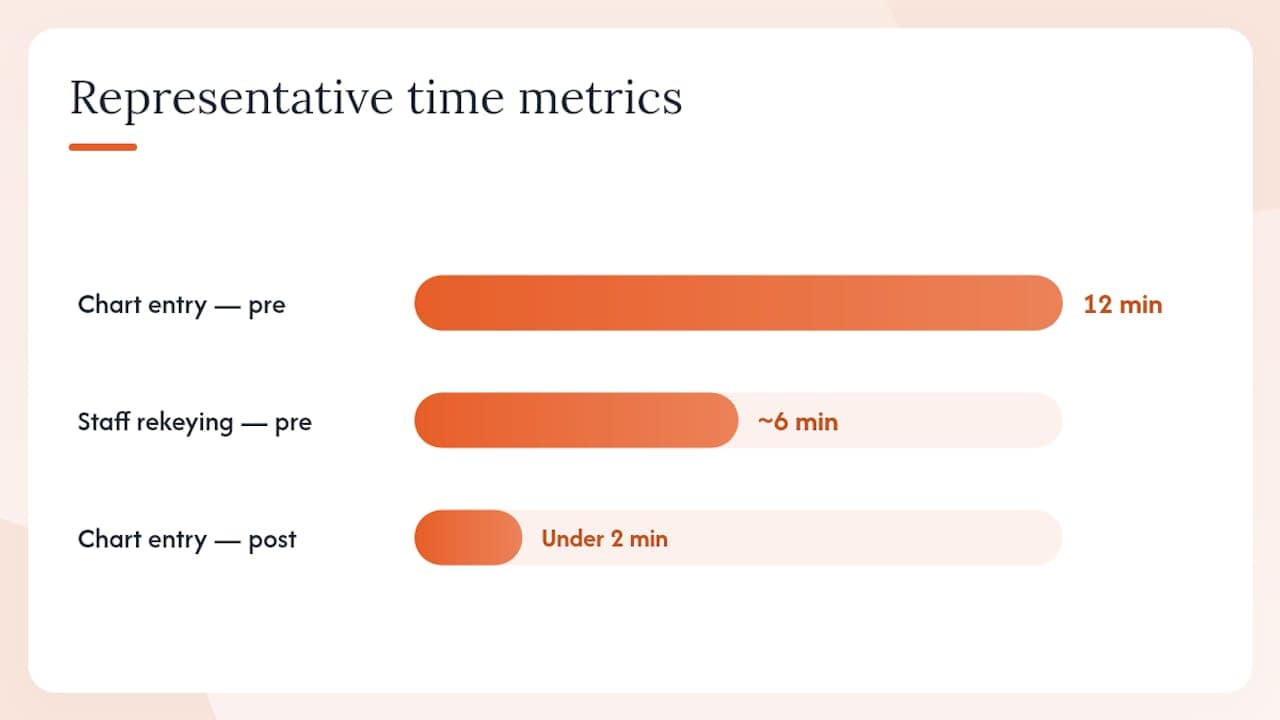
Illustrative outcomes from this type of engagement (representative of the category, not guaranteed for any specific client):
| Metric | Pre-deployment | Post-deployment |
|---|---|---|
| Form completion rate | lower completion with PDF baseline | higher completion with mobile-first flow |
| Time to chart entry | 12 minutes (manual) | Under 2 minutes (automated writeback) |
| Pilot duration | — | 3–4 weeks |
| Staff rekeying per visit | ~6 minutes | Near zero |
Engagements run as consulting projects with optional ongoing managed services. There is no SaaS subscription or vendor lock-in. Clients own the system. For architecture detail, the AI OS for Healthcare page covers the end-to-end platform design.
Key Takeaways
Compliant digital intake requires discrete EHR writeback, a signed BAA, encryption in transit and at rest, and role-based access controls — mobile-first UX is what makes those controls stick in practice.
| Point | Details |
|---|---|
| BAA is non-negotiable | Every vendor and subprocessor must sign a BAA before any PHI is shared. |
| Discrete writeback beats PDF | Field-level EHR writeback eliminates rekeying and enables pre-visit clinician briefs. |
| Mobile-first doubles completion | Chat-like, no-login flows finish roughly twice as often as PDF-style forms. |
| Pilot before full rollout | A 3–4 week pilot on one visit type gives real completion and accuracy data before org-wide commitment. |
| Arosplatforms builds custom | Arosplatforms designs end-to-end AI intake systems with discrete writeback, compliance controls, and staff training included. |
The tradeoffs nobody talks about in intake system deployments
The conventional framing in this space is “find a HIPAA-compliant vendor and you’re covered.” That framing is wrong, and it costs organizations real money.
The actual tradeoff is between speed and data fidelity. A secure form builder gets you live in days, but if it outputs PDFs, you have digitized the paper without digitizing the workflow. Staff still retype. Errors still happen. The chart is still incomplete when the clinician walks in. That is not a technology failure; it is a scoping failure that happens when procurement focuses on deployment speed instead of data architecture.
The second tradeoff is off-the-shelf versus custom. Off-the-shelf tools cover 80% of standard intake scenarios well. The remaining 20% — complex triage logic, multi-system EHR environments, specialty-specific conditional flows — is where they break down. Organizations that try to force a standard tool into a non-standard workflow end up with workarounds that create compliance gaps. Custom builds cost more upfront and take longer, but they eliminate the workaround layer entirely.
The third tradeoff is security versus convenience. No-login magic links are genuinely better for completion. They are also a real security consideration if the SMS or email account is compromised. The answer is not to abandon magic links; it is to pair them with short expiration windows and session controls. Convenience and security are not opposites here, but they require deliberate configuration, not defaults.
When the complexity of any one of these tradeoffs exceeds your internal capacity to resolve it, that is the right moment to bring in a consultancy.
Arosplatforms helps U.S. organizations deploy compliant intake without the guesswork
Getting compliant intake right the first time, with discrete writeback, a signed BAA, and a mobile-first UX that staff and patients actually use, is faster with a team that has built these systems before. Arosplatforms works with U.S. healthcare providers and enterprise organizations to design, build, and deploy custom AI intake systems: from field mapping and EHR integration to compliance documentation and staff training. No SaaS lock-in, no generic templates. You own the system when the engagement ends.
If your organization is evaluating compliant digital intake options and needs a partner who can handle the integration and governance layer, connect with the Arosplatforms US team to scope a pilot.
Useful sources
- Best HIPAA Compliant Online Forms for Secure Patient Intake
- How to Build a HIPAA-Compliant Patient Intake Form
- HIPAA-Compliant Digital Patient Forms for Healthcare Practices
FAQ
What makes a digital intake system HIPAA-compliant?
A signed BAA, encryption in transit and at rest, role-based access controls, immutable audit logs, and proper configuration by the organization — not just the vendor’s platform capabilities.
What is the difference between discrete writeback and PDF export?
Discrete writeback maps patient responses directly into structured EHR fields. PDF export creates a document that staff must read and retype manually, which reintroduces the errors and delays that digital intake is supposed to eliminate.
Which intake system type is best for most healthcare organizations?
Mobile-first, chat-like intake with a pre-built EHR connector and discrete writeback covers the majority of outpatient and multi-location use cases, with the highest completion rates and manageable compliance overhead.
How long does it take to implement a compliant intake system?
A pre-built EHR connector typically takes 2–4 weeks to configure and validate. Custom FHIR integrations run 6–12 weeks. Full custom AI intake systems, like those Arosplatforms builds, typically include a 3–4 week pilot phase before broader rollout.
Can Arosplatforms build a compliant intake system for my organization?
Yes. Arosplatforms designs and deploys custom AI intake and triage systems for U.S. healthcare and enterprise clients, including discrete EHR writeback, BAA documentation, compliance controls, and staff training as part of the engagement.