The Role of AI in Field Service Quoting: A Leader's Guide
The Role of AI in Field Service Quoting: A Leader’s Guide
AI-native quoting transforms how field service organizations price work. Instead of technicians spending hours on spreadsheets, an AI system ingests IoT sensor readings, FSM job histories, and live parts pricing to produce a draft quote in minutes. Arosplatforms reports clients see an average 82% faster turnaround for key tasks, with returns on investment typically within 12 months.
- Speed: AI-native pilots report substantially faster quote preparation when IoT and historical job data feed the model directly.
- Consistency: AI establishes a pricing baseline that reduces variance across individual estimators, cutting price disputes and protecting margins.
- Data-driven risk flags: IoT streams and FSM maintenance histories surface scope risks and upsell signals that manual quoting routinely misses.
Table of Contents
- What does AI actually do in field service quoting?
- AI-native versus rule-based quoting: which approach fits your operation?
- What data inputs and integrations does reliable AI quoting require?
- How should humans and AI share the quoting workflow?
- How do you measure the impact of AI quoting?
- What does a solid implementation checklist look like?
- How do you choose a vendor or deployment model?
- How does AI quoting work across healthcare, logistics, and insurance?
- How does Arosplatforms approach AI-native quoting in practice?
- Key Takeaways
- When should you push for AI-native quoting now, and when should you wait?
- Arosplatforms builds AI-native quoting systems for enterprise field operations
- Useful sources and further reading
- FAQ
What does AI actually do in field service quoting?
The core capabilities go well beyond auto-filling a form. A well-integrated AI quoting system handles dynamic cost estimation by pulling live labor rates, parts pricing from your ERP, and travel-time adjustments from routing data. It applies visual scope inference from uploaded photos or voice notes, so a technician can describe a job on-site and receive a structured draft before leaving the parking lot.
Concrete outputs a decision-maker should expect:
- Itemized line items: part number, labor hours, unit cost, and quantity, each traceable to a source job record.
- Confidence score with explanation: “87% confidence — based on 214 similar HVAC compressor jobs; main uncertainty is parts lead time.”
- Suggested SLA language: auto-populated response and resolution windows matched to asset criticality.
- Scope and exclusions paragraph: generated from job type and asset history, ready for the customer-facing proposal.
- Upsell suggestions: flagged when asset age or failure patterns indicate a higher-value intervention is warranted.
Integration-enabled outputs add another layer. Live parts pricing from an ERP prevents the common problem of quoting a part at last quarter’s cost. Inventory checks confirm availability before the quote leaves the system. Scheduling data adjusts labor costs for overtime or after-hours rates automatically.
Pro Tip: Insist on editable AI drafts and require technicians to log a reason code whenever they override a line item. Those override logs become training labels that tighten the model over time.
AI-native versus rule-based quoting: which approach fits your operation?
Rule-based quoting uses hard-coded logic: if job type equals “boiler service,” apply rate table B and parts list 12. It works well for simple, stable job catalogs. The maintenance overhead is low until the catalog changes, at which point someone has to manually update every rule.
AI-native quoting trains models on your historical jobs and streams live asset telemetry. The system adapts when a new asset type appears, handles incomplete data by surfacing a lower confidence score rather than failing silently, and improves continuously as more labeled jobs accumulate. Best-performing quoting strategies are AI-native, built on a business’s own data rather than static rule sets.
When to choose AI-native:
- Job types are complex or varied (multi-trade, regulated environments, asset-heavy industries).
- You have centralized FSM data and at least several hundred labeled historical jobs per major job family.
- Pricing changes frequently due to parts volatility or labor market shifts.
- You need continuous improvement without manual rule updates.
When rule-based is sufficient:
- Catalog is small, stable, and well-defined.
- Data is fragmented and a centralization project is not yet funded.
- Speed-to-value matters more than long-term accuracy gains.
The critical risk with AI-native: the model is only as good as the data feeding it. Fragmented historical data across spreadsheets and email threads produces biased outputs. Minimum data hygiene requirements before going AI-native include unified rate tables, normalized unit costs, deduplicated job records, and outcome tagging (accepted, margin realized, callbacks).
What data inputs and integrations does reliable AI quoting require?
Getting the integrations right is where most pilots stall. The priority order matters.
MVP integrations (highest value first):
- FSM or dispatch system (job history, asset records, technician skills)
- Parts catalog and ERP pricing feed (live costs, lead times)
- Scheduling and routing (labor rate adjustments, travel time)
Phase 2 integrations (add after MVP is stable):
- IoT and sensor streams (condition-based triggers, anomaly flags)
- Maintenance histories and warranty records
- CRM (customer tier pricing, relationship context)
- Photo and voice capture pipelines for visual AI scope inference
Data hygiene actions before you build:
- Unify rate tables across regions and business units.
- Normalize unit costs (eliminate “each,” “lot,” and “misc” line items).
- Remove duplicate job records and standardize job-type descriptions.
- Tag historical jobs for outcome: accepted, rejected, margin realized, callbacks.
On privacy: capture the minimum personal data required for quoting. Document data flows, especially where IoT telemetry or customer asset data crosses system boundaries. For US operations, align data minimization practices with applicable state privacy laws and encrypt data in transit and at rest.
| Integration | MVP Priority | Value Delivered |
|---|---|---|
| FSM / dispatch | High | Job history, asset context, technician match |
| ERP / parts catalog | High | Live pricing, inventory availability |
| Scheduling / routing | High | Labor rate accuracy, travel-time cost |
| IoT / sensor streams | Medium | Condition-based scope, risk flags |
| CRM | Medium | Customer-tier pricing, upsell context |
| Photo / voice capture | Medium | Remote scope inference, fewer site visits |
How should humans and AI share the quoting workflow?
The workflow that works in practice follows a clear handoff sequence. A technician captures job details on-site (photos, voice notes, asset readings). The AI drafts a quote with line items, a confidence score, and suggested scope language. The technician reviews, edits any line items, and submits. For jobs below a margin threshold or above a dollar value, a manager approves before the proposal reaches the customer.

Human review for itemized costs and scope exclusions is not optional. AI drafts are a starting point, not a final answer.
Confidence threshold guidance:
- Above 85% confidence, routine job type: auto-approve for customer delivery after technician review.
- 65–85% confidence: technician must validate key assumptions before sending.
- Below 65% or high-value job: require manager sign-off.
Exceptions that humans must always own: relationship conversations, bespoke contract terms, legal language, and any scope dispute where the customer is already unhappy. AI handles the calculation; the technician handles the conversation.
Pro Tip: Log every override with a reason code (“parts price outdated,” “scope expanded on-site,” “customer negotiated discount”). Feed those codes back into model retraining on a rolling 30–90 day window to catch systemic gaps before they compound.
How do you measure the impact of AI quoting?
Track these KPIs from day one of a pilot:
| KPI | Baseline Target | Measurement Cadence |
|---|---|---|
| Time-to-quote | Reduce by 82% within 6–12 months | Weekly |
| Quote-to-book conversion rate | Improve by a measurable percentage | Monthly |
| Quoted vs. realized margin | Narrow the gap quarter over quarter | Monthly |
| Quote accuracy (scope misses) | Reduce callbacks and change orders | Monthly |
| Technician time saved on admin | Track hours recaptured per week | Weekly |
| Customer response time | Faster proposal delivery, faster acceptance | Monthly |
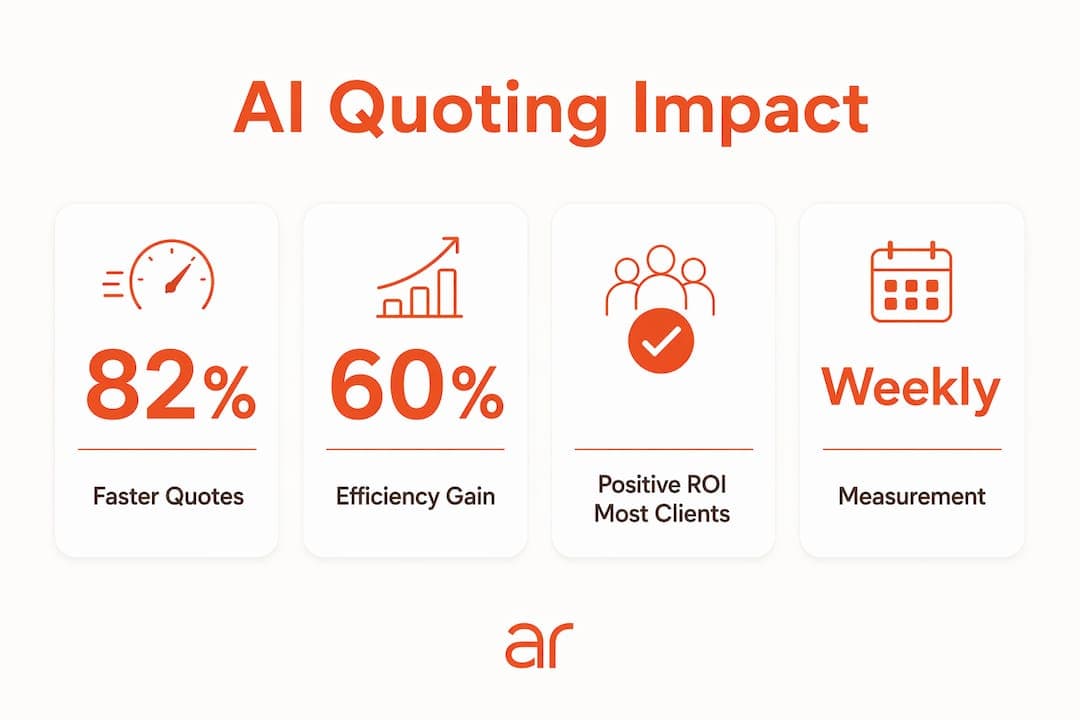
Arosplatforms’ internal data shows clients average 82% faster turnaround on key tasks, with most seeing positive ROI within 12 months. Use those figures as a realistic benchmark when building a business case, not a guarantee, since results depend on data quality and integration depth.
What does a solid implementation checklist look like?
Phase 1: Foundation (weeks 1–6)
- Secure stakeholder alignment across ops, IT, and finance.
- Complete a data audit: inventory FSM records, parts catalogs, and historical job data.
- Define MVP scope: one job family, one region, one integration pair.
- Document the integration plan with API owners and data stewards.
Phase 2: Build and pilot (weeks 7–20)
- Stand up the AI quoting model on cleaned, labeled historical data.
- Run a controlled pilot with a defined technician group and clear KPIs.
- Collect override logs and retrain on a 30–90 day cadence.
- Conduct weekly feedback sessions with field staff.
Risk matrix:
| Risk | Mitigation |
|---|---|
| Poor data quality | Data audit and centralization before model training |
| Model drift | Scheduled retraining, monitoring on margin variance |
| Integration failure | Staged rollout with fallback to manual entry |
| User resistance | Early technician involvement, visible time savings |
| Compliance incident | Access controls, encrypted transport, audit logs |
Governance essentials: version-control pricing models, restrict who can modify rate tables, log every quote generation event for auditability, and define a formal retraining approval process.
Pro Tip: Run a parallel quoting period during the pilot: AI draft alongside the manual quote for the same jobs. The gap between them is your clearest evidence of model accuracy and the fastest way to build internal confidence.
How do you choose a vendor or deployment model?
The build-versus-buy decision turns on one question: how unique and regulated is your workflow? Complex, regulated operations with proprietary asset data and bespoke pricing logic benefit from a custom AI operating system built around their data. Simpler operations with standard job catalogs can often adopt an integration-friendly solution faster.
Vendor evaluation checklist:
- Data ownership: you must retain ownership of your training data and model weights.
- Model explainability: can the system show why a line item was priced at a specific amount?
- Integration APIs: open, documented, and versioned.
- Exit terms: can you export your data and models without penalty?
- Security posture: SOC 2 Type II or equivalent, encrypted transport, role-based access.
- Support SLAs: defined response times for production incidents.
Deployment options range from cloud-hosted multi-tenant (fastest to deploy, shared infrastructure) to dedicated cloud (data isolation, higher cost) to hybrid with edge components for on-site IoT telemetry where latency or data-residency rules apply. For multi-site operations, ask vendors for reference architectures showing how they handle incremental site onboarding. The platform architecture question matters more at scale than it does in a single-site pilot.
How does AI quoting work across healthcare, logistics, and insurance?
The same AI quoting logic applies differently depending on the asset and the stakes involved. Across industries, you can explore real-world AI use cases that show how these systems ship in practice.
Healthcare — hospital equipment servicing
A biomedical technician arrives to service an infusion pump. The AI pulls maintenance history, IoT vitals from the device’s last 90 days, and parts pricing from the hospital’s GPO catalog to produce an on-site quote with prioritized SLA options.
- Faster quote delivery reduces equipment downtime.
- Maintenance history prevents under-scoping on aging devices.
- SLA prioritization aligns with clinical criticality, not just cost.
Logistics — fleet repair and downtime pricing
A fleet manager needs a repair quote for a refrigerated trailer. The AI ingests telematics data, calculates route impact (revenue lost per day of downtime), and recommends a repair-versus-replace timeline based on historical failure rates for that asset class.
- Telematics data grounds the quote in actual asset condition.
- Downtime cost modeling makes the business case for faster repair decisions.
- Replacement timeline recommendations reduce reactive emergency spend.
Insurance — underwriting and repair assessment
An adjuster uploads inspection photos of storm-damaged commercial HVAC units. The AI cross-references historical claims for similar damage profiles, flags high-risk scope items, and suggests exclusion language for the quote.
- Photo-based scope inference reduces unnecessary site visits.
- Historical claims data improves pricing accuracy on complex losses.
- Automated exclusion suggestions reduce coverage disputes downstream.
For insurance-specific applications, AI underwriting automation shows how these workflows translate into production systems.
How does Arosplatforms approach AI-native quoting in practice?
Arosplatforms builds tailored AI operating systems by starting with a data-first audit: mapping every source of job history, parts pricing, and asset data before writing a line of model code. Integrations are phased, beginning with FSM and parts catalog connections that deliver immediate quote speed improvements, then layering IoT and visual AI inputs as data quality matures.
The model training process uses a business’s own labeled historical jobs, which means the system learns the pricing logic specific to that operation rather than applying generic industry averages. Human-in-loop validation is built into the workflow from day one, with override logs feeding back into retraining cycles.
ROI benchmarks from Arosplatforms’ program: clients average 82% faster turnaround on key tasks and typically see returns within 12 months.
Suggested pilot scope for leaders:
- Weeks 1–12: Discovery and data audit. Map FSM records, identify the highest-volume job family, define MVP KPIs.
- Months 3–6: Controlled pilot with one technician group. Track time-to-quote, margin accuracy, and override frequency.
- Who to involve: Operations lead (job-type expertise), IT (integration ownership), Finance (margin baseline and ROI tracking).
- Low-risk guardrail: run AI drafts in parallel with manual quotes for the first 30 days before switching to AI-first.
Key Takeaways
AI-native quoting delivers measurable speed and margin improvements when built on clean, centralized FSM data and governed by human-in-loop validation from the start.
| Point | Details |
|---|---|
| AI-native beats rule-based | Models trained on your own job history adapt to new asset types and pricing changes without manual rule updates. |
| Data hygiene comes first | Unify rate tables, deduplicate job records, and tag outcomes before training any model. |
| Start with FSM and parts catalog | These two integrations deliver the highest immediate value; add IoT and visual AI in phase 2. |
| Human-in-loop is non-negotiable | Set confidence thresholds and require manager approval for low-confidence or high-value quotes. |
| Measure time-to-quote and margin accuracy | Track weekly from pilot day one; target 82% quote-time reduction within 6–12 months. |
| Arosplatforms benchmark | Clients average 82% faster turnaround and typically see ROI within 12 months using Arosplatforms’ AI OS approach. |
When should you push for AI-native quoting now, and when should you wait?
The honest answer is that AI-native quoting is worth pursuing now if you have centralized FSM data and enough labeled historical jobs per major job family to train a useful model. If your job history lives across spreadsheets, email threads, and three different systems that have never been reconciled, the right first move is a data hygiene project, not a model deployment.
The operational triggers that signal it is time to act are specific: quote delays that cost you jobs, pricing variance across technicians that customers notice, frequent scope disputes that eat into realized margins, or measurable margin leakage on complex jobs. Any one of those is a signal. All four together means the cost of waiting is compounding.
The part most leaders underestimate is governance. AI speeds the quoting process, but without change-control on pricing models, a retraining cadence, and clear override protocols, the speed gain comes with margin risk. The technology is ready. The governance and change management discipline is what separates deployments that hold their gains from ones that drift back to manual workarounds within a year.
Arosplatforms builds AI-native quoting systems for enterprise field operations
Most field service organizations don’t need another quoting tool. They need an AI system built around their own data, their job types, and their pricing logic. That is what Arosplatforms delivers: a custom AI operating system for US enterprises that integrates FSM records, parts catalogs, IoT inputs, and human-in-loop validation into a single, owned quoting workflow.
The typical engagement starts with an 8–12 week discovery and data audit, followed by a 3–6 month pilot on a defined job family with clear KPIs. Teams retain full ownership of their models and data, with no vendor lock-in. Clients using AI sales tools alongside AI quoting report faster close rates, on top of the operational gains. To discuss a discovery workshop for your operation, reach out to Arosplatforms directly through the US consulting page.
Useful sources and further reading
- Arosplatforms AI operating systems and services — primary reference for ROI benchmarks and the AI OS approach.
- Arosplatforms AI use cases across industries — real-world implementations in healthcare, logistics, and insurance.
- AI-native CPQ for field service (ServicePath) — practitioner data on speed improvements in AI-native quoting pilots.
- How AI is changing quoting for field service (ServBuilder) — overview of consistency, visual AI, and the assistant role of AI in quoting.
- Quoting software for maintenance and service teams (Tibr) — guidance on human-in-loop validation and override logging.
- Build a service quote app using AI (FieldProxy) — technical guidance on minimal viable quote artifacts and integration priorities.
For tailored ROI estimates based on your job volume and data maturity, request a pilot discovery workshop with Arosplatforms.
FAQ
What is the role of AI in field service quoting?
AI automates cost estimation, parts lookup, and proposal generation by ingesting FSM job histories, IoT sensor data, and live parts pricing. The result is faster, more consistent quotes with built-in risk flags and upsell suggestions.
How much faster does AI make field service quoting?
AI-native CPQ pilots report 60% faster quote preparation when IoT and historical job data are fed into the model. Arosplatforms clients report an average 82% faster turnaround on key tasks overall.
Do technicians still need to review AI-generated quotes?
Yes. Human review of itemized costs, assumptions, and scope exclusions is mandatory. AI drafts are a starting point; technicians validate and managers approve below-threshold or high-value jobs before proposals reach customers.
What data does an AI quoting system need to work well?
At minimum: centralized FSM job records, a live parts catalog with pricing, and scheduling data. IoT streams and maintenance histories improve accuracy further but are phase 2 inputs once the MVP is stable.
How long does it take to see ROI from AI quoting?
Arosplatforms’ program data shows most clients see returns within 12 months, with quote-time reductions of 60–80% achievable within the first 6–12 months of a well-scoped pilot.