AI in Service Call Optimization: A Manager's Guide
AI in Service Call Optimization: A Manager’s Guide

AI in service call optimization is defined as the systematic use of automated voice agents, intelligent routing, and real-time analytics to reduce missed calls, cut response times, and increase the number of jobs technicians complete each day. The role of AI in service call optimization has moved well beyond basic chatbots. The industry term for this discipline is intelligent service management, and it covers everything from natural language call handling to predictive staffing. AI voice agents now handle 30%–50% of incoming service calls, freeing technicians to dispatch 1.4 more jobs daily. For service managers, that productivity shift is the clearest signal that AI has become an operational necessity, not a future experiment.
How does AI improve service call efficiency and technician dispatch?
AI improves service call efficiency by automating the intake and triage work that previously consumed dispatcher and technician time. When a caller contacts your service center, an AI voice agent identifies intent, checks availability, and books or routes the call without a human touching the queue. That automation directly reduces the average missed call rate of 27% recorded across field service operations in 2024–2025, with AI-equipped teams cutting missed appointments by 22%–31%.
Dispatch efficiency gains are equally concrete. Skill-specific routing cuts drive time from 32%–35% of the workday down to 18%–20%, and jobs completed per technician jump from 2–3 per day to 4–5 or more. First-visit fix rates climb from the 72%–78% range to 88%–95% when the right technician arrives with the right skills. That improvement in first-visit resolution directly reduces repeat call volume, which compounds the efficiency gain across the entire operation.

Cost structure also shifts in favor of AI adoption. AI voice agents cost roughly 10%–30% of a full-time service employee’s monthly salary. That ratio makes AI a financially defensible choice even for mid-size service operations, not just enterprise-level organizations.
| Metric | Before AI | After AI |
|---|---|---|
| Drive time as % of workday | 32%–35% | 18%–20% |
| Jobs completed per technician/day | 2–3 | 4–5+ |
| First-visit fix rate | 72%–78% | 88%–95% |
| Missed appointment rate | ~27% | Reduced by 22%–31% |
| Calls handled without human agent | 0% | 30%–50% |
Pro Tip: Track first-visit fix rate weekly, not monthly. A drop in that metric is the earliest signal that your routing logic or skill matrix has drifted out of alignment with your technician roster.
What AI optimization techniques apply to service calls?
Several proven techniques drive the efficiency gains described above. Each addresses a different friction point in the service call workflow.
- Intent-based call routing. AI analyzes caller language in real time to detect the type of service needed, then matches the call to the technician or agent best qualified to handle it. This replaces the blunt “press 1 for billing” menu with a system that understands context.
- Technician skill matrix routing. AI dispatch engines tag technicians by certifications, specialties, and geographic constraints. Broad technician labels cause inefficient dispatch and appointment reassignments. A well-defined skill matrix eliminates that waste.
- Real-time CRM integration and summarization. AI logs call intent, customer history, and agreed actions into the CRM during the call, not after. Agents and technicians arrive at each interaction with full context, cutting handle time and repeat questions.
- Predictive analytics for staffing. Predictive analytics models analyze historical call volume patterns to forecast demand by hour, day, and season. Service managers use those forecasts to staff correctly before a surge, not after complaints arrive.
- Automated follow-up and missed call recovery. When a call goes unanswered, AI triggers an outbound text or callback sequence automatically. This closes the gap that previously resulted in lost bookings and customer churn.
- Hybrid AI-human handoff protocols. AI running in the call background handles routing, intent detection, and CRM logging while a human agent manages the conversation. Customers get the speed of automation and the trust of a human voice.
The most effective deployments combine at least three of these techniques. Applying only one, such as a standalone chatbot, produces limited results because the friction simply moves to the next step in the workflow.
What challenges come with implementing AI for service calls?
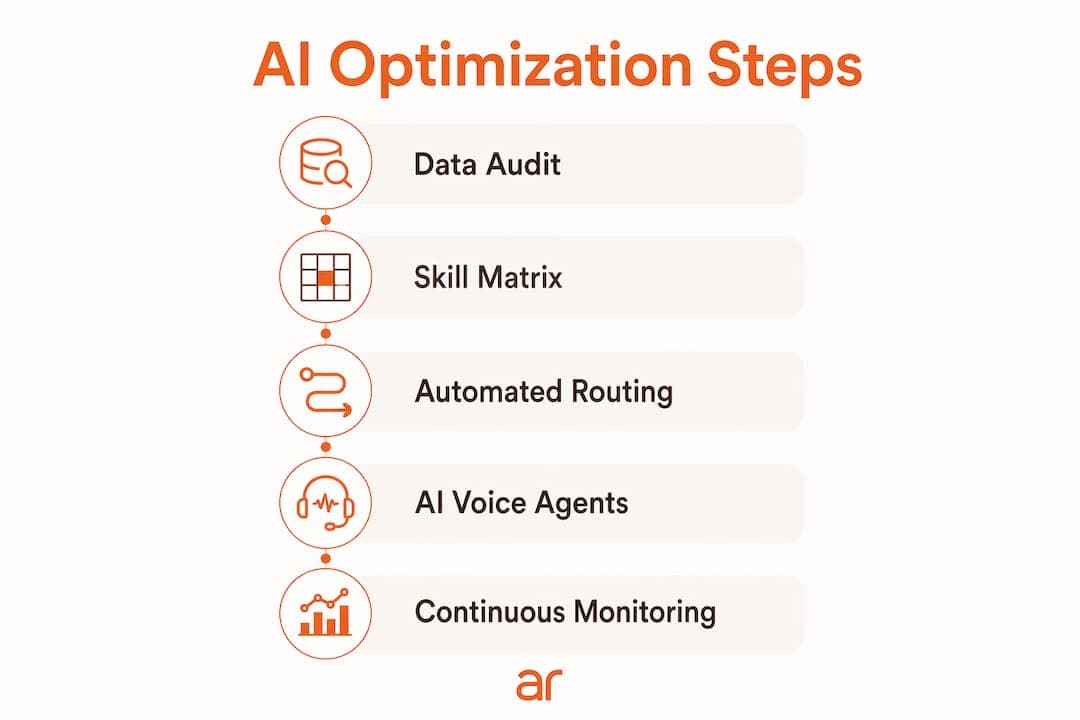
AI adoption in service operations dropped from 95% to 54% year over year as organizations moved from pilot enthusiasm to production reality. That drop reflects a hard truth: the primary barriers are data quality, system integration, and governance, not the AI technology itself. Service managers who treat AI as a plug-and-play tool consistently underperform those who treat it as an infrastructure project.
The four most common implementation pitfalls follow a predictable pattern:
- Poor data quality. AI routing and prediction models are only as accurate as the data feeding them. Outdated technician records, incomplete CRM histories, and inconsistent call tagging all degrade model performance within weeks of deployment.
- Standalone chatbot traps. Customers increasingly prefer AI that completes tasks, such as booking appointments and updating accounts, over bots that only answer questions. Deploying a Q&A bot and calling it AI optimization misses the point entirely.
- Missing human fallback paths. Fully automated AI reduces costs but tends to lose conversion and loyalty compared to hybrid models. Every AI-powered service journey needs a clear, fast path to a human agent. Without it, frustrated customers leave.
- Undefined skill matrices. Routing AI cannot optimize what it cannot distinguish. Tagging all field technicians as “general service” forces the system to guess, which produces the same inefficient dispatch that existed before AI was introduced.
Pro Tip: Before deploying any AI routing tool, audit your technician records for completeness. If more than 15% of records lack certification or specialty tags, fix the data first. The AI will only amplify whatever is already in the system.
The governance challenge is structural. Service managers need clear ownership of AI model performance, defined retraining schedules, and a process for flagging when model outputs diverge from real-world outcomes. Without that structure, AI systems degrade silently.
Best practices for integrating AI into service call workflows
Effective integration starts with the technician skill matrix, not the AI platform. Build a complete record of each technician’s certifications, specialties, geographic range, and scheduling constraints before connecting any routing engine. Routing that respects these constraints produces the dispatch efficiency gains described earlier. Routing without them produces expensive reassignments and customer callbacks.
AI also performs better when it operates across the full customer journey rather than in a single channel. A customer who books via voice, receives a confirmation text, and gets a follow-up survey after service completion has interacted with three AI touchpoints. Each one generates data that improves the next interaction. Siloed AI, applied only to inbound calls, captures a fraction of that value.
The table below compares two integration approaches service managers commonly choose:
| Integration approach | Scope | Outcome |
|---|---|---|
| Single-channel AI (voice only) | Inbound call handling | Reduces call volume burden; misses cross-channel data |
| Full-journey AI integration | Voice, text, CRM, dispatch, follow-up | Compounds efficiency gains; builds richer customer profiles |
Balancing automation with human judgment is the most important ongoing decision in any AI deployment. Companies implementing AI in service operations see a 19% average boost in customer satisfaction and response time efficiency. That number holds where human agents remain available for complex and emotional interactions. Where full automation replaces human contact, satisfaction gains erode.
Continuous monitoring closes the loop. Set weekly reviews of first-visit fix rate, missed appointment rate, and call abandonment rate. When any metric moves in the wrong direction, trace it back to the model input, not the output. The AI customer support agent model that Arosplatforms builds into client operations includes this monitoring layer as a standard component, not an add-on.
Pro Tip: Run a 30-day parallel test before full cutover. Keep your existing dispatch process running alongside the AI system and compare outcomes directly. The data from that test will tell you exactly where to tune the model before it handles your full call volume.
Key Takeaways
AI in service call optimization delivers measurable gains only when data quality, skill matrix accuracy, and human-AI collaboration are treated as foundational requirements, not afterthoughts.
| Point | Details |
|---|---|
| AI voice agents cut missed calls | AI handles 30%–50% of calls, reducing missed appointments by 22%–31%. |
| Skill matrix accuracy drives dispatch | Tagging technicians by specialty cuts drive time and raises first-visit fix rates to 88%–95%. |
| Data quality is the real barrier | AI adoption stalls at 54% because of data and integration gaps, not technology limits. |
| Hybrid models outperform full automation | Keeping humans on complex calls preserves conversion rates and customer loyalty. |
| Full-journey integration compounds gains | AI applied across voice, CRM, and follow-up builds richer data and larger efficiency returns. |
The shift from cost-cutting to revenue-building AI
The Arosplatforms team has worked across service operations in healthcare, logistics, and field services long enough to see a clear pattern. Most service managers adopt AI to cut costs. That is a reasonable starting point, but it is also where most programs stall.
The organizations that extract the most value from AI-driven service improvements are the ones that reframe the question. They stop asking “How do we reduce headcount?” and start asking “How do we handle more revenue-generating calls without adding headcount?” That reframe changes everything. It shifts the success metric from cost per call to revenue per technician per day, and it changes which AI capabilities get prioritized.
The chatbot vs. AI agent distinction matters enormously here. A chatbot answers questions. An AI agent completes tasks, books appointments, updates records, and triggers follow-ups. Service managers who deploy agents instead of bots see compounding returns because the system generates data and closes loops that a Q&A bot never touches.
The next wave of AI in this space will be context-aware systems that recognize a returning customer, recall their service history, and proactively offer the right appointment before the customer even states their problem. That capability exists in early form today. Service managers who build clean data foundations now will be positioned to use it when it matures. Those who wait will spend the next two years catching up on data hygiene instead of capturing revenue.
Human-AI collaboration is not a compromise. It is the architecture that produces the best outcomes. The emotional side of a service call, where a customer is frustrated, anxious, or confused, is where human agents build loyalty that no automation can replicate. AI handles the commodity work. Humans handle the relationship. That division of labor is not a temporary workaround. It is the right design.
— Arosplatforms team
How Arosplatforms supports service call optimization
Arosplatforms builds customized AI operating systems for service-intensive industries, including logistics, healthcare, and field services. The approach goes beyond software deployment. The Arosplatforms team embeds within client operations to map existing workflows, identify where automation creates the most value, and build AI systems that teams can manage without vendor dependency.
Clients working with Arosplatforms on AI agents and automation typically see key task turnaround improve by 82% within the first year. For service managers ready to move from pilot to production, Arosplatforms offers AI consulting for US enterprises with a clear focus on operational efficiency and measurable ROI. The starting point is always a workflow audit, not a software pitch.
FAQ
What is the role of AI in service call optimization?
AI in service call optimization automates routine call handling, routes calls to the right technician by skill, and logs interactions into CRM systems in real time. The result is fewer missed calls, faster response times, and more jobs completed per technician each day.
How many service calls can AI handle without a human agent?
AI voice agents handle 30%–50% of incoming service calls autonomously. The remaining calls, particularly those involving complex or emotional interactions, are routed to human agents for resolution.
Why do so many AI service implementations fail?
AI adoption in service operations dropped to 54% year over year because most failures trace back to poor data quality, weak system integration, and missing governance structures, not the AI technology itself.
What is a technician skill matrix and why does it matter?
A technician skill matrix tags each technician by certifications, specialties, and geographic constraints. Without it, AI routing engines cannot distinguish between technicians and produce the same inefficient dispatch that existed before AI was introduced.
Should service operations use full AI automation or a hybrid model?
Hybrid models that keep human agents on complex and emotional calls consistently outperform fully automated systems on conversion rates and customer loyalty. Full automation reduces costs but tends to erode the trust that drives repeat business.