AI in Service Lane Management: 2026 Executive Guide
AI in Service Lane Management: 2026 Executive Guide

The role of AI in service lane management is to automate appointment scheduling, vehicle diagnostics, technician allocation, and customer communication so service operations run faster and with fewer errors. Agentic AI now handles tasks that once required a full advisor’s attention, from booking confirmations to generating inspection reports. Service managers who treat AI as a productivity tool rather than a replacement for staff see the strongest results. This guide covers the specific applications, integration requirements, and human-AI boundaries that matter most for automotive and logistics executives deploying these systems in 2026.
How AI improves scheduling and appointment management in service lanes
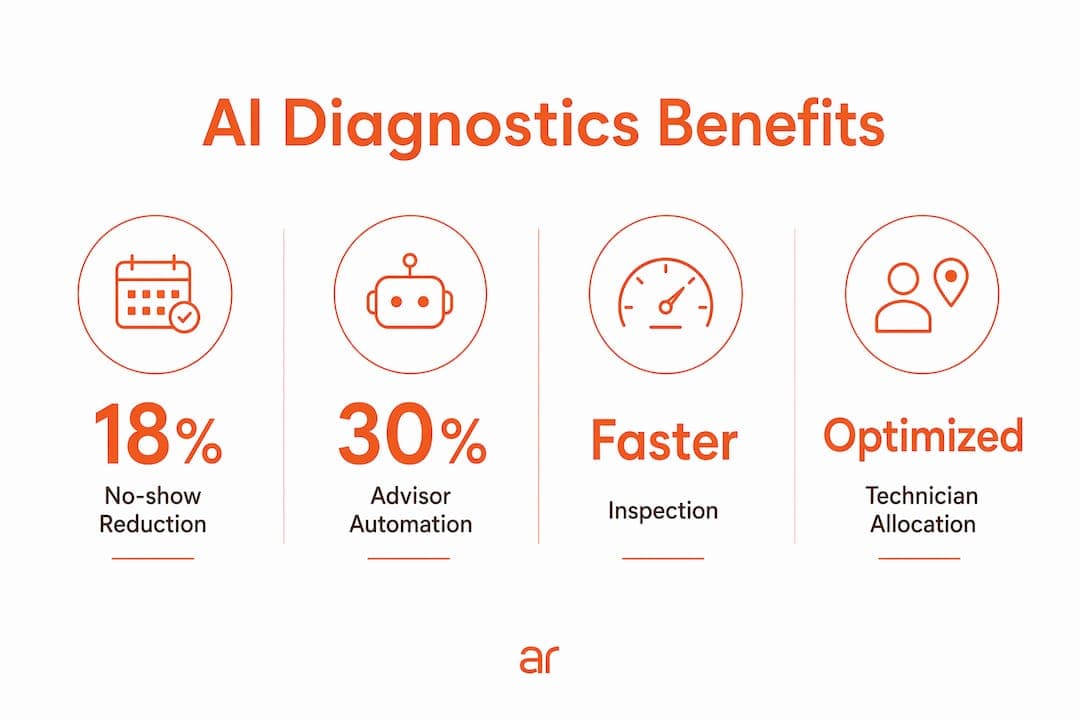
AI scheduling agents reduce appointment no-shows by 18% through automated confirmations, reminders, and real-time rescheduling. That single metric translates directly to higher bay utilization and more predictable daily revenue. The system works by monitoring booking patterns, flagging high-risk appointments, and sending personalized follow-ups without advisor involvement.
Customer expectations have already shifted. 61% of car buyers expect to use AI chatbots for service scheduling, which means dealerships without a digital booking option are already behind the curve. Agentic AI booking systems handle the full cycle: intake, confirmation, parts pre-ordering, and advisor notification before the vehicle arrives.
The practical gains go beyond convenience. When AI handles scheduling intake, advisors spend their first minutes with a customer on relationship-building rather than data entry. That shift in how time is spent compounds across hundreds of appointments per month.
Key capabilities AI scheduling agents deliver in service lanes:
- Autonomous appointment booking across web, SMS, and voice channels
- Real-time calendar syncing with technician availability and bay capacity
- Automated pre-arrival communication including service reminders and cost estimates
- Integration with CRM records to personalize each customer interaction
- Escalation triggers that route complex requests to a live advisor
Pro Tip: Integrate your AI scheduling agent directly with your CRM so every customer touchpoint, from first booking to post-service follow-up, feeds the same record. Disconnected scheduling tools create data gaps that undermine personalization and reporting.
What does AI-powered diagnostics do for technician efficiency?
AI vision systems inspect vehicles automatically during write-up, generating customer-facing reports from photos or video captured at the drive-in lane. The quality of AI-generated inspection write-ups has improved significantly, though accuracy still varies by vehicle type and lighting conditions in 2026. The practical value is speed: a visual inspection that took an advisor five minutes now takes under sixty seconds.

Predictive maintenance AI goes further by analyzing historical repair data, mileage patterns, and sensor readings to flag likely failures before they occur. This approach reduces vehicle downtime by up to 40% when applied consistently across a fleet or high-volume service department. For logistics operators managing large vehicle fleets, that reduction in unplanned downtime is a direct cost saving.
Technician efficiency improves when AI handles bay and task allocation. Rather than a service manager manually assigning jobs based on gut feel, AI matches each repair order to the technician with the right certification, current workload, and nearest available bay. Technician efficiency gains of around 20% are documented when AI optimizes this allocation in real time.
| AI Application | Primary Benefit | Efficiency Gain |
|---|---|---|
| Vision-based inspection | Automated defect detection at write-up | Faster customer approval |
| Predictive maintenance analytics | Early failure identification | Up to 40% less downtime |
| AI bay and task allocation | Optimized technician assignment | ~20% efficiency improvement |
| Repair order integration | Parts pre-ordered before arrival | Reduced wait time |
Pro Tip: Link your AI diagnostics output directly to your Repair Order system and parts inventory. An inspection report that doesn’t trigger automatic parts availability checks still requires manual follow-up, which defeats the purpose of automation.
Human-AI collaboration: where does automation stop?
AI handles approximately 30% of the service advisor role effectively, specifically writing-heavy tasks like inspection summaries, service recommendations, and technical translation for customers. That frees advisor capacity for the work AI cannot do. The remaining 40% of the role, which involves emotional judgment, conflict resolution, and trust-building, remains firmly human.
This split is not a limitation to work around. It is the operating model. Service managers who deploy AI expecting it to replace advisors end up with frustrated customers and advisors who feel undermined. The better frame is that AI frees advisor capacity by 30%, which advisors should reinvest in higher-value interactions.
Common pitfalls in human-AI collaboration at the service lane:
- Deploying AI chatbots without a clear escalation path to a live advisor
- Allowing AI to send unapproved repair recommendations directly to customers
- Removing human review from AI-generated inspection reports before customer delivery
- Failing to train advisors on how to interpret and override AI suggestions
- Measuring AI success only on speed, ignoring customer satisfaction scores
AI will improve steadily at technical writing and diagnostic tasks through 2030. It will not close the gap on nuanced customer relationships in that same period. Service managers should hire and train specifically for emotional intelligence, knowing that the technical-writing burden will continue to shift toward AI.
How should executives integrate AI with existing dealership systems?
Deep integration with Dealer Management Systems and CRMs is the single most important factor in AI deployment success. Standalone AI tools without this integration create data silos and deliver limited operational value. An AI scheduling agent that cannot read technician availability from the DMS will double-book bays. An inspection tool that cannot write to the Repair Order requires manual transcription, which eliminates the time savings.
A structured integration approach for service lane executives:
- Audit your current DMS and CRM data quality before deploying any AI layer. AI amplifies whatever data it receives, including errors.
- Map every service lane workflow from customer arrival to vehicle delivery, and identify which steps are high-volume and rule-based. Those are the best candidates for AI automation.
- Set explicit guardrails for each AI agent, including what decisions require human approval and what triggers an automatic escalation.
- Define human override paths at every AI touchpoint so advisors and managers can intervene without disrupting the workflow.
- Establish performance metrics before go-live: no-show rate, bay utilization, average repair order cycle time, and customer satisfaction score. Measure weekly for the first 90 days.
- Monitor continuously and adjust AI parameters as vehicle mix, staffing, and customer patterns change.
Service Lane Operating Systems that unify voice AI, video inspections, digital payments, and loaner management under a single workflow tied to Repair Orders outperform isolated AI tools in operational value. Voice AI alone lacks the workflow control to manage a full service lane. It becomes effective only when it is one component of a connected system.
AI without operational policy reform risks automating inefficient existing processes rather than improving them. Before deploying, audit your current workflows for bottlenecks that exist because of policy or staffing decisions, not just technology gaps.
Pro Tip: Choose a service lane operating system that connects voice AI, inspections, payments, and loaner management in one platform tied to your Repair Orders. Piecemeal tools require custom integrations that break under software updates and create support gaps.
Key Takeaways
AI in service lane management delivers measurable results only when it is tightly integrated with existing DMS and CRM systems, paired with clear human override controls, and deployed across unified workflows rather than as isolated tools.
| Point | Details |
|---|---|
| Scheduling automation | AI reduces no-shows by 18% and meets the 61% of buyers who expect digital booking. |
| Diagnostics and maintenance | Predictive AI cuts vehicle downtime by up to 40% and improves technician efficiency by ~20%. |
| Human-AI split | AI handles ~30% of advisor tasks; emotional and relational work stays with people. |
| Integration is non-negotiable | Standalone AI tools create silos; DMS and CRM integration determines deployment success. |
| Unified operating systems win | Platforms combining voice AI, inspections, payments, and loaner management outperform point solutions. |
The Arosplatforms view on AI adoption in service lanes
The conversation about AI in service lanes gets stuck on the wrong question. Most executives ask “how much can AI replace?” when the productive question is “what does AI make possible that wasn’t possible before?” Those are very different starting points, and they lead to very different deployments.
At Arosplatforms, we have seen the pattern repeat across automotive and logistics clients. The teams that get the fastest ROI are not the ones who deploy the most AI tools. They are the ones who pick two or three high-volume, rule-based workflows, integrate AI deeply into those specific processes, and measure results weekly. The teams that struggle deploy broadly, integrate shallowly, and measure nothing for the first six months.
The harder truth is that policy and process reform matter as much as the technology itself. An AI scheduling agent deployed on top of a broken appointment workflow will book appointments faster into the same chaos. The technology does not fix the underlying process. It amplifies whatever is already there.
Hiring for emotional intelligence is the strategic move most service managers overlook. As AI absorbs more of the writing and technical translation work, the advisors who thrive will be the ones who are genuinely good with people under pressure. That skill does not come from software. It comes from deliberate hiring and ongoing coaching.
The ROI case for AI in service lanes is real and well-documented. The execution case is more nuanced. Executives who treat AI as a system to be managed, with guardrails, monitoring, and human judgment at the edges, will outperform those who treat it as a plug-and-play solution.
— Arosplatforms team
How Arosplatforms supports AI deployment in service operations
Arosplatforms builds customized AI operating systems for automotive, logistics, and manufacturing clients who need more than off-the-shelf software.

The approach starts with embedding directly in client workflows to identify which processes are ready for AI and which need process reform first. For service lane applications, that means connecting AI scheduling, diagnostics, and technician allocation to existing DMS and CRM infrastructure without vendor lock-in. Clients working with Arosplatforms on AI for US enterprises typically see returns within twelve months, with an average of 82% faster turnaround on key operational tasks. For logistics operators, the AI OS for logistics covers load planning, dispatch, and real-time tracking within a single connected system. Contact Arosplatforms to discuss a deployment scoped to your service lane environment.
FAQ
What is the role of AI in service lane management?
AI in service lane management automates scheduling, vehicle diagnostics, technician assignment, and customer communication to reduce wait times and improve bay utilization. The strongest results come from integrating AI with Dealer Management Systems and CRM platforms rather than deploying standalone tools.
How much of a service advisor’s job can AI handle?
AI effectively handles approximately 30% of the service advisor role, primarily writing-heavy and technical translation tasks. Emotional and relational work, which accounts for roughly 40% of the role, requires human judgment and cannot be reliably automated.
What is agentic AI and how does it apply to service lanes?
Agentic AI refers to systems that take autonomous actions, such as booking appointments, sending confirmations, and routing repair orders, without requiring human input at each step. In service lanes, agentic AI manages the full appointment cycle and can trigger parts orders before a vehicle arrives.
How does AI reduce vehicle downtime in service operations?
Predictive maintenance AI analyzes repair history, sensor data, and mileage patterns to identify likely failures before they occur, reducing unplanned vehicle downtime by up to 40%. This is particularly valuable for logistics fleets where unplanned breakdowns carry direct revenue costs.
What is the biggest mistake executives make when deploying AI in service lanes?
The most common mistake is deploying AI tools without deep integration into existing DMS and CRM systems. Standalone AI creates data silos, requires manual workarounds, and delivers a fraction of the operational value that a fully integrated system provides.