US Finance: Context Layer First in Regulatory Reporting Automation
US Finance: Context Layer First in Regulatory Reporting Automation
Regulatory reporting automation turns manual, periodic filings into timely, auditable submissions by automating data collection, validation, transformation, and submission. It replaces spreadsheet chains and quarter-end scrambles with continuous, traceable pipelines. This guide covers the core components, the data prerequisites that determine success, and a phased path, from pilot to production.
TL;DR:
- Automation requires a strong data foundation with a normalized context layer to ensure accurate and defensible reporting.
- Progressing gradually through assessment, pilot, extension, and operation phases helps manage risks and builds stakeholder confidence.
- Initial automation efforts should focus on high-volume, structured reports like SEC filings to maximize early returns.
- Ensuring traceable lineage, validation, and security controls in the data pipeline is crucial for audit readiness and regulatory confidence.
- Building custom AI-based data layers owned by the institution delivers more reliable risk reduction than off-the-shelf solutions that lack institution-specific context.
Table of Contents
- What Compliance Officers Need To Know About Regulatory Reporting Automation
- What Is Regulatory Reporting Automation and What Are Its Core Components?
- How Does Automating Regulatory Reporting Cut Costs and Risk?
- Why Does a Data Context Layer Matter for Compliance?
- How Do You Roll Out Regulatory Reporting Automation?
- What Regulatory Reports Can Financial Institutions Automate First?
- What Are the Biggest Risks in Automating Compliance Reporting?
- How Does Continuous Compliance Change Audit Readiness?
- Should Your Institution Automate Regulatory Reporting Now?
- What We’ve Learned Building These Systems With Clients
- A Different Way To Build Regulatory Reporting Automation
- Primary Sources and Useful Links
- Sources
- FAQ
What Compliance Officers Need To Know About Regulatory Reporting Automation
Here’s what matters before you build a business case.
- It’s a pipeline, not a single tool. Automation covers ingestion, validation, mapping, and submission, all stitched together, not one piece of software that does everything.
- ROI arrives faster than most finance teams expect. Institutions that get data foundations right often see measurable time savings within a year of a well-scoped rollout.
- Continuous compliance beats point-in-time audits. Modern platforms maintain searchable, verifiable evidence stores so regulators can query records on demand instead of waiting for an annual package.
- Data quality determines success or failure. Automating on top of bad mappings just moves errors faster.
- The first move is an honest data readiness assessment, not a vendor demo.
Start by mapping which reports consume the most manual hours today. That list becomes your automation roadmap.
What Is Regulatory Reporting Automation and What Are Its Core Components?
Regulatory reporting automation is the use of software to move data through four stages: collection, validation, transformation, and submission, with minimal manual intervention at each handoff. A compliance analyst used to pull numbers from five systems, reconcile them by hand, and format a filing overnight. Automation compresses that into a monitored pipeline that runs on a schedule and flags exceptions instead of hiding them in a spreadsheet.
Six components typically make up a working system.
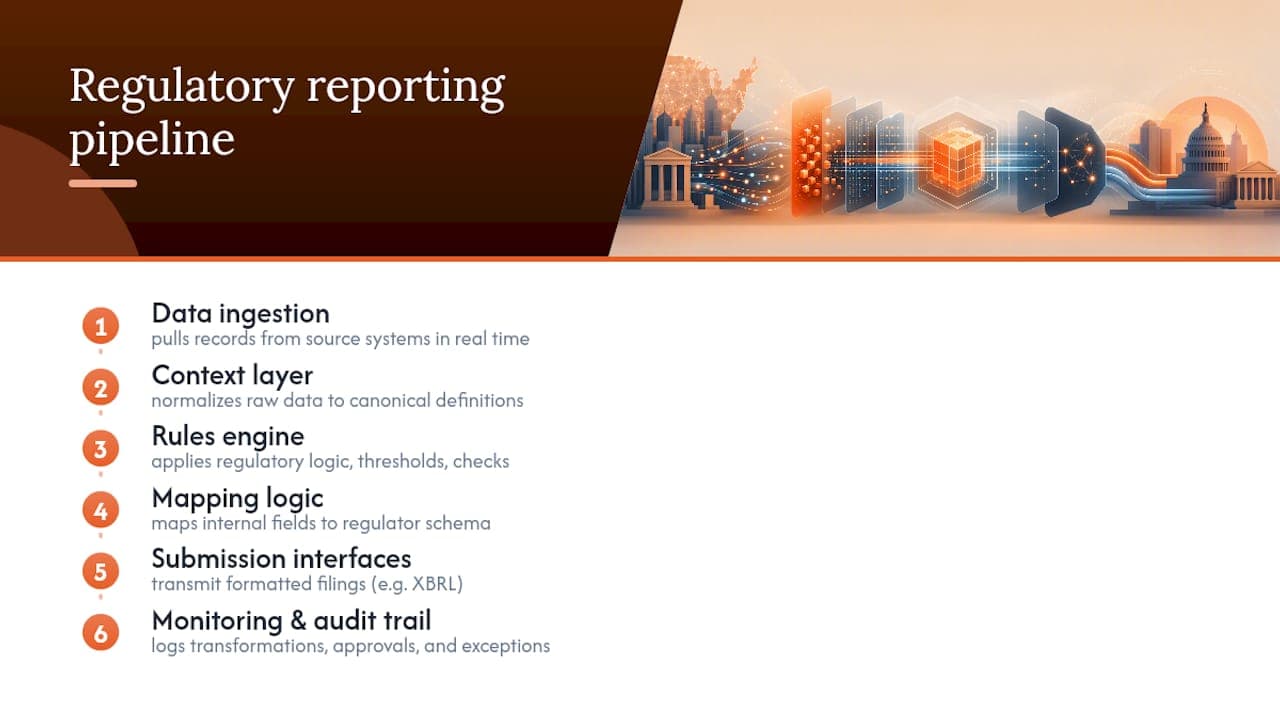
Data ingestion pulls records from source systems, ledgers, trading platforms, loan origination tools, and data warehouses, often in real time rather than batch.
A context layer or normalization step translates raw source data into consistent, canonical definitions before anything downstream touches it. This is the piece most vendors gloss over and most failed projects skip.

A rules engine applies the regulatory logic, thresholds, calculations, and format checks specific to each report type, whether that’s a call report, a trade blotter, or a fund disclosure.
Mapping logic connects internal data fields to the exact schema a regulator expects, which changes report by report and sometimes version by version.
Submission interfaces handle the actual transmission, formatted correctly for the receiving system, whether that’s XBRL tagging for SEC filings or a proprietary portal for a prudential regulator.
Monitoring and audit trail capture log every transformation, approval, and exception so the process can be reconstructed later.
Most implementations connect to general ledgers, trading and position systems, and enterprise data warehouses as primary sources. The quality of those connections, not the sophistication of the rules engine, tends to decide whether a project ships on time.
How Does Automating Regulatory Reporting Cut Costs and Risk?
Speed is the most visible benefit, but it’s not the only one that matters to a CFO.
Filing cycles that took days of manual reconciliation compress to hours once validation runs automatically against source data instead of a static export. That frees compliance staff from data wrangling and puts them back on the work that actually needs judgment: interpreting exceptions, reviewing edge cases, and managing regulator relationships.
Fewer submission errors follow naturally. Manual re-keying is where most reporting mistakes originate, and every mistake caught after submission means an amended filing, a call with the regulator, or both. Automated validation catches formatting and threshold errors before they leave the building, and intelligent automation shifts that validation earlier in the pipeline, which is a meaningfully different posture than catching errors after the fact.
Audit readiness improves in a way that’s easy to underestimate until you need it. Every transformation gets versioned and timestamped, which means a regulator inquiry six months after a filing doesn’t require reconstructing what happened from memory or scattered emails. You pull the record.

Scalability is the quiet benefit. Adding a new report type or a new jurisdiction’s requirements to a hand-built spreadsheet process usually means starting over. Adding it to an automated pipeline with a solid context layer means extending existing mappings, which is a fraction of the effort. Institutions that build this way once tend to absorb new regulatory regimes far faster than those still working manually. That compounding advantage, more than any single filing cycle, is where the real cost savings show up over a two or three year horizon.
Why Does a Data Context Layer Matter for Compliance?
Automation without a data foundation doesn’t reduce risk. It accelerates the delivery of wrong numbers, and a fast wrong filing is worse than a slow accurate one because it reaches the regulator before anyone catches the error.
A unified context layer or normalized data model is the prerequisite most projects underestimate. Without one, every report ends up with its own ad hoc translation logic, and small definitional drift between reports (what counts as a “position,” what counts as a “customer”) becomes a reconciliation nightmare that automation just executes faster.
Metadata and authoritative source mapping need to exist before rules get built. Every reportable data element should trace back to one system of record, with a documented owner, so nobody debates which number is correct at 11 p.m. before a filing deadline.
Data quality and reconciliation processes have to run continuously, not just at quarter-end. Lineage tracking, showing exactly where a number came from and every transformation it passed through, is what turns a “trust me” filing into a defensible one.
Security and access controls round out the list. Regulatory data is sensitive by definition, and role-based access with logged changes protects both the data and the institution’s ability to prove who touched what.
Treat the context layer as an engineering deliverable with its own timeline, not a side effect of buying reporting software. Start with canonical definitions for a narrow set of reportable concepts, map their authoritative sources, and instrument lineage capture before writing a single transformation rule. Institutions considering broader AI governance and compliance frameworks for financial services usually find this groundwork pays off well beyond reporting alone.
How Do You Roll Out Regulatory Reporting Automation?
A phased rollout beats a big-bang deployment for one simple reason: regulatory reporting has zero tolerance for a botched go-live. Four phases, each with a clear exit criterion, keep the project honest.
- Assess. Inventory every report your institution files, how many hours each consumes, and where errors happen most often. Score each report by manual effort and error frequency, then rank them. This phase also includes data discovery: which systems hold the source data, and how clean is it really.
- Pilot. Pick one or two high-volume, high-error reports and build the full pipeline for them, ingestion through submission, including a shadow run against the existing manual process. Mapping and rule translation happen here, along with validation testing against historical filings to confirm the automated output matches what was actually submitted.
- Extend. Once the pilot clears a sign-off gate (typically a compliance officer and a technical lead both approving that outputs reconcile against manual results for two consecutive cycles), extend the same context layer and rules engine to additional report types. This is where the upfront investment in the data model starts paying for itself.
- Operate. Move to steady-state monitoring: exception dashboards, automated reconciliation, and scheduled reviews of rule changes as regulations update. Early regulator engagement or sandbox testing during the pilot phase tends to reduce friction once you reach production submissions.
Track three KPIs across every phase: timeliness (are filings submitted before the deadline with margin to spare), error rate (how many submissions require amendment), and evidence completeness (can every reported figure be traced to its source without manual reconstruction).
Governance can’t be an afterthought bolted on at the end. Every phase needs a sign-off gate, a reconciliation check against the old process, and, where the regulator allows it, some form of test submission before the pipeline goes live for real filings.
Pro Tip: Run your pilot report through both the old manual process and the new automated pipeline in parallel for at least two full filing cycles before retiring the manual version. Discrepancies during that overlap window are far cheaper to fix than discrepancies discovered by a regulator.
What Regulatory Reports Can Financial Institutions Automate First?
Some report types are better automation candidates than others, mostly based on volume and how mechanical the underlying logic is.
SEC filings that rely on structured formats like XBRL tagging are strong early candidates because the schema is well documented and the validation rules are explicit rather than judgment-based. Fund-related disclosures, the kind of periodic portfolio holdings reports asset managers file regularly, follow a similar pattern: high volume, standardized structure, and a validation process that’s mostly rule-based rather than interpretive.
Prudential returns filed with banking regulators tend to involve more cross-referencing between internal ledgers and regulatory categories, which makes the context layer’s mapping work more valuable relative to the rules engine itself. Transaction-level exception reporting, the kind broker-dealers handle for suspicious activity or threshold breaches, benefits from automation differently: it’s less about periodic batch submission and more about continuous monitoring that flags exceptions as they occur rather than at month-end.
A typical pilot outcome looks like this: an institution automating one high-volume, structured report often sees manual reconciliation hours drop sharply and time-to-file compress from days to hours. The bigger win shows up on the second and third reports, once the context layer already exists and extension work replaces from-scratch build work. If you’re mapping your own reporting set against this pattern, start with whichever report combines the highest filing frequency with the most standardized format. That’s almost always the best return on a first automation investment. Arosplatforms’ regulatory filing use case walks through how that data-to-format mapping typically works in practice.
What Are the Biggest Risks in Automating Compliance Reporting?
Bad data mapping is the risk that sinks the most projects. If the context layer conflates two similar but distinct data fields, the rules engine will faithfully apply the wrong number every single cycle until someone notices, usually a regulator.
Gaps in validation and lineage compound quietly. A pipeline that passes formatting checks but can’t show where a figure originated will fail an audit even if the number happens to be correct, because “happens to be correct” isn’t a defensible compliance posture.
Human-in-the-loop controls remain necessary even in mature systems. Academic research on intelligent automation in regulatory reporting points to real limits: edge cases, novel transaction types, and ambiguous regulatory language still need a person to make the call, and systems that route those cases to a reviewer outperform systems that force everything through the same automated path.
Vendor risk deserves more attention than it usually gets. A platform that owns your mappings, your rules logic, and your submission formatting in a proprietary format creates a dependency that’s expensive to unwind. Before signing, ask how data and configurations export if you switch providers, and treat a vague answer as a red flag.
How Does Continuous Compliance Change Audit Readiness?
The old model of regulatory evidence was a binder assembled once a year for an exam. The shift toward continuous compliance replaces that binder with a living, searchable evidence store that answers a regulator’s question the moment it’s asked, not three weeks later.
That shift depends on a few specific controls working together, not just good intentions:
- Cryptographic signing and version history on submitted data, so any record can be proven unaltered since the moment it was filed.
- Traceable lineage connecting every reported number back through its transformations to the original source system.
- Explainable validation logs that show exactly which rule fired, when, and why a given record passed or failed.
Deployments Arosplatforms has built for regulated clients consistently confirm the same pattern: institutions with this evidence infrastructure in place respond to regulator inquiries in hours rather than days, and the rapid ROI shows up specifically in reduced audit-prep labor, not just filing speed.
The ownership question matters as much as the technology. Systems built so the compliance team can maintain rules and mappings directly, without waiting on a vendor’s change request queue, avoid the lock-in that turns a compliance tool into a compliance bottleneck.
Should Your Institution Automate Regulatory Reporting Now?
If your compliance team spends more hours reconciling data than analyzing it, the answer is yes. Start with your highest-volume, highest-error report, not the most complex one. Confirm your data lineage before you automate a single rule; automation on a shaky foundation just moves risk faster. Pair every rollout with continuous monitoring and a governance sign-off process, because the technology only reduces risk if someone is accountable for watching it work.
What We’ve Learned Building These Systems With Clients
Every deployment Arosplatforms has run in financial services confirms the same lesson: the context layer decides the outcome, not the rules engine. Teams that rush to automate rules before nailing down canonical data definitions end up rebuilding twice. The teams that invest in the data foundation first hit their ROI targets faster and extend to new reports with a fraction of the original effort. If you want a candid assessment of where your data readiness actually stands, talk to our team before you talk to a vendor.
— arosplatforms team
A Different Way To Build Regulatory Reporting Automation
Off-the-shelf reporting platforms solve the submission-format problem well. What they don’t solve is the context layer specific to your institution’s ledgers, legacy systems, and reporting history, the part that determines whether automation actually reduces risk or just moves it faster. Arosplatforms builds that layer as a custom AI operating system embedded directly in your operations, so your compliance team owns the rules, the mappings, and the evidence trail rather than renting access to someone else’s black box.
That ownership model matters most for institutions with complex, multi-regime reporting obligations where a generic template doesn’t map cleanly to how your data actually lives. If your reporting stack has outgrown spreadsheets but a rigid platform feels like the wrong fit, talk to the Arosplatforms team about US enterprise engagements and get a straight assessment of what a custom build would take.
Primary Sources and Useful Links
- U.S. Securities and Exchange Commission
- FINRA
- BIS / Basel Committee
- FSB regulatory technology report
Sources
FAQ
What Is Regulatory Reporting Automation?
It’s the use of software to handle data collection, validation, transformation, and submission for compliance filings with minimal manual intervention, replacing spreadsheet-based processes with monitored, auditable pipelines.
How Long Does It Take To See ROI From Automation?
Institutions that establish solid data foundations before automating typically see measurable returns within twelve months, with the biggest gains showing up once a second or third report reuses the same context layer.
What Is a Context Layer in Regulatory Reporting?
It’s a normalized data model that gives every reportable figure a single canonical definition and traceable source, and it’s the piece most failed automation projects skipped before building their rules engine.
Can Small or Mid-Sized Institutions Automate Regulatory Reporting?
Yes. Starting with the single highest-volume, most standardized report, rather than attempting a full-scope rollout, gives smaller teams a manageable pilot and a faster path to measurable results.
Does Automation Eliminate the Need for Compliance Staff Review?
No. Human-in-the-loop review remains necessary for edge cases and novel transactions; automation shifts staff time toward judgment calls and away from manual data reconciliation.