AI Document Processing in Finance: What It Really Does
AI Document Processing in Finance: What It Really Does

AI document processing for finance, formally called Intelligent Document Processing (IDP), converts raw financial documents into validated, system-ready structured data, and Arosplatforms builds these systems as part of a broader AI operating system tailored to each client’s workflows. Domain-trained IDP systems can achieve accuracy rates of 95%+ on financial document extraction. That threshold matters because it is the point where straight-through processing becomes operationally viable without a human reviewing every record.
Finance teams adopting IDP can expect:
- Faster throughput on invoices, bank statements, loan documents, and KYC packets
- Fewer manual exceptions as validation rules catch mismatches before they reach a reviewer
- A permanent audit trail linking every extracted field back to its source page
Table of Contents
- How does AI document processing work in finance?
- Where does IDP deliver the most value for finance teams?
- What accuracy benchmarks should you expect from finance IDP?
- How does processed data reach your ERP and accounting systems?
- How do you run a finance IDP pilot and scale it?
- What should you look for when choosing a finance IDP vendor?
- What compliance and governance requirements apply to US finance teams?
- How Arosplatforms approaches finance document processing
- Key Takeaways
- The mistake most finance teams make with IDP
- Arosplatforms builds finance IDP as part of a full AI operating system
- Useful sources
- FAQ
How does AI document processing work in finance?
Multistage pipelines consistently outperform single-stage, end-to-end models for financial documents. Research published in ACL’s industry track shows that decoupling page-level retrieval from extraction improves field-level accuracy by up to 31.9 percentage points on long, scanned financial documents in KYC workflows. That gap is too large to ignore when you are processing thousands of pages daily.
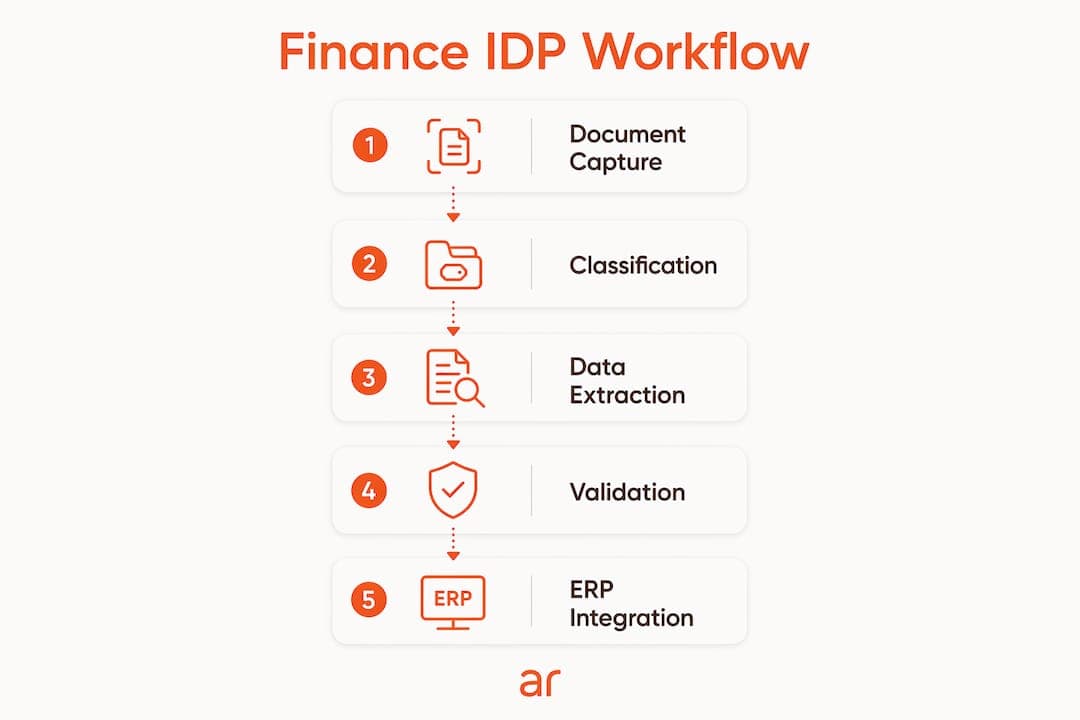
The pipeline moves through five stages:
- Ingest: Accept PDFs, scanned images, faxes, and photographs in any format
- Classify: Identify document type (invoice, bank statement, tax return, loan agreement)
- OCR + computer vision: Convert image content to machine-readable text; correct skew, noise, and low resolution
- Extract: Vision-language models (VLMs) or domain-trained ML models pull field values using structured prompts and schema-first instructions
- Validate and route: Business rules check internal consistency (do line items sum to the invoice total?), then output clean JSON to the target system
The enabling technologies are OCR, VLMs, NLP, and schema-first extraction with API/JSON outputs. Each stage is modular, which is the point.
Pro Tip: Feed whole multi-page financial reports into a single LLM and hallucination rates climb fast. Separate page localization from multimodal extraction: the retrieval stage filters irrelevant pages first, so the VLM only sees the handful of pages that actually contain the target fields. Computational cost drops, and accuracy improves.
| Approach | Accuracy on long financial docs | Cost per page | Hallucination risk |
|---|---|---|---|
| End-to-end single-stage VLM | Lower baseline | Higher | Higher |
| Multistage pipeline (OCR + retrieval + VLM) | Up to 31.9 pp higher | Lower | Lower |
Where does IDP deliver the most value for finance teams?
High-volume document types see the biggest throughput gains and exception reductions when AI handles initial extraction. Institutions using domain-trained AI for financial spreading have reported a 36% reduction in spreading and extraction time in production lending deployments.
Core use cases and how their outputs are consumed:
- Invoice ingestion and 3-way matching: Extracted header and line-item data posts directly to the AP module in SAP or Oracle; variances flag before approval
- Bank statement reconciliation: Transaction rows map to the general ledger; unmatched items surface with context for the reconciliation engine
- Tax return spreading: Structured fields populate a spreading template in the loan origination system (LOS), cutting analyst time per file
- Loan origination document intake: Income verification, property appraisals, and title documents route to the LOS with confidence scores attached
- KYC document extraction: Identity documents and financial statements feed AML screening queues with field-level provenance
- Covenant monitoring: Periodic financial statements are extracted and compared against covenant thresholds automatically
The validation layer deserves special attention. Verifying that an invoice’s line items sum to the stated total, or that a bank statement’s running balance is internally consistent, provides the largest operational uplift and should be embedded in the pipeline, not bolted on afterward.
What accuracy benchmarks should you expect from finance IDP?
Domain-trained IDP should target 95%+ field-level accuracy for straight-through processing. Generic tools commonly plateau below that threshold because they lack the domain context to handle financial terminology, table structures, and multi-page layouts reliably.
Benchmark signal: Pay-as-you-go pricing for financial extraction APIs can be as low as $0.05 per page, which means accuracy, not cost, is the primary selection variable at scale.
Measure accuracy across these dimensions:
- Field-level accuracy: Percentage of individual fields extracted correctly
- Document-level straight-through rate: Share of documents processed without human intervention
- Exception rate: Volume of documents flagged for review per period
- Precision and recall: Especially for table extraction and multi-value fields
- Latency and cost per page: Operational efficiency metrics for high-volume workflows
Methodologically, multistage pipelines outperform end-to-end VLM-only approaches on long, scanned documents because page-level retrieval filters noise before extraction begins. For finance documents specifically, that design choice is the single biggest driver of accuracy improvement.
How does processed data reach your ERP and accounting systems?
IDP returns schema-validated JSON with field-level confidence scores and source citations, designed to map directly into ERPs, LOS platforms, and reconciliation engines. Pre-built connectors to SAP, Oracle, NetSuite, Microsoft Dynamics, and QuickBooks mean the agent posts clean data to the right account without stopping at extraction.
Common integration targets and mapping patterns:
- SAP / Oracle: Invoice header maps to AP; line items map to GL coding with cost center assignment
- NetSuite / QuickBooks: Bank transactions map to the reconciliation module; vendor records match against the master file
- Loan origination systems: Spreading fields from tax returns and financial statements populate underwriting templates
- Reconciliation engines: Bank statement rows map to open GL items; unmatched transactions route to exception queues
| Output field | Source document | Target system | Downstream use |
|---|---|---|---|
| Invoice total, vendor ID | Invoice | SAP AP module | 3-way match, payment run |
| Transaction rows | Bank statement | Reconciliation engine | Period-close matching |
| Net income, EBITDA | Tax return / P&L | LOS spreading template | Underwriting decision |
| Entity name, ID number | KYC document | AML screening queue | Onboarding approval |
Open, documented schemas and field-level source citations are non-negotiable for AI document extraction in regulated environments. Without them, downstream dispute resolution and audit responses become manual exercises.

How do you run a finance IDP pilot and scale it?
Start narrow: pick one high-volume document type, define the schema first, and measure exceptions before expanding. Blueprinting documents to map outputs to your organization’s internal schema reduces exceptions more than generic model tuning.
- Discovery and blueprinting: Map target document types, downstream system fields, and exception-handling rules
- Sample collection: Gather 200–500 representative documents, including edge cases and poor-quality scans
- Domain model configuration: Train or configure extraction models on your specific document layouts and field definitions
- Pilot with human-in-the-loop: Run extraction with analyst review; corrections feed prompt refinements and model improvements
- Validation metrics review: Measure field-level accuracy, straight-through rate, and exception backlog against targets
- Production rollout: Expand document types, connect ERP integrations, and implement change management for the review team
KPIs to track from day one:
- Field-level accuracy (target: 95%+)
- Straight-through rate per document type
- Exception backlog and mean time to resolution
- Cost per page processed
- Time-to-value (go-live milestone)
Pro Tip: Blueprinting your internal purchase order format and any non-standard invoice fields before the pilot starts cuts exception rates faster than any post-hoc model tuning. The downstream system’s schema should drive the extraction schema, not the other way around.
What should you look for when choosing a finance IDP vendor?
Prioritize domain-trained models, schema-first outputs, field-level source citations, explainability, ERP integrations, security controls, and SLA terms that support audit needs. Generic LLMs fail for finance because they hallucinate numeric values and lack the domain logic to validate financial relationships.
Selection checklist:
- Accuracy demonstrated on your document types, not benchmark datasets
- Validation rules embedded in the pipeline (not post-processing scripts)
- Human-in-the-loop tooling with exception queues and reviewer decision logging
- Pre-built connectors to your ERP and LOS
- Data retention, deletion, and access control policies documented
- SOC 2 Type II or ISO 27001 certification
- Pricing model that includes pay-as-you-go options alongside subscription tiers
Red flags to walk away from:
- Black-box outputs with no field-level source citations
- Monthly subscription lock-in with no PAYG alternative
- No ability to show which page and bounding box a value came from
- Missing ERP connectors requiring custom middleware for every integration
- No SOC or ISO controls documentation
What compliance and governance requirements apply to US finance teams?
Auditability and data lineage are non-negotiable for production finance workflows. Every extracted field must link back to its source page, bounding box, and verbatim text to satisfy examiners and support downstream dispute resolution. Field-level provenance is what separates audit-ready IDP from a black box.
Core compliance considerations for US finance operations:
- Field-level provenance: Each value traces to page number, bounding box, and source text
- Immutable audit trails: Every extraction, exception, and reviewer decision logged and tamper-evident
- Retention and deletion policies: Aligned with your data governance framework and applicable regulations
- Access controls: Role-based permissions on extracted data and reviewer queues
- Encryption: Data encrypted at rest and in transit
- SOX-ready logging: Financial reporting workflows require complete records of automated decisions for internal controls
Compliance signal: Human-in-the-loop records are not just an operational convenience. In high-stakes KYC and financial reporting workflows, manual review records are a regulatory requirement that supports examiner reviews and internal audit sign-off.
Involve your internal audit team and compliance officers before the pilot ends, not after go-live. AI governance frameworks for financial services address examiner expectations and help structure the documentation your reviewers will need.
How Arosplatforms approaches finance document processing
Arosplatforms builds blueprinted AI OS solutions that produce measurable throughput improvements and rapid ROI, with many clients seeing returns within twelve months.
The engagement follows a structured path: discovery and blueprinting identify the document types, downstream schemas, and exception rules that matter most. Domain model configuration and schema design follow, producing an extraction pipeline calibrated to the client’s actual documents rather than generic benchmarks. Pilot outcomes typically include significant exception reduction and accuracy improvement against the client’s baseline.
Brand signal: Arosplatforms clients report significantly faster turnaround for key document processing tasks after deployment.
What the build phase delivers:
- Custom document blueprints mapped to internal ERP and LOS schemas
- Domain-trained extraction models for the client’s specific document mix
- Human-in-the-loop review queues with decision logging for audit readiness
- Pre-built integrations to SAP, Oracle, NetSuite, or QuickBooks as applicable
Key Takeaways
Domain-trained IDP with multistage pipelines, schema-first blueprinting, and embedded validation is the architecture that makes finance document automation audit-ready and operationally viable at scale.
| Point | Details |
|---|---|
| Target 95%+ field accuracy | Domain-trained models hit this threshold; generic tools commonly plateau below it. |
| Multistage pipelines win | Separating page retrieval from extraction improves accuracy by up to 31.9 percentage points. |
| Blueprint before you build | Mapping your internal schemas first cuts exception rates faster than post-hoc model tuning. |
| Audit trail is mandatory | Every extracted field needs page, bounding box, and source-text provenance for US finance compliance. |
| Arosplatforms delivers significantly faster turnaround | Blueprinted AI OS builds produce rapid ROI, with returns typically within twelve months. |
The mistake most finance teams make with IDP
Finance teams consistently over-index on feature checkboxes and under-invest in blueprinting and workflow fit. The result is a technically capable system that generates exceptions nobody planned to handle.
The most common errors: treating IDP as a smarter OCR tool (it is not), expecting straight-through processing on day one without domain training, and trusting generic LLMs to extract numeric values reliably from multi-page financial statements. A general-purpose model that reads a balance sheet fluently can still hallucinate a subtotal or misattribute a line item to the wrong period.
The corrective approach is iterative and schema-first. Start with the downstream system’s data requirements, build the extraction schema around them, run a narrow pilot with human-in-the-loop review, and measure field-level accuracy before expanding. Involve your auditors in the pilot phase. Their questions about provenance and exception handling will surface gaps that no vendor demo will show you.
ROI measurement should start at the pilot, not after full deployment. Track cost per page, straight-through rate, and exception backlog from week one. Those three numbers tell you whether the system is ready to scale or needs another round of blueprinting.
Arosplatforms builds finance IDP as part of a full AI operating system
Most finance teams need more than an extraction tool. They need a system that blueprints their document types, integrates with their ERP, handles exceptions, and produces an audit trail their compliance team can actually use.
Arosplatforms engages through a structured process: assessment, pilot, build, and scale. Each engagement produces custom blueprints, domain-trained extraction models, and pre-built integrations to SAP, Oracle, NetSuite, or QuickBooks. Clients own the system at the end, with no ongoing vendor dependency. For US enterprises ready to move from manual document handling to production-grade automation, the starting point is an AI readiness assessment for financial services or a conversation with the Arosplatforms US consulting team.
Useful sources
These sources support the accuracy claims, methodology, and implementation patterns referenced throughout this article.
- A Multistage Extraction Pipeline for Long Scanned Financial Documents (ACL 2026) — Empirical study on KYC workflows; source for the 31.9 percentage point accuracy improvement figure
- Intelligent Document Processing for Financial Docs, Fintract — Domain-trained IDP accuracy benchmarks and PAYG pricing data
- AI for Financial Document Processing, Hebbia — Guidance on explainability, audit trails, and the limits of generic LLMs
- What Is AI Document Processing, Uptiq Glossary — Production lending data including the 36% reduction in spreading time
- Process Financial Documents Using Amazon Bedrock Data Automation, AWS — Blueprint-first implementation patterns and schema design guidance
- Scoutforge notes on financial validation — Validation layer design and embedded business rules
FAQ
What is AI document processing for finance?
AI document processing for finance (IDP) uses OCR, machine learning, and vision-language models to extract, validate, and route structured data from financial documents into ERPs and other systems, replacing manual data entry. Domain-trained systems target 95%+ field-level accuracy for straight-through processing.
How is IDP different from basic OCR?
OCR converts image text to characters; IDP understands document structure, classifies document types, applies business-rule validation, and outputs schema-validated JSON ready for downstream systems. The difference is the validation and routing layer, not the reading layer.
What ERP systems does finance IDP integrate with?
Finance IDP platforms typically offer pre-built connectors to SAP, Oracle, NetSuite, Microsoft Dynamics, and QuickBooks, mapping extracted fields directly to AP modules, GL coding, and reconciliation engines.
How long does a finance IDP pilot take?
Industry implementations report go-live targets as short as 10 days for narrow pilots; full enterprise deployments typically run 2–4 weeks. Arosplatforms structures pilots around a single high-volume document type with a defined schema before expanding scope.
What makes finance IDP outputs audit-ready?
Audit-ready IDP links every extracted field to its source page number, bounding box, and verbatim text, logs all human reviewer decisions, and maintains immutable records of exceptions and corrections to satisfy SOX controls and examiner reviews.