Keep Data or Move Fast? Langfuse vs LangSmith for Engineers
Keep Data or Move Fast? Langfuse vs LangSmith for Engineers
If you’re already deep in LangChain or LangGraph and want tracing that works the moment you install it, LangSmith is the pick. If your team needs to self-host, control data residency, or keep costs predictable at scale, Langfuse wins. The decision comes down to ownership versus convenience, and because both tools accept OpenTelemetry, it’s a choice you can reverse later without starting from zero.
TL;DR:
- Langfuse is better suited for teams needing data control, self-hosting, and predictable costs at high trace volumes, especially when compliance is critical.
- LangSmith offers quick setup for LangChain-heavy applications with zero-configuration tracing and built-in evaluation pipelines, but charges on a per-seat basis.
- At scale, Langfuse typically costs significantly less for high trace volumes due to its usage-based pricing, while LangSmith’s per-seat model becomes expensive.
- Your choice should consider stack fit, privacy requirements, enterprise controls, and projected trace volume, with parallel testing recommended before committing.
- Instrumenting with OpenTelemetry standardizes migration, making platform switching easier and more manageable at production scale.
Table of Contents
- Langfuse vs LangSmith: Who Wins Which Use Case?
- Feature-by-Feature: License, Pricing, and Production Readiness
- How Do You Choose Between Langfuse and LangSmith?
- Migrating Between Langfuse and LangSmith: What to Expect
- What I’d Actually Do Before Committing to Either
- Need Help Standing Up Observability Without the Ops Headache?
- Sources
- FAQ
Langfuse vs LangSmith: Who Wins Which Use Case?
The short version: LangSmith is built for speed of setup, Langfuse is built for control over the long haul. Once you know which of those two things your team values more this quarter, the rest of the decision mostly falls into place.
LangSmith is the right call when:
- Your stack is already LangChain or LangGraph, and you want tracing that appears in the dashboard with zero configuration.
- You want hosted evals out of the box rather than building your own scoring pipeline.
- Your team has no appetite for running infrastructure, and a per-seat SaaS bill is an easier internal sell than a self-hosting project.
- You’re running complex, deeply nested agent traces where query performance on the trace tree actually matters, since LangSmith’s purpose-built SmithDB is optimized specifically for that pattern.
Langfuse is the right call when:
- Data residency or compliance requirements mean traces, prompts, and outputs cannot leave infrastructure you control.
- You expect trace volume to grow into the millions and want a pricing shape tied to usage or infrastructure rather than seats.
- You want the option to self-host now or later without a vendor forcing your hand, since the core platform is MIT-licensed.
- Your framework mix is broader than LangChain (raw OpenAI SDK calls, custom agent loops, LlamaIndex), where Langfuse’s framework-agnostic instrumentation has an edge.
The cost model differences matter more than most teams expect going in. LangSmith’s pricing runs on a per-seat basis, with a Plus tier reported at a moderate price per seat per month in mid-2026, alongside a Developer free tier with limited monthly traces. Langfuse’s managed cloud starts with a free Hobby tier and a Core tier reported around $29 per month, but the pricing shape shifts toward usage as you scale, which is exactly where the gap between the two tools widens.
Here’s the rule of thumb that actually holds up: if your engineering team has zero bandwidth for running ClickHouse and Postgres in production, and you’re already committed to LangChain, don’t fight it. Pay for LangSmith and get back to building. If you have even a part-time platform engineer and expect serious trace volume, the self-hosting math on Langfuse starts looking very different within a year.
Feature-by-Feature: License, Pricing, and Production Readiness
The headline differences sit in seven places: how the software is licensed, how you pay for it, how well it plugs into LangChain, how evaluations get built and run, how alerting works, how granular the access controls are, and how deployment gets managed. Here’s how the two stack up.
| Dimension | LangSmith | Langfuse |
|---|---|---|
| License / self-hosting | Proprietary, hosted only | MIT core, self-hostable or managed cloud |
| Best for | LangChain/LangGraph teams wanting zero-config tracing | Teams needing data ownership and cost control at scale |
| Pricing model | Per-seat | Usage/infrastructure based (Core ~$29/month, plus self-host) |
| Framework fit | Native zero-config LangChain/LangGraph tracing | Framework-agnostic, OpenTelemetry-native ingestion |
| Evals & automation | Hosted evals pipeline, packaged templates | Evals available, some automation features earlier stage |
| Alerting & monitoring | Built-in alerting and automation rules | Present, with some production controls still maturing |
| RBAC & enterprise controls | Granular RBAC documented | RBAC available, generally less granular in reporting |
| Managed deployment | Managed hosting for long-running agents | Managed cloud tiers, or full self-host ownership |
License and self-hosting is the dimension that decides everything else downstream. LangSmith is hosted only. There is no version you run inside your own network. Langfuse ships an MIT-licensed core you can deploy yourself, alongside a managed cloud if you’d rather not. That single fact explains most of the other rows in this table.
Pricing model follows directly from licensing. LangSmith charges per seat, which is simple to budget for a ten-person team and brutal to budget for a company processing millions of production traces. Langfuse’s model leans toward usage and infrastructure cost, which scales more predictably with volume rather than headcount.
Framework fit favors LangSmith if you live inside LangChain. Tracing appears automatically, no manual instrumentation required. Langfuse takes a more neutral stance: it’s OpenTelemetry-native, so it ingests traces from LangChain, raw SDK calls, or custom frameworks with equal ease, but you’ll do a bit more setup work to get LangChain-specific detail out of it.
Evals and automation run deeper on LangSmith today. It ships packaged eval templates and a hosted pipeline, which matters if your team doesn’t want to build scoring logic from scratch. Langfuse supports evaluations too, but LangSmith documents more of the production-grade automation layer, specifically alerting, automation rules, and granular RBAC, with Langfuse noting some of these as still maturing or on its roadmap.
The gap widens fast at scale. One independent cost analysis found LangSmith running roughly 25 times more expensive than Langfuse at 1 million traces, with Langfuse’s managed estimate landing near $101 per month against roughly $2,514 per month for comparable LangSmith usage. Treat those exact numbers as illustrative rather than gospel. Pricing pages change, and your trace shape and retention settings will move the real number. But the direction of the gap, seat pricing losing to usage pricing as volume climbs, is consistent enough to plan around.
One more wrinkle worth knowing before you commit: Langfuse was acquired by ClickHouse in January 2026. The MIT core and self-hosting story are reportedly unchanged, but any team weighing a multi-year bet should factor new ownership into their risk assessment the same way they’d factor in any vendor acquisition.
How Do You Choose Between Langfuse and LangSmith?
Run this as an actual checklist before you sign anything, not a mental shortcut. Order matters here. Fit and cost should eliminate one option before compliance details even come into play.
- Stack fit. Are you LangChain or LangGraph heavy? If more than half your traces would need manual instrumentation on LangSmith anyway, its zero-config advantage shrinks fast.
- Privacy and residency. Does your data need to stay inside your own network or a specific region? If yes, Langfuse’s self-host option is the only one of the two that satisfies that requirement outright.
- Cost at your real volume. Model pricing at your projected trace count in six months, not today’s pilot volume. Per-seat pricing looks cheap early and expensive late.
- RBAC and access controls. Check whether your compliance team needs role granularity finer than “admin” and “member.” LangSmith documents more granular RBAC out of the box.
- Alerting and automation rules. Ask whether the platform can page someone when error rates spike or latency drifts, not just log the event after the fact.
- Retention policy. Confirm how long traces are kept by default and what it costs to extend that window, since retention windows differ meaningfully between managed tiers.
For the pilot itself, keep the comparison honest by running both platforms on identical traffic. Instrument your application once, using OpenTelemetry conventions, then point that same instrumentation at both backends in parallel for one to two weeks. Compare trace completeness, eval scoring consistency, and alert latency on the same underlying data instead of trusting marketing pages.
Pro Tip: Model your cost at 1M traces before you model it at your current volume. A tool that looks cheap at 10,000 traces a month can flip completely once you’re at production scale, and per-seat pricing is the variable most teams forget to stress-test.
Before you sign a contract, get straight answers to five questions: What’s the default data retention period, and what does extending it cost? Can we export our full dataset, including historical evals, in a portable format? Does the OTLP ingestion endpoint support our existing auth setup without custom middleware? What SLA applies to the managed tier, and does it cover alerting uptime specifically? Which export formats are supported if we need to switch platforms again in eighteen months?
Migrating Between Langfuse and LangSmith: What to Expect
Moving from one platform to the other is a project, not a flag flip, but it’s a manageable one if you instrument correctly from the start. Here’s the realistic sequence.
- Instrument to OpenTelemetry conventions first. Both platforms accept OTLP ingestion, so building your tracing layer around OpenTelemetry standards rather than a vendor SDK means new traces can point at either backend with a configuration change, not a rewrite.
- Pilot on live traffic for a few days. Confirm trace completeness and latency on both platforms before committing further engineering time.
- Run a parallel period. Send the same production traffic to both systems for one to two weeks to validate eval scoring and alerting parity.
- Export and migrate historical datasets and evals. This is the part that actually takes time. Realistic estimates put full dataset and eval migration at one to two weeks for most teams, assuming instrumentation parity and moderate dataset size.
- Cut over and decommission. Keep the old platform live in read-only mode for a few weeks in case you need historical traces for an incident review.
The math changes if you’re heading toward self-hosting Langfuse. Production-grade deployments need ClickHouse, Postgres, Redis, and S3-compatible storage tuned to handle large nested trace volumes, and teams routinely underestimate that operational load until they’re the ones on call for it. Onboarding LangSmith, by contrast, is mostly a matter of grabbing an API key, pointing your OTLP endpoint at their ingestion service, and setting retention preferences. One direction takes an afternoon. The other takes a platform team.
What I’d Actually Do Before Committing to Either
Instrument with OpenTelemetry before you pick a vendor. That single decision keeps you from getting boxed in, since it turns “Langfuse vs LangSmith” from a rewrite into a configuration change if you guess wrong the first time.
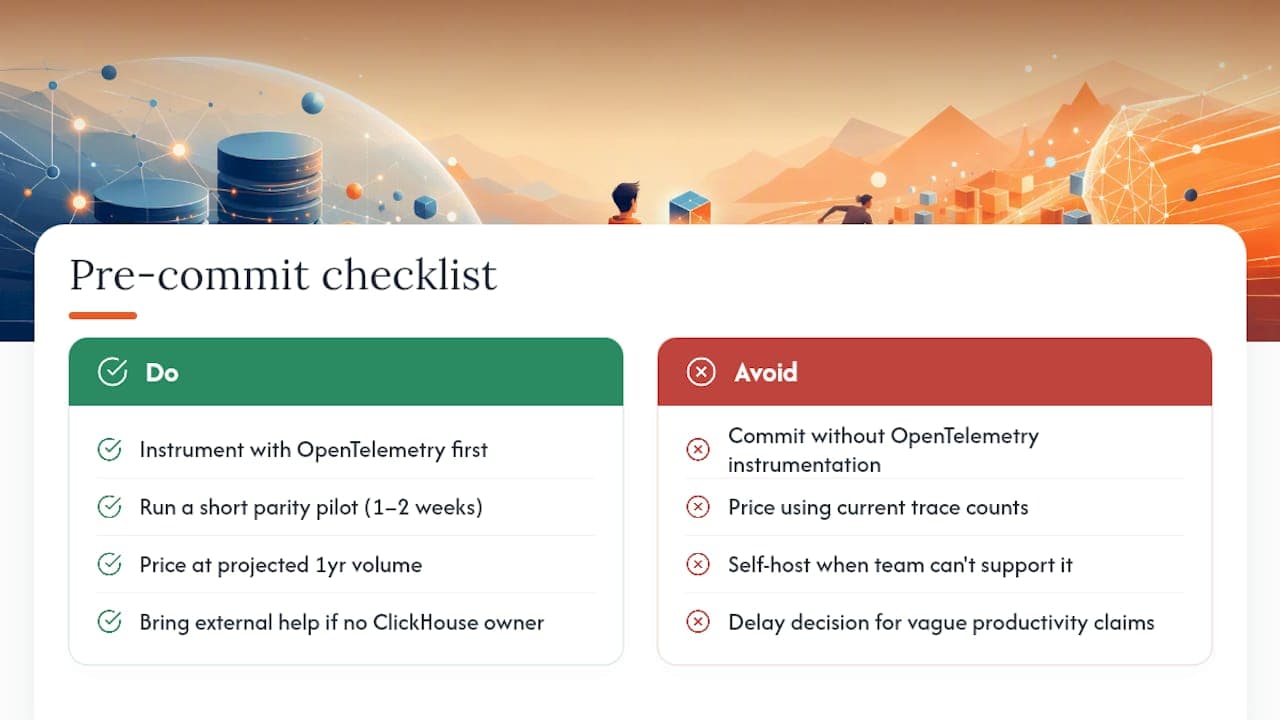
Run a short parity pilot, a week or two of real traffic, and price both options at your projected volume in a year, not your current trace count. Most teams that regret their choice regretted the pricing shape, not the feature set.
If your team has no one who wants to own ClickHouse in production, or you’re on a compliance deadline that doesn’t leave room to learn self-hosting on the job, that’s exactly when bringing in outside help to scope and deploy the platform beats muddling through solo. Speed and ownership pull in opposite directions here, and knowing which one your team can actually afford this quarter, not in principle, is most of the decision. Teams weighing that trade-off against measurable productivity gains from outside AI support tend to make the call faster once they see the numbers side by side.
— arosplatforms team
Need Help Standing Up Observability Without the Ops Headache?
Choosing between Langfuse and LangSmith is only half the job. Someone still has to instrument the traces, wire up evals, migrate historical data, and keep RBAC and retention policies aligned with whatever compliance framework your industry runs on. Arosplatforms builds that layer for teams that would rather ship product than run ClickHouse clusters or debug OTLP auth on a Friday afternoon. The observability and governance setup deployed is designed around how teams actually work, not a generic template, and turnaround on the tasks that used to eat a sprint can be faster. If your deadline doesn’t leave room to learn self-hosting from scratch, or your compliance team needs an audit trail before either platform goes near production data, start with a readiness assessment scoped to your AI stack and get a concrete migration and deployment plan before you commit engineering time to either tool.
Sources
- LangSmith vs. Langfuse
- LangSmith vs Langfuse: Rent Your Agent Observability, or Own It?
- Langfuse vs LangSmith in 2026 - The Honest Head-to-Head | LLMTools
FAQ
Is Langfuse Part of LangChain?
No. Langfuse is an independent, MIT-core observability platform built separately from LangChain and works with any framework. LangSmith is the platform built directly by the LangChain team, which is why it offers zero-config tracing specifically for LangChain and LangGraph.
What’s the Difference Between LangSmith and LangGraph?
LangGraph is an orchestration framework for building stateful, multi-agent workflows. LangSmith is the observability and evaluation platform that traces what LangGraph (or LangChain) applications do at runtime, so the two aren’t competitors. They’re built to work together.
What Are the Key Differences Between Langfuse and LangWatch?
Langfuse offers a self-hostable MIT core alongside a usage-based managed cloud, giving teams a real choice between ownership and convenience. LangWatch is a separate observability entrant with its own pricing and hosting model. Anyone comparing the two should verify current feature sets and pricing directly on each vendor’s site, since both change frequently.
What Are Good Alternatives to LangSmith?
Langfuse is the most direct alternative, particularly for teams that need self-hosting or usage-based pricing instead of per-seat billing. Other observability tools exist in this space too, and teams evaluating broader alternatives for RAG evaluation or CI-gated testing should weigh framework fit and data residency needs the same way they would for LangSmith or Langfuse.
Does Arosplatforms Help Teams Deploy These Tools?
Yes. Arosplatforms offers custom AI development and production deployment services, including scoping and migration support for teams adopting either Langfuse or LangSmith inside a broader AI system. Pricing is scoped per engagement and available on request through a readiness assessment.