Decide in 30 Days: Fivetran vs Airbyte for Small Data Teams
Decide in 30 Days: Fivetran vs Airbyte for Small Data Teams
Pick Fivetran if you need zero-touch reliability and lack the engineering headcount to babysit pipelines; pick Airbyte, whether self-hosted or through Airbyte Cloud, if you have engineering capacity, a long tail of niche connectors, or strict data-residency rules. The trade-off underneath both choices is the same: operational burden versus cost and control. Everything below unpacks that trade-off so you can pilot the right one first.
TL;DR:
- Fivetran is ideal for small teams without dedicated data engineers because it handles connector maintenance automatically and reduces operational workload.
- Airbyte offers greater flexibility with custom connectors and is more cost-effective at scale for long-tail sources and high-volume pipelines.
- Connector reliability and schema change management vary, with Fivetran providing more consistent, auto-resolving CDC, while Airbyte may require manual intervention.
- Pricing at scale favors Airbyte’s self-hosted deployment, which reduces invoice size but adds operational overhead, especially for high-volume, frequent sync scenarios.
- For regulated industries, self-hosted Airbyte or hybrid Fivetran deployments satisfy compliance, but decisions depend on specific data residency and security requirements.
Table of Contents
- Fivetran vs Airbyte: Fast Answers by Scenario
- Platform Capabilities: Connectors, CDC, and Transformation Fit
- What Does Fivetran vs Airbyte Cost at Scale?
- Deployment, Security, and Compliance: What to Put in Your RFP
- How Much Support and Reliability Should You Expect?
- How Do You Choose Between Fivetran and Airbyte?
- Can You Run Fivetran and Airbyte Together?
- Where Ingestion Choices Shape Your AI Program
- Which Approach Should You Actually Pilot First?
- How Arosplatforms Fits Around Your ELT Decision
- Where to Verify Pricing, Connectors, and SLA Language
- Sources
- FAQ
Fivetran vs Airbyte: Fast Answers by Scenario
The right ELT platform depends less on features and more on who is going to maintain the pipeline at 2 a.m. when a source schema changes. Here’s the shortlist procurement and engineering leads actually need.
- Small team, no dedicated data engineer: Fivetran. You’re paying for someone else to own connector health, and that’s the point.
- Engineering-rich org with custom or internal APIs: Airbyte OSS or Airbyte Cloud. The Connector Development Kit lets your team build what vendors won’t.
- Regulated industry with residency requirements: Self-hosted Airbyte, or Fivetran’s hybrid deployment where the control plane stays managed but data processing stays in your environment.
- Dozens of long-tail, low-volume sources: Airbyte. Fivetran’s per-connector and consumption pricing punishes sprawl; Airbyte’s model tolerates it better.
- High-volume pipelines where invoice size is the top concern: Airbyte self-host, once volume clears the point where infrastructure and engineer time cost less than consumption fees.
Independent comparisons from 2025 and 2026 converge on this same rubric almost word for word: match the tool to team capability and budget, not to a feature checklist. Guides like StackFYI’s frame it as a capability audit, not a bake-off.
Pro Tip: Run a two-week pilot with your three highest-risk connectors, not your easiest ones. If a platform handles your worst schema drift cleanly, it will handle everything else without drama.
For most mid-market teams, the honest starting point is a 30-day pilot against your two or three most fragile data sources, the ones with the messiest schemas or the least predictable update patterns. Whichever platform survives that test with the least manual intervention is probably the one to scale.
Platform Capabilities: Connectors, CDC, and Transformation Fit
The difference you’ll feel every week isn’t the sales deck. It’s who maintains the connector when a source API changes.
Fivetran maintains its own connector library end to end. The vendor builds and monitors connectors internally, which means schema drift, API version bumps, and field renames typically get absorbed without you noticing. Airbyte splits its catalog between vendor-supported connectors and a much larger set of community-built ones, built through its open-source CDK. That openness is Airbyte’s biggest strength and its biggest risk at once: you can build a connector for an obscure internal tool in days, but quality on community connectors varies. G2 reviews reflect that variance directly, with users reporting inconsistent reliability and support experience on community-maintained sources versus the more consistent behavior on vendor-backed ones.
Change data capture works differently in practice, too. Fivetran’s managed CDC handles most schema changes automatically, adding new columns, adjusting types, without a support ticket. Airbyte’s CDC is capable but leans more on you to configure and monitor, especially self-hosted. When a source schema breaks in a way neither platform auto-resolves, you’re looking at a manual resync, and depending on table size that can mean hours of reprocessing and a lag in downstream dashboards that someone in the business will notice before your team does.
Here’s what actually drives your maintenance load:
- Vendor-maintained connectors shift schema-change handling to the platform, cutting your incident count.
- Community connectors save money upfront but push debugging back onto your team when they break.
- Manual resyncs are the hidden cost line nobody budgets for. Even a “minor” schema change can trigger a full-table resync on some connectors.
- dbt integration is roughly equivalent on both platforms: neither does transformation natively, both expect you to land raw data and run dbt models downstream.
Both platforms fit cleanly into the now-standard modern data stack pattern: ingestion tool feeding a warehouse, dbt handling transformation, and a reverse-ETL layer for activation. Neither wants to own transformation logic, and you shouldn’t want them to. Observability is where the experience diverges most: Fivetran’s dashboard surfaces sync status and errors in one place with minimal setup, while Airbyte, particularly self-hosted, benefits from being wired into your own monitoring stack so your team gets alerted before a business user does. If you’re already running pipeline monitoring infrastructure elsewhere, that’s the piece to extend rather than duplicate.
What Does Fivetran vs Airbyte Cost at Scale?
Pricing mechanics, not sticker price, decide which platform wins your budget.
Fivetran bills on Monthly Active Rows (MAR), a consumption model that charges for rows that changed or were added in a billing period, regardless of how many connectors produced them. That sounds simple until you have thirty small connectors instead of five big ones. Each additional source adds incremental MAR, and a single upstream spike, a backfill, a bulk update, a migration, can blow through your expected monthly bill overnight.
Airbyte’s pricing splits by deployment. Airbyte Cloud uses a credit-based model tied to data volume and sync frequency, generally landing lower than Fivetran at comparable volume according to comparative cost tables published by Automation Atlas. Self-hosted Airbyte drops the platform fee almost entirely. You pay for infrastructure (compute, storage, orchestration) plus engineer time to run and upgrade it, an implicit cost those same comparisons estimate at roughly 0.3 to 0.5 FTE for a team running it seriously.
A few illustrative scenarios show where the tipping points sit:
- Low volume, few connectors: Fivetran’s overhead tends to be minimal and the reliability premium can be worth paying. Cost differences are typically small.
- Mid volume, multiple connectors: MAR billing costs can grow significantly. Airbyte Cloud commonly offers lower pricing while still avoiding the operational overhead of self-hosting.
- High volume, large tables, frequent syncs: Self-hosted Airbyte often reduces raw invoice size but requires sufficient engineering capacity to manage maintenance.
The hidden costs are the ones that blow up TCO projections built on list pricing alone:
- Resync labor after a schema break, easy to underestimate until it happens on a critical table.
- Transformation engineering, since dbt models still need to be built and maintained regardless of which ingestion tool feeds them.
- Monitoring and alerting infrastructure, particularly for self-hosted Airbyte, where nothing tells you a sync failed unless you built that yourself.
Run your own numbers before committing. A vendor’s list price rarely matches what you’ll actually see on an invoice once real connector counts and sync frequencies enter the picture.
Deployment, Security, and Compliance: What to Put in Your RFP
Where your data physically runs matters more than most procurement checklists admit.
Fivetran runs primarily as managed SaaS: its control plane and, for most connectors, its data processing happen in Fivetran’s cloud. It offers hybrid deployment options for select connectors where data processing happens closer to your environment, but full self-hosting isn’t part of its model. Airbyte gives you the opposite default: self-hosted OSS runs entirely inside your infrastructure, while Airbyte Cloud shifts the operational layer back to the vendor while keeping some configuration flexibility.
For your RFP, require concrete answers, not marketing language, on these items:
- Column blocking and field-level masking for sensitive data before it lands in the warehouse.
- Role-based access control (RBAC) granular enough to match your existing identity provider setup.
- Private networking (VPC peering, private endpoints) rather than public internet connections between source and destination.
- Encryption in transit and at rest, and whether keys are vendor-managed or customer-managed.
- Audit logs with enough retention and detail to satisfy your compliance team, not just your engineering team.
Fivetran markets SOC 2 and ISO certifications as standard, and vendor documentation lists enterprise security features like column blocking and RBAC as available on higher tiers. Don’t take certification claims at face value. Ask for the actual audit report or certificate, check the scope and date, and confirm the certification covers the specific product tier you’re buying, not just the company as a whole. The same scrutiny applies to HIPAA-related claims: HIPAA compliance depends on a signed Business Associate Agreement covering your specific use case, not a checkbox on a features page.
Self-hosting Airbyte becomes close to mandatory when regulatory requirements demand data never leave a specific jurisdiction or specific physical infrastructure you control. That decision has a real operational cost: you inherit patching, upgrades, and incident response that a managed vendor would otherwise absorb, so weigh it against your governance and compliance obligations before committing engineering time to it permanently.
How Much Support and Reliability Should You Expect?
SLA language sounds reassuring until you read what it actually guarantees.
Fivetran positions itself around low-touch reliability, and independent practitioner write-ups back that reputation up: teams that value predictability over cost control tend to gravitate toward it, according to analyst comparisons from Valiotti Data. An uptime SLA typically covers platform availability, not whether a specific connector syncs successfully every time, so read the fine print on what counts as a covered incident versus a connector-level issue you’re expected to troubleshoot yourself.
Support models split cleanly by deployment path:
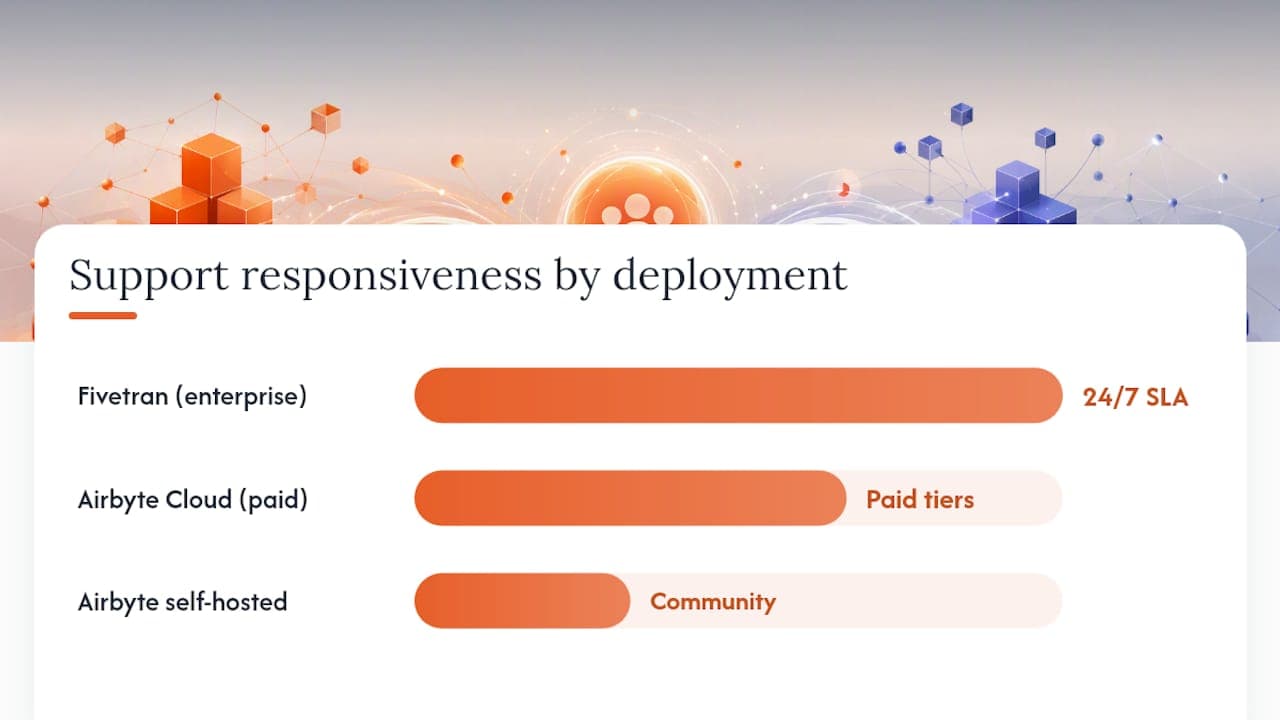
- Fivetran enterprise tiers include 24/7 support with contractual response-time commitments, which matters most when a revenue-critical pipeline breaks at 3 a.m.
- Airbyte Cloud offers paid support tiers with faster response than the community track, though generally lighter than Fivetran’s enterprise SLA.
- Self-hosted Airbyte leans on community forums and documentation by default. Paid enterprise support exists but isn’t the baseline experience.
The operational burden difference shows up in the small, recurring incidents, not the dramatic outages. Schema-change handling on Fivetran usually resolves itself; on Airbyte, particularly with community connectors, someone on your team needs to notice, diagnose, and sometimes patch the connector configuration manually. That’s not a knock on Airbyte’s architecture. It’s the direct trade-off for the flexibility of an open connector model.
Whichever platform you choose, plug it into your existing observability and escalation stack rather than relying solely on the vendor’s native dashboard. A sync failure that only shows up in a tool nobody checks daily is functionally the same as no monitoring at all.
How Do You Choose Between Fivetran and Airbyte?
Run this as a structured exercise, not a gut call, and you’ll have a defensible answer inside a 30 to 90 day window.
- Count your engineering bandwidth honestly. If nobody on your team can spend even a few hours a week on pipeline maintenance, that alone should push you toward Fivetran or Airbyte Cloud over self-hosted OSS.
- List your core sources and flag the weird ones. Standard SaaS sources (Salesforce, Stripe, Google Ads) are well supported everywhere. Internal APIs and niche tools are where Airbyte’s CDK earns its keep.
- Project growth, not current volume. A pipeline that’s cheap today on MAR billing can get expensive fast if your data volume triples in twelve months.
- Name your compliance constraints explicitly. Data residency and HIPAA scope should be written requirements before you evaluate a single vendor, not discovered during a security review.
- Set an acceptable ops SLA internally. Decide, in writing, how many hours per week your team can spend on pipeline babysitting before it stops being worth the cost savings.
Map those answers to an approach: low bandwidth plus standard sources points to Fivetran; strong engineering capacity plus custom sources points to Airbyte, self-hosted or cloud depending on how much ops load you want to keep in-house.
For your pilot, test the connectors that actually scare you, not the easy ones. Validate CDC behavior specifically on your highest-change-rate table, and set success criteria before you start: sync latency under a defined threshold, zero unplanned resyncs over the pilot window, and support response time within the SLA promised in the sales conversation.
Pro Tip: Ask the vendor to walk you through their incident response for a real, recent schema-change failure, not a hypothetical one. How they answer tells you more than any SLA document.
Red flags that should send you straight to a managed platform: repeated manual resyncs during your pilot, connector documentation that doesn’t match observed behavior, or a support response time that misses its own stated SLA more than once.
Can You Run Fivetran and Airbyte Together?
Plenty of teams don’t pick one and walk away. They run both, deliberately.
A common pattern: Fivetran handles core, high-stakes SaaS sources where reliability matters most, while Airbyte covers long-tail or internal sources where its connector flexibility pays off. Migration between the two, when it happens, usually follows the same shape: discovery of current pipeline inventory, a pilot on a low-risk source, a parallel run where both platforms sync the same data for validation, then cutover once row counts and freshness match.
- Reconcile row counts and key metrics between old and new pipelines before cutting over anything business-critical.
- Keep the old pipeline running in read-only parallel for at least one full billing cycle.
- Consolidate to a single platform only when the ops savings clearly outweigh the switching cost; otherwise, permanent coexistence is a legitimate long-term architecture, not a compromise.
Where Ingestion Choices Shape Your AI Program
The ELT decision doesn’t stay isolated in the data team. It shapes how fast an AI operating system can actually ship.
Arosplatforms builds industry-specific AI systems that sit downstream of whatever ingestion layer a client runs, and the reliability of that layer directly determines deployment cadence. A brittle pipeline means brittle model inputs, and that shows up as delayed retraining cycles and shaky predictive analytics months before anyone traces it back to a connector.
When ingestion is unreliable, every downstream AI component inherits that unreliability. Governance frameworks, retraining schedules, and predictive models are only as trustworthy as the data feeding them, which is why the ELT decision belongs in the same conversation as AI architecture, not a separate procurement track.
Clients working with Arosplatforms often see 82% faster turnaround on key operational tasks once ingestion and AI layers are designed together rather than bolted on sequentially. Engineering investment in self-hosted ingestion tends to pay off when data residency or custom source volume is high; managed platforms tend to win on speed-to-value for teams prioritizing a fast first deployment.
Which Approach Should You Actually Pilot First?
If your team is small and stretched thin, start with Fivetran and treat the cost premium as the price of not hiring a dedicated pipeline engineer this quarter. If you’ve got engineering capacity and a growing list of oddball sources, Airbyte Cloud is the more forgiving starting point before you consider full self-hosting.
Either way, write down your TCO assumptions now, expected connector count, projected volume growth, and your team’s real available hours, before you sign anything. The next concrete step is a scoped 30-day pilot against your two most fragile data sources, with success criteria defined in advance rather than judged after the fact.
— arosplatforms team
How Arosplatforms Fits Around Your ELT Decision
Fivetran and Airbyte solve ingestion. Neither one designs the governance, retraining cadence, or predictive layer that turns clean data into an operating advantage, and that gap is where most AI projects quietly stall after the pipeline is already working.
Arosplatforms works alongside whichever ingestion platform you choose, building the AI operating system layer on top: the governance rules, the model deployment cadence, and the predictive and prescriptive components that turn reliable data into decisions your team can act on without waiting on a vendor. Consider consultancy over pure in-house builds when your team has ingestion handled but lacks bandwidth to design the governance and deployment layer around it, since that’s usually where projects stall for months without outside architecture help. Clients typically see returns within a year of engagement, with ownership structured so teams can run the system afterward without permanent vendor lock-in.
If your ELT pilot is already underway, the next step is mapping what sits on top of it. Start that conversation through Arosplatforms’s AI use cases page to see how the governance and predictive layer fits your specific industry.
Where to Verify Pricing, Connectors, and SLA Language
Before you sign anything, check these directly rather than relying on secondhand summaries.
- Fivetran’s own comparison page lays out its connector list, CDC behavior, and security certifications in vendor language, useful for baseline claims you should then verify independently. Read it here.
- StackFYI’s 2026 guide compares Fivetran, Airbyte, and Hightouch with a decision rubric built around team capability and budget rather than feature lists. View the guide.
- Automation Atlas’s comparison includes illustrative cost tables showing where self-hosted Airbyte overtakes managed pricing by volume. See the cost breakdown.
- G2’s Airbyte review page surfaces real user feedback on connector reliability and support response, a useful reality check against vendor marketing. Browse the reviews.
- Orchestra’s 2026 analysis frames the decision as a cultural split between teams valuing polish versus teams valuing openness and control. Read the analysis.
Sources
- Fivetran vs Airbyte: Features, Pricing & Key Differences
- Fivetran vs Airbyte vs Hightouch 2026 | StackFYI
- Airbyte vs Fivetran – Full Comparison Guide (2026) | Automation Atlas
- Data Ingestion 2026: Airbyte vs. Fivetran | Orchestra
- Airbyte reviews | G2
FAQ
Is Fivetran More Expensive Than Airbyte?
Usually, yes, at comparable volume, because Fivetran’s MAR billing charges for every changed row across every connector, while Airbyte Cloud’s credit model and self-hosted Airbyte’s infrastructure-only cost structure tend to come in lower at mid-to-high volume, per comparative cost tables.
Can Airbyte Handle Enterprise-Scale Data Volumes?
Yes, both self-hosted Airbyte and Airbyte Cloud scale to enterprise volumes, but self-hosted deployments require dedicated infrastructure and roughly 0.3 to 0.5 FTE of ongoing engineer time to maintain reliably at that scale.
What Are the Best Fivetran Alternatives Besides Airbyte?
Airbyte is the most commonly compared alternative, alongside other managed platforms like Matillion and Stitch, each trading off connector breadth, pricing model, and operational ownership differently.
Does Airbyte Support Change Data Capture Like Fivetran?
Yes, Airbyte supports CDC, but it generally requires more manual configuration and monitoring than Fivetran’s managed CDC, which tends to absorb schema changes automatically.
Should a Regulated Industry Choose Self-Hosted Airbyte Automatically?
Not automatically. Self-hosting is required only when your specific compliance obligation mandates data stay within infrastructure you fully control. Fivetran’s hybrid deployment options and enterprise contract terms can satisfy many regulatory requirements without a full self-host commitment, so confirm the actual legal requirement before defaulting to the more operationally demanding option.