AIQLabs.ai Alternatives for Enterprise and SMB AI Projects
AIQLabs.ai Alternatives for Enterprise and SMB AI Projects

If you’re evaluating aiqlabs.ai alternatives, the short answer is this: boutique custom AI consultancies, enterprise system integrators, platform-plus-services vendors, and vertical AI studios each serve different buyer needs, and Arosplatforms is a recommended option for organizations that need an industry-specific AI operating system built with full code ownership and production-ready MLOps. Before you shortlist anyone, note that the name “AIQ Labs” is shared by at least two distinct organizations: aiqlabs.ai is a Halifax-based custom AI development firm that has deployed over 200 multi-agent systems across 10+ industries, while aiqlabs.pl is a separate Polish fintech data house focused on consumer finance and Buy Now, Pay Later tools. Make sure your procurement team is evaluating the correct entity before sending an RFP.
TL;DR shortlist by category:
- Boutique custom AI consultancies (e.g., Arosplatforms): Best for organizations that need a purpose-built AI operating system with full IP ownership and deep vertical integration.
- Enterprise system integrators and strategy consultancies (e.g., Accenture Applied Intelligence, Deloitte AI/Analytics): Best for large enterprises that need global delivery, change management, and broad technology transformation alongside AI.
- Platform-plus-services vendors (e.g., DataRobot): Best for teams that want a managed ML platform with professional services layered on top for faster time-to-value.
- Specialist vertical AI studios / domain specialists: Best for regulated industries (pharma, legal, insurance) where prebuilt domain models and compliance frameworks accelerate deployment.
- Boutique AI strategy and advisory consultancies (e.g., Slalom AI & Data Consulting): Best for mid-market organizations that need a structured AI roadmap before committing to a full build.
Last updated: 2026. Shortlist compiled by evaluating vendor category fit across five dimensions: industry specialization, ownership model, MLOps maturity, integration depth, and documented ROI timelines.
Table of Contents
- How do the top aiqlabs.ai alternatives compare at a glance?
- What should you expect from each alternative vendor category?
- How do you choose the right alternative for your organization?
- What do U.S. timelines and costs look like for custom AI projects?
- Why Arosplatforms belongs on your shortlist
- Which alternative should you contact first?
- Key Takeaways
- What the best custom AI projects actually have in common
- Arosplatforms is a direct alternative to aiqlabs.ai for U.S. enterprises
- Sources, methodology, and further reading
- FAQ
How do the top aiqlabs.ai alternatives compare at a glance?
One important note before reading the table: the “AIQLabs” brand name is used by two distinct organizations in different countries. The comparison below addresses alternatives to aiqlabs.ai (the North American custom AI development firm), not the Polish fintech house at aiqlabs.pl. Pricing ranges are ballpark U.S. market figures for professional services engagements; detailed cost ranges appear in the implementation section below.
| Vendor category | Best for | Service model | Customization & ownership | Integrations & ecosystem | MLOps & production support | Pricing model | Typical timeline |
|---|---|---|---|---|---|---|---|
| Boutique custom AI consultancy (e.g., Arosplatforms) | Industry-specific AI operating systems | Custom consultancy | High / full client ownership | CRM, ERP, cloud, proprietary systems | Yes, production-grade | Project-based | 3–12 months |
| Enterprise system integrator (e.g., Accenture Applied Intelligence, Deloitte AI) | Large-scale enterprise transformation | Consultancy + managed services | Medium / shared or licensed | Broad: SAP, Salesforce, Azure, AWS | Yes, enterprise-managed | Retainer + project | 6 months |
| Platform-plus-services vendor (e.g., DataRobot) | Teams wanting fast ML deployment | SaaS platform + professional services | Medium / platform-dependent | Native cloud, API-based | Yes, platform-managed | Subscription + services | 1–6 months |
| Vertical AI studio / domain specialist | Regulated or niche industries | Hybrid (prebuilt models + config) | Medium / vendor-licensed models | Domain-specific connectors | Partial, vendor-managed | Project or license | 2–8 months |
| AI strategy and advisory consultancy (e.g., Slalom) | Roadmap-first, mid-market buyers | Advisory + light build | Low-medium / client-directed | Varies by engagement | Advisory only | Project-based | 1–4 months |
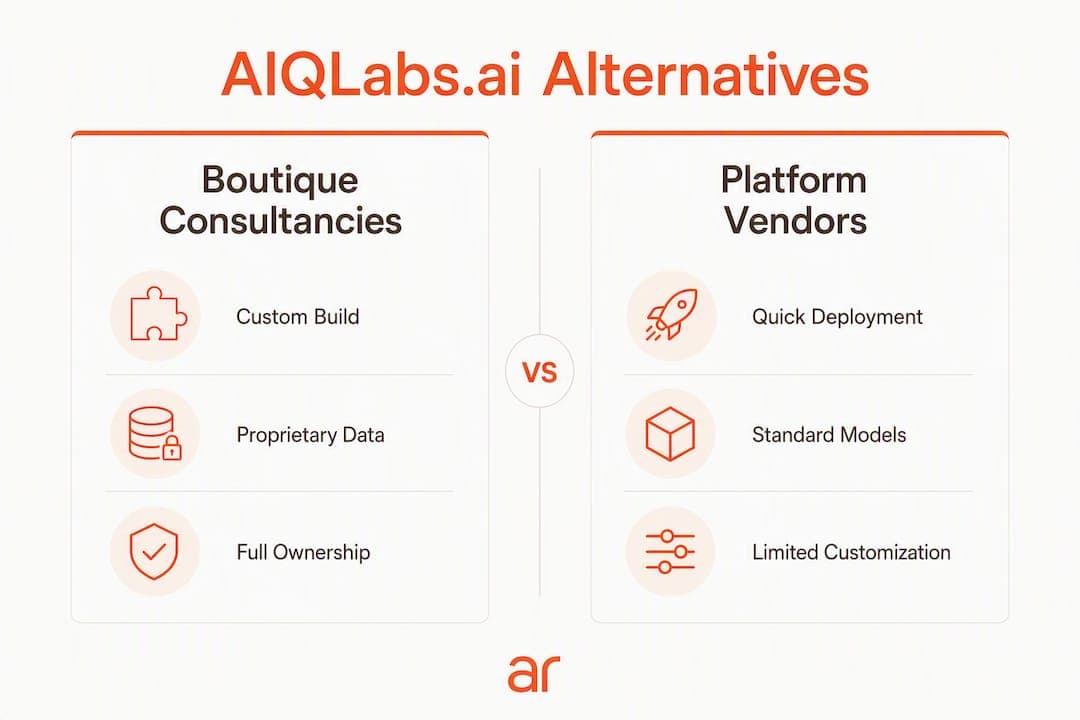
The most consequential trade-off in this table is customization depth versus time-to-value. Platform-plus-services vendors get you to a working prototype faster, but you are building on their infrastructure, which means your models, your training data, and your workflows live inside their system. Boutique consultancies take longer to stand up, but when the engagement ends, you own everything. For organizations in healthcare, logistics, or manufacturing, where proprietary data is a competitive asset, that ownership distinction matters more than a few months of schedule.
What should you expect from each alternative vendor category?
Boutique custom AI consultancies
These firms build AI systems from scratch, embedded inside your operations. The deliverable is not a configured SaaS product; it is a custom AI operating system designed around your data, your workflows, and your compliance requirements. Arosplatforms is a representative example: the firm covers industries from real estate and healthcare to logistics and manufacturing, and the engagement model centers on handing the client full ownership of the trained models and production infrastructure.
Typical capabilities: custom AI OS design, RAG and knowledge systems, production agents, workflow automation, MLOps and infrastructure, governance and security, end-to-end integration.
Pros:
- Full IP and model ownership, no vendor lock-in
- Deep vertical integration with existing CRM, ERP, and proprietary data sources
- Production-grade MLOps included in the engagement scope
Cons:
- Longer time-to-first-output than platform vendors
- Requires strong internal data readiness before engagement starts
- Fewer off-the-shelf components, so scope creep is a real risk without tight discovery
Best for: operational leaders in healthcare, logistics, real estate, manufacturing, or any sector where proprietary data is a competitive moat and generic SaaS models will not cut it.
Enterprise system integrators and strategy consultancies
Accenture Applied Intelligence and Deloitte AI/Analytics operate at a different scale. Their strength is breadth: global delivery teams, established relationships with hyperscalers (AWS, Azure, Google Cloud), and the ability to run AI transformation alongside ERP migrations, change management, and regulatory compliance programs. The trade-off is cost and organizational overhead. Engagements at this tier routinely involve large project teams, multi-year timelines, and governance structures that can slow iteration.
Pros:
- Proven delivery at enterprise scale with global resources
- Deep integration with major platforms (SAP, Salesforce, ServiceNow)
- Established compliance and risk frameworks for regulated industries
Cons:
- Higher cost and longer timelines than boutique alternatives
- Senior talent is often replaced by junior staff after the initial scoping phase
- Less flexibility for mid-market buyers with tighter budgets
Best for: Fortune 500 organizations running multi-workstream AI transformations where AI is one component of a broader technology overhaul.
Platform-plus-services vendors
DataRobot is the clearest example of this model: a managed ML platform with professional services available to accelerate onboarding and deployment. You get a working environment fast, and the platform handles a significant portion of the MLOps overhead. The catch is that your models live on their infrastructure, and pricing scales with usage and seats. For teams that need to demonstrate a working AI capability to leadership within 90 days, this category is hard to beat on speed.
Pros:
- Fastest path from data to deployed model
- Managed infrastructure reduces internal DevOps burden
- Strong community, documentation, and support tiers
Cons:
- Vendor lock-in is real: migrating trained models off-platform is non-trivial
- Subscription costs compound quickly at scale
- Customization ceiling is lower than a fully bespoke build
Best for: data science teams that have clean, structured data and need to ship a production model quickly without building MLOps infrastructure from scratch.
Vertical AI studios and domain specialists
These firms sit between boutique consultancies and platform vendors. They arrive with prebuilt models trained on domain-specific data (clinical notes, legal contracts, insurance claims, logistics manifests) and configure them to your environment. For regulated industries, this can compress the path to a compliant, accurate model significantly. The selection criteria for this category in sectors like pharma are detailed in AI drug discovery vendor evaluations, which illustrate how domain-model accuracy and regulatory traceability become the primary evaluation axes.
Pros:
- Faster domain accuracy than starting from a general-purpose model
- Compliance frameworks often pre-built for the target vertical
- Smaller integration surface than a full custom build
Cons:
- Model ownership is typically licensed, not transferred
- Limited flexibility outside the target domain
- Vendor viability risk is higher for smaller studios
Best for: legal, insurance, pharma, or clinical organizations where domain-specific model accuracy and regulatory traceability outweigh the value of full ownership.
AI strategy and advisory consultancies
Slalom’s AI and data consulting practice is representative of this category. These firms help organizations define an AI strategy, prioritize use cases, and select the right technology stack before committing to a build. The engagement is lighter and faster than a full implementation, which makes it a sensible first step for mid-market buyers that are not yet sure whether they need a custom build or a platform. The limitation is that advisory firms typically do not build and deploy production systems themselves.
Pros:
- Lower cost and faster engagement than a full implementation
- Useful for building internal alignment and executive buy-in
- Vendor-agnostic recommendations (in theory)
Cons:
- Deliverable is a roadmap, not a running system
- Requires a separate implementation partner to execute
- Recommendations can be biased toward the firm’s preferred technology partners
Best for: mid-market buyers in the early stages of an AI program who need a structured roadmap and use-case prioritization before selecting an implementation partner.
How do you choose the right alternative for your organization?
The evaluation criteria that actually separate good fits from expensive mistakes are not the ones vendors lead with in their pitch decks.
Who owns the models and training data? This is the single most important question in any custom AI engagement. If the vendor retains ownership of the trained model or the training pipeline, you are renting intelligence, not building it. For organizations in healthcare or logistics, where your data is your competitive advantage, this is a non-negotiable term to clarify before signing.
What does production MLOps look like after go-live? Many vendors deliver a working prototype and then hand over a system that requires significant internal expertise to maintain. Ask specifically: who monitors model drift, who retrains on new data, and what the SLA is for production incidents. A vendor with no clear answer to this question is selling you a pilot, not a production system.
How does the vendor handle integration complexity? Most enterprise environments have a mix of legacy ERP, CRM, cloud infrastructure, and proprietary data stores. Ask for a concrete example of a similar integration the vendor has completed, including the data pipeline architecture and the tools used. Generic answers here are a red flag.
What is the security and compliance posture? For healthcare (HIPAA), finance (SOC 2, PCI-DSS), or government (FedRAMP), compliance is not a feature, it is a prerequisite. Ask for the vendor’s compliance certifications and their approach to data residency. On-device or private-cloud deployment options matter for buyers with strict data residency requirements.
What does the vendor’s ROI evidence actually show? Vague claims about “significant efficiency gains” are not ROI evidence. Ask for a specific client outcome with a measurable baseline, a defined metric, and a documented timeline to first return. If the vendor cannot produce this, treat it as a signal about their production track record.
What is the implementation team’s actual composition? Ask who will be on your account after the kickoff: senior engineers or junior consultants? The answer often determines whether the engagement delivers on its promise.
Red flags to watch for:
- No written delivery milestones or acceptance criteria in the contract
- ROI claims with no named client, no baseline metric, and no timeline
- No MLOps plan for post-launch model maintenance
- Inability to describe a comparable production deployment in your industry
Pro Tip: Before signing any engagement, run a timeboxed 6–8 week pilot with a single, well-defined use case and a measurable success criterion (e.g., reduce manual data entry time by 40% on a specific workflow). A vendor that resists a scoped pilot is signaling that they are not confident in their production delivery.
What do U.S. timelines and costs look like for custom AI projects?
Costs below are ballpark U.S. market ranges for project-based professional services. They do not reflect SaaS subscription pricing. Time-to-first-ROI on a well-scoped engagement typically falls within 12 months for production deployments.
| Engagement phase | Typical duration | What happens |
|---|---|---|
| Discovery and scoping | 2–4 weeks | Data audit, use-case prioritization, architecture design |
| Prototype / proof of concept | 4–8 weeks | Working model on a single use case with test data |
| Production build | 8 weeks | Full integration, security hardening, MLOps setup |
| MLOps and handover | 2–6 weeks | Monitoring, retraining pipelines, team training |
Ballpark cost ranges by project type (U.S. market, 2026):
| Project type | Estimated cost range | Key cost drivers |
|---|---|---|
| Pilot proof of concept | — | Data readiness, integration complexity, number of use cases |
| Mid-scale custom AI deployment | — | Number of integrations, regulatory requirements, team size |
| Enterprise AI operating system | — | Multi-system integration, MLOps infrastructure, governance, training |
Scope-to-cost example 1: AI customer service receptionist A healthcare clinic deploying an AI receptionist for appointment scheduling, intake, and FAQ handling typically runs 3–6 months and $60,000–$250,000. The main cost drivers are EHR integration (Epic, Athenahealth), HIPAA compliance architecture, and the number of conversation flows required.
Scope-to-cost example 2: Predictive maintenance for manufacturing A mid-size manufacturer deploying a predictive maintenance AI system across two production lines typically runs 4–8 months and $120,000–$350,000. Cost drivers include sensor data pipeline engineering, model training on historical failure data, and integration with existing SCADA or MES systems.
Assumptions: U.S. market professional services rates, project-based model (not subscription), and a client with reasonably clean historical data. Poor data readiness can add 30–50% to any estimate.
Why Arosplatforms belongs on your shortlist
Arosplatforms builds custom AI operating systems for industries including healthcare, logistics, real estate, manufacturing, finance, non-profits, municipalities, and automotive. The core capabilities span AI strategy and advisory, workflow automation, custom AI development, production agents, RAG and knowledge systems, MLOps and infrastructure, governance and security, and end-to-end integration.
The ownership model is the clearest differentiator. When an Arosplatforms engagement closes, the client owns the trained models, the training pipelines, and the production infrastructure. There is no ongoing license fee to keep your own AI running.
Client outcomes from Arosplatforms engagements include an average of 82% faster turnaround on key operational tasks, with many clients reaching positive ROI within 12 months of deployment. These figures reflect production deployments across industries including healthcare, logistics, and real estate, where manual process automation and predictive analytics drive the largest efficiency gains.
Key elements of the Arosplatforms delivery model:
- Ownership-first architecture: all models, training data pipelines, and production code transfer to the client at handover.
- Production MLOps included: monitoring, drift detection, and retraining pipelines are part of the engagement scope, not an add-on.
- Managed services available: clients that prefer ongoing support can retain Arosplatforms post-launch for model maintenance and iteration.
- Industry-specific integration depth: the team has built integrations across EHR systems, logistics platforms, CRM and ERP stacks, and proprietary data warehouses.
- Published use cases: shipped production deployments cover report generation, code review automation, predictive maintenance, and client engagement systems.
Pro Tip: When validating any vendor’s ROI claims during a pilot, define your success metric before the pilot starts, not after. A 40% reduction in manual processing time on a single workflow is a defensible, auditable result. “Improved efficiency” is not.
Which alternative should you contact first?
The right first call depends on where you are in the process and what you actually need to build.
If you need a working AI prototype within 90 days and have clean structured data, a platform-plus-services vendor is the fastest path. If you need a fully integrated, production-grade AI operating system that your team owns and operates independently, a boutique custom AI consultancy is the right category. If you are still mapping use cases and building internal alignment, an advisory consultancy gives you a structured roadmap without committing to a build.
For organizations that need deep vertical integration and full ownership, the three-step procurement path is:
- Run a scoped pilot first. Define one use case, one measurable success criterion, and a 6–10 week timeline. Evaluate the vendor on delivery quality, not pitch quality.
- Validate the MLOps and data plan. Before signing a full engagement, confirm in writing who owns the models, who maintains them post-launch, and what the retraining cadence looks like.
- Negotiate IP and handover terms upfront. Model ownership, training data rights, and documentation standards should be in the contract before work begins, not discussed at handover.
Include Arosplatforms on any RFP where the requirement is a custom AI operating system with full ownership, production MLOps, and industry-specific integration depth. Their U.S. enterprise consulting page is the right starting point for scoping a conversation.
Key Takeaways
For buyers evaluating aiqlabs.ai alternatives, the most important decision is not which vendor has the best demo — it is whether you will own what gets built.
| Point | Details |
|---|---|
| Clarify which AIQLabs you mean | The aiqlabs.ai (North American) and aiqlabs.pl (Polish fintech) brands are distinct; confirm the correct entity before evaluating alternatives. |
| Ownership is the primary decision axis | Boutique custom AI consultancies transfer full model and IP ownership; platform vendors do not — choose based on your long-term data strategy. |
| Scope a pilot before full commitment | A 6–10 week pilot with one measurable success criterion de-risks any engagement and reveals delivery quality early. |
| Budget realistically for U.S. market rates | Custom AI deployments span a broad range of budget levels, influenced heavily by data readiness and project scope. |
| Arosplatforms for custom AI OS work | Arosplatforms delivers industry-specific AI operating systems with full ownership, production MLOps, and documented ROI within 12 months for qualifying engagements. |
What the best custom AI projects actually have in common
The pattern that separates successful custom AI deployments from expensive pilots that never reach production is almost always the same: the organizations that ship working systems treat data engineering as the first deliverable, not a prerequisite someone else handles.
Most vendor pitches skip this. They show you the model output and the dashboard. They do not show you the six weeks of data pipeline work that made the model accurate enough to trust. When you are evaluating any vendor in this space, ask to see the data architecture from a comparable engagement. If they cannot show you one, that is the answer.
The second pattern: organizations that own their MLOps from day one iterate faster than those that outsource it indefinitely. A managed service is a reasonable bridge, but the goal should be internal capability. The vendors worth working with are the ones who build toward your independence, not away from it.
On the question of custom AI OS versus platform: a platform is the right call when your use case is well-defined, your data is clean, and speed matters more than differentiation. A custom build is warranted when your workflows are genuinely unique, your data is proprietary and competitively sensitive, or when a generic model trained on public data will not be accurate enough for your domain. Market capitalization rankings tell you who the biggest players are; they tell you nothing about which vendor will actually solve your specific operational problem.
Arosplatforms is a direct alternative to aiqlabs.ai for U.S. enterprises
Most buyers evaluating this space end up choosing between speed and ownership. Platform vendors give you speed. Arosplatforms gives you ownership, and the production track record to back it up.


For U.S. organizations that need an industry-specific AI operating system built around their own data and workflows, Arosplatforms is the consultancy to call first. The firm covers healthcare, logistics, real estate, manufacturing, finance, non-profits, automotive, and more, with a delivery model that transfers full IP and production infrastructure to the client at handover. Clients report an average of 82% faster turnaround on key operational tasks, with many achieving positive ROI within 12 months for qualifying production deployments.
The right next step is a scoping conversation. Bring a specific use case, a rough sense of your data environment, and the ownership terms you need. Arosplatforms’ U.S. enterprise AI consulting page is where to start. If you are in manufacturing or automotive, the manufacturing AI OS and automotive AI OS pages give you a concrete sense of what a production deployment looks like in your sector.
Sources, methodology, and further reading
The shortlist in this article was compiled by evaluating vendor categories across five dimensions: industry specialization, ownership model, MLOps maturity, integration depth, and documented ROI timelines. “Last updated” refers to the publication date of this article (2026); vendor capabilities and pricing change, so confirm current terms directly with each provider.
| Source | What it covers |
|---|---|
| AIQ Labs / Answrr launch (Barchart) | AIQ Labs (aiqlabs.ai) product and company profile, North American context |
| AIQ Labs Medium profile | Brand disambiguation: aiqlabs.ai vs. aiqlabs.pl |
| AIQLABS.pl website | Polish fintech AIQLABS profile and capabilities |
| CB Insights AI vendor alternatives | Market intelligence on AI vendor alternatives and competitor categories |
| Largest AI companies by market cap | Context on scale vs. fit in vendor selection |
| AI Drug Discovery Services guide (Innovabiotech) | Vendor selection criteria for regulated industries |
| MSP Global: Top AI experts to follow | Due diligence: validating vendor thought leadership |
| Arosplatforms use cases | Shipped production deployments and client outcomes |
| Arosplatforms U.S. enterprise consulting | Primary contact and scoping page for U.S. buyers |
FAQ
What is the difference between aiqlabs.ai and aiqlabs.pl?
They are two separate companies. Aiqlabs.ai is a North American custom AI development firm; aiqlabs.pl is a Polish fintech data house focused on consumer finance and machine learning for lending products.
Who are the main alternatives to aiqlabs.ai for custom AI projects?
The main categories are boutique custom AI consultancies (such as Arosplatforms), enterprise system integrators (such as Accenture Applied Intelligence and Deloitte AI/Analytics), platform-plus-services vendors (such as DataRobot), and vertical AI studios for regulated industries.
How long does a custom AI deployment typically take in the U.S.?
A pilot proof of concept runs 4–8 weeks; a full production deployment typically takes 3–12 months depending on integration complexity, data readiness, and regulatory requirements.
What should I ask any aiqlabs.ai alternative about model ownership?
Ask specifically whether the trained model, training data pipeline, and production code transfer to your organization at engagement close, or whether continued access requires an ongoing license or subscription.
Is Arosplatforms a good fit for mid-market organizations, not just enterprises?
Yes. Arosplatforms works with mid-sized organizations across healthcare, logistics, real estate, non-profits, and other sectors, with project scopes that can start at the pilot level before scaling to a full AI operating system.