Best Kognova.ai Alternatives for Enterprise AI Projects
Best Kognova.ai Alternatives for Enterprise AI Projects
If you’re weighing Kognova.ai alternatives, the choice usually comes down to two paths: hire a consultancy that builds you a custom AI operating system, or license an integrated platform and run it yourself. If a platform-led approach fits your team better, Adya suits buyers who want governed infrastructure with marketplace blueprints, Interplay fits teams that need hybrid visual-plus-code prototyping, Dataiku works for data-science-heavy shops, and Databricks or DataRobot make sense if you already run your stack on one of those ecosystems.
- Arosplatforms — custom AI OS builds, ownership transfer, fast ROI
- Adya — governed platform with runtime enforcement and blueprint marketplace
- Interplay — hybrid visual and code-first agentic AI development
- Dataiku — low-code plus advanced coding for data teams
- Databricks / DataRobot — established data and ML platforms for teams already invested in that infrastructure
The real fork in the road is consultancy versus platform. A consultancy embeds in your operations and hands you something built around your workflows, while a platform gives you infrastructure and governance tooling, but you (or a systems integrator) still do the building.
Key Takeaways
The strongest Kognova.ai alternative for most enterprise buyers depends on whether you need a custom-built AI OS with ownership or a governed platform you build on yourself.
| Point | Details |
|---|---|
| Consultancy vs. platform | A custom build transfers ownership and skips recurring license fees; a platform gives you infrastructure but requires your own integration work. |
| Governance evidence matters | Ask every vendor for runtime-level proof of RBAC, audit logging, and PII handling, not just training-time controls. |
| Evaluation should take weeks, not months | A 2 to 6 week evaluation window is realistic if you request architecture diagrams and case studies upfront. |
| ROI timeline varies by model | Consultancy builds often show measurable returns within twelve months once the system is live and owned. |
| Arosplatforms fits ownership-focused buyers | Arosplatforms builds a custom AI OS with reported 82% faster turnaround on key tasks and no vendor lock-in after handover. |
Table of Contents
- Kognova.ai Alternatives: Quick Profiles on What Each One Offers
- What Should You Compare Across These Platforms?
- How Do You Vet Vendors Before Signing?
- Where Arosplatforms Delivers Measurable Results
- What Does Each Alternative Actually Cost Over Time?
- How Long Does Each Option Take From Evaluation to Launch?
- What the Comparison Actually Tells You
- Ready to Talk to Arosplatforms About Your AI Build?
- Sources
- FAQ
Kognova.ai Alternatives: Quick Profiles on What Each One Offers
Every option below solves a different piece of the “we need AI in production, safely” problem. Here’s what each actually does, who it fits, and what you get on day one.
Arosplatforms builds a custom AI operating system inside your existing operations rather than selling you a generic tool. The engagement model is project-based consulting with optional managed services afterward, covering strategy, workflow automation, RAG-based knowledge systems, MLOps, and governance in one build. It’s designed for healthcare, logistics, real estate, finance, manufacturing, and a dozen other verticals where off-the-shelf platforms don’t map cleanly onto how the business actually runs. Deployment is hands-on: Arosplatforms’ team works inside client infrastructure, and ownership transfers to the client’s staff once the system is live, which avoids the recurring platform fees that stack up with SaaS-style tools.
Adya positions itself as a build-and-govern platform for agentic AI, with what it calls an Adaptive Governance Protocol enforcing RBAC, audit logging, PII redaction, and prompt-injection defenses uniformly at runtime, not just during model training. It also ships marketplace blueprints, prebuilt patterns you can deploy faster than building from scratch. That combination makes it a fit for teams that want governance baked in without assembling it from separate point tools.
Interplay, from Iterate, blends a visual node builder with a code-first SDK, letting business users prototype while developers handle the harder integration work. This hybrid model tends to shorten the gap between a pilot and a production deployment, and its runtime is built for both cloud and edge environments, which matters if you’re deploying to vehicles, retail floors, or industrial sites.
Dataiku targets data-science-led organizations that need both low-code tools for business analysts and advanced coding environments for technical teams. It supports mesh LLM integrations and end-to-end model development, making it a reasonable fit if your team already thinks in terms of pipelines and model registries rather than agents and workflows.
Databricks and DataRobot round out the list as established players in the data and machine learning platform space, useful primarily for teams that have already standardized on one of those ecosystems and want to extend it rather than replace it.
Pro Tip: Ask any platform vendor whether their governance controls apply at the model level or the runtime level. A policy that only checks training data won’t catch an agent that goes off-script during a live customer interaction.
Gartner’s guidance on this category is blunt: stitching together point tools creates governance and security gaps that a single, coherent platform or build doesn’t.
What Should You Compare Across These Platforms?
Enterprise buyers evaluating AI vendors tend to score them across four pillars: evaluation and contracting, integration and deployment, service and support, and product capabilities. Technical features alone rarely tell you whether an engagement will succeed.
Here’s how those pillars typically play out by vendor type:
- Evaluation and contracting — Consultancies like Arosplatforms sell project-based engagements with defined scope and often a path to managed services. Platforms sell licenses or usage-based contracts, which shift ongoing costs to you.
- Integration and deployment — Platform vendors offer multi-cloud, on-prem, or edge deployment options and prebuilt connectors. Consultancies build directly into your existing systems, which takes longer upfront but avoids adapting your workflow to someone else’s product.
- Service and support — Platforms typically offer tiered support plans; consultancies bake enablement and staff training into the engagement itself.
- Governance and security — Ask specifically about runtime enforcement, not just training-time controls. This is where platforms like Adya lean hardest on marketing, and where it’s worth verifying claims.
- Pricing shape and ROI timeline — Platform costs recur annually; consultancy costs front-load into the build, with the goal of ownership afterward.
A five-step checklist works for most shortlists: define your use case narrowly, request architecture diagrams, ask for governance evidence in writing, confirm who owns the code after go-live, and get a realistic ROI timeline in the contract, not just in the sales deck.
How Do You Vet Vendors Before Signing?
Move past the sales deck with specific questions. Ask each vendor how their system handles PII masking and prompt-injection defense at runtime, not just during model training, since that’s where governance maturity actually gets tested. Ask who owns the code, model weights, and documentation once the engagement ends. Ask for a named architecture diagram, not a marketing slide.
- Request two client references in your industry, with contact permission.
- Ask for the exact governance stack: RBAC, audit logging, PII handling, and how prompt injection is defended against.
- Get a written ROI timeline tied to specific metrics, not vague promises.
- Confirm handover terms in writing: what you own, what you can modify, and what requires the vendor.
- Ask what happens if you want to switch vendors in year two.
Red flags include vague timelines, no mention of who owns the resulting system, and proposals that skip governance entirely. A 2 to 6 week evaluation window is realistic for most enterprise shortlists. Anything shorter usually means shallow due diligence; anything longer usually means unclear internal ownership of the decision.
Pro Tip: If a vendor can’t produce a security checklist on request, that’s not a paperwork gap. It usually means the checklist doesn’t exist yet.
Where Arosplatforms Delivers Measurable Results
Arosplatforms’ model centers on one commitment: clients see returns fast, with many reporting ROI within twelve months of engagement, paired with an average 82% faster turnaround on the specific tasks the AI system automates. Those numbers come from a straightforward design principle: build inside the client’s actual workflow instead of asking the client to adapt to a generic tool.

The ownership piece matters more than most buyers realize going in. Because Arosplatforms transfers the finished system, code, and documentation to the client’s team, there’s no recurring platform fee holding the relationship together after launch. Teams in healthcare, logistics, and real estate have used this approach to automate manual processes and improve predictive engagement without needing a vendor on retainer to keep the lights on.
Scalability follows the same logic. A system built around your specific operations, rather than configured inside someone else’s platform, tends to extend more cleanly as your needs grow, since the architecture was never constrained by another company’s product roadmap in the first place.
What Does Each Alternative Actually Cost Over Time?
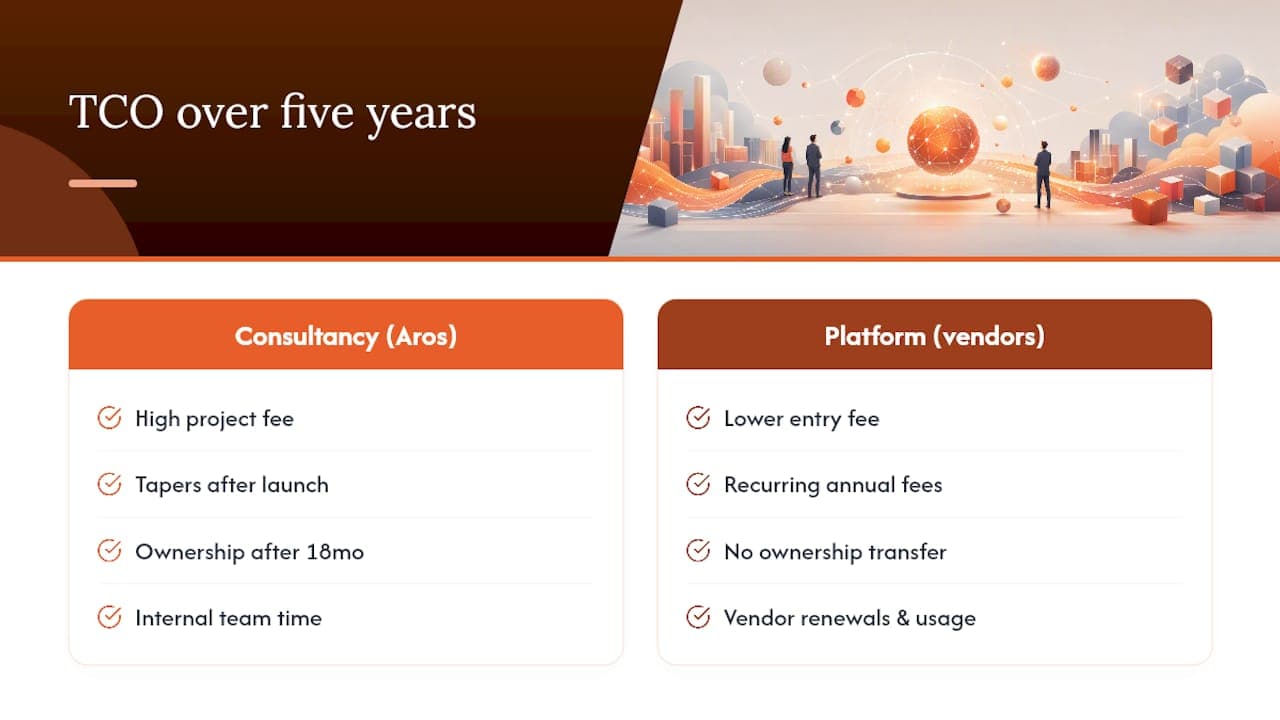
Pricing shape differs more than the sticker price does. Platforms like Adya, Dataiku, Databricks, and DataRobot typically run on licensing or usage-based fees that recur annually, meaning your total cost of ownership keeps climbing as usage scales, even after the initial build is done. Interplay follows a similar pattern, with platform access fees layered on top of whatever integration work you commission separately.
Arosplatforms works differently: project-based consulting fees cover the design, build, and deployment, with optional managed services afterward rather than a mandatory subscription. Because ownership transfers at the end of the engagement, the biggest cost driver in year two and beyond is your own team’s time, not a renewal invoice.
The practical takeaway for total cost of ownership: platform models front-load a lower entry cost but carry it forward indefinitely. Consultancy models front-load a larger initial investment but taper sharply once the system is live and owned. For a five-year horizon, that difference compounds. A team that owns its system after eighteen months is paying for maintenance and upgrades on its own terms; a team on a platform license is still paying the platform vendor every year for the privilege of using what it built.
How Long Does Each Option Take From Evaluation to Launch?
Timelines vary by engagement type more than by vendor size. A consultancy build with Arosplatforms typically starts with a discovery phase to map workflows and data sources, followed by an iterative build phase, with clients often seeing initial ROI signals within the first twelve months. Platform-based options like Adya or Interplay can get a pilot running faster, sometimes within weeks, because you’re deploying existing infrastructure rather than building from scratch. But that speed comes with a tradeoff: pilots on a platform still need custom integration work to reach production, and that phase often takes as long as a full consultancy build would have.
Dataiku and Databricks-style engagements tend to move at the pace of your internal data team, since the platform is a toolkit rather than a finished system. If your data science group is lean, expect the timeline to stretch. The evaluation phase itself, across every option, should run 2 to 6 weeks if you’re asking the right governance and ownership questions upfront. Rushing past that step is the single most common reason enterprise AI projects stall after signing.
What the Comparison Actually Tells You
Most comparisons in this space get seduced by feature lists: who has the slickest visual builder, who claims the most connectors. That misses the point. The real differentiator is what happens eighteen months after signing, when the vendor relationship either turns into a dependency or turns into an asset you own outright.
Platforms are genuinely useful when your team has the internal capacity to build and maintain what you deploy. Adya’s governance framework and Interplay’s hybrid tooling solve real problems for teams that have engineers to spare. But most mid-sized organizations don’t have that spare capacity, and that’s exactly where a consultancy model earns its cost. The conventional advice to “pick the platform with the most features” skips over who does the actual integration work, and who’s left holding the system when the vendor’s roadmap moves on without you.
Prioritize ownership and governance evidence over demo polish. Ask what you’ll actually control in year two before you ask what the product can do in year one.
— arosplatforms team
Ready to Talk to Arosplatforms About Your AI Build?
Unlike a platform subscription that keeps billing you long after the pilot ends, an engagement with Arosplatforms is built to hand you a finished, owned system. Most clients see measurable ROI within twelve months, without a recurring license fee tied to their operations indefinitely. That ownership model is the practical difference between renting infrastructure and building an asset your team controls outright.
Before a discovery call, gather a few things: examples of the manual processes or data you want automated, a clear picture of your desired outcomes, and an inventory of your current tech stack so the team can map integration points early. If you’re an enterprise buyer in the US evaluating custom AI builds, the AI Consulting for US Enterprises page is the fastest way to start a conversation and get a scoped proposal.
FAQ
What Is the Main Difference Between Kognova.ai Alternatives Like Arosplatforms and Adya?
Arosplatforms builds a custom AI operating system your team owns after deployment, while Adya offers a governed platform you build and run on yourselves with marketplace blueprints and runtime enforcement tools.
Are Platform-Based Alternatives Cheaper Than Consultancy-Led Ones?
Platforms often have a lower entry cost but carry recurring license fees indefinitely, while consultancy engagements front-load the cost but typically taper off once the system is owned and live.
How Long Does It Take to Evaluate Kognova.ai Alternatives?
A realistic evaluation window runs 2 to 6 weeks if you request architecture diagrams, governance evidence, and client references before signing.
Does Governance Maturity Really Matter When Comparing These Tools?
Yes. Runtime-level enforcement of RBAC, audit logging, and PII masking catches issues that training-time controls miss entirely, which is why enterprise buyers should request this evidence in writing.
Which Alternative Is Best for Fast ROI?
Arosplatforms reports that many clients see ROI within about a year, supported by significantly faster turnaround on the specific tasks their AI systems automate.
Recommended
Related: custom AI development.