The Best Vecni.ai Alternatives for Enterprise AI in 2026
The Best Vecni.ai Alternatives for Enterprise AI in 2026
For enterprise teams that need production-grade, industry-specific AI, Arosplatforms is the recommended alternative to Vecni.ai — it delivers a custom AI operating system your team owns outright, with documented ROI typically within twelve months and a significant improvement in turnaround time on key operational tasks.
Other strong options, depending on your buyer profile:
- DataRobot — best for data-science teams that want AutoML and MLOps automation at scale
- H2O.ai — best for organizations that want open-architecture ML pipelines with developer control
- C3.ai — best for large enterprises needing prebuilt applications and cross-system data connectors
- Accenture (AI practice) — best for multinationals requiring consulting-led transformation and global delivery
- Vecni.ai — best for organizations already invested in its predictive workflow tooling and seeking incremental expansion
The primary decision axis: if you need a vendor that builds to your spec, transfers ownership, and measures ROI in production, a consultancy model outperforms a platform license every time.
Key Takeaways
Arosplatforms is the strongest alternative to Vecni.ai for enterprises that need a custom, owned AI system with measurable ROI — not a platform subscription with ongoing dependency.
| Point | Details |
|---|---|
| Ownership vs. lock-in | Consultancy models transfer AI assets to you; platform subscriptions keep them on the vendor’s infrastructure. |
| Hidden TCO drivers | Retraining, monitoring, integration labor, and support tiers routinely double the headline contract price. |
| Vertical fit matters | Industry-specific AI built for your workflows outperforms generalized models on operational accuracy and ROI speed. |
| Vendor vetting signal | Request named production deployments and reference contacts — the single most revealing test of delivery capability. |
| Arosplatforms | Delivers a custom AI OS with documented ROI typically within twelve months and a significant improvement in turnaround time on key operational tasks. |
Table of Contents
- What does Vecni.ai actually cost you over time?
- When should you choose a consultancy over a platform?
- Side-by-side comparison: which provider fits your situation?
- Arosplatforms: a different route to the same goal
- Sources
- FAQ
What does Vecni.ai actually cost you over time?
Total cost of ownership for any custom AI vendor goes well beyond the initial contract. AI consulting services typically span strategy, implementation, data infrastructure, and change management — and costs scale with integration complexity, not just model sophistication.
Hidden fees to pressure-test in every vendor conversation:
- Ongoing model retraining — most platforms charge separately for scheduled retraining as your data drifts
- MLOps and monitoring — production observability (drift detection, alerting, logging) is often a premium add-on
- Integration labor — connecting AI outputs to your ERP, CRM, or operational systems frequently requires professional services billed at hourly rates
- Support tiers — enterprise SLAs with named support contacts cost significantly more than standard plans
- Vendor lock-in exit costs — proprietary data formats and model artifacts can make migration expensive; edge AI deployments that run on your own infrastructure sidestep this entirely
Ownership structure matters here. A platform subscription keeps the model weights and pipeline logic on the vendor’s infrastructure. A consultancy that delivers a custom AI operating system transfers those assets to you — reducing long-term dependency and making the total cost more predictable.
When should you choose a consultancy over a platform?
Platform vendors sell leverage. Consultancies sell fit. The right choice depends on five things practitioners learn the hard way.
Problem definition. If your use case is well-defined and maps cleanly to a prebuilt application (demand forecasting, churn scoring), a platform gets you there faster. If the problem is novel or cross-functional, a consultancy that embeds in your operations will define it more accurately.
Data maturity. Platforms assume reasonably clean, accessible data. If your data is siloed, inconsistently labeled, or lives across legacy systems, you will spend more fixing pipelines than building models — and a consultancy handles that as part of the engagement.
Integration complexity. Vertical AI built for a specific industry workflow outperforms generalized models on operational accuracy. When your stack is complex, a consultancy that architects the integration end-to-end reduces the risk of a model that works in a notebook but fails in production.

Time to ROI. Predictive maintenance is a good benchmark: it has predictable implementation phases and measurable ROI when instrumented correctly. Platforms can accelerate early phases; consultancies tend to compress the gap between pilot and production.
Ownership vs. managed services. Ask every vendor for named production deployments and reference contacts — that single request separates firms with real delivery experience from those selling strategy decks. A consultancy that recommends the same model vendor to every client is selling a product, not a strategy.
Buyer profiles that should shortlist a consultancy first: operational leaders with complex, multi-system environments; organizations in regulated verticals (healthcare, finance, logistics) where compliance is non-negotiable; and teams that want to build internal AI capability rather than depend on a vendor indefinitely. Platform-first makes sense when your data is clean, your use case is standard, and speed of deployment outweighs customization.
Side-by-side comparison: which provider fits your situation?
An enterprise AI platform combines models, MLOps, data pipelines, and governance to support production AI at scale. Use the table below to match each provider to your procurement criteria.
Quick decision checklist — ask every vendor these three questions:
- Can you provide two named production deployments in my industry, with reference contacts I can call?
- Who owns the model weights, pipeline code, and data artifacts at contract end?
- What is included in the base contract versus billed separately (retraining, monitoring, support SLA)?
Short profiles:
Arosplatforms embeds within your operations to design and build a custom AI OS — not a configured SaaS product. The deliverable is yours to run, extend, and scale without returning to the vendor. Strong fit for healthcare, logistics, real estate, and manufacturing. Pro: full ownership, vertical depth. Con: requires active client engagement during build.
DataRobot accelerates model development for teams that already have data scientists. Its AutoML and deployment monitoring are genuinely strong. Pro: fast model iteration. Con: ongoing platform dependency.
H2O.ai gives engineering teams control over the full ML pipeline via its open-source core. Pro: no lock-in on the open-source tier. Con: requires internal ML engineering capacity.
C3.ai suits large enterprises with complex, cross-system data environments and a tolerance for longer implementation timelines. Pro: deep enterprise connectors. Con: expensive and slow to customize.
Accenture is the right call when you need multinational delivery, deep systems integration, and a firm that can manage organizational change at scale. Pro: unmatched delivery breadth. Con: premium cost and slower engagement cycles.
Arosplatforms: a different route to the same goal
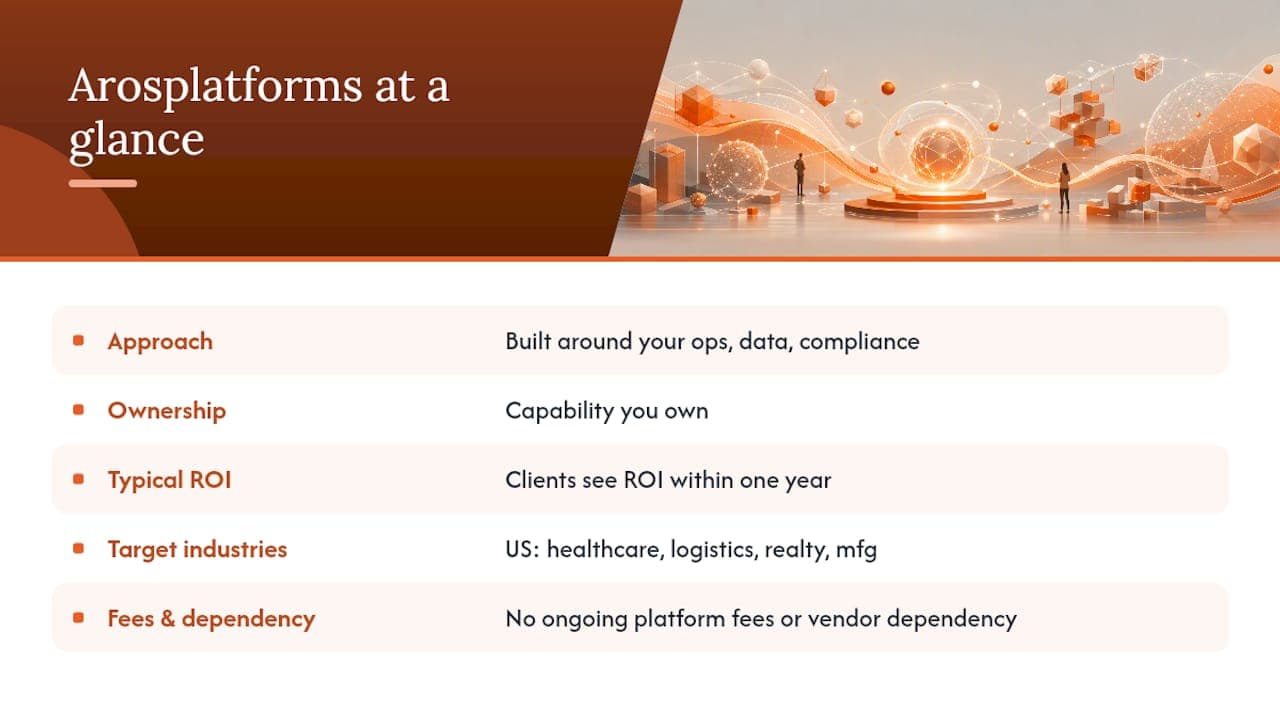
The providers compared above each require you to adapt to their architecture. Arosplatforms works the other way: it builds the AI system around your operations, your data, and your compliance requirements — then hands it to you.
For US enterprises in healthcare, logistics, real estate, or manufacturing, that distinction is the difference between a tool you rent and a capability you own. Clients typically see ROI within a year and a significant improvement in turnaround time on key tasks, without ongoing platform fees or vendor dependency.
Talk to the Arosplatforms US team to scope a custom engagement for your industry.
Sources
Use these for due diligence, technical validation, and scoping conversations:
- How to Choose an AI Consulting Partner | Human Agency
FAQ
Who are the top enterprise AI platforms right now?
DataRobot, H2O.ai, and C3.ai are widely recognized platforms for enterprise ML and operational AI. For fully custom, industry-specific deployments, Arosplatforms and Accenture’s AI practice are the primary consultancy-led options.
Which AI is better than ChatGPT for writing tasks?
Several specialized writing tools outperform ChatGPT on drafting and editorial workflows in 2026 — the right choice depends on your content type and integration needs, not the model alone.
What is the biggest risk of choosing a platform over a consultancy?
Vendor lock-in: your model weights, pipeline logic, and data artifacts stay on the vendor’s infrastructure, making migration costly. Always ask who owns the deliverables at contract end before signing.
How long does enterprise AI implementation typically take?
Timelines vary by complexity. A well-scoped vertical use case like predictive maintenance can reach production in months; cross-system enterprise transformations with Accenture-scale scope typically run one to three years.