Human Decision Making in Enterprise AI: A Practical Guide
Human Decision Making in Enterprise AI: A Practical Guide
Where AI should act autonomously and where humans must keep decision rights is determined by a risk × ambiguity matrix you design, govern, and update quarterly. That single design choice separates organizations that run dependable AI operations from those performing oversight theater.
Your immediate next step: run a one-day workshop to map three high-value workflows into that matrix. Use MIT CISR’s AI decision matrix as your framework anchor, cross-reference CSET’s four-stage operationalization guide, and apply Arosplatforms’ decision-rights templates to produce a prioritized short list of workflows ready for shadow-mode piloting.
- Map three workflows to the risk × ambiguity matrix
- Assign human vs. AI authority for each quadrant
- Identify which workflows are reversible enough to pilot first
- Schedule 2–4 weeks of shadow-mode running before any autonomous action
Key Takeaways
Effective human decision making in AI systems requires a governed decision-rights matrix, enforced review SLAs, and override logs treated as calibration data, not failure signals.
| Point | Details |
|---|---|
| Use the risk × ambiguity matrix | Assign human vs. AI authority per quadrant before any workflow goes live. |
| Start with reversible, high-volume workflows | Shadow-mode errors are recoverable and override logs accumulate faster for calibration. |
| Treat overrides as training signals | Feed override logs back into model calibration quarterly to expand autonomy over time. |
| Enforce review SLAs operationally | Measure SLA compliance on a monitoring dashboard; aspirational SLAs produce backlog, not oversight. |
| Arosplatforms delivers end-to-end HITL design | From decision-rights workshop through production deployment, with clients reaching ROI within 12 months. |
Table of Contents
- How do you know when to keep humans in the loop?
- What does a concrete decision-rights framework look like?
- What does the planning stage require?
- How should you approach implementation, testing, and security?
- How do you run deployment and ongoing operations?
- What roles and governance structures does this require?
- How do you measure success and prove ROI?
- Your one-page decision-rights checklist
- Short enterprise examples showing time-to-value
- How cognitive biases affect organizational decision processes
- How emotions and social dynamics shape review decisions
- Decision-making models that inform HITL system design
- Methods for improving decision quality and reducing errors
- Where most leaders get the sequencing wrong
- Arosplatforms designs and deploys HITL decision systems for U.S. enterprises
- Sources
- FAQ
How do you know when to keep humans in the loop?
The answer turns on five criteria, not intuition. BetterCloud’s enterprise HITL analysis names reversibility and blast radius as the two most operationally decisive axes, and the logic holds up in practice.
- Impact magnitude: How many downstream records, transactions, or people does one decision touch?
- Ambiguity/uncertainty: Does the AI’s confidence score fall below a defined threshold, or does the input contain novel patterns outside training distribution?
- Reversibility: Can the action be undone in under 60 seconds, or does it trigger a cascade of irreversible downstream steps?
- Regulatory and compliance constraints: Does the workflow touch HIPAA, SOX, FCRA, or another regulated domain where human accountability is legally required?
- Accountability requirements: Is there a named human who must be able to explain and defend the decision to an auditor or regulator?
Operationalizing “blast radius” means counting affected records or dollar exposure per decision. A payment approval touching $50,000 and 200 vendor records has a large blast radius; a document-classification tag does not. Low reversibility plus large blast radius means pre-approval is required, full stop.
Pro Tip: Prefer upstream intervention for low-reversibility actions. Placing a human review gate before the action fires is categorically safer than a post-action audit. Measure review SLA as an operational metric on your monitoring dashboard, not as a governance checkbox buried in a quarterly report.
What does a concrete decision-rights framework look like?
The matrix has two axes: risk/impact (low to high) and ambiguity/uncertainty (low to high). Each quadrant maps to a default autonomy model.
For each row, policy should specify: the approval owner by role (not by name), the reversal process, and the telemetry to capture — confidence score, input provenance, and the specific features that drove the output. The HITL 2.0 framework from Thorsten Meyer formalizes trigger types as confidence threshold, risk score, and anomaly detection, which map cleanly onto these quadrants.
One design error to avoid: placing humans in the notification stream rather than the decision stream. A Slack alert sent after an action fires is not human-in-the-loop. Intervention must occur at a point where a human can change the outcome.
Pro Tip: Treat the matrix as a living document. Review it quarterly and feed it with override logs. If override rates in a quadrant are trending down, you have evidence to expand autonomy. If they are spiking, tighten the trigger threshold before the next incident.
- Document each policy row in version-controlled format
- Assign a named policy owner per workflow tier
- Log every override with reason code and timestamp
What does the planning stage require?
CSET’s operationalization guidance breaks production readiness into four stages: plan, implement, deploy, and operate. The planning stage is where most projects fail quietly.
Stakeholders to include from day one:
- Workflow owner (defines the decision and its business rules)
- Policy owner (sets authority tiers and SLAs)
- Approver tiers (the humans who will sit in review queues)
- Platform and DevOps lead
- Security and legal/compliance
- Change management lead
Data readiness criteria before any build begins:
- Inputs are clean, labeled, and accessible via API or event stream
- Baseline performance metrics exist for the current human process
- Audit trail requirements are documented and technically feasible
- Label quality has been validated against ground truth
Suggested planning timeline:
- Week 0–1: Stakeholder alignment workshop, workflow selection
- Week 2–3: Decision taxonomy draft, data readiness audit
- Week 4–6: AI risk assessment and compliance review
- Week 7–8: Shadow-mode pilot plan finalized, baseline metrics locked
Pro Tip: Redesign the workflow before you automate it. Dropping AI onto a broken process produces faster errors. Map the current state, identify the decision points, and define what “correct” looks like before writing a single prompt or training a single model.
How should you approach implementation, testing, and security?
Build vs. buy turns on three variables: how differentiated your decision logic is, how fast you need to move, and how much ongoing maintenance your team can absorb. Buy components for commodity tasks (document parsing, classification, scheduling). Build custom agents where your decision rules encode proprietary business logic or where vendor lock-in creates unacceptable risk.
Integration checklist:
- APIs wired to CRM, ERP, or ticketing system with event-driven triggers
- Role-based access controls enforced at the agent layer, not just the UI
- Reversible control primitives: every action the AI can take must have a corresponding undo operation
- Secrets management via a vault, not environment variables
Testing gates before any autonomous action is permitted:
- Shadow mode on real production data for 2–4 weeks, with accuracy metrics shared transparently with the teams who will use the system
- A/B comparison against the current human baseline
- Edge-case fuzz testing with inputs outside training distribution
- Adversarial tests targeting known failure modes
- Vulnerability scan of all API endpoints and data access paths
Diosh Lequiron’s AI integration guide is direct on this point: governance prerequisites — a named accountability owner, a monitoring mechanism, and a documented override path — must be in place before deployment, not retrofitted afterward.
How do you run deployment and ongoing operations?
Roll out in stages: production shadow first, then soft launch to a single cohort, then full launch. Each stage requires a go/no-go gate based on measured accuracy and override rate, not a calendar date.
Monitoring metrics to track from day one:
- Accuracy and precision by cohort
- Confidence score distribution (watch for drift toward the boundary)
- Override rate and override reason codes
- Escalation latency against defined SLAs
- False positive and false negative rates by decision type
- Model drift indicators (input distribution shift)
| SLO | Target | Alert Threshold |
|---|---|---|
| Review queue SLA | resolved within defined window | Below 90% triggers incident |
| Override rate | Baseline established in shadow mode | increase triggers review |
| Escalation latency | Under 2 hours for approval-required tier | Over 4 hours triggers page |
Incident response needs an owner, a containment step (pause autonomous actions for the affected workflow), a rollback mechanism, a communications template, and a post-incident calibration session. Every override, reversal, and incident feeds back into model improvement and policy updates. That feedback loop is what converts human oversight from a cost center into a performance lever.
What roles and governance structures does this require?
Role taxonomy:
- Operators: monitor review queues and execute approvals within defined SLAs
- Approvers: hold authority for the approval-required tier; named per workflow
- Incident owners: on-call rotation for containment and rollback
- Policy owners: update the decision-rights matrix and version AI policies
- Senior governance committee: quarterly calibration reviews, maturity assessments, and policy change authority
Training and onboarding steps:
- Decision criteria walkthrough for each workflow tier
- Anomaly examples drawn from shadow-mode logs
- Simulated override exercises before live queue access
- Quarterly refresher tied to calibration review findings
Policy documents should be versioned, scoped by workflow, and include: decision tiers, trigger definitions, SLAs, override logging fields, and escalation paths. The Arosplatforms AI governance framework and Arosplatforms’ responsible AI policy provide template structures for U.S. enterprise deployments.
How do you measure success and prove ROI?
| KPI | Target | Owner | Cadence |
|---|---|---|---|
| % decisions automated | Increases each quarter | Platform lead | Monthly |
| Override rate | Trending down post-calibration | Policy owner | Occasionally |
| Time saved per decision | Measured vs. baseline | Workflow owner | Periodic |
| Escalation latency | Within SLO most of the time | Ops lead | Weekly |
| Incident rate | Zero P1 incidents per quarter | Incident owner | Quarterly |
The Rework AI decision-making maturity guide maps a five-level maturity model from basic analytics to autonomous strategic intelligence. Most enterprise teams reach measurable ROI at level 3, typically within 3–12 months of a structured pilot.
Secondary metrics worth tracking: reviewer throughput, review SLA compliance trend, false positive/negative trend by cohort, and calibration drift between quarterly reviews.
Your one-page decision-rights checklist
Use this checklist to run the pilot workshop and move into production.
- Select three candidate workflows using the risk × ambiguity matrix
- Map each workflow to a quadrant and assign a default autonomy model
- Define roles: workflow owner, policy owner, approver tier, incident owner
- Set SLAs for each review tier and document them in the policy template
- Run 2–4 weeks of shadow mode on real production data
- Collect override logs with reason codes throughout shadow mode
- Review accuracy metrics and override rate against baseline before advancing
- Schedule quarterly calibration review and assign the policy owner now
Follow-up ownership handoffs:
- Platform/DevOps owns integration and monitoring setup
- Legal/compliance signs off on the decision taxonomy before shadow mode begins
- Change management lead owns reviewer training and communication plan
Download the one-page template and start your pilot by contacting Arosplatforms for a decision-rights workshop.
Short enterprise examples showing time-to-value
Supply-chain exception routing (logistics, mid-size distributor): The team mapped supplier exception approvals to the approval-required quadrant. After a period of shadow mode, AI recommendations closely matched human decisions, and the override rate declined notably over time as the model was calibrated against override logs. Total review time per exception fell from 47 minutes to under 8 minutes.
Access provisioning (financial services, 1,200-seat enterprise): IT mapped access provisioning to bounded-autonomous for standard roles and approval-required for privileged access. Shadow mode surfaced three edge cases the policy had not anticipated. Post-launch, provisioning SLA compliance improved significantly within a few months.
Arosplatforms engagement summary: In a representative consulting engagement, Arosplatforms embedded within client operations to map decision workflows, build the rights matrix, and deploy a custom AI operating system with Anthropic-powered safety controls.
How cognitive biases affect organizational decision processes
Even well-designed HITL systems can fail if the humans in the loop are not aware of the cognitive patterns that distort judgment. Confirmation bias leads reviewers to approve AI recommendations that match their prior expectations without scrutinizing the inputs. Automation bias is the specific tendency to defer to AI outputs even when something feels off, because the system “should know.” Both patterns erode the value of human oversight.
Anchoring is particularly dangerous in approval queues: the first number or recommendation a reviewer sees shapes every subsequent judgment in that session. Availability heuristic causes reviewers to weight recent incidents heavily, which can produce inconsistent override rates across time.
The practical fix is structural, not motivational. Randomize the order in which recommendations are presented. Require reviewers to record a reason code before seeing the AI’s confidence score. Rotate reviewers across workflow types to prevent over-familiarity. These design choices reduce bias without relying on individual willpower.
How emotions and social dynamics shape review decisions
Reviewer fatigue is a real operational risk. Decision quality degrades after extended queue sessions, a pattern well-documented in behavioral research on judicial decisions and clinical triage. Queue length, time of day, and workload pressure all affect override rates in ways that have nothing to do with model accuracy.
Social dynamics compound the problem. Reviewers who know their decisions are visible to a senior approver tend to be more conservative, which inflates escalation rates. Peer pressure in team review settings can suppress dissent from the reviewer who spots a genuine anomaly.
Mitigate these factors by capping daily review queue depth per reviewer, building mandatory break intervals into queue tooling, and making override reason codes visible to the policy owner but not to the reviewer’s immediate manager. Anonymized override data surfaces patterns without creating social pressure that distorts individual judgment.
Decision-making models that inform HITL system design
Three frameworks from decision-making psychology translate directly into system design choices.
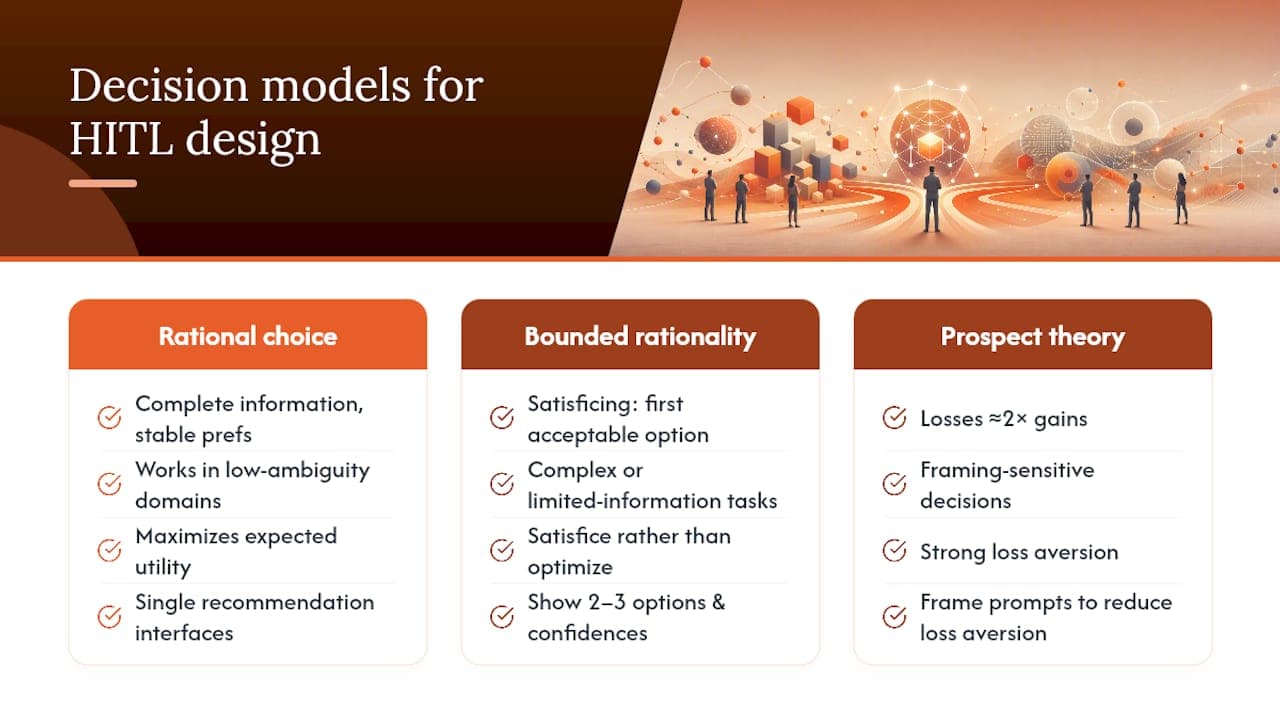
Rational choice theory assumes a decision-maker with complete information and stable preferences who maximizes expected utility. This is the model most AI recommendation engines implicitly assume. It works well in low-ambiguity, well-defined domains. It breaks down wherever inputs are incomplete or preferences shift with context.
Bounded rationality, Herbert Simon’s corrective, holds that humans satisfice rather than optimize: they accept the first option that clears a threshold rather than exhaustively comparing all options. HITL systems that present a single AI recommendation exploit this tendency. Presenting two or three ranked options with confidence scores and key differentiators produces better human decisions than a single recommendation with a binary approve/reject interface.
Prospect theory, developed by Daniel Kahneman and Amos Tversky, shows that humans weight losses roughly twice as heavily as equivalent gains. In practice, reviewers will override AI recommendations more aggressively when the framing emphasizes potential downside than when it emphasizes potential upside, even for identical expected values. Interface designers who understand this can frame decision prompts to reduce loss-aversion-driven over-caution in low-risk quadrants.
Methods for improving decision quality and reducing errors
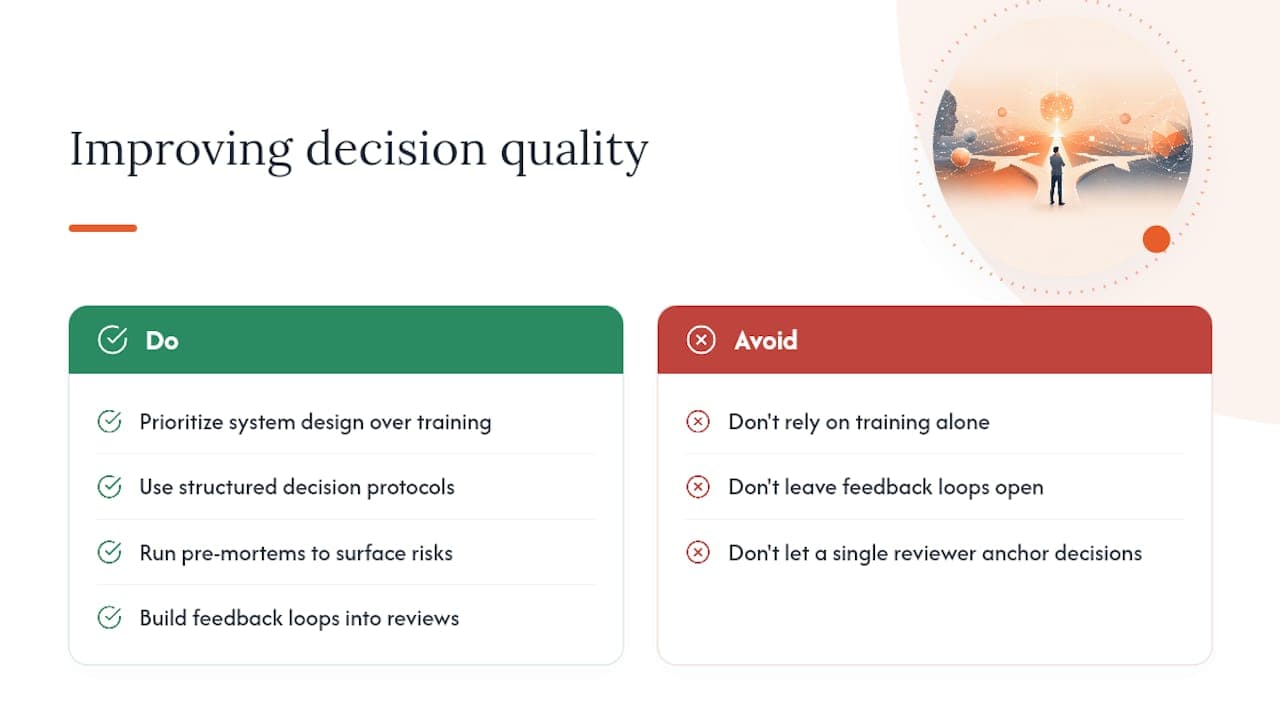
The most durable improvements come from system design, not from training people to “think better.”
Structured decision protocols reduce variance. Pre-mortems, where a reviewer imagines the decision has already failed and works backward to identify why, surface risks that forward-looking analysis misses. Checklists, as Atul Gawande documented in surgical settings, reduce error rates in high-complexity, high-stakes decisions by externalizing working memory.
Feedback loops are the single highest-leverage intervention. When reviewers see the downstream outcome of their decisions, accuracy improves over time. Most enterprise systems do not close this loop. Building outcome tracking into the review interface, even a simple “was this decision correct?” flag resolved 30 days later, produces measurable calibration gains.
Diverse review panels for high-stakes decisions reduce the impact of individual bias. A single reviewer anchors; two reviewers with different functional backgrounds produce more consistent outcomes. For the assist-only quadrant, structured dissent protocols (requiring the second reviewer to argue against the recommendation before agreeing) further reduce groupthink.
Predictive analytics tools can surface the historical base rate for a decision type before the reviewer sees the specific case, which counters availability bias and anchors judgment to the actual distribution rather than recent memorable examples.
Where most leaders get the sequencing wrong
The standard failure mode is not choosing the wrong model. It is deploying the right model into an organization that has not decided who owns the decision.
Vague ownership is the most common root cause of HITL failure. When the policy says “the team” reviews exceptions, no one reviews them on a Friday afternoon. When the SLA is aspirational rather than enforced, the review queue becomes a backlog that the system learns to route around.
The second failure mode is starting with the highest-stakes, lowest-reversibility workflows because they have the most visible ROI. Those workflows are exactly the wrong place to start. Begin with high-volume, reversible decisions where shadow-mode errors are recoverable and override logs accumulate quickly. The data you collect in the first 90 days of a reversible pilot is worth more than any pre-deployment analysis.
Oversight theater, where a human receives a notification after an irreversible action has already fired, is worse than no oversight at all. It creates the appearance of control while providing none, and it trains reviewers to treat the queue as a formality.
Arosplatforms designs and deploys HITL decision systems for U.S. enterprises
Most organizations can map their decision workflows and build the rights matrix in a single structured workshop. Getting from that map to a production system with enforced SLAs, monitored override rates, and quarterly calibration is where engagements stall without the right technical and operational support.
Arosplatforms embeds directly within client operations to design the decision-rights matrix, build custom AI agents with Anthropic-powered safety controls, and deploy a governed enterprise AI platform that your team owns without vendor lock-in. Clients across logistics, healthcare, financial services, and manufacturing reach measurable ROI within about a year, with substantially faster turnaround on key decision workflows.
The starting point is a one-day decision-rights workshop. Request your workshop with Arosplatforms for U.S. enterprises and leave with a prioritized pilot plan the same day.
Sources
- MIT CISR: AI decision matrix and enterprise guidance
- CSET — Operationalizing AI Guidance (planning → implementation → deployment → operation)
- Human-in-the-Loop Operations 2.0: From Safety Net to Performance System - Thorsten Meyer AI
FAQ
What is a decision-rights matrix in AI systems?
A decision-rights matrix maps each workflow against two axes, risk/impact and ambiguity/uncertainty, to assign whether AI acts autonomously, requires human approval, or only assists. MIT CISR frames this as a deliberate organizational design choice, not a safety checkbox.
How long should shadow mode run before going live?
Shadow mode should run on real production data for 2–4 weeks, with accuracy metrics shared transparently with the teams who will use the system. This timeline surfaces edge cases and builds reviewer trust before any autonomous action is permitted.
What is the most common reason HITL systems fail?
Vague ownership is the leading root cause. When no named individual holds the review SLA, queues become backlogs and oversight becomes performative. Assigning a named policy owner and enforcer per workflow tier before deployment prevents this.
How does Arosplatforms support decision-rights design?
Arosplatforms embeds within client operations to map decision workflows, build the rights matrix, and deploy custom AI systems with Anthropic-powered safety controls. Clients typically reach measurable ROI within 12 months.
How often should the decision-rights matrix be reviewed?
Review the matrix quarterly, using override logs as the primary input.
Recommended
Related: custom AI development.