Best AI Document Processing Tools for Analysts: 2026 Guide
Best AI Document Processing Tools for Analysts: 2026 Guide

For enterprise analysts and operational leaders, the best AI document processing tools are not off-the-shelf SaaS subscriptions. They are custom-built, consultancy-designed systems that own your extraction logic, integrate with your downstream platforms, and produce defensible audit trails. Hiring a consultancy to design and build a custom AI operating system for document intelligence gives you something a SaaS license never can: full ownership of the schema, the models, and the accountability chain.
Arosplatforms designs exactly this kind of system for mid-sized and enterprise organizations across healthcare, finance, logistics, legal, and manufacturing in the United States. The sections below give you the architecture, methodology, vetting checklist, and budget guidance to commission one with confidence.

Table of Contents
- What does an enterprise AI document-processing stack actually look like?
- When should you hire a consultancy instead of building in-house?
- How Arosplatforms designs and delivers custom document-processing systems
- What questions should you ask before signing a consultancy engagement?
- What does a custom build actually cost, and how long does it take?
- What use cases deliver the clearest ROI?
- Which KPIs and governance items should you track during pilot and production?
- Key Takeaways
- Why the “just point AI at your documents” approach keeps failing
- Arosplatforms builds custom document-processing systems for US enterprises
- Useful sources and prep materials
- FAQ
What does an enterprise AI document-processing stack actually look like?
Document intelligence is a layered system, not a single model. Each layer has a distinct job, and the decision of what to buy versus what to build custom changes at every level.
- Ingest: File receipt, format normalization, deduplication, and quality checks. Buy commoditized storage and queue infrastructure here.
- OCR/layout parsing: Convert raw PDFs, scans, and forms into structured layout objects. This is where most enterprise projects fail. Naive RAG over PDFs hits an accuracy ceiling near 65% because PDFs flatten tables and break cross-references. The fix is substrate engineering, not a better model.
- Classification: Route each document to the correct extraction schema. Buy pre-trained classifiers; customize for domain-specific document types.
- Extraction/NER: Pull named entities, field values, and relationships. This is the custom core. Domain IP lives here.
- Validation/audit signature: Every extracted field carries provenance, confidence score, and a reviewer trail. Define this before build begins or regulated deployments will fail.
- Structured target: Write clean, typed outputs to your data warehouse, ERP, or case management system.
- Routing/integration: API connectors to downstream systems. Custom work, always.
- Monitoring/MLOps: Drift detection, retraining triggers, and SLA dashboards. Buy tooling; build the governance logic.
A well-designed architecture diagram shows these layers as a vertical stack with data flowing top-to-bottom and an audit trail running parallel on the right side, capturing provenance at every stage.
Pro Tip: Treat documents as structured data graphs with typed nodes rather than unstructured blobs. Practitioners who build the harness first — parsing, provenance, deterministic checks — before touching the model layer consistently outperform teams that start with a vector store and work backward.
When should you hire a consultancy instead of building in-house?
Hire a consultancy when you need production-grade auditability, named accountability, and integrations with regulated downstream systems. Consider an internal pilot when document variance is low, the workload is non-regulated, and your team has ML engineering capacity to spare.
Five signals that point toward a consultancy engagement:
- Regulatory exposure — HIPAA, SOC 2, or federal compliance requirements demand documented audit trails and data residency controls your internal team cannot certify alone.
- High document variance — more than three or four distinct document types with different layouts, languages, or schemas.
- Downstream complexity — outputs must feed an ERP, claims platform, or loan origination system via tested API connectors.
- No named owner — NIST guidance on trustworthy AI emphasizes that accountability must be assigned to a specific person before deployment, not after. If that person does not exist in your org chart yet, the build should not start.
- Time pressure — a fixed-bid consultancy pilot delivers a working system in 4–6 weeks; an internal team exploring the same problem typically takes two to three quarters to reach the same milestone.
Hybrid approaches work well when you have internal data engineers who can own the infrastructure layer while the consultancy designs the extraction logic, audit signature, and integration connectors.
How Arosplatforms designs and delivers custom document-processing systems
Arosplatforms collapses strategy and build into one accountable engagement. There is no separate “strategy deck” phase that hands off to a different implementation team.
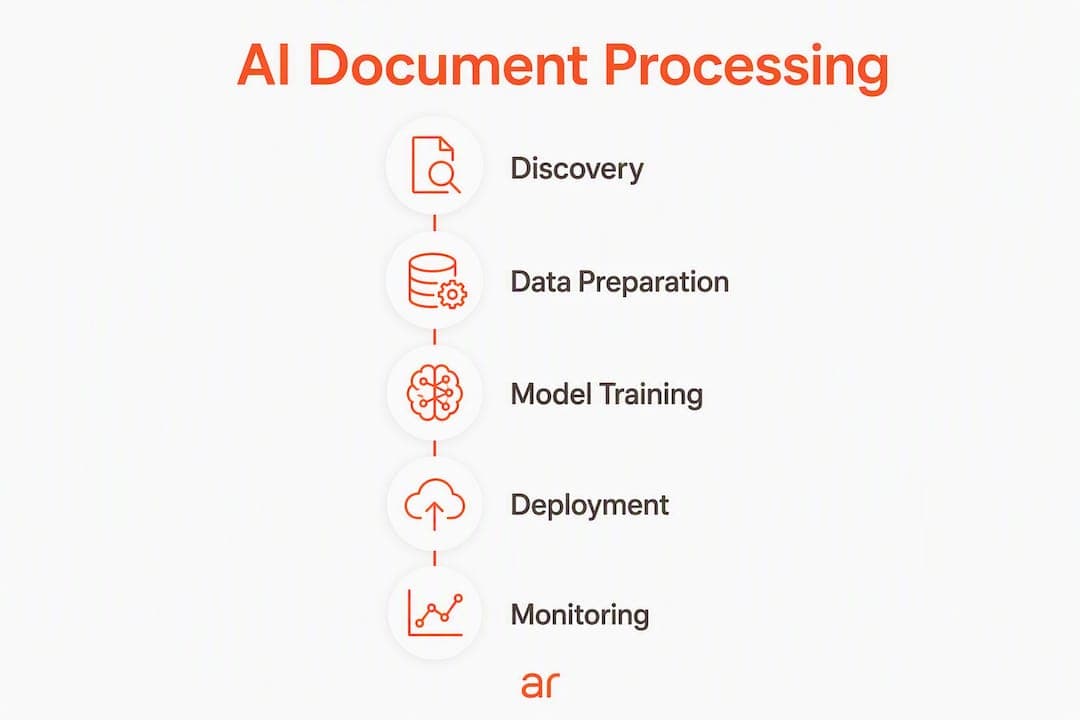
| Phase | Typical Duration | Key Deliverables |
|---|---|---|
| Discovery | 1–2 weeks | Document inventory, downstream system map, named owner confirmed, audit signature defined |
| Custom IDP design | 1–2 weeks | Extraction schema, classification taxonomy, integration spec |
| Model training | 1–2 weeks | Domain-trained extraction models on client document samples |
| Human-in-loop setup | 1 week | Reviewer workflows, confidence thresholds, escalation rules |
| Integration/testing | 1–2 weeks | API connectors, acceptance test suite, sandbox validation |
| Production go-live | Ongoing | SLA dashboards, drift alerts, retraining schedule |
The full path from discovery to a working pilot typically runs 4–6 weeks. Models typically start near 93% field-level accuracy at launch and can improve to 99%+ by month 12 through retraining and human review feedback loops.
Clients across Arosplatforms’ portfolio report ROI within a year and significantly faster turnaround on key document tasks. The Arosplatforms customer stories page carries case study details by vertical.
What questions should you ask before signing a consultancy engagement?
Vetted consultancies must demonstrate ownership of auditability, integration capability, and a clear handover plan. Here is what to probe.
Technical questions to ask:
Ask for the consultancy’s parser accuracy on documents structurally similar to yours, specifically on tables and multi-column layouts. Ask how they define and store provenance for each extracted field. Ask what their eval suite looks like: golden sets, field-level precision/recall, and how they detect drift after go-live.
Red flags in proposals:
Watch for proposals that describe accuracy in aggregate (“95% overall”) without field-level breakdowns. No audit signature definition is a hard stop. Vague ownership language (“the client will manage retraining”) without a named process is a governance gap. Lock-in terms that prevent you from exporting your extraction schemas or models are unacceptable.
Contract clauses to require:
- IP ownership of extraction schemas and trained model weights assigned to you, not the consultancy.
- Data residency and encryption standards stated explicitly (at-rest and in-transit).
- SLA definitions tied to field-level accuracy and turnaround time, not just uptime.
- An escape/handover clause that gives you a documented runbook and model artifacts if the engagement ends.
- Change management terms covering schema updates and document type additions.
Pro Tip: Fixed-bid pilot pricing, as opposed to time-and-materials, forces the consultancy to scope accurately and aligns their incentives with your acceptance criteria. Boutique AI consultancies that ship code rather than decks typically offer this model — ask for it explicitly.
What does a custom build actually cost, and how long does it take?
Costs vary with scope, document variance, integration complexity, and governance obligations. A fixed-bid discovery and pilot for a mid-enterprise use case typically lands in the low six figures. Complex regulated programs with multiple document types, multi-system integrations, and compliance controls run higher.
Primary cost drivers:
- Discovery depth — number of document types, downstream systems, and compliance requirements scoped.
- Document variance — more layout variants require more training data and longer model iteration cycles.
- Integration complexity — each API connector to an ERP, CRM, or claims platform adds scoping and testing time.
- Security and compliance controls — data residency, encryption, audit logging, and access controls.
- Human review setup — reviewer interface, escalation workflows, and training for the named owner’s team.
- Ongoing managed services — retraining cadence, drift monitoring, and SLA reporting post-launch.
Procurement checklist:
- Issue a focused RFP to three to five consultancies with a sample document set and a list of downstream systems.
- Require a fixed-bid pilot proposal with acceptance criteria tied to field-level accuracy targets.
- Evaluate pilot proposals on schema ownership, audit signature definition, and integration test environment.
- Tie payment milestones to acceptance tests, not calendar dates.
- Include a holdback (typically 10–15%) released only after 30-day SLA performance is confirmed.
What use cases deliver the clearest ROI?
Target document workflows where throughput, accuracy, and auditability map directly to a dollar outcome. The strongest candidates are claims processing, loan underwriting, contract analytics, and compliance remediation.
| Use Case | Leading KPIs | Target Thresholds | Measurement Period |
|---|---|---|---|
| Claims processing | Automation rate, turnaround time | — | Monthly |
| Loan underwriting | Field accuracy, reviewer time | 95%+ field precision, 50% time reduction | 90-day pilot |
| Contract analytics | Clause extraction recall, cycle time | 90%+ recall, — | Quarterly |
| Compliance remediation | Coverage rate, audit pass rate | 100% coverage, zero missed flags | Per audit cycle |
| Invoice processing | Match rate, exception rate | — | Monthly |
Measurement approach: build a golden set of 200–500 manually verified documents before the pilot starts. Measure field-level precision and recall against that set at launch, at 30 days, and at 90 days. Track reviewer queue size and cost per document over time. These four metrics give you everything you need to defend the program to auditors and executives.
The AI document extraction use case page at Arosplatforms shows real-world KPI examples by vertical.
Which KPIs and governance items should you track during pilot and production?
Track field-level precision/recall, parser consistency, reviewer queue size, drift alerts, and end-to-end latency as your primary operational KPIs.
- Daily: Document throughput, end-to-end latency, reviewer queue depth, SLA breach count.
- Weekly: Field-level precision/recall by document type, human review rate, exception escalation rate.
- Monthly: Drift detection results, model retraining decisions, cost per document, audit signature compliance rate.
Implementation checklist before go-live:
- Named human owner confirmed and trained on reviewer workflows.
- Audit signature documented and signed off by compliance.
- Golden evaluation set locked and versioned.
- Integration acceptance tests passed in sandbox environment.
- Rollback plan documented with a tested restore procedure.
Governance runbook items: define an incident response process for mis-extractions (who gets notified, what gets flagged, how the record is corrected). Schedule periodic model re-evals tied to document volume milestones. Document every schema change with a version log. Enterprise document intelligence architectures built with structure-first retrieval and relational outputs are significantly easier to audit and maintain than vector-store-only approaches.
Key Takeaways
A consultancy-led, custom AI document-processing system built as a layered stack delivers ownership, auditability, and measurable ROI that off-the-shelf SaaS tools cannot match in regulated enterprise environments.
| Point | Details |
|---|---|
| Custom build beats SaaS for regulated use cases | Ownership of extraction schemas, audit signatures, and integration connectors is non-negotiable in regulated environments. |
| Accuracy improves over time | Models typically start near 93% field-level accuracy at launch and can reach 99%+ by month 12 through retraining and human review loops. |
| Pilot in 4–6 weeks | A fixed-bid discovery-to-pilot engagement delivers a working production system in 4–6 weeks, not quarters. |
| Name an owner before build starts | NIST governance guidance requires a named human accountable for AI outputs before deployment begins. |
| Arosplatforms delivers end-to-end | Arosplatforms designs, builds, and hands over custom document-processing systems with 82% faster turnaround and ROI within 12 months. |
Why the “just point AI at your documents” approach keeps failing
The conventional wisdom in enterprise AI procurement is to start with a SaaS tool, prove value in a pilot, and then scale. The problem is that the pilot almost always works on clean, uniform documents — and production fails on the messy ones. Tables that span pages, scanned forms with variable layouts, PDFs that flatten cross-references: these are not edge cases in enterprise document workflows. They are the majority of the volume.
The real failure mode is not the model. It is the substrate. Teams that skip the harness engineering phase and go straight to a language model end up with a system that performs well in demos and poorly in production. By the time the accuracy ceiling shows up, the budget is spent and the named owner is frustrated.
The consultancy-first approach forces substrate engineering into week one. The audit signature gets defined before a single model is trained. The extraction schema is owned by the client, not the vendor. That sequence is not just good practice — it is the difference between a system that passes a compliance audit and one that does not.
Arosplatforms builds custom document-processing systems for US enterprises
Operational leaders who need production-grade document intelligence — not another SaaS subscription to manage — get something specific from Arosplatforms: a single accountable team that designs the architecture, trains the models, builds the integrations, and hands over a system you own outright.
Services relevant to document processing engagements include discovery and document inventory, custom IDP design and extraction schema ownership, domain model training with human-in-loop review workflows, API integration to your ERP, CRM, or claims platform, MLOps setup with drift monitoring and retraining schedules, and ongoing managed services with documented SLAs.
Clients report ROI within a year and significantly faster turnaround on key tasks. The engagement starts with a fixed-bid discovery call. Book your discovery call for US enterprises and get a scoped pilot proposal within two weeks.
Useful sources and prep materials
Before a discovery call, prepare a document inventory (types, volumes, formats), a sample set of 50–100 representative documents, a list of downstream systems that need to receive structured outputs, and the name of the person who will own the system post-launch.
- Enterprise Document Intelligence: building RAG brick by brick (Angela Shi / Medium)
- The document is the last unsolved data structure (Built In)
- Intelligent document processing — definition and glossary (Arosplatforms)
- AI case studies and customer stories (Arosplatforms)
- Best PandaDoc alternatives for AI proposal and document teams
FAQ
What makes a custom AI document-processing system better than SaaS?
Custom systems give you ownership of the extraction schema, audit trail, and model weights, which SaaS tools do not. In regulated industries, that ownership is required for compliance and auditability.
How long does it take to go from discovery to a working pilot?
A consultancy-led engagement typically delivers a working production pilot in 4–6 weeks, covering discovery, model training, human-in-loop setup, and integration testing.
What accuracy should I expect from a custom document-processing system?
Models typically start near 93% field-level accuracy at launch and can improve to 99%+ by month 12 through retraining and human review feedback loops.
What is an audit signature and why does it matter?
An audit signature is a precise definition of what a defensible extracted field looks like, including provenance, confidence score, and reviewer trail. Without it, extracted data cannot be defended in a regulated audit.
How does Arosplatforms structure its engagements?
Arosplatforms uses a fixed-bid, phased model: discovery, custom IDP design, model training, integration, and production go-live, with clients reporting ROI within 12 months and 82% faster turnaround on key document tasks.