AI in Government Workflow Efficiency: A 2026 Guide
AI in Government Workflow Efficiency: A 2026 Guide

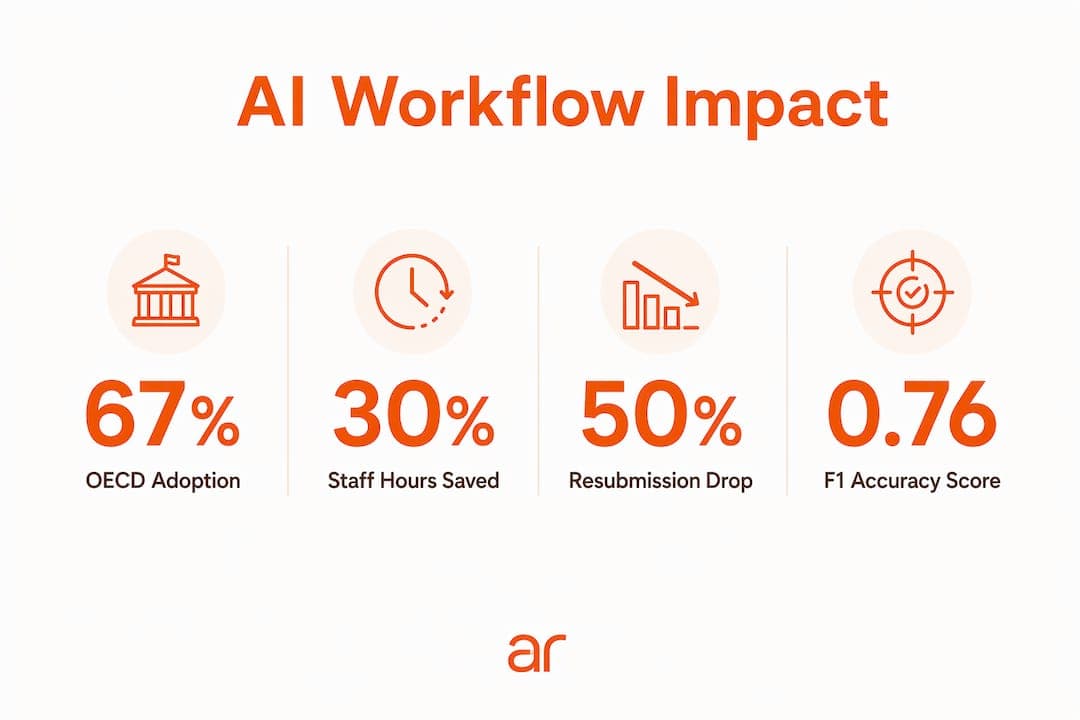
Artificial intelligence is already cutting tens of thousands of staff hours from US government operations, not as a future promise but as a documented outcome. The role of AI in government workflow efficiency covers three core functions: automating repetitive, rules-based tasks; coordinating multi-step processes across agencies; and augmenting human judgment with faster, more consistent information. The City of Bellevue, Washington, is targeting a 30% reduction in 20,000 annual permitting staff hours and a 50% drop in permit resubmissions. The UK government’s “Consult” tool is on track to save a large number of analysis days annually, worth millions in staffing costs. These are not pilots in a lab. They are live deployments reshaping how public agencies operate.
Key AI applications already running in government workflows include:
- Document processing and text categorization — extracting, sorting, and summarizing large volumes of unstructured information
- Permit and application triage — routing submissions by complexity so staff focus on nuanced cases
- Consultation analysis — identifying themes across thousands of public responses in hours instead of weeks
- Internal chatbots — answering routine code and policy questions so staff spend time on complex decisions
- Fraud detection and anomaly monitoring — flagging irregular transactions in tax and benefits administration
- Predictive resource allocation — optimizing staffing levels and service capacity before demand spikes
Table of Contents
- What does AI actually deliver for government workflows?
- How should government agencies approach AI implementation strategically?
- What governance and compliance frameworks does AI in government require?
- How Arosplatforms approaches government AI transformation
- Change management strategies for AI adoption in public sector
- How do you upskill government workers for AI-driven workflows?
- How do you measure AI’s impact on workflow efficiency?
- Arosplatforms: faster ROI on government AI without the guesswork
- Key Takeaways
- FAQ
What does AI actually deliver for government workflows?
The efficiency case is concrete. Approximately 67% of OECD countries have adopted AI to improve public service design and delivery, focusing on automation, resource optimization, and tailored citizen services. The Alan Turing Institute estimates AI could automate a large portion of repetitive public service transactions in the UK, saving a substantial amount of work annually.
| Case Study | Metric | Outcome |
|---|---|---|
| City of Bellevue permitting | Annual staff hours targeted for reduction | 30% of 20,000 hours |
| City of Bellevue permitting | Permit resubmissions targeted | 50% reduction |
| UK “Consult” tool | Annual analysis days saved | — |
| UK “Consult” tool | Annual staffing cost savings | £20 million |
| OECD member countries | AI adoption in public service delivery | — |
Beyond the numbers, qualitative gains matter just as much. Officials who used the Consult tool noted it “takes away the bias and makes it more consistent,” removing opportunities for individual analysts to project preconceived ideas onto consultation responses. That consistency is hard to achieve at scale with human-only review. OECD research confirms that automating text categorization and form filling produces productivity gains by freeing civil servants for complex, judgment-intensive activities.
The accuracy bar is also rising. Consult’s first live evaluation produced an F1 score of 0.76, widely considered “good” for AI classification tools, and human reviewers found differences had a negligible impact on how themes ranked overall.
How should government agencies approach AI implementation strategically?
The most common mistake is mapping AI onto an organizational chart. Agentic AI works across workflows, meaning the recurring, end-to-end processes that cut across agencies, not departmental silos. Think permit issuance, eligibility assessment, and document validation. Those are the units that matter.
A World Economic Forum readiness framework recommends prioritizing information-driven functions before judgment-based ones. Cybersecurity monitoring is lower-risk than eligibility assessment. Starting there builds institutional confidence and generates visible wins before tackling higher-stakes decisions.

Bellevue’s phased approach illustrates this well. Phase one deployed an internal staff chatbot before any public-facing tool launched. Staff learned the system, flagged edge cases, and built trust in the outputs. That groundwork made phases two and three, real-time application guidance and automated triage, far less disruptive.
Best practices for sequencing AI implementation:
- Start with high-volume, rules-based functions where AI reduces manual handoffs without replacing human judgment
- Apply a structured process lens (such as the ESOAR framework: eliminate, standardize, optimize, automate, robotize) before deploying AI into any workflow
- Run small pilots as structured learning exercises, not one-off experiments
- Treat cross-agency coordination as a longer-term goal; data integration challenges in federal systems slow adoption when tackled too early
- Revisit readiness assessments regularly as technology and local conditions shift
Pro Tip: Involve frontline staff from day one. Bellevue’s permit techs shaped the tool’s design directly, which is why traceability and feedback loops were built in early rather than retrofitted later.
What governance and compliance frameworks does AI in government require?
Governance is not optional. It is what separates a trusted deployment from a liability. Germany’s SPARK initiative, which accelerates planning and approval procedures using agentic AI, keeps final decisions with staff while AI prepares information and proposals. A dedicated security review is mandatory before any module enters production. That structure is the standard, not the exception.
Human-in-the-loop design is an operational mandate, not a theoretical safeguard. The UK’s Consult tool gives officials an interactive dashboard to filter, search, and override AI-sorted themes. Agentic AI systems maintain comprehensive audit trails and adapt to workflow exceptions in ways that rigid robotic process automation cannot, which is critical in regulated government environments where every decision must be traceable.
Governance best practices for AI in public administration:
- Embed transparency and traceability into system design from the start, not as an afterthought
- Maintain human override capability at every decision point with legal accountability
- Conduct phased rollouts with security reviews before production deployment
- Define bounded autonomy for AI agents: clear mandates, escalation paths, and audit logs
- Align AI use with fairness and equity standards to avoid entrenching bias in automated decisions
Statistic callout: UK Government AI Governance data shows that systems like Consult, designed with human-in-the-loop oversight, achieved an F1 alignment score of 0.76 on their first live evaluation, with human reviewers confirming negligible impact from AI-human disagreements on overall theme rankings.
How Arosplatforms approaches government AI transformation
Arosplatforms builds customized AI operating systems embedded directly into agency operations, not generic platforms dropped in from outside. Their government practice covers four service areas: AI Agents & Automation, Governance & Compliance, Readiness Assessments, and Infrastructure & MLOps.
What separates Arosplatforms from standard consultancies is the ownership model. Agencies retain control of their systems without vendor lock-in, and teams are trained to manage and extend the AI independently. Clients report an average of 82% faster turnaround on key tasks, with many reaching positive ROI within twelve months.
Core differentiators:
- Workflow-centric deployment that maps to how agencies actually operate, not how org charts are drawn
- Governance and compliance frameworks built in from the design phase
- Readiness assessments that identify where AI creates the most value before any build begins
- Scalable architecture that grows with the agency without requiring a new vendor contract
Change management strategies for AI adoption in public sector
Technology rarely fails because of the technology. It fails because the people operating it were not brought along. Successful AI adoption in government requires treating change management as a parallel workstream, not a final step.
The most effective approach is co-design: involving frontline staff in defining requirements, testing outputs, and refining workflows. When permit techs at Bellevue shaped the chatbot’s design, adoption followed naturally because the tool solved problems they had actually named. Contrast that with top-down deployments where staff discover the system on launch day.
Communication matters at every level. Leadership needs to articulate why AI is being introduced and what it is not replacing. Middle managers need clarity on how their teams’ roles will shift. Frontline staff need hands-on time with the tool before it goes live. Skipping any of those layers creates resistance that slows adoption for months.
Workplace safety compliance tools that automate information-driven monitoring offer a useful model: they succeed when staff understand the system’s logic and trust its outputs, not when they are simply told to use it.
How do you upskill government workers for AI-driven workflows?
Training for AI adoption is not a one-time event. It is an ongoing capability-building program. The OECD notes that nearly two-thirds of workers surveyed reported that AI improved their enjoyment of work, but that outcome depends on preparation, not assumption.
Effective upskilling programs for government agencies focus on three layers. First, AI literacy for all staff: understanding what the system does, how it makes decisions, and when to escalate or override. Second, role-specific training for power users who configure, monitor, and refine AI tools. Third, data stewardship skills across the organization, because AI is only as reliable as the data it runs on.
Agencies that treat AI training as a compliance checkbox tend to see low adoption rates and high error rates. Those that build it into onboarding, performance reviews, and continuous learning cycles see staff confidence grow alongside system performance.
How do you measure AI’s impact on workflow efficiency?
Measurement starts before deployment. Agencies need a baseline: current processing times, error rates, staff hours per task, and citizen satisfaction scores. Without that, there is no way to know whether AI made a difference or just added complexity.
The most useful metrics for government AI programs fall into three categories. Operational metrics track time savings, error reduction, and throughput. Quality metrics track accuracy, consistency, and compliance rates. Outcome metrics track citizen satisfaction, service access rates, and equity impacts.
Bellevue’s permitting project is a strong model: specific targets (30% staff hour reduction, 50% fewer resubmissions) set before deployment, with 198 users in development services already accessing the tool and progress tracked against those benchmarks. That structure turns a pilot into a learning exercise with clear criteria for scaling.
Arosplatforms: faster ROI on government AI without the guesswork
Most government AI projects stall not from lack of ambition but from lack of a clear path from pilot to production. Arosplatforms closes that gap for US agencies by embedding directly into operations, building AI systems the agency owns, and delivering measurable results within twelve months.

The difference is in the approach. Arosplatforms does not hand over a platform and a manual. Their team maps your actual workflows, identifies where AI creates the highest value, and builds governance in from day one, so there are no compliance surprises after launch. Agencies that have worked with Arosplatforms report 82% faster turnaround on key tasks, with full ownership of the system and no ongoing vendor dependency.
If your agency is ready to move from exploring AI to deploying it responsibly, talk to Arosplatforms about a readiness assessment tailored to your workflows.
Key Takeaways
AI in government workflow efficiency delivers the most value when agencies start with high-volume, information-driven functions, embed governance from day one, and treat staff involvement as a deployment requirement, not an afterthought.
| Point | Details |
|---|---|
| Start with information-driven tasks | Functions like document processing and consultation analysis offer high value and lower risk than judgment-based decisions. |
| Real-world results are documented | Bellevue targets 30% fewer staff hours and 50% fewer resubmissions; the UK “Consult” tool saves 75,000 analysis days annually, and £20 million in staffing costs. |
| Governance is non-negotiable | Human-in-the-loop oversight, audit trails, and bounded AI autonomy are operational requirements, not optional safeguards. |
| Change management drives adoption | Co-designing tools with frontline staff, as Bellevue did with permit techs, is what separates successful rollouts from stalled ones. |
| Arosplatforms | Builds government AI operating systems with embedded governance, delivering 82% faster task turnaround and full agency ownership. |
FAQ
How does AI improve government workflow efficiency?
AI automates repetitive, rules-based tasks like document sorting, form processing, and consultation analysis, freeing civil servants for complex decisions. OECD research shows this can produce significant productivity gains across internal operations and public service delivery.
What is the biggest risk of AI in public administration?
Deploying AI without human oversight and audit trails is the primary risk. Systems like Germany’s SPARK and the UK’s Consult are designed with human-in-the-loop controls so final decisions and legal accountability remain with government officials.
Where should a government agency start with AI?
The World Economic Forum recommends starting with high-readiness, information-driven functions such as appointment management, document validation, and public information provision before moving to judgment-based processes like eligibility assessment.
How long does it take to see ROI from government AI projects?
Timelines vary by scope, but Arosplatforms clients typically reach positive ROI within twelve months, with an average of 82% faster turnaround on key tasks from the point of deployment.
What metrics should agencies track to evaluate AI impact?
Track operational metrics (processing time, staff hours, error rates), quality metrics (accuracy, compliance), and outcome metrics (citizen satisfaction, service access rates) against a pre-deployment baseline.