Economic Consulting: Build an AI OS That Pays Off
Economic Consulting: Build an AI OS That Pays Off
In this guide, “economic consulting” means one thing: a custom AI operating system built to automate your highest-volume workflows and deliver measurable ROI. If you own a repeatable process with clear cost or error pain, you should start a discovery engagement now. The right consultancy will map your workflows, propose a scoped pilot, and hand you a system you own outright.
Who should act immediately:
- Operations leaders running manual invoice processing, claims triage, or field-service dispatch at scale
- IT decision-makers whose teams are stitching together point tools and losing data between systems
- Executives who have approved AI budgets but stalled at the pilot stage
Pro Tip: Before your first vendor call, document one workflow end-to-end: inputs, steps, decision points, and error rates. Consultancies that ask for this upfront are the ones worth talking to.
Key Takeaways
Custom AI OS consulting delivers measurable ROI when you start with one scoped workflow, a named internal owner, and contractual IP transfer at project close.
| Point | Details |
|---|---|
| Definition | “Economic consulting” here means custom AI OS design and deployment to automate workflows and deliver measurable ROI. |
| When to engage | Act now if you own a high-volume, repeatable workflow with clear cost or error pain and executive sponsorship confirmed. |
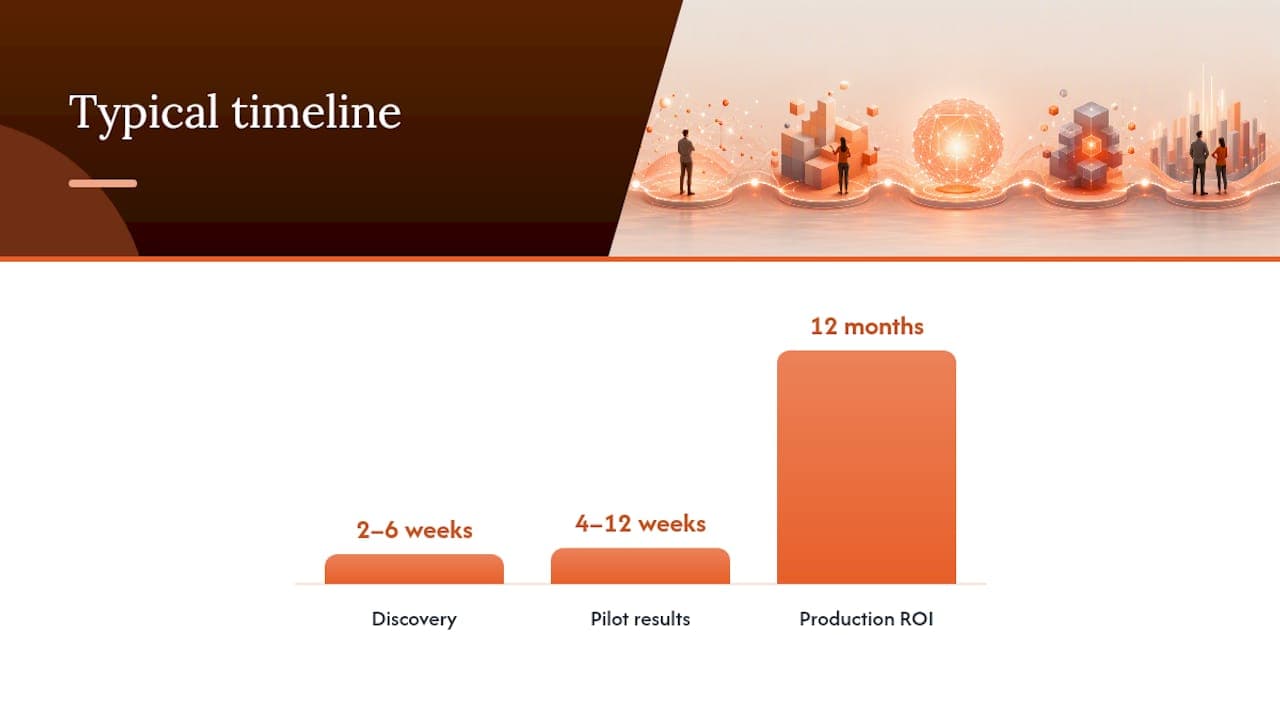
| Typical timeline | Discovery takes 2–6 weeks; expect measurable pilot results within 4–12 weeks and production ROI within 12 months. |
| Top evaluation criteria | Demand measured case studies, runbook handover, IP transfer clauses, and capped pricing before signing. |
| Arosplatforms | Offers a 4–6 week discovery, 82% faster task turnaround in reported engagements, and full client ownership at project close. |
Table of Contents
- What industries hire custom AI OS consultancies?
- What must a custom AI consultancy actually deliver?
- What does a typical engagement timeline look like?
- How does pricing work for a custom AI OS engagement?
- How do you pick the right consultancy?
- Which KPIs and governance structures protect your investment?
- What do real client outcomes look like?
- What are your practical next steps?
- Understanding total cost of ownership and hidden costs
- What contract terms should you negotiate?
- What post-deployment support should you expect?
- What risks should you plan for in an AI consulting project?
- How should you handle compliance, data privacy, and security?
- How do you manage integration challenges and change management?
- Why the Arosplatforms approach is worth understanding
- Arosplatforms builds the AI OS your operations team will actually own
- Sources
- FAQ
What industries hire custom AI OS consultancies?
The organizations that get the most from this kind of business economic advisory share one trait: they have high-volume, rule-bound workflows where errors cost real money. Production use cases that ship span nearly every sector.
- Predictive maintenance (manufacturing, energy): Sensor data feeds a model that flags equipment failure before it happens. Predictive maintenance programs commonly cite cost savings around 30% on maintenance spend when implemented on a unified OT/IT platform.
- Invoice processing (finance, logistics): Automated extraction and three-way matching cuts processing time by 60–80% and nearly eliminates keying errors.
- Claims triage (insurance, healthcare): An AI agent scores and routes incoming claims, reducing average handle time by 40–60%.
- Property portfolio analytics (real estate): Predictive models surface rent-risk and vacancy signals weeks before they show in financials.
- Meeting intelligence (professional services): Auto-summarization and action-item extraction reclaim several hours per team member per week.
- Field-service routing (logistics, utilities): Dynamic scheduling cuts drive time and improves first-visit resolution rates.
- Supply chain exception handling (manufacturing, retail): Agents monitor order and shipment data and escalate anomalies before they become stockouts.
- Clinical intake automation (healthcare): Structured data capture from unstructured patient notes reduces administrative burden on clinical staff.
What must a custom AI consultancy actually deliver?
An AI Operating System is the middle layer your enterprise needs: model gateway, agent orchestration, governance, and observability. Without it, you accumulate point solutions that fragment your data and multiply your vendor dependencies. Enterprise buyers confirm this: 72% cite tool fragmentation as a top challenge, and 63% rank integration above feature innovation when selecting vendors.
Service catalog to demand from any proposal:
- AI strategy and workflow discovery
- RAG and knowledge system design
- Production agent development and automation
- MLOps, infrastructure, and observability
- ERP, CRM, EMS, and IoT integrations
- Governance, security, and compliance architecture
- Training, runbook authoring, and handover
Deliverables checklist:
- Discovery report with prioritized workflow map
- Proof-of-value pilot with defined success metrics
- Production AI OS (model gateway, orchestration layer, observability dashboards)
- Runbook and transition acceptance criteria
- Training materials for in-house operators
Ownership clauses matter as much as the build. Every contract should specify that model artifacts, code, data pipelines, and runbooks transfer to you at project close.
What does a typical engagement timeline look like?
A well-run engagement follows five phases. Durations shift based on data readiness and integration complexity, but the sequence is consistent.
- Discovery (2–6 weeks): Workflow mapping, data audit, stakeholder interviews, and a prioritized opportunity list. Start with one measurable workflow: map the loop, define success metrics, and appoint an internal owner to keep the map current after launch.
- Pilot (4–12 weeks): A supervised proof-of-value build on the highest-priority workflow. Metrics are tracked from day one.
- Build to MVP (3–6 months): The full AI OS is assembled: integrations, agents, orchestration, and observability.
- Production hardening (2–4 months): Load testing, edge-case handling, security review, and rollout gating.
- Scale (3–12+ months): Additional workflows onboarded, model performance monitored, and governance cadence established.
What delays engagements most:
- Poor data readiness (missing labels, inconsistent schemas, siloed systems)
- Stakeholder misalignment on pilot scope or success metrics
- Regulatory and compliance review cycles
- Integration complexity with legacy ERP or proprietary systems
- Skills gaps and employee distrust — training and change management must be planned before broad deployment, not bolted on afterward
Measurable ROI typically appears at the pilot stage (weeks 4–12) and compounds through the first 6–12 months of production operation.
How does pricing work for a custom AI OS engagement?
Pricing structures vary, but most engagements combine a fixed-fee discovery phase with time-and-materials or milestone-based build fees.
Common models:
- Fixed-price discovery ($15,000–$50,000 depending on scope and number of workflows)
- Time-and-materials build (billed against a capped estimate)
- Milestone payments tied to pilot sign-off, MVP delivery, and production launch
- Optional managed services retainer for ongoing MLOps, monitoring, and model updates
- Performance-based components tied to agreed KPIs (less common but negotiable)
Primary cost drivers:
- Data engineering and pipeline work (often 25–35% of total build cost)
- Third-party model licensing (OpenAI, Anthropic, or open-source hosting costs)
- Integration development for ERP, CRM, or legacy systems
- MLOps infrastructure and observability tooling
- Security, compliance, and audit logging
- Training and change management programs
Pro Tip: Always request a total cost of ownership estimate that includes year-two model licensing, infrastructure, and support costs. Discovery-phase pricing is rarely the biggest number.
How do you pick the right consultancy?
Evaluation criteria that separate real capability from polished decks:
| Category | What to look for |
|---|---|
| Domain experience | Named industry references, not generic “we serve all sectors” |
| Engineering depth | Production deployments, not just prototypes |
| Data and integration | Demonstrated ERP/CRM/IoT integration work |
| MLOps and observability | Monitoring dashboards, drift detection, rollback procedures |
| Governance and security | RBAC, audit logs, data residency controls |
| Ownership and handover | Contractual IP transfer, runbook delivery, transition criteria |
| Pricing transparency | Capped estimates, milestone gates, no open-ended T&M |
| Measured ROI evidence | Case studies with specific metrics, not testimonial quotes |
Interview questions that surface real competency:
- Show a workflow map you owned end-to-end, from discovery to production.
- How do you attribute token and model costs across business units?
- What does your runbook handover look like, and who signs off on transition acceptance?
- Describe a pilot that failed to hit its metric. What happened next?
- How do you handle model drift after deployment?
Red flags: missing runbooks, opaque licensing terms, refusal to transfer model artifacts, no measurable case studies, and a discovery phase that produces a slide deck instead of a workflow map.
Which KPIs and governance structures protect your investment?
KPIs worth tracking from pilot day one:
- Cycle time reduction (before vs. after per workflow)
- Error rate reduction (keying errors, misrouted claims, missed escalations)
- FTE-equivalent hours saved per month
- Cost per transaction
- Revenue retention or uplift tied to the automated workflow
- Model recall and precision for classification tasks
Governance checklist:
- Steering committee with operational, IT, and finance representation
- Change control process for model updates and workflow modifications
- Rollout gating criteria (pilot metric thresholds before production promotion)
- Audit logs for all model decisions
- ML model evaluation cadence (monthly minimum in the first year)
Ownership recommendations: IP assignment clauses, data export rights, model artifact delivery, runbook acceptance sign-off, and a defined transition period where the consultancy supports in-house operators before stepping back.
What do real client outcomes look like?
Arosplatforms reports that clients frequently see ROI within twelve months and an average of 82% faster turnaround on key tasks in production engagements. Across AI consulting engagements for US enterprises, the pattern is consistent: the pilot phase surfaces the first measurable gains, and the production AI OS compounds them quarter over quarter.
Clients who enter discovery with a single, well-scoped workflow and a named internal owner consistently reach production faster and hit their pilot metrics more reliably than those who try to automate five processes at once.
For manufacturing and logistics clients, predictive maintenance programs on unified OT/IT platforms have delivered maintenance cost reductions around 30%. Detailed case studies and customer stories show the full range of outcomes across industries.
What are your practical next steps?
RFP and discovery brief template:
- State the objective: which workflow, what the current error rate or cycle time is, and what success looks like in numbers.
- Define scope: data sources, systems involved, integration touchpoints.
- Set a timeline: target pilot start date and production go-live window.
- Declare a budget band: discovery fee range and total build ceiling.
- Name the pilot owner internally before the first vendor call.
Evaluation timeline:
- Weeks 0–6: shortlist vendors, issue RFP, conduct interviews
- Weeks 6–12: run parallel pilots or select one vendor for a scoped pilot
- Week 12+: pilot metric review, go/no-go decision on full build
Decision checklist: executive sponsorship confirmed, data access granted, pilot workflow scoped, internal owner named, budget band approved.
Understanding total cost of ownership and hidden costs
The discovery fee is the smallest number in a custom AI OS engagement. The costs that surprise buyers cluster in three areas.
First, data engineering. Raw operational data is rarely model-ready.

Second, model licensing. Third-party foundation model costs scale with usage. A workflow processing 50,000 documents per month at current API rates can generate $3,000–$8,000 in monthly model costs alone, depending on model choice and prompt design. Build TCO estimates around actual volume projections, not pilot-scale usage.
Third, ongoing MLOps and support. Models drift. Workflows change. A production AI OS requires monthly monitoring, quarterly model evaluations, and periodic retraining.
What contract terms should you negotiate?
Standard consulting contracts favor the vendor. These clauses shift the balance.
Negotiate for: fixed-price discovery with a defined deliverable (workflow map, not a slide deck), milestone-gated payments tied to accepted deliverables, a cap on time-and-materials phases, IP and model artifact transfer at project close, data export rights in a portable format, and a 30–90 day transition support period after handover.
Watch for: open-ended T&M with no ceiling, licensing terms that tie you to the vendor’s model hosting, vague “ongoing support” language without defined SLAs, and acceptance criteria that the vendor controls unilaterally.
A well-structured contract includes a runbook acceptance checklist that your team signs off on, not the vendor.
What post-deployment support should you expect?
Production deployment is not the finish line. The first 90 days after go-live are where most AI OS projects either compound their gains or stall.
Good consultancies offer a structured hypercare period (typically 30–60 days) with dedicated support for edge cases, integration issues, and user questions. After hypercare, the options split: a managed services retainer covering MLOps, monitoring, and model updates, or a clean handover to your in-house team with documented runbooks and a trained operator.
Training matters more than most buyers budget for. Employee distrust and skills gaps are primary barriers to moving AI programs past pilots. Role-specific training (operators, IT admins, and business stakeholders each need different content) and a named internal champion accelerate adoption faster than any feature.
What risks should you plan for in an AI consulting project?
The risks that derail AI OS projects are rarely technical. They are organizational.
Scope creep is the most common. A pilot scoped to one workflow expands to three before the first metric is measured. Milestone gates and a written change-control process are the only reliable check.
Data unavailability surfaces after contract signing. Systems that “should have” the data often don’t, or the data is locked in a format that requires months of engineering to extract. A data audit in the discovery phase is non-negotiable.
Stakeholder turnover mid-project resets alignment. Document decisions, keep a steering committee active, and maintain a written workflow map that survives personnel changes.
Model performance degradation post-launch is predictable and manageable with a defined evaluation cadence. The risk is ignoring it until a business process breaks.
How should you handle compliance, data privacy, and security?
Any AI OS that touches patient records, financial data, or personally identifiable information requires a security architecture review before build, not after.
Key requirements: role-based access control (RBAC) on all model endpoints, audit logging for every model decision that affects a regulated record, data residency controls if your industry requires on-premises or regional hosting, and a documented data retention and deletion policy for training data.
For healthcare clients, HIPAA-compliant data handling and Business Associate Agreements with any third-party model provider are mandatory. For financial services, model explainability and audit trails for credit or claims decisions are standard regulatory expectations. Build these requirements into the RFP, not the post-launch remediation list.
How do you manage integration challenges and change management?
Legacy ERP and CRM systems are the most common integration bottleneck. Most enterprise systems expose APIs, but the data models are inconsistent, the documentation is outdated, and the IT teams managing them have competing priorities.
Practical approach: allocate dedicated integration engineering time in the build phase (not discovery), establish a joint integration working group with your IT team and the consultancy, and test integrations against production data volumes before pilot sign-off.
Change management is equally concrete. Map the roles affected by each automated workflow, communicate what changes and what stays the same, and involve frontline operators in pilot testing. Workers who help shape the system adopt it faster than those who receive it as a mandate.
Why the Arosplatforms approach is worth understanding
Most AI consultancies build a system and leave. The harder problem is building one your team can actually run.
Arosplatforms embeds within client operations from discovery through handover, which means the workflow maps, runbooks, and governance structures are built by people who understand your specific process, not a generic template. The emphasis on client ownership is not a marketing position: it is a contractual commitment. Model artifacts, code, and data pipelines transfer to the client at project close, with a defined transition period and trained in-house operators.
What the approach gets right is the sequence: one workflow, one owner, one measurable metric before any expansion. That discipline is what separates engagements that compound ROI from those that stall at the pilot stage.
Arosplatforms builds the AI OS your operations team will actually own
Operational leaders who need measurable efficiency gains without a permanent vendor dependency get a specific alternative with Arosplatforms: a 4–6 week discovery engagement that produces a prioritized workflow map and a scoped pilot proposal, not a slide deck. A typical pilot targets one high-volume workflow (invoice processing, claims triage, or field-service routing) with a defined success metric agreed before build starts. You own the system at close.
Start your discovery engagement to map your workflows and get a pilot proposal with defined deliverables and success metrics.
Sources
- Rapid7’s strong Q2 2026 results signal resilience amid cybersecurity challenges
- Unite
- Industrial AI OS: Unifying Intelligence for Operations | Suitable AI
FAQ
What does “economic consulting” mean in an AI context?
Here, it means hiring a consultancy to design and build a custom AI operating system that automates your workflows and delivers measurable business ROI, not traditional economic analysis or policy work.
How long does a custom AI OS engagement take?
Discovery runs 2–6 weeks, a pilot takes 4–12 weeks, and a full production build typically reaches MVP in 3–6 months. Measurable ROI usually appears within the first 12 months of production operation.
What should I budget for a custom AI OS project?
Discovery engagements typically run $15,000–$50,000.
How do I avoid vendor lock-in with an AI consultancy?
Require contractual IP transfer of model artifacts, code, and data pipelines at project close, plus a defined runbook handover and transition support period. Arosplatforms structures engagements around client ownership as a contractual commitment.
Which industries benefit most from custom AI OS consulting?
Manufacturing, logistics, healthcare, insurance, real estate, and financial services see the highest ROI, particularly for predictive maintenance, claims triage, invoice processing, and clinical intake automation.