Best maiconsulting.io Alternatives for Tailored AI Systems
Best maiconsulting.io Alternatives for Tailored AI Systems

If you’re evaluating maiconsulting.io alternatives, the short answer is this: the best options are consultancies that build AI operating systems directly into your industry’s workflows, not generic platforms you adapt after the fact. Arosplatforms leads that category for US businesses, with an execution-first model that delivers. Clients see an average 82% faster turnaround on key tasks and measurable ROI within twelve months. maiconsulting.io positions itself as an “AI by Design” advisory partner built around Google Cloud products like Gemini and Vertex AI, guiding clients from proof of concept through adoption. That’s a legitimate approach for organizations already committed to the Google Cloud ecosystem. But for businesses that need a system built around their specific operations, not a cloud vendor’s product suite, the comparison shifts quickly.
| Factor | maiconsulting.io | Arosplatforms |
|---|---|---|
| Specialization | Google Cloud AI advisory | Industry-specific AI OS (healthcare, logistics, real estate) |
| Compliance readiness | Not publicly detailed | NIST AI RMF, EU AI Act mapped from day one |
| ROI timeline | Not publicly stated | Within twelve months; 82% faster task turnaround. |
| Ownership model | Vendor-aligned (Google Cloud) | Client owns the system; no vendor lock-in |
| Strategy vs. execution | Strategy and adoption guidance | Execution-first; working system over roadmap |
Table of Contents
- What sets maiconsulting.io alternatives apart in 2026?
- How do you choose the right AI operating system consultancy?
- Common misconceptions that derail AI operating system projects
- How do pricing models differ across AI consultancy options?
- What do industry-specific results actually look like?
- What support and training do the best consultancies provide?
- Arosplatforms delivers where most AI consultancies stop short
- Key Takeaways
- FAQ
What sets maiconsulting.io alternatives apart in 2026?
The core difference between maiconsulting.io and the strongest alternatives comes down to one question: who owns the system when the engagement ends?
maiconsulting.io’s model is built around Google Cloud’s AI stack. That gives clients access to powerful infrastructure, but it also ties the system’s future to a single vendor’s pricing, roadmap, and product decisions. For a business in healthcare or logistics, that dependency can become a real constraint as operational needs evolve.
Specialist boutiques solve this differently. The person who scoped your project is typically the same person who builds it, which means architecture decisions get made by someone who has actually shipped a model to production. Arosplatforms takes this further by embedding directly within client operations, so the AI system gets designed around the actual workflow rather than retrofitted to it.

Compliance readiness is the other major differentiator. Mapping AI initiatives to frameworks like NIST AI RMF or the EU AI Act early prevents costly project restructuring later. Arosplatforms builds compliance mapping into the initial design phase. maiconsulting.io does not publicly detail its compliance framework coverage.
Engagement models worth knowing
- Specialist boutiques (5–50 people): senior-led execution, same team from kickoff through delivery, best for mid-market firms needing a working system fast
- Global consultancies (Big Four, MBB): board-level credibility, multi-unit program scale, best for enterprises with complex governance needs
- Fractional Chief AI Officers: ongoing senior AI leadership without full-time executive overhead, well-suited to startups closing a strategic gap affordably
- Arosplatforms: industry-embedded AI OS builder, ownership transferred to the client, compliance-ready from the start
Over 75% of surveyed organizations adopted fractional Chief AI Officers in 2026 to close AI strategic gaps affordably.
How do you choose the right AI operating system consultancy?
The selection process has four non-negotiable checkpoints. Skip any one of them and you’re likely to end up with a stalled project or a system that degrades within months of launch.
1. Run a data-readiness audit first. The single biggest cause of AI project failure is inadequate early-stage data readiness validation. Most buyers focus on algorithmic sophistication and miss this entirely. Before signing anything, confirm the consultancy will assess your data infrastructure, not just your use case.
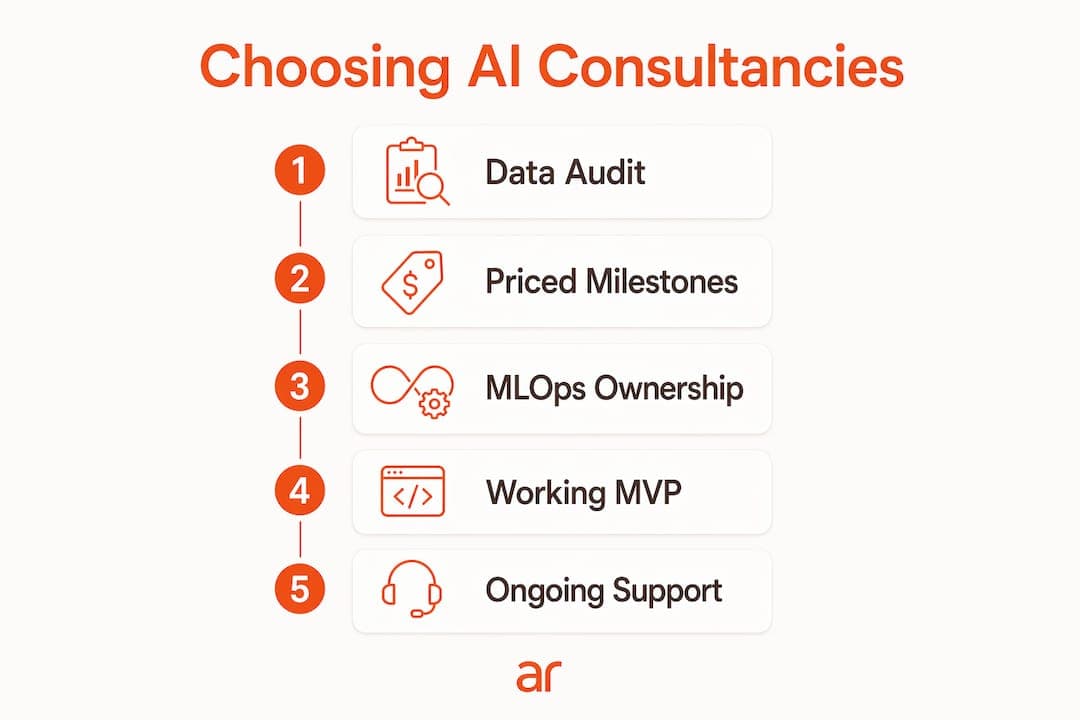
2. Demand a staged path with priced milestones. Avoid lump-sum contracts. A credible consultancy structures pricing across proof of concept, MVP, and production phases, with go/no-go decision points at each step. That structure protects your budget and forces accountability.
3. Confirm who owns MLOps after launch. An effective AI operating system requires a named MLOps owner with a documented plan covering ongoing monitoring, model retraining cycles, and performance benchmarks. If the consultancy can’t name that person before you sign, the system will degrade within months.
4. Verify compliance mapping is built in. Ask specifically which frameworks the consultancy maps to. NIST AI RMF and the EU AI Act are the two standards that matter most for US enterprises with any cross-border exposure. Check the AI governance approach before the project scope is finalized, not after.
Questions to ask every candidate:
- Who specifically will own MLOps post-launch, and what does their monitoring plan look like?
- How do you handle compliance mapping to NIST AI RMF or the EU AI Act?
- Can you show a working system you’ve shipped in my industry, not just a case study slide?
- What does your PoC-to-production pricing structure look like?
Pro Tip: Prioritize consultancies that can show you a working MVP in your industry within 60–90 days. A firm that leads with a six-month strategy phase before any system gets built is optimizing for its own billing cycle, not your ROI.
Common misconceptions that derail AI operating system projects
Most AI projects don’t fail because the technology was wrong. They fail because of decisions made before a single line of code gets written.
- “Strategy first, execution later” costs more than it saves. Businesses that delay execution while seeking perfect strategic alignment lose early ROI opportunities and often restart the project entirely. MVP-first partners consistently outperform strategy-heavy firms for SME success.
- Compliance is not a final-stage checkbox. Treating NIST AI RMF or the EU AI Act as an afterthought rather than a foundational design element leads to expensive restructuring. Build it in from day one.
- Data readiness gets skipped because it’s unglamorous. Buyers focus on the AI model’s capabilities and skip the infrastructure audit. That’s the most reliable way to stall a project mid-build.
- No MLOps plan means the system degrades fast. Neglecting post-launch operational planning leads to measurable performance drops within months as data conditions evolve.
- Vendor lock-in gets rationalized as “ecosystem benefits.” Tying your AI system to a single cloud vendor’s product roadmap feels safe until that vendor changes pricing or deprecates a feature your operations depend on.
How do pricing models differ across AI consultancy options?
Pricing in this space varies more than most buyers expect, and the structure of a contract often matters more than the headline number.
Global consultancies typically charge $300–$1,000+ per hour, with large program budgets that can reach $1M or more for multi-unit enterprise rollouts. Specialist boutiques generally run $150–$350 per hour or offer fixed-scope project pricing, with total engagements commonly falling in the $50,000–$250,000 range for mid-market firms. Fractional Chief AI Officers typically work on monthly retainers of $2,000–$30,000, depending on scope and seniority. These figures come from 2026 buyer’s guide benchmarks.
Arosplatforms does not publish flat-rate pricing publicly, which is standard for custom AI OS engagements. maiconsulting.io similarly does not list pricing. Budget 20–40% above any quoted number to cover the costs that proposals routinely leave out, including data preparation, integration work, and post-launch support.
What do industry-specific results actually look like?
The difference between a generic AI deployment and an industry-embedded one shows up clearly in how fast teams adopt the system and how quickly it affects operations.
In logistics, AI operating systems built around actual dispatch and routing workflows, rather than adapted from general-purpose tools, reduce manual coordination time and surface routing inefficiencies that generic platforms miss entirely. In healthcare, enterprise AI integrations that map to existing clinical workflows and compliance requirements get adopted faster because staff don’t have to change how they work to use them. In real estate, predictive analytics built into client engagement processes, rather than bolted on as a separate reporting layer, change how agents prioritize leads in real time.
Arosplatforms builds its AI operating systems specifically for these vertical contexts, embedding within client operations rather than delivering a configurable platform. That’s the structural difference between a system that gets used and one that gets shelved after the first quarter.
What support and training do the best consultancies provide?
Post-launch support separates a consultancy from a vendor. A system that ships without ongoing training and maintenance planning will underperform within months.
The strongest AI consultancy partners provide a named MLOps owner, documented retraining schedules, and performance benchmarks that the client’s team can monitor independently. They also run structured knowledge transfer so internal teams can manage the system without calling the consultancy for every adjustment. Arosplatforms builds this into its engagements by design, with the explicit goal of transferring full ownership to the client. That means your team runs the system, not a third-party support desk.
Training should cover three areas: how the system makes decisions, how to identify when it’s drifting from expected performance, and how to escalate when retraining is needed. Consultancies that skip this step are building dependency, not capability.
Arosplatforms delivers where most AI consultancies stop short
Most AI consultancies hand you a roadmap. Arosplatforms hands you a working system your team actually owns.
For US businesses that need an AI operating system built around their specific industry, not a cloud vendor’s product catalog, Arosplatforms is the direct alternative to maiconsulting.io’s advisory model. The difference is concrete: Clients see an average 82% faster turnaround on key tasks, ROI within twelve months, and full system ownership with no vendor lock-in. Compliance mapping to NIST AI RMF and the EU AI Act is built into the design phase, not added at the end. Arosplatforms embeds within your operations in healthcare, logistics, real estate, and other verticals to build systems that fit how your team actually works. To see what that looks like for your industry, explore AI consulting for US enterprises and request a scoped engagement.
Key Takeaways
The strongest maiconsulting.io alternatives build compliance, ownership, and execution-first delivery into the AI operating system from day one, not as add-ons after the strategy phase.
| Point | Details |
|---|---|
| Ownership model matters most | Choose a consultancy that transfers full system ownership to your team, with no vendor lock-in. |
| Compliance must be built in early | Map to NIST AI RMF and EU AI Act at the design stage to avoid costly restructuring later. |
| MVP-first beats strategy-first | Execution-first partners deliver faster ROI; strategy-only firms delay results and increase cost. |
| Data readiness is the top failure point | Audit your data infrastructure before contracting any AI consultancy, regardless of their capabilities. |
| Arosplatforms as a leading option | Arosplatforms delivers industry-embedded AI operating systems with 82% faster task turnaround and twelve-month ROI. |
FAQ
What makes a maiconsulting.io alternative worth considering?
A credible alternative builds an AI operating system around your specific industry workflows rather than adapting a general platform, and transfers full ownership to your team at the end of the engagement.
How does Arosplatforms differ from maiconsulting.io?
Arosplatforms builds custom AI operating systems embedded in client operations across industries like healthcare and logistics, with compliance mapping and no vendor lock-in. maiconsulting.io is an advisory consultancy aligned to Google Cloud’s AI product stack.
What compliance frameworks should an AI consultancy cover?
NIST AI RMF and the EU AI Act are the two frameworks that matter most for US enterprises, particularly those with any cross-border exposure. Both should be mapped during the initial design phase, not after launch.
How long does it take to see ROI from an AI operating system?
With an execution-first consultancy like Arosplatforms, clients typically see returns within twelve months, with an average 82% faster turnaround on key tasks once the system is live.
What red flags should I watch for when evaluating AI consultancies?
Avoid firms that quote a single lump-sum price with no milestone structure, can’t name a specific MLOps owner for post-launch maintenance, or lead with a multi-month strategy phase before any working system gets built.