Save 30–50% on Voice Costs: Twilio vs Vonage for Developers
Save 30–50% on Voice Costs: Twilio vs Vonage for Developers
Pick Twilio if you need the broadest API surface, the deepest developer ecosystem, and you’re building AI-enabled or data-driven communication workflows. Pick Vonage if per-unit cost, per-second voice billing, or a unified messaging endpoint across SMS and WhatsApp matter more than raw feature breadth. Vonage (Nexmo) is the same Vonage network APIs under a legacy name, worth knowing if old documentation or SDKs reference “Nexmo” directly. The sections below break down features, pricing math, and a practitioner checklist for either path.
TL;DR:
- Carrier surcharges significantly impact total costs at scale, making negotiation and volume discounts crucial for high-volume messaging applications.
- Per-second voice billing from Vonage can save up to 50% on short calls compared to Twilio’s per-minute rounding, benefiting verification and brief interactions.
- Twilio offers a broader ecosystem, extensive documentation, and more SDK languages, which speeds up development but adds complexity and potential surprise costs.
- For unified multi-channel messaging like SMS, WhatsApp, and Messenger, Vonage’s API simplifies integration, while Twilio provides more advanced features and extensive support.
- A thorough proof of concept measuring real delivery rates, latency, and costs under load beats initial specs, especially when integrating into AI workflows demanding reliable event handling.
Table of Contents
- Twilio vs Vonage: Feature Shortlist and Side-By-Side Comparison
- How Do SMS, Voice, Video, and WhatsApp Compare?
- Twilio Pricing vs Vonage: What Do They Actually Cost?
- Which Platform Offers a Better Developer Experience?
- How Do Twilio and Vonage Handle Scale and Reliability?
- What Compliance and Support Options Does Each Vendor Offer?
- How Do You Choose Between Twilio and Vonage?
- When Does a CPaaS Choice Need Outside Integration Help?
- What Actually Determines the Right Choice Here?
- Need Help Choosing or Integrating a CPaaS Into Your AI Stack?
- Sources
- FAQ
Twilio vs Vonage: Feature Shortlist and Side-By-Side Comparison
Twilio is the default answer when a team wants control over every layer of the stack: SMS, voice, video, email through SendGrid, and customer data through Segment, all under one account. Vonage answers a narrower but sharper question: how do I message customers across SMS, WhatsApp, and Messenger without stitching together three separate APIs, and how do I keep voice costs down on short calls.
Twilio holds roughly 34.5% CPaaS mindshare versus Vonage’s 11.9%, a gap that shows up directly in ecosystem size: more Stack Overflow answers, more third-party libraries, more sample code to borrow from. Vonage counters with carrier-grade backing from its parent company Ericsson, which shows up in provisioning speed and network routing rather than in GitHub stars.
Here’s how the three options stack up on the dimensions that actually change a build:
| Dimension | Twilio | Vonage | Vonage (Nexmo) |
|---|---|---|---|
| Best for | Deep customization, large dev teams, AI/data-driven stacks | Lower per-unit cost, unified multi-channel messaging | Teams on legacy Nexmo integrations, network-level APIs |
| Pricing shape | Per-feature, granular line items | Bundled/unified endpoints, competitive unit rates | Same as Vonage, under prior product naming |
| Billing granularity | Per-minute voice rounding | Per-second voice billing | Per-second voice billing |
| Channels | SMS, voice, video, WhatsApp, email (SendGrid) | SMS, voice, video, WhatsApp, Messenger (unified) | SMS, voice, WhatsApp, network APIs |
| Developer experience | Extensive SDKs, the largest community | Solid SDKs, smaller community | Legacy docs, being folded into Vonage stack |
| Compliance | SOC 2, HIPAA-eligible with BAA | SOC 2, HIPAA-eligible with BAA | Same as Vonage |
| Support | Tiered, enterprise named support | Tiered, carrier-backed reliability | Same as Vonage |
Twilio’s case in three lines: broader ecosystem, deeper documentation, and a product suite (Flex, SendGrid, Segment) built for teams layering AI or analytics on top of messaging. The tradeoff is complexity. More knobs to turn means more decisions before shipping, and per-feature pricing can surprise teams that don’t model usage carefully.
Vonage’s case in three lines: a single Messages API that handles SMS, WhatsApp, and Messenger through one endpoint, per-second voice billing that rewards short-call use cases, and infrastructure backed directly by a telecom carrier. The tradeoff is a smaller ecosystem and fewer bells and whistles for teams that want to build custom orchestration layers on top of raw APIs.
How Do SMS, Voice, Video, and WhatsApp Compare?
Every channel has its own economics and its own developer friction, and the differences matter more in production than they do on a pricing page.
SMS. Headline per-segment rates sit close together, headline SMS rates sit close together, with Twilio and Vonage having similar base pricing (https://apiscout.dev/guides/twilio-vs-vonage-api-2026). The real gap opens up after carrier surcharges, which Twilio applies on top of base rates in the US and which can push effective cost noticeably higher than the sticker price suggests. A2P 10DLC registration requirements apply to both vendors for US traffic, so budget time for carrier vetting regardless of which platform you choose.
Voice. This is where billing granularity actually bites. Vonage bills voice per second; Twilio bills per minute with rounding up to the next full minute. For short calls, that difference can save 30% to 50% on voice costs, which matters enormously for verification calls, appointment reminders, or IVR flows that rarely run long. For sustained contact-center calls, the per-minute versus per-second gap shrinks toward irrelevance. Twilio’s IVR logic runs on TwiML; Vonage’s runs on NCCO (Nexmo Call Control Objects). Both are XML/JSON-style instruction sets, but they aren’t interchangeable, so migrating IVR logic between platforms means a rewrite, not a find-and-replace.
Video. Twilio Video gives you granular controls: recording, room composition, and network quality metrics exposed at a fine level. Vonage Video (formerly TokBox/OpenTok) covers similar ground with participant-based pricing and built-in moderation tools. Neither platform’s video product is the headline feature for most buyers comparing Twilio vs Vonage, but if your roadmap includes telehealth or remote consultations, test both SDKs against your actual bandwidth constraints before committing.
Messaging and WhatsApp. This is Vonage’s strongest pitch. The Messages API accepts a channel parameter and unifies SMS, WhatsApp, and Facebook Messenger behind one endpoint, which cuts integration surface area compared with wiring three channel-specific APIs. Twilio’s Conversations API does something similar but layers in more session state and threading logic, which is powerful for building a true omnichannel inbox but adds setup overhead if all you need is send-and-track.
Email. Twilio owns SendGrid outright, which means transactional and marketing email lives in the same account structure as your SMS and voice traffic. Vonage has no comparable owned email product, so teams that need unified messaging and email reporting in one dashboard lean toward Twilio by default.
Pro Tip: Before you commit to either vendor’s WhatsApp integration, check your message template approval turnaround with Meta directly. Approval delays are a bigger bottleneck than any API difference between Twilio and Vonage.
Twilio Pricing vs Vonage: What Do They Actually Cost?
Headline rates rarely tell the real story. What changes your monthly bill is billing granularity, carrier surcharges, and how many numbers or short codes you’re renting.
For a low-volume transactional SMS use case, say 5,000 messages a month for order confirmations, the difference between Twilio and Vonage’s base rate is fractions of a cent per message. Once Twilio’s carrier surcharge is factored in, though, the effective per-message cost can run measurably higher than Vonage’s flatter structure. At typical low volumes, cost differences between the vendors are minimal.
At 1 million messages a month, the math changes. A surcharge of even half a cent per message adds up to $5,000 a month in extra cost, and that’s before volume discounts either vendor might offer at that scale. This is the volume tier where it’s worth negotiating directly with sales rather than trusting the public rate card.
For short verification or IVR calls, typically 15 to 30 seconds, Vonage’s per-second billing wins outright. Twilio rounds a 20-second call up to a full minute of billed time. Run 50,000 verification calls a month at that length, and the rounding difference compounds into real money.
| Scenario | What Drives Cost | Vendor Advantage |
|---|---|---|
| 5,000 SMS/month, transactional | Base rate + carrier fee | Marginal difference, negligible at this volume |
| 1 million messages a month | Carrier surcharge compounding | Worth negotiating volume tier with either vendor |
| Short IVR/verification calls (15-30 sec) | Per-second vs per-minute rounding | Vonage’s granularity saves 30-50% on voice |
Three things to check before signing anything:
- Ask for the all-in cost per message or per minute after carrier surcharges, not the headline rate.
- Confirm number rental and short code fees separately. These are line items both vendors often quote separately from usage rates.
- Request volume-tier pricing in writing if you’re above 500,000 monthly messages. Both vendors negotiate at scale, but only if you ask.
Pricing dominates the decision when your use case is high-volume and channel-simple, like transactional SMS at scale. It matters less when your use case is feature-driven, like building an AI voice agent that needs Twilio’s broader tooling regardless of the per-minute rate.
Which Platform Offers a Better Developer Experience?
Documentation depth and SDK coverage decide how fast your team ships, and this is where the gap between Twilio and Vonage is most visible day to day.
Twilio’s documentation covers more edge cases, more sample apps, and SDKs in more languages, a direct byproduct of its larger market mindshare. That ecosystem size is a real productivity multiplier: when something breaks at 2 a.m., there’s a higher chance someone already posted the fix on Stack Overflow. Vonage’s documentation is solid and improving, but the community answering questions on forums is smaller, so you’ll lean on official support more often.
Both platforms offer no-code and low-code tooling for teams that don’t want to write orchestration logic from scratch:
- Twilio Studio provides a visual flow builder for SMS and voice workflows, plus an AI-assisted layer for building conversational flows without deep coding.
- Vonage offers its own visual builder tools within the dashboard, though with fewer integrations than Studio’s ecosystem.
- Both vendors ship CLIs and sandbox environments for local testing before you touch production numbers.
- Both support webhook-based testing tools like ngrok for local development against live callbacks.
On raw community size, G2 reviewer data shows both platforms scoring around 4.2 out of 5 overall, with Vonage rated higher for ease of integration in some categories and Twilio rated higher for documentation and API breadth. Neither vendor loses on developer experience outright. Twilio wins on ecosystem depth; Vonage wins on getting a simple integration running with less ceremony.
How Do Twilio and Vonage Handle Scale and Reliability?
Throughput limits, carrier routing, and number inventory decide whether your integration survives a traffic spike or buckles under it.
Twilio’s larger scale gives it broader carrier relationships and number inventory across more countries, which matters if your roadmap includes international expansion. Vonage’s Ericsson backing gives it carrier-level routing advantages that can mean fewer hops between your API call and the recipient’s phone, particularly for voice traffic.
A few things worth checking during procurement, regardless of vendor:
- Ask for documented rate limits per account tier, not just the default sandbox limits.
- Confirm regional data routing if you have latency-sensitive use cases, like real-time voice transcription.
- Request the vendor’s actual SLA language, not the marketing summary. Look for uptime percentage, credit terms, and what counts as an outage.
- Test failover behavior in your POC. Both vendors support number pooling and failover routing, but implementation details differ.
- For high-throughput messaging, plan for queuing and retry logic on your side. Neither vendor guarantees instant delivery at every volume tier.
Scaling patterns look similar across both platforms: horizontal number pooling, message queuing, and webhook-based delivery confirmation.
What Compliance and Support Options Does Each Vendor Offer?
For regulated industries, healthcare and finance most obviously, compliance certifications and support tiers often decide the vendor question before pricing even enters the conversation.
Both Twilio and Vonage offer SOC 2 compliance and HIPAA-eligible services with a signed Business Associate Agreement (BAA) available on qualifying plans. Neither vendor makes HIPAA compliance automatic. You still need to configure your integration correctly, and that responsibility sits with your team, not the vendor. If you’re building for a healthcare workflow, review HIPAA considerations for AI-enabled systems before you architect the data flow.
- Both vendors support PCI-related use cases for payment-adjacent messaging, though neither is a PCI processor itself.
- Support tiers range from community/self-serve up to named-engineer enterprise contracts on both platforms.
- Professional services are available from both vendors for complex migrations, usually at an additional cost beyond standard support plans.
- Contact-center integration differs meaningfully: Twilio Flex is a fully programmable contact-center platform built on Twilio’s primitives, while Vonage’s contact-center offerings lean more toward pre-built UCaaS features with less low-level customization.
If your use case needs deep contact-center customization, Flex gives you more room to build exactly what you want, at the cost of more implementation work. If you want a contact center that works closer to out of the box, Vonage’s packaged approach asks less of your engineering team.
How Do You Choose Between Twilio and Vonage?
A structured proof of concept beats a spec sheet comparison every time, because real delivery rates and real latency numbers only show up once you send real traffic.
Before you write a line of production code, work through this checklist:
- Map your channel mix. List every channel you need today (SMS, voice, WhatsApp, video, email) and every channel you might need in 18 months. Ecosystem breadth matters more the longer that list gets.
- Estimate real volume. Model monthly message and minute volume at your expected 12-month scale, not your current pilot numbers. This is what pricing tiers actually key off.
- Set latency and delivery thresholds. Decide your acceptable delivery rate (commonly 98%+) and latency ceiling before you test, so the POC has a pass/fail line instead of a vibe check.
- Confirm compliance requirements up front. If you need a BAA or specific data residency, ask for it in writing before you build anything, not after.
- Run the POC against both vendors with identical traffic. Send the same message volume through both platforms and measure actual delivery rate, latency, and error rate side by side. Vendor guides consistently recommend this step because headline specs rarely match production reality.
Questions worth asking sales directly, not just reading off the pricing page:
- What’s the all-in cost per unit after carrier surcharges, in writing?
- How is voice billed exactly, per second or per minute, and is there rounding?
- What’s the number portability process if we need to leave?
- What does the SLA actually guarantee, and what’s the credit process for downtime?
Pro Tip: Run your POC during your actual peak traffic window, not during a quiet Tuesday afternoon. Delivery rates and latency both degrade under real load, and that’s exactly the condition you’re testing for.
When Does a CPaaS Choice Need Outside Integration Help?
DIY integration works fine when your use case is a single channel with predictable volume, like transactional SMS confirmations. It stops working cleanly the moment you’re wiring CPaaS output into an AI agent, a RAG-based support system, or a predictive engagement model, because that’s where delivery guarantees and event ordering start to matter more than the per-message rate.
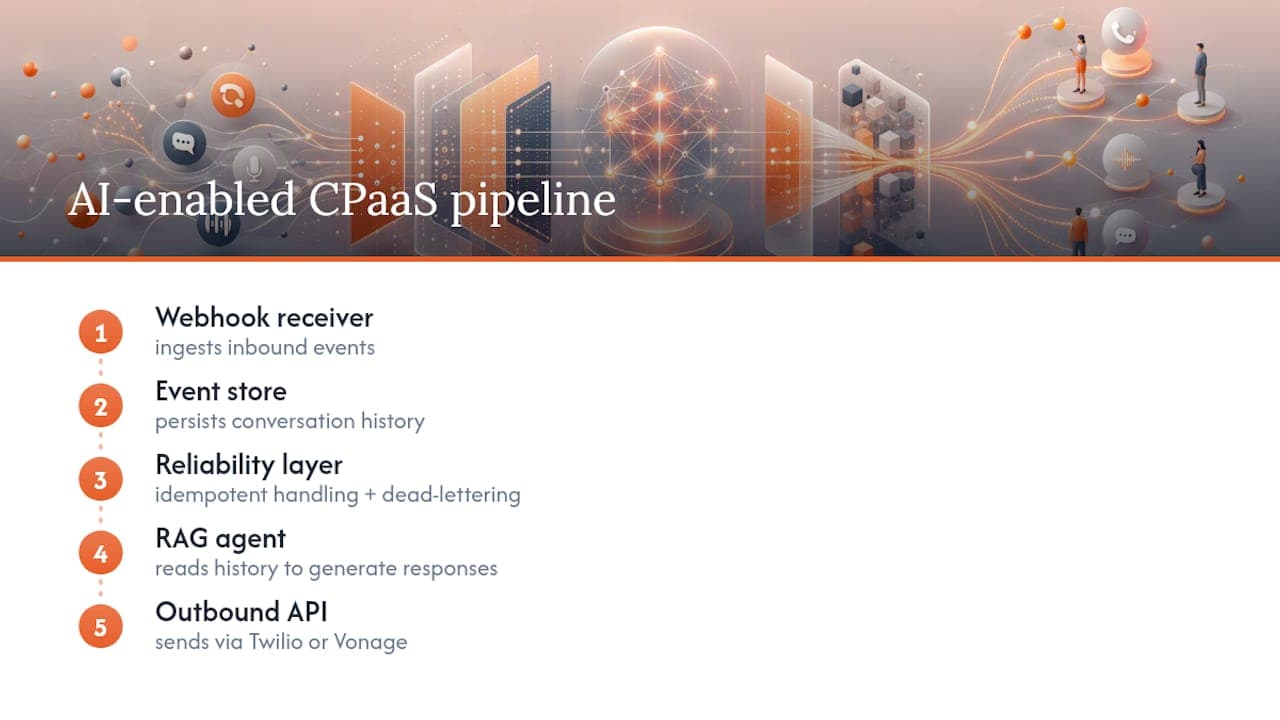
A typical production architecture for that scenario looks like: webhook receiver, event store, then a RAG agent that reads conversation history to generate context-aware responses before anything gets sent back through Twilio or Vonage’s API. Getting that pipeline reliable, with idempotent message handling and dead-lettering for failed deliveries, is where most teams underestimate the engineering effort.
That’s the exact problem arosplatforms has been embedded in solving across industries: not picking the CPaaS vendor, but making sure the AI system built on top of it doesn’t drop messages, lose context, or double-send under load. Teams evaluating real-world AI use cases tend to hit this integration layer right after the vendor decision, not before it.
What Actually Determines the Right Choice Here?
Most comparisons treat this as a features-versus-price question, and that framing undersells the real decision. The research consistently points to one thing: billing granularity and ecosystem depth matter more in practice than the headline per-message rate everyone fixates on first.
Conventional advice tells buyers to compare unit prices line by line. That’s backwards for most teams. A half-cent difference on SMS disappears next to what you lose in engineering time if you pick the platform with thinner documentation and then spend three extra sprints debugging edge cases nobody answered on Stack Overflow.
Prioritize the POC before the pricing sheet. Send real traffic, measure real delivery rates, and only then run the cost math at your actual volume. Reliable event handling, idempotent retries, and dead-lettering matter more for AI-enabled workflows than shaving fractions of a cent off a per-message rate, a point worth taking seriously before signing anything long term.
— arosplatforms team
Need Help Choosing or Integrating a CPaaS Into Your AI Stack?
Comparing Twilio and Vonage tells you which vendor to sign with. It doesn’t tell you how to wire that vendor into a production AI system that needs deterministic delivery, event ordering, and zero data loss under load. That integration layer is where Arosplatforms works, embedding directly inside client operations to build the AI operating system that sits on top of whichever CPaaS you choose, rather than replacing the CPaaS decision itself.
If you’re past the vendor pick and staring at a webhook-to-agent pipeline that needs to actually hold up in production, Arosplatforms offers a Readiness Assessment and Proof of Concept to scope exactly what that build requires before you commit engineering time. Building it entirely in-house makes sense when you have spare senior capacity; bringing in outside help makes sense when you need it working reliably in months, not quarters. Reach out to scope your integration.
Sources
- Twilio vs Vonage: Cloud Communication APIs in 2026 | APIScout
- G2 compare: Twilio vs Vonage Communications APIs
- Twilio vs Vonage 2026: Voice and SMS | Epiphany Dynamics
FAQ
Is Vonage Cheaper Than Twilio?
It depends on the use case. For short voice calls, Vonage’s per-second billing can save 30% to 50% versus Twilio’s per-minute rounding. For SMS, headline rates are close, but Twilio’s carrier surcharges often push its effective cost higher at scale.
Who Is Twilio’s Biggest Competitor?
Vonage is Twilio’s most direct competitor in the CPaaS space, though MessageBird and Sinch also compete for the same messaging and voice API business. Twilio leads on market mindshare at roughly 34.5% versus Vonage’s 11.9%, but the gap doesn’t mean Vonage is weaker for every use case, especially cost-sensitive multi-channel messaging.
Who Owns Twilio?
Twilio is a publicly traded, independent company (NYSE: TWLO) and is not owned by another parent corporation. That’s a structural difference from Vonage, which operates under Ericsson’s ownership following a 2022 acquisition.
Why Is Twilio So Expensive?
Twilio’s costs add up mainly through carrier surcharges layered on top of base rates and per-minute voice rounding, not through unusually high headline pricing. The tradeoff is a broader product suite, including SendGrid and Segment, that many teams find worth the added cost when building data-driven or AI-enabled communication systems.
Should I Choose Twilio or Vonage for an AI-Enabled Workflow?
Twilio tends to fit better when you’re building complex orchestration on top of messaging, since its broader ecosystem and Segment integration support data-driven use cases directly. Vonage fits well when your AI workflow needs simple, unified multi-channel messaging without heavy custom orchestration. Either way, the integration layer connecting your CPaaS to your AI agent matters more than the vendor pick itself, which is where a readiness assessment helps before you build.