The Role of AI in Deal Closing: A Sales Guide
The Role of AI in Deal Closing: A Sales Guide

AI in deal closing is defined as the use of machine learning, predictive analytics, and automated workflows to increase the speed, accuracy, and success rate of sales negotiations. This is not a marginal efficiency gain. AI-augmented sales teams closed 31% more deals than teams relying on traditional CRM alone, measured over 14 months by a Gartner study. Research also shows 40–45% efficiency gains in complex deal preparation when AI handles front-end analysis. The critical distinction: AI augments human judgment. It does not replace the sales executive who reads the room and closes the relationship.
How does AI in deal closing actually change workflows?
AI transforms deal closing through four specific workflow areas. Each one removes a different bottleneck that slows sales teams down.
Pipeline forecasting and intelligence uses machine learning to score deals by close probability in real time. Instead of gut-feel pipeline reviews, sales managers see which deals need attention and why. Predictive analytics models pull from CRM activity, email engagement, and historical win patterns to surface the right priorities.

Conversation intelligence records, transcribes, and analyzes sales calls automatically. The system flags competitor mentions, objection patterns, and buying signals that reps miss in the moment. AI meeting intelligence tools then feed those insights directly into coaching workflows, cutting new rep ramp time significantly.
Deal scoring and prioritization ranks active opportunities by revenue potential and close likelihood. Reps stop spending equal time on every deal. They concentrate effort where the probability of closing is highest, which is where AI-driven closing strategies produce the clearest ROI.
Outreach personalization at scale is where AI tools for closing deals generate customized follow-up sequences based on prospect behavior. A rep who previously sent the same email to 50 prospects now sends 50 different messages, each timed and framed to match the individual’s engagement history.
Pro Tip: Embed all four AI workflow areas inside your existing CRM rather than running them as separate tools. Teams that toggle between disconnected systems see far lower adoption and weaker results.
The integration point matters enormously. Full AI workflow integration in CRM drives adoption above the 72% threshold that Gartner identifies as necessary for reliable performance gains. Below that threshold, results are inconsistent and hard to attribute.
What does the evidence say about AI’s impact on deal velocity?
The numbers on AI in sales processes are specific enough to act on.
“66% of AI users in sales spend more time on high-value work, and 58% produce outputs they could not previously create.” — Microsoft, 2026
That second figure is the more important one. AI does not just free up time. It expands what sales teams can actually deliver, from more personalized proposals to faster competitive analysis.
The table below shows the contrast between AI-augmented and traditional sales operations across key performance metrics.
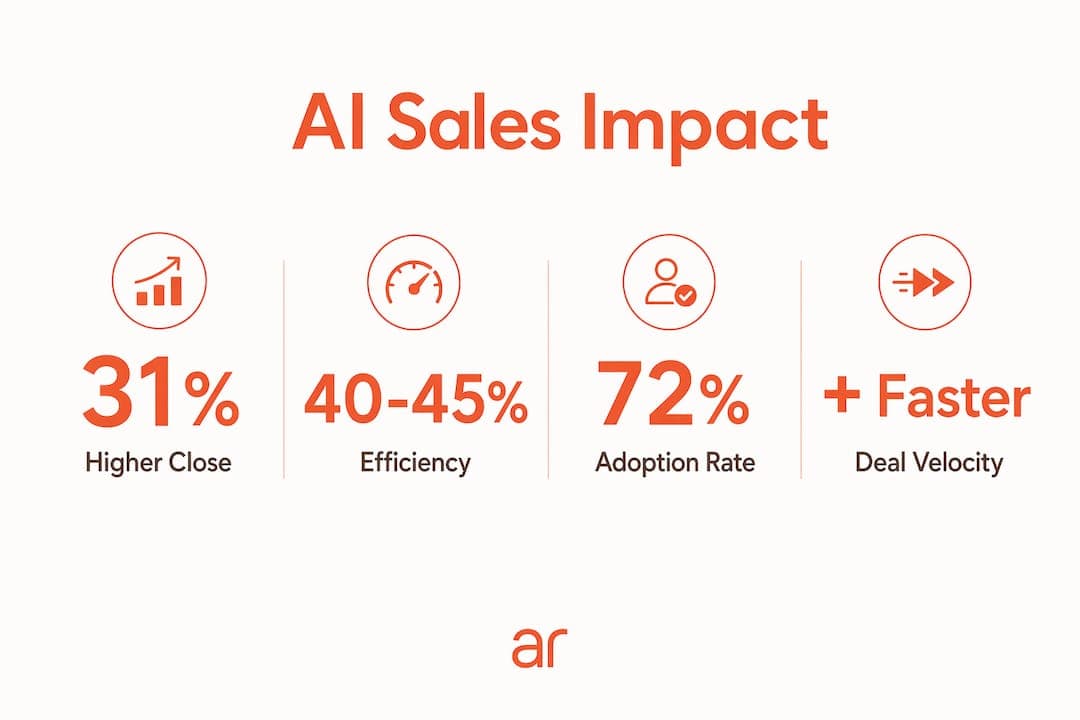
| Metric | Traditional CRM only | AI-augmented teams |
|---|---|---|
| Deal close rate | Baseline | +31% improvement |
| Deal prep efficiency | Baseline | 40–45% faster |
| Rep time on high-value work | Minority of hours | 66% of users report increase |
| Tool adoption rate | Variable | 72%+ needed for gains |
The 40–45% efficiency gain in deal preparation compresses the time between first contact and final negotiation. That compression has a side effect worth noting: it puts more pressure on senior judgment, not less. When AI handles the research, the human decision-maker faces the hard call faster and with less time to deliberate.
Why does human judgment still determine the outcome?
AI handles data. Humans handle trust. That division of labor is not a limitation of current technology. It reflects how deals actually get done.
MIT Sloan research on AI negotiation agents found that bots programmed to demonstrate warmth and empathy achieved better deal outcomes than aggressive, purely transactional bots. That finding matters because it confirms emotional intelligence is a scalable advantage, not just a human trait. AI can simulate warmth effectively enough to shift outcomes.
The practical implication for sales executives is this: the emotional register of your AI-driven outreach is a design decision. Teams that treat AI-generated messages as neutral information delivery leave value on the table. Teams that program warmth, curiosity, and responsiveness into their AI agents close more.
Human reps remain essential for three specific functions that AI cannot fully replicate:
- Reading nonverbal signals and adjusting in real time during live negotiations
- Building the long-term trust that protects a deal when something goes wrong
- Providing ethical oversight and intervening when AI outputs are wrong or inappropriate
AI sales agents operate 24/7 for lead qualifying and nurturing. Human reps close deals, build relationships, and supervise AI tasks. That division is not temporary. It reflects the structural reality of how artificial intelligence in business deals creates value.
Pro Tip: Review your AI-generated outreach sequences quarterly for tone. Cold, transactional language in automated messages undermines the relationship your reps are building in parallel.
How should you redesign sales workflows to get full AI benefits?
Most teams add AI tools on top of existing workflows and wonder why results are modest. The teams that see the largest gains rebuild the workflow around AI outputs from the start.
-
Audit your current pipeline process. Map every step from lead identification to contract signature. Identify which steps consume the most rep time and produce the least differentiated output. Those are your AI targets.
-
Reassign initial research and qualification to AI. Top-performing teams restructure so AI handles initial sourcing and qualification. Human reps enter the process at prioritization and personalization, not at the beginning.
-
Embed AI directly in your CRM. Avoid standalone tools that require switching between systems. AI agents and automation built into CRM workflows drive the adoption rates that produce measurable gains.
-
Set a 72% adoption target as a hard floor. Track tool usage by rep and by team. Partial adoption produces partial results. Gartner’s data is clear: the performance gains appear reliably only above the 72% adoption threshold.
-
Use conversation intelligence data in manager coaching. AI-generated coaching insights from call analysis dramatically reduce new rep ramp time. Managers who review AI-flagged call moments coach more specifically and more efficiently than those relying on memory or random call sampling.
-
Define decision rights explicitly. Specify which decisions AI makes autonomously, which it recommends for human review, and which always require senior sign-off. Faster deal cycles without clear decision rights create confusion and errors.
Pro Tip: Treat AI adoption rate as a sales performance metric, not an IT metric. Put it on the same dashboard as close rate and pipeline coverage. What gets measured gets managed.
What are the biggest pitfalls when integrating AI in deal closing?
The impact of AI on negotiations is real, but implementation errors are common and costly.
-
Siloed AI adoption is the most frequent failure mode. Teams that run AI tools separately from their CRM see inconsistent results because reps toggle between systems and skip steps. Partial or siloed deployment consistently underperforms fully integrated approaches.
-
Over-reliance on AI scoring creates a different problem. When reps trust deal scores without questioning the underlying data, they pursue the wrong opportunities with confidence. AI scores reflect historical patterns. They do not account for relationship dynamics, political changes inside a prospect’s organization, or new competitive moves.
-
Faster cycles without redesigned decision rights put senior judgment under pressure without giving senior leaders the support they need. AI compresses decision time but does not improve the quality of the judgment itself. Organizations that skip the redesign of escalation rules end up with faster bad decisions.
-
Ignoring the human bandwidth constraint is a structural mistake. AI speeds up the analytical side of deals. If the human side of the organization cannot absorb faster deal cycles, bottlenecks simply move rather than disappear.
The teams that avoid these pitfalls share one characteristic: they treat AI integration as a workflow redesign project, not a software purchase.
Key Takeaways
AI in deal closing produces the largest gains when teams redesign workflows around AI outputs, maintain human oversight, and drive adoption above 72% across the full CRM-integrated stack.
| Point | Details |
|---|---|
| AI closes more deals | AI-augmented teams close 31% more deals than CRM-only teams, per Gartner. |
| Efficiency gains are front-loaded | AI cuts deal preparation time by 40–45%, compressing the path to negotiation. |
| Adoption threshold matters | Teams need 72%+ tool adoption inside CRM to see reliable performance gains. |
| Human judgment is irreplaceable | AI handles data and qualification; humans close, build trust, and supervise. |
| Workflow redesign beats tool addition | Adding AI on top of old workflows produces modest results; rebuilding around AI outputs produces structural gains. |
The widening gap between AI-augmented and traditional sales teams
From where Arosplatforms sits, working inside sales and deal-making operations across industries, the most striking thing is not how much AI improves individual deals. It is how fast the performance gap is widening between teams that have redesigned their workflows and teams that have not.
The teams that added an AI tool to their existing process are seeing modest gains. The teams that rebuilt their pipeline management, coaching, and outreach around AI outputs are pulling ahead in ways that are hard to reverse. That gap compounds. A team closing 31% more deals this year has more revenue to reinvest in better AI, better talent, and better data next year.
The caution I would offer is this: speed without judgment is a liability. AI compresses the time between insight and decision. If your organization has not deliberately redesigned who makes which decisions and when, faster cycles will surface your weakest judgment calls more often, not less. The technology does not fix the process. It amplifies whatever process you already have.
The opportunity is real. The teams that treat AI integration as a structural revenue question, not a technology question, are the ones building durable advantages.
— Arosplatforms team
How Arosplatforms supports AI-driven deal closing
Sales teams that want to move from tool adoption to genuine workflow transformation need more than software. They need a partner who understands how deals actually get done inside their specific industry.
Arosplatforms builds customized AI operating systems for sales and deal-making workflows, embedding directly in client operations rather than delivering a generic platform. Clients see an average of 82% faster turnaround on key tasks and measurable ROI within twelve months. For US enterprises ready to close more deals with AI, Arosplatforms’ US consulting team works alongside your sales leadership to redesign workflows, set adoption targets, and build systems your team owns. Explore AI use cases built for sales to see what full integration looks like in practice.
FAQ
What is the role of AI in deal closing?
AI in deal closing automates pipeline intelligence, lead scoring, conversation analysis, and outreach personalization to increase close rates and reduce time to close. AI-augmented teams close 31% more deals than teams using traditional CRM alone.
Does AI replace sales reps in negotiations?
AI does not replace sales reps. AI handles data-intensive and repetitive tasks while human reps focus on relationship building, live negotiation, and ethical oversight of AI outputs.
How much efficiency does AI add to deal preparation?
AI delivers 40–45% efficiency gains in complex deal preparation, significantly compressing the time between initial analysis and the start of active negotiation.
What adoption rate is needed for AI to improve close rates?
Teams need AI tool adoption above 72% within their CRM workflows to see reliable performance gains, according to Gartner research on AI-augmented sales teams.
What is the biggest mistake teams make when adopting AI for deal closing?
The most common mistake is adding AI tools on top of existing workflows rather than redesigning the workflow around AI outputs. Siloed or partial adoption consistently underperforms fully integrated approaches.