The Role of AI in Parts Inventory Forecasting: 2026 Guide
The Role of AI in Parts Inventory Forecasting: 2026 Guide

AI converts calendar-based reorder logic into probabilistic, condition-aware forecasts and closed-loop inventory control. The practical payoff is significant: a 2026 integrated LSTM + Q‑learning framework reported a 15.7% total cost reduction versus traditional MRP, a 4.2 annual inventory turnover rate, and a 0% stockout rate in industrial experiments. The one-line recommendation for operational leaders: run a focused, CMMS-layered pilot on your 20–50 highest-impact SKUs, governed by an AI operating system with embedded business logic, before committing to enterprise rollout.
Table of Contents
- How AI changes parts forecasting and inventory decisions in practice
- What AI architectures actually work for parts forecasting
- What data you actually need and how to layer AI over your existing CMMS
- Your pilot-to-scale roadmap, KPIs, and realistic ROI timeline
- Governance, explainability, and how to avoid vendor lock-in
- Common risks and how to mitigate them
- How Arosplatforms builds AI operating systems for parts forecasting
- Key Takeaways
- What we’ve learned working with manufacturers and field service teams
- Arosplatforms’ AI operating system for parts forecasting
- FAQ
How AI changes parts forecasting and inventory decisions in practice
Traditional MRP recalculates reorder points on a fixed schedule using average demand and static lead times. AI replaces that with continuous recalculation driven by live signals: work order closures, PM calendar events, condition sensor readings, and supplier delivery variance. The result is probabilistic safety stock that adjusts to actual risk rather than a worst-case buffer that sits idle.
Where value concentrates most:
- Critical long-lead SKUs where a single stockout triggers a production shutdown
- Intermittent-demand MRO parts with lumpy, irregular consumption that defeats moving-average models
- Multi-site pooling where AI can redistribute stock across locations before a local shortage occurs
Predictive analytics for inventory combines historical consumption, current asset conditions, and supplier behavior to produce real-time decisions that fixed reorder points simply cannot match. Operationally, CMMS-centered AI implementations report 20–40% fewer emergency orders and 15–30% lower carrying costs, with improvements measurable within roughly 60 days for many plants.
Stat to know: The LSTM + Q‑learning architecture achieved a MAPE of 3.3% in industrial tests, a level of forecast accuracy that most MRP-driven operations cannot approach with calendar-based logic alone.
What AI architectures actually work for parts forecasting
The production-grade pattern that consistently outperforms single-model approaches combines a sequence forecasting model with a reinforcement learning control layer. LSTM networks capture long-range temporal dependencies in demand, including seasonal spikes and failure-driven surges. Q‑learning then acts as the inventory controller, deciding order quantities and timing based on the forecast state and current stock position. Together, they form a closed-loop system that reduces the “decoupling bias” between what the forecast says and what the warehouse actually does.
| Architecture Layer | Technique | Primary Role |
|---|---|---|
| Demand forecasting | LSTM / sequence model | Predict part consumption over rolling horizon |
| Inventory control | Q‑learning (RL) | Optimize order quantity and timing |
| Cold-start handling | Zero-Inflated Gamma / probabilistic | Estimate demand for new or rare SKUs |
| Multi-agent coordination | LLM agents (e.g., InvAgent) | Coordinate multi-stage or multi-site decisions |
| Explainability layer | Chain-of-Thought / embedded rules | Surface reasoning for planners and auditors |
Pro Tip: Embed your existing base-stock levels and safety-stock rules directly into the AI decision framework. Hybrid designs that preserve business logic train faster, behave more predictably in production, and earn planner trust far quicker than unconstrained models.
For new or rarely consumed parts, probabilistic approaches using physical attributes (weight, price, criticality class) and hierarchical demand priors outperform single-point averages. LLM-based multi-agent systems like InvAgent add a coordination layer for multi-stage supply chains, with Chain-of-Thought reasoning that lets planners see why a reorder was triggered.
What data you actually need and how to layer AI over your existing CMMS
You do not need a full infrastructure overhaul. Layering AI over existing CMMS and inventory records can decode dormant demand signals quickly and deliver high-value gains before any sensor project completes.
Data readiness checklist:
- Work order history (closed orders with part numbers, quantities, asset IDs)
- BOM-to-asset mapping (which parts belong to which equipment)
- PM schedules and actual completion dates
- Supplier lead-time history and actual delivery performance
- Inventory transaction records (receipts, issues, adjustments)
- Asset age and utilization data (hours, cycles, mileage where available)
- IoT or condition data (optional at pilot stage, valuable at scale)
Every closed work order is a demand signal. Connecting work orders to BOMs, maintenance schedules, and supplier lead times lets models flag replenishment needs before failures happen.
Integration sequence:
- Extract and clean work order and inventory transaction history from your CMMS (12–36 months minimum)
- Map parts to assets and PM schedules to create demand-event features
- Build lead-time variance measures from purchase order vs. actual receipt dates
- Stand up an API sync layer between CMMS and the AI forecasting module
- Add condition-derived hazard signals and IoT enrichment in later phases
Feature engineering is where most pilots succeed or stall. Translating raw work orders into demand events, computing lead-time variance distributions, and deriving condition-based hazard signals from maintenance records are the steps that separate a working model from a proof-of-concept that never ships.
Your pilot-to-scale roadmap, KPIs, and realistic ROI timeline

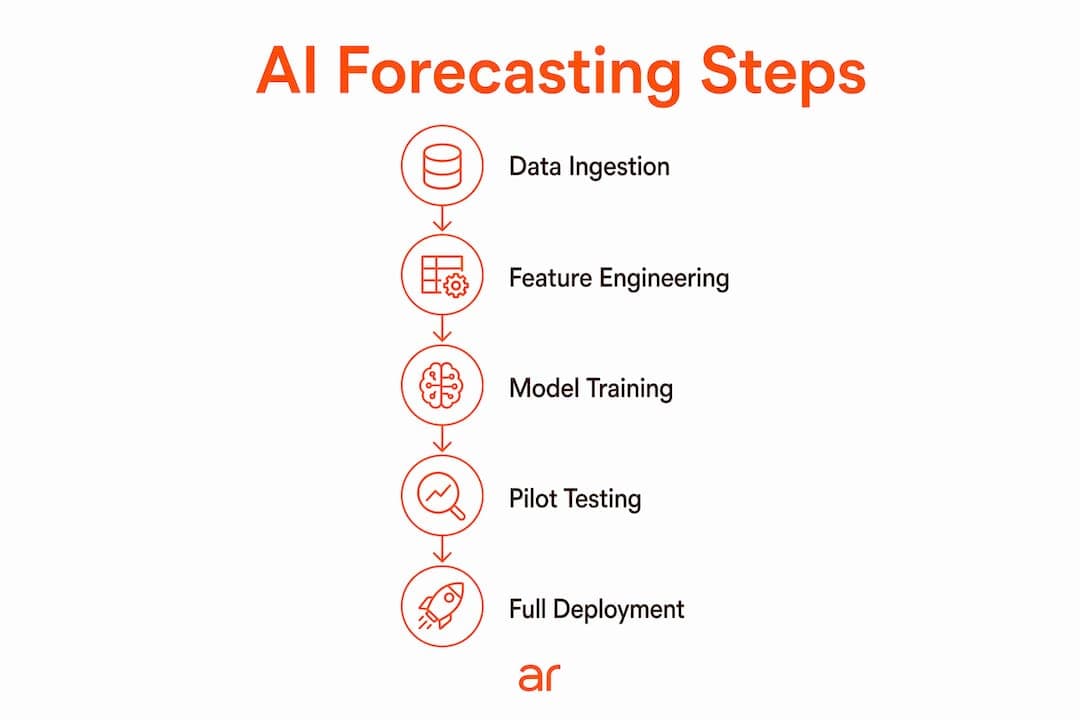
Start narrow. Scope the pilot to 20–50 high-impact SKUs across one to three sites, chosen for a mix of high criticality and sufficient historical demand. A 60–120 day pilot is enough to validate forecast accuracy and measure operational impact before committing to broader rollout.
| Stage | Duration | Key Activities | Success Gate |
|---|---|---|---|
| Pilot | 60–120 days | Data ingestion, model training, shadow mode forecasting | MAPE < 10%, planner sign-off |
| Validation | 30–60 days | Live recommendations, A/B vs. current process | Stockout reduction, emergency PO cost drop |
| Controlled scale | 3–6 months | Expand SKU coverage, add sites, MLOps monitoring | Carrying cost change, turnover improvement |
| Enterprise rollout | 6–12 months | Full integration, governance, automated reordering | ROI milestone, audit trail active |
KPIs to track from day one: stockout frequency, emergency procurement cost, carrying cost per SKU, forecast MAPE, and inventory turnover rate. Many clients see measurable returns within 12 months. Prevented shutdowns compound ROI quickly because a single avoided line-down event often exceeds the entire pilot cost. For AI supply chain forecasting deployments, the 82% faster turnaround on key planning tasks is a consistent operational signal that the system is working.
Governance, explainability, and how to avoid vendor lock-in
Ownership must be explicit before go-live, not after. Assign four roles:
- Model steward (data science): monitors drift, retrains, and approves model changes
- Operational owner (maintenance/planning): validates recommendations and flags anomalies
- IT owner (integration/MLOps): manages pipelines, versioning, and infrastructure SLAs
- Procurement owner: tracks supplier variance and feeds updated lead-time data
Governance checklist: model versioning with rollback procedures, change-approval gates before any model update goes live, performance SLAs with defined thresholds that trigger manual review, and audit trails for every Chain-of-Thought explanation surfaced to planners.
Pro Tip: Require exportable model artifacts and open API contracts in every vendor SOW. If the vendor’s architecture cannot hand over a trained model and feature store to your team, you are building on a foundation you do not own. Arosplatforms structures engagements with explicit handover milestones so your team operates the system independently.
For MLOps and AI infrastructure patterns that support this kind of governance, the key is treating model deployment like software deployment: canary releases, automated rollback triggers, and performance dashboards that non-data-science staff can read.
Common risks and how to mitigate them
| Risk | Cause | Mitigation |
|---|---|---|
| Model overfitting | Trained on historic outage patterns unique to one period | Cross-validate on held-out time windows; use rolling-origin evaluation |
| Data drift | Supplier changes, new equipment, process shifts | Closed-loop feedback with work-order reconciliation; drift detection alerts |
| Cold-start failure | New SKU with no demand history | Probabilistic attribute-driven priors (Zero-Inflated Gamma); physical-attribute features |
| False positives from IoT | Noisy sensor readings triggering spurious reorders | Hybrid rules that bound AI order actions; human-review threshold for outlier signals |
| Supplier variability | Lead times shift without model update | Dynamic lead-time features updated from PO actuals; safety-stock floor rules |
Roll-forward experiments and canary deployments for model updates are the two operational guardrails that prevent a single bad model version from affecting live inventory decisions. Set KPI thresholds that automatically route recommendations to manual review when confidence scores fall below a defined floor.
How Arosplatforms builds AI operating systems for parts forecasting
Arosplatforms engages in four stages: discovery and data audit, CMMS-first data onboarding, hybrid forecast-plus-control model design, and operational handover with MLOps enablement. The discovery phase typically surfaces data quality gaps and integration points within two to three weeks, before any model work begins.
Quantified outcomes clients can expect:
- Many clients see measurable ROI within 12 months of go-live
- An average 82% faster turnaround on key planning and procurement tasks
- Emergency procurement costs and carrying costs that move in the right direction within the first validated pilot window
In practice, the highest-impact early wins come from long-lead critical SKUs where a single prevented stockout justifies the pilot cost. A manufacturer running AI agents for manufacturing workflows, for example, typically sees the clearest signal in emergency PO frequency within the first 60 days of live recommendations.
Arosplatforms builds systems the client team owns. No proprietary black-box models, no perpetual managed-service dependency unless the client wants it. The handover includes trained model artifacts, feature pipelines, monitoring dashboards, and documented retraining procedures.
Stat to know: The LSTM + Q‑learning framework achieved 4.2 inventory turns per year and a 0% stockout rate in industrial experiments, benchmarks that represent a meaningful step up from what most MRP-driven operations achieve today.
Key Takeaways
AI-driven parts inventory forecasting using LSTM forecasting combined with Q‑learning control delivers a 15.7% total cost reduction versus traditional MRP, with measurable ROI typically within 12 months when piloted on critical SKUs with embedded business logic and clear governance.
| Point | Details |
|---|---|
| Start with CMMS data | Work orders, PM schedules, and lead-time history are sufficient to launch a pilot without IoT infrastructure. |
| Use hybrid architectures | Embedding base-stock rules into AI models improves stability and planner trust versus unconstrained approaches. |
| Pilot 20–50 SKUs first | A 60–120 day scoped pilot on high-impact parts validates ROI before enterprise commitment. |
| Govern from day one | Assign model steward, operational owner, IT owner, and procurement owner before go-live. |
| Arosplatforms builds and hands over | Arosplatforms designs custom AI operating systems for parts forecasting with explicit ownership transfer and no vendor lock-in. |
What we’ve learned working with manufacturers and field service teams
The biggest adoption blocker is rarely the technology. It is trust, specifically, planners who have been burned by a system that confidently recommended the wrong thing and left them holding the consequences. The fix is not a better algorithm in isolation. It is an algorithm whose reasoning is visible.
Every engagement that has moved from pilot to scale shares one pattern: the operational owner could explain, in plain language, why the system flagged a reorder. Chain-of-Thought explanations and embedded business rules are not nice features. They are the mechanism by which a planner stops overriding the system and starts trusting it.
Noisy data is the second blocker, and it is more tractable than it sounds. Most CMMS databases have years of work order history that has never been cleaned or structured for forecasting. The value is already there. The work is connecting it. Organizations that wait for a perfect data environment before starting a pilot almost always wait too long.
The hybrid approach, encoding business logic, preserving human oversight, and iterating quickly through pilots, is not a compromise. It is the architecture that actually ships and stays in production.
Arosplatforms’ AI operating system for parts forecasting
Parts forecasting is one of the highest-ROI entry points for an AI operating system in asset-intensive operations. Arosplatforms designs and builds custom forecasting and inventory control systems for manufacturers, field service organizations, and logistics teams across the United States, starting with a structured discovery and data readiness assessment that takes two to three weeks.

The engagement covers discovery, CMMS-first data onboarding, hybrid model design, pilot validation, and full handover with MLOps documentation. Most clients reach their first meaningful result, a validated reduction in emergency procurement or stockout frequency, within the pilot window. For US enterprise teams ready to move from MRP to AI-driven inventory control, request a pilot scope or schedule a technical discovery call with the Arosplatforms team.
FAQ
What is the role of AI in parts inventory forecasting?
AI replaces fixed reorder-point logic with continuous, probabilistic forecasts driven by work orders, PM schedules, condition data, and supplier lead times. The result is lower carrying costs, fewer stockouts, and faster inventory turnover.
How much cost reduction can AI deliver versus traditional MRP?
A 2026 integrated LSTM + Q‑learning framework reported a 15.7% total cost reduction versus conventional MRP in industrial experiments, alongside a 4.2 annual inventory turnover rate and a 0% stockout rate.
What data do you need to start an AI parts forecasting pilot?
Work order history, BOM-to-asset mapping, PM schedules, and supplier lead-time records are sufficient for a pilot. IoT and condition sensor data add value at scale but are not required to begin.
How do you prevent vendor lock-in with an AI forecasting system?
Require exportable model artifacts, open API contracts, and explicit handover milestones in the vendor’s statement of work. Arosplatforms builds systems with full ownership transfer so client teams can operate and retrain models independently.
How long before an AI parts forecasting system delivers measurable ROI?
Many clients see measurable returns within 12 months. CMMS-centered implementations often show a reduction in emergency orders and carrying costs within roughly 60 days of a live pilot.