AI Logistics Automation: A 2026 Guide for Managers
AI Logistics Automation: A 2026 Guide for Managers

AI logistics automation is defined as the application of machine learning, agentic AI, and generative AI to autonomously manage and optimize logistics operations, replacing static rule-based processes with systems that learn and adapt in real time. The industry term for this broader category is intelligent logistics automation, though “AI logistics automation” has become the working shorthand across operations teams. AI-enabled warehouse systems now achieve 99.9% order picking accuracy, tripling speed compared to manual processes. That single figure captures why logistics professionals are moving fast. AI in supply chain management no longer means adding a dashboard. It means replacing entire decision loops with systems that monitor, reason, and act without waiting for a human to intervene.
What is AI logistics automation, and how does it differ from traditional automation?
Traditional logistics automation runs on fixed if-then logic. A rule fires when a condition is met, and the same action executes every time, regardless of context. That works well for repetitive, predictable tasks. It fails the moment conditions shift: a port closure, a sudden demand spike, or a carrier going offline.
AI logistics automation breaks that constraint. Agentic AI autonomously monitors environments, identifies deviations, and triggers corrective workflows within ERP systems at machine speed. The system does not wait for a human to notice a problem. It detects the deviation, evaluates options, and executes a response, all within seconds. That is the core operational difference.

The 2026 shift is from static rule-based automation to agentic AI providing adaptive workflows within logistics platforms. This matters because supply chains generate too many variables for any fixed ruleset to handle. Traffic, weather, carrier capacity, customs delays, and demand signals all change simultaneously.
Generative AI adds another layer. LLM-based systems automate text-based workflows, including writing shipment exception summaries and customer delay notifications. That closes the communication gap between automated systems and the humans who need to act on their outputs.
Pro Tip: When evaluating AI logistics solutions, ask vendors whether their system learns from exceptions over time or simply logs them. A system that logs but does not learn is still rule-based automation with a better interface.
| Feature | Rule-based automation | AI logistics automation |
|---|---|---|
| Decision logic | Fixed if-then rules | Learned from data, updated continuously |
| Exception handling | Escalates to humans | Detects, evaluates, and resolves autonomously |
| Adaptability | Requires manual reprogramming | Adapts to new patterns without reprogramming |
| Communication | System alerts only | Generative AI drafts human-readable summaries |
What are the key applications of AI logistics automation in operations?
The practical applications of automating supply chain management with AI fall into four operational clusters. Each one addresses a category of work that is too data-heavy or too time-sensitive for manual handling.
Route optimization and shipment tracking
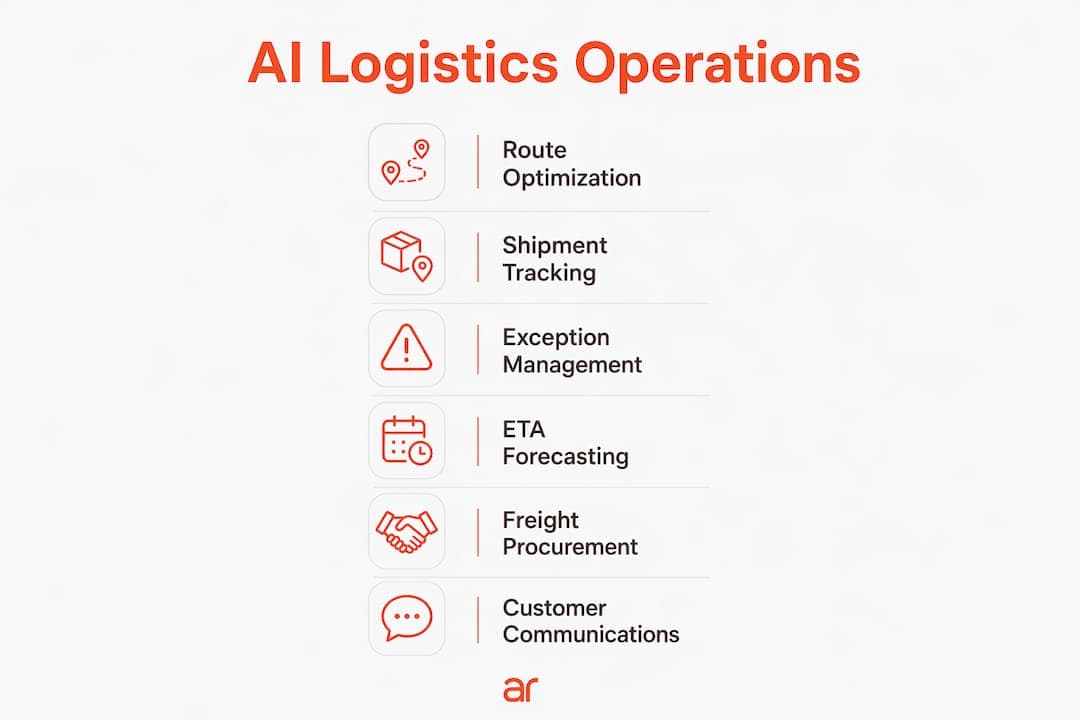
AI-driven dynamic route optimization handles millions of variables, including order urgency, live traffic, weather conditions, and carrier capacity, simultaneously. No human dispatcher can process that volume in real time. AI does it continuously, recalculating routes as conditions change and surfacing the best option at every decision point.
Exception management and ETA forecasting
Shipment exceptions, such as missed pickups, customs holds, and carrier failures, are inevitable. The question is how fast you catch and resolve them. AI systems monitor every shipment in real time, flag deviations the moment they occur, and generate resolution options before the delay compounds. Predictive ETA forecasting uses historical patterns and live data to give customers accurate delivery windows rather than static estimates.
Inventory positioning and warehouse picking
- AI models analyze demand signals, seasonal patterns, and supplier lead times to position inventory closer to where orders will originate.
- Warehouse picking systems guided by AI achieve 99.9% order accuracy while operating at three times the speed of manual picking.
- Demand-driven replenishment reduces both stockouts and excess inventory, cutting carrying costs without sacrificing service levels.
Freight procurement and customer communications
AI systems evaluate carrier rates, capacity availability, and historical performance to recommend freight procurement decisions. Generative AI then handles the downstream communication: writing delay notifications, updating customers on rerouted shipments, and summarizing exception reports for operations managers. This is where AI use cases in logistics move from back-office efficiency into direct customer experience impact.
Pro Tip: Start exception management automation before route optimization. Exceptions are high-frequency, high-cost events with clear resolution logic. They deliver fast, measurable ROI and build organizational confidence in AI-driven decisions.
How does AI logistics automation integrate with existing systems?
Integration is where most AI logistics projects succeed or stall. The technology is rarely the bottleneck. The bottleneck is connecting AI models to the ERP, TMS, and WMS platforms that already run your operations.
The Model Context Protocol (MCP) solves this directly. MCP is a standardized protocol that enables AI agents to connect with existing enterprise systems without bespoke custom integration for each connection. With over 97 million installs by 2026, MCP has become the practical integration backbone for AI in supply chain environments. That scale signals industry consensus, not an experimental standard.
A structured integration approach follows four steps:
- Audit your data sources. Map every system that generates operational data: your TMS, WMS, ERP, carrier APIs, and customer order platforms. Identify where data is clean, where it is inconsistent, and where it does not exist at all.
- Establish data governance before deploying models. Clean data governance and human-in-the-loop oversight are critical for successful AI adoption. AI models trained on poor data produce poor recommendations, and operations teams will stop trusting the system quickly.
- Connect AI agents via MCP to your core platforms. This gives AI models read and write access to live operational data without rebuilding your existing architecture. The agentic AI layer sits above your existing systems, orchestrating decisions across them.
- Define human oversight boundaries. Specify which decisions AI executes autonomously and which require human confirmation. Start with low-risk, high-frequency decisions. Expand autonomy as trust builds and performance data accumulates.
The Lenovo supply chain case illustrates why governance matters. Transparent AI recommendations with human oversight drive operational adoption. When teams cannot see why an AI made a decision, they override it or ignore it. Documented reasoning is not a nice-to-have. It is what separates a deployed system from an expensive pilot.
What are the measurable benefits and challenges of AI logistics automation?
The benefits of logistics automation with AI are well-documented at this point. The challenges are equally real and often underestimated during planning.
Quantified operational improvements
Warehouse automation reduces workplace injuries by 50% and increases productivity by 25–50% in fulfillment centers. Labor expenses represent 50–60% of total warehouse costs, which means productivity gains at that scale translate directly to margin improvement. Safety improvements also reduce workers’ compensation costs and operational disruptions from incidents.
AI integration transitions operations from reactive to predictive and self-evolving ecosystems. That shift improves resilience. When a disruption hits, a predictive system has already modeled contingencies. A reactive system starts problem-solving after the damage is done.
Common implementation challenges
| Challenge | Impact | Mitigation |
|---|---|---|
| Poor data quality | AI models produce unreliable outputs | Audit and clean data before model deployment |
| Change management resistance | Teams override or ignore AI recommendations | Involve operations staff in system design and testing |
| Integration complexity | Delays and cost overruns | Use MCP to reduce custom integration requirements |
| Unclear autonomy boundaries | Decision conflicts between AI and humans | Define escalation rules before go-live |
Arosplatforms clients report an average of 82% faster turnaround for key operational tasks after AI deployment. That figure reflects what happens when AI is embedded into daily execution rather than bolted on as a reporting layer.
Key Takeaways
AI logistics automation delivers measurable operational gains only when AI models are embedded into daily workflows, supported by clean data, and governed with clear human oversight boundaries.
| Point | Details |
|---|---|
| AI vs. rule-based automation | AI adapts to new conditions continuously; rule-based systems require manual reprogramming when conditions change. |
| Top application areas | Route optimization, exception management, inventory positioning, and freight procurement deliver the clearest ROI. |
| MCP integration standard | The Model Context Protocol connects AI agents to ERP, TMS, and WMS systems without custom integration for each platform. |
| Data governance is non-negotiable | Clean data and documented AI reasoning are prerequisites for operational trust and adoption. |
| Productivity and safety gains | Warehouse automation increases productivity by 25–50% and reduces workplace injuries by 50%. |
The part of AI logistics automation most teams get wrong
The Arosplatforms team has worked across enough logistics operations to see a consistent pattern. Organizations invest in AI technology and then measure success by whether the technology works. That is the wrong question. The right question is whether the technology changed how decisions get made every day.
Most failed AI logistics projects share one trait: the AI runs in parallel with existing processes rather than replacing them. Teams receive AI recommendations, compare them to what they would have done manually, and then do what they would have done manually anyway. The AI never gets a chance to prove itself, and the organization never builds the operational muscle to trust it.
The organizations that succeed treat AI as an orchestrating layer, not a reporting tool. AI synchronizes physical, information, and value chains into a single decision-making environment. That requires giving AI systems actual authority over defined decision categories, not just advisory access.
The future of AI in supply chain management points toward multi-agent coordination, where specialized AI agents handle route optimization, procurement, and exception management simultaneously, passing context between them through protocols like MCP. Natural language interfaces will make these systems accessible to operations managers without technical backgrounds. But none of that matters if the foundation is wrong. Governance, data quality, and bounded human oversight are not implementation details. They are the architecture.
— Arosplatforms team
How Arosplatforms approaches AI logistics automation
Arosplatforms builds customized AI operating systems for logistics and supply chain operations, embedding directly into client workflows rather than delivering standalone tools.

The Arosplatforms approach starts with a deep audit of existing ERP, TMS, and WMS environments, then deploys AI agents connected via Model Context Protocol to create an integrated decision layer across your operations. Clients retain full ownership of their systems, with no vendor lock-in. Many see returns within twelve months. For logistics and supply chain teams ready to move from reactive operations to predictive execution, Arosplatforms AI consulting for US enterprises provides the implementation depth and industry expertise to get there.
FAQ
What is AI logistics automation?
AI logistics automation is the use of machine learning, agentic AI, and generative AI to autonomously manage logistics operations, including route optimization, inventory management, and exception handling, replacing static rule-based systems with adaptive, self-improving processes.
How does AI automate logistics differently than traditional software?
Traditional logistics software executes fixed rules. AI systems learn from operational data, detect deviations in real time, and trigger corrective actions autonomously, without requiring manual reprogramming when conditions change.
What is the Model Context Protocol and why does it matter for logistics?
The Model Context Protocol (MCP) is a standardized integration protocol that connects AI agents to ERP, TMS, and WMS platforms without custom-built connectors for each system. With over 97 million installs by 2026, it has become the standard integration backbone for enterprise AI in logistics.
What are the biggest challenges in adopting AI logistics automation?
Poor data quality, change management resistance, and unclear human-AI decision boundaries are the three most common obstacles. Addressing data governance and defining autonomy limits before deployment significantly improves adoption outcomes.
What productivity gains can logistics operations expect from AI automation?
Warehouse automation increases productivity by 25–50% in fulfillment centers and reduces workplace injuries by 50%. AI-enabled picking systems achieve 99.9% order accuracy, compared to manual error rates of 1–3%.