Operational Due Diligence for Custom AI Operating Systems
Operational Due Diligence for Custom AI Operating Systems
Operational due diligence for a custom AI operating system is a structured readiness assessment. It maps your processes, data pipelines, governance controls, and technical architecture into a set of production gates before you commit budget to a build. If you’re evaluating a vendor proposal or already mid-build, the first move is simple: run a 1 to 2 week quick checklist and name one accountable owner for every data stream feeding the system. Skip that step and you’re negotiating a contract on hope, not evidence.
This isn’t a compliance exercise you bolt on at the end. A deterministic scoring model like the one behind aipr, the open-source production-readiness toolkit, gives you a repeatable way to grade a workflow the same way twice. Arosplatforms applies the same production-readiness logic when scoping AI operating system engagements, and touchpoints like the NIST AI Risk Management Framework or the EU AI Act increasingly shape what “ready” even means for regulated industries.
- Do this now: Run the 1 to 2 week quick checklist below, assign a named owner to every data pipeline, and don’t let the project move to pilot until both are done.
Key Takeaways
Operational due diligence succeeds when a deterministic scoring model, named data owners, and contract-aligned remediation plans work together to gate a system before production.
| Point | Details |
|---|---|
| Score across ten categories | Weight business value, data readiness, governance, evals, and seven more categories rather than judging on gut feel. |
| Treat critical findings as gates | A high aggregate score doesn’t override a missing incident owner or absent eval dataset. |
| Run the 1 to 2 week checklist first | Confirm data ownership, lineage, and a rollback plan before committing further budget. |
| Align policy and contract language | A contract clause is worthless if internal policy lets employees route around it. |
| Arosplatforms runs the full cycle | Assessment, remediation planning, CI gating, and contract alignment delivered as one engagement. |
Table of Contents
- What Is the Operational Due Diligence Process for an AI System?
- What Should Be on a 1 to 2 Week Readiness Checklist?
- How Do You Actually Run a Deterministic Readiness Assessment?
- How Do You Turn Assessment Results Into a Go or No-Go Decision?
- Why Do Internal Policies Need to Match Your AI Vendor Contract?
- What Do the Assessment Deliverables Actually Look Like?
- Why This Isn’t Just Another Compliance Checkbox
- How Arosplatforms Runs This for You
- Sources
- FAQ
What Is the Operational Due Diligence Process for an AI System?
The process scores an AI workflow across multiple weighted categories, then translates that score into a risk band that tells you whether to proceed, pilot with controls, or stop. It’s the same instinct behind any business operational review: find the weak link before it becomes a production incident, not after.
The categories that deterministic frameworks typically score include business value and workflow fit, data readiness, retrieval quality (for RAG systems), model architecture, governance and security, human-in-the-loop design, evals and QA, observability and cost control, operations and ownership, and adoption and enablement. Each carries a weight, because a broken retrieval pipeline matters more to a customer-facing chatbot than a missing dashboard does.
| Score range | Risk band | What it means |
|---|---|---|
| Low | Not ready | Core categories are missing; don’t build yet |
| Moderate | Pilot only | Test in a sandboxed workflow, no customer-facing use |
| Medium | Production with controls | Ship with monitoring, manual review, and tight scope |
| High | Production-ready, minor gaps | Ship with a remediation timeline for the gaps |
| Very High | Strong readiness | Full production deployment justified |
A numeric score alone can mislead you. The ai-production-readiness-kit treats certain findings as hard gates regardless of aggregate score: no golden eval dataset, no named incident owner, or no rollback plan can each block production even at a 78 overall. That’s by design. A high score built on four strong categories and one catastrophic gap is not a passing system.
Pro Tip: Don’t grade on the aggregate alone. Set a minimum threshold per category (say, 50 out of 100) alongside your overall pass score. A system can average 80 and still have a governance score of 20 hiding underneath it.
What Should Be on a 1 to 2 Week Readiness Checklist?
Before you spend real engineering time, run this in parallel across your team. Each item maps back to one of the ten scoring categories.
- Confirm data ownership. The business owner and data engineer identify every data stream and name a single accountable owner for each (2 to 3 days). This single step, according to background operational reviews, resolves more late-stage failures than any other line item.
- Audit data lineage. Data engineer traces where source data originates and how it’s transformed before it reaches the model (3 to 4 days).
- Test retrieval quality. MLOps runs a sample of representative queries against the retrieval layer and checks precision against a golden set (3 to 5 days, can run parallel to lineage work).
- Check for an eval dataset. Business owner and MLOps confirm a labeled golden eval set exists, or commit to building a minimum viable one (2 to 3 days).
- Name an incident owner. Security and operations agree on who owns production incidents and what the escalation path looks like (1 day).
- Draft a rollback plan. MLOps documents how to revert to the prior process if the AI system fails (2 days).
- Model the cost curve. Procurement and business owner project cost per transaction at expected volume (2 to 3 days).
Three outcomes fall out of this: green (every item clears, proceed to pilot), amber (gaps exist but are mitigatable within 30 days, pilot with controls), or red (no data lineage, no incident owner, no eval plan: stop and remediate before spending more).
How Do You Actually Run a Deterministic Readiness Assessment?
Treat this like a five-stage runbook, not a one-off workshop.
- Intake and risk classification. The program owner classifies the use case by exposure (customer-facing, internal-only, regulated data) and picks the applicable scoring weights.
- Assemble the evidence package. Data owners, security, and MLOps gather architecture diagrams, data flow maps, existing vendor attestations, and any eval results already in hand.
- Cross-functional review. Procurement, legal, security, and the business owner walk through each of the ten categories together, scoring as a group rather than in silos.
- Score and flag critical findings. Run the scoring model, generate the risk band, and isolate any gate-blocking findings separately from the aggregate number.
- Remediation planning and gating. The program owner assigns owners and deadlines to every critical finding before the project advances.
This process works best when it’s automatable rather than manual. The aipr toolkit uses a usecase.yaml file to define the workflow, then a CLI command like aipr score usecase.yaml --format executive generates a report in seconds. Wiring aipr score usecase.yaml --fail-on-critical into your CI pipeline means a critical governance or eval gap fails the build automatically, the same way a broken unit test would. Store your usecase.yaml templates alongside your infrastructure-as-code repo, and export JSON reports into whatever dashboard your steering committee already watches.
Pro Tip: Put the fail-on-critical check as early as possible in your delivery pipeline, similar to how you’d run automated code review checks before a merge. Catching a missing incident owner in week two costs you a Slack message. Catching it in week twelve costs you a production outage.

How Do You Turn Assessment Results Into a Go or No-Go Decision?
Every assessment output should route to one of four decisions: approve, conditional approve with controls, reject, or re-assess after remediation.
- Approve when the score lands in a production-ready band and no critical findings exist.
- Conditional approve when the score is acceptable but one or two mitigatable gaps remain, each with an assigned owner and a deadline under 30 days.
- Reject when a critical finding has no credible remediation path (for example, the vendor won’t grant audit rights over model decisions).
- Re-assess after remediation closes, treating it as a new, shorter assessment cycle rather than reopening the full runbook.
Build your remediation template around four fields: owner, ETA, the specific risk-reduction measure, and the verification criteria that proves it’s fixed. A finding like “no per-decision audit trail” maps to a remediation of “vendor implements exportable decision logs,” verified by a sample export reviewed by security. Vendor attestations like SOC 2 or ISO 27001 aren’t sufficient on their own; you still need runtime evidence.
The line between a blocker and a mitigatable gap usually comes down to time and leverage. Missing documentation is mitigatable in days. A vendor’s contractual refusal to grant audit access is a blocker until the contract changes. Push remediation proof into your acceptance criteria and contract language, not just your project tracker, so it survives staff turnover.
Why Do Internal Policies Need to Match Your AI Vendor Contract?
A contract that prohibits vendor training on customer data means nothing if your own policy lets employees paste that data into the vendor’s public sandbox. Pre-contract diligence has to map vendor capabilities directly to contract terms and operational policy, or the two will quietly work against each other.
Run this checklist before signing:
- Define data-use boundaries in both the policy and the contract, using identical language.
- Restrict what employees can upload, and name the approved tools explicitly.
- Get subprocessor disclosure and notification rights in writing.
- Set retention periods that match your actual regulatory obligations, not the vendor’s default.
- Confirm the contract forbids training on your data unless you’ve explicitly opted in.
- Secure audit rights and an exit and portability plan covering data, prompts, configs, and logs.
Pro Tip: Fold policy validation into your acceptance criteria. If a policy violation shows up as a scored finding during your quarterly re-assessment, it’s a remediation task. If it shows up as a breach report, it’s an incident.
What Do the Assessment Deliverables Actually Look Like?
Three report formats serve three different audiences, and handing the wrong one to the wrong room wastes a meeting.
| Report style | Audience | Contains |
|---|---|---|
| Executive | Board, steering committee | Top 3 risks, required decisions, one-page summary |
| Balanced | Operations leadership | Full score breakdown, remediation plan, timelines |
| Engineering | MLOps, data teams | Field-level scoring, raw control inputs, config detail |
Each exports to Markdown or JSON, which means the same underlying assessment feeds a board deck, a project dashboard, and a CI gate without three separate reviews.
Why This Isn’t Just Another Compliance Checkbox
Most teams treat readiness review as paperwork to clear before the “real work” starts. That’s backward. The most expensive AI failures we’ve seen didn’t come from bad models. They came from nobody owning the data pipeline, nobody defining what “good” looked like for the retrieval layer, and nobody deciding in advance what happens when the system is wrong.
Arosplatforms builds ownership and portability into every engagement from day one, because a client who can’t operate or exit their own system hasn’t actually bought an asset. What you should expect after a proper assessment: acceptance criteria your team actually understands, remediation items with names and dates attached instead of vague action items, CI gates that catch regressions automatically, and a documented exit plan you never hope to use but always have.
How Arosplatforms Runs This for You
Arosplatforms is the option for operational leaders who don’t have three months to build a deterministic scoring practice from scratch before they can even start evaluating a vendor. We run the readiness assessment, translate every critical finding into contract language your legal team can actually negotiate, and implement the CI gating so the checks don’t quietly stop happening six months after the pilot ships.
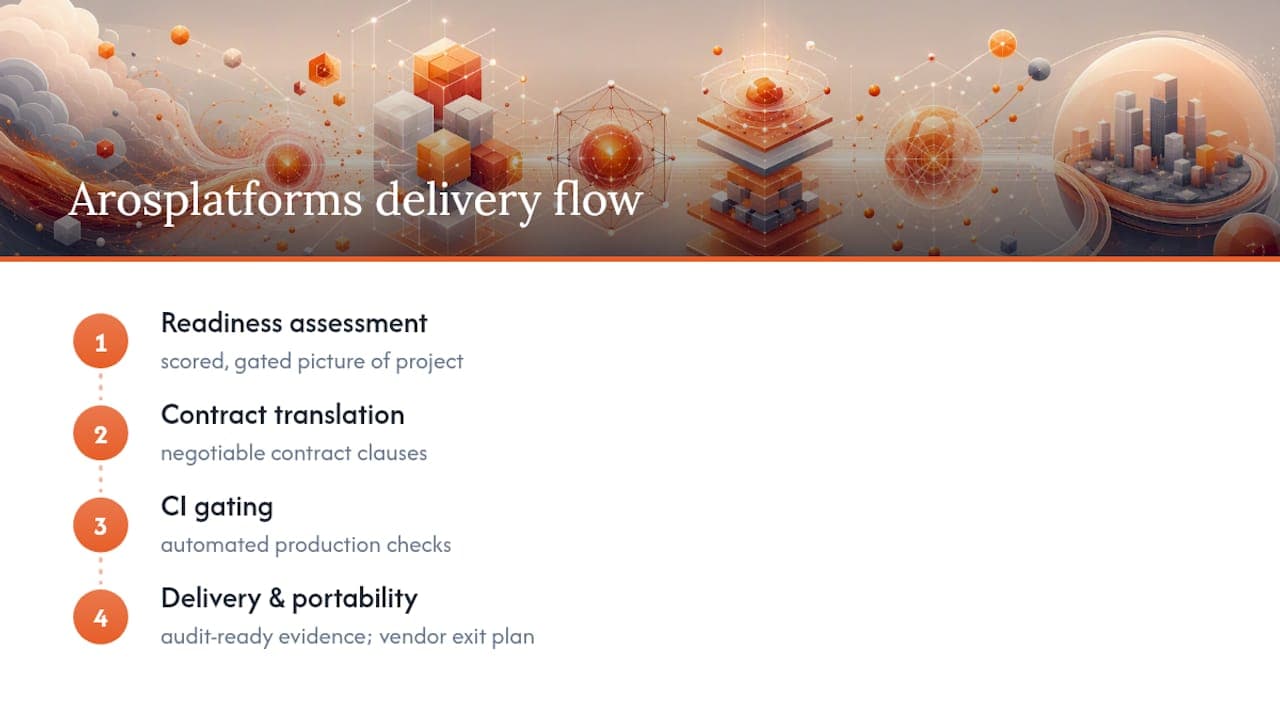
You get production gates mapped directly to contract terms, audit-ready evidence your compliance team can hand to a regulator without a scramble, and a portability plan that keeps you from getting stuck with a vendor you can’t leave. If you’re commissioning or evaluating a custom AI operating system right now, start with our AI readiness assessment service and get a scored, gated picture of where the project actually stands before you sign anything.
Sources
- Pre-Contract Due Diligence and Operational Safeguards for AI Vendor Engagements | Ward and Smith, P.A.
- mihaibc/ai-production-readiness-kit
- AI Vendor Risk Management: The Diligence Questions That Actually Bind Under Audit | DeepInspect
- AI Vendor Due Diligence: Procurement and Legal Playbook | AI&Scale
FAQ
What Is Operational Due Diligence for an AI System?
It’s a structured readiness assessment that scores a custom AI operating system across categories like data readiness, governance, and observability, then converts that score into a production go or no-go decision.
How Long Does an Operational Readiness Assessment Take?
A focused quick checklist takes 1 to 2 weeks with the right people involved; a full cross-functional assessment with remediation planning typically runs 3 to 6 weeks depending on system complexity.
What Counts as a Critical Finding That Blocks Production?
Common blockers include no named data owner, no golden eval dataset, no incident owner, and no rollback plan. Any one of these can override an otherwise strong score.
Can Vendor Certifications Like SOC 2 Replace Operational Due Diligence?
No. Vendor attestations are necessary but not sufficient; you still need runtime evidence like audit trails and contractual audit rights specific to your deployment.
Does Arosplatforms Run These Assessments Directly?
Yes. Arosplatforms conducts the readiness assessment, maps findings to contract terms, and implements CI gating as part of its AI operating system engagements.