What Does an AI Dealership Operating System Mean?
What Does an AI Dealership Operating System Mean?

An AI dealership operating system is defined as a centralized platform that uses artificial intelligence to automate, unify, and enhance dealership workflows and customer interactions across all departments. The industry term for this concept is an “AI OS,” and it represents a fundamental shift in how dealerships think about technology. Rather than running separate tools for CRM, DMS, marketing, and service, an AI OS acts as a continuous operational layer that connects all of them. Understanding what does an AI dealership operating system mean is no longer optional: 90% of dealerships report using or planning to integrate AI into their workflows as of 2025. That number signals a structural change in automotive retail, not a passing trend.
What does an AI dealership operating system mean for your tech stack?
An AI dealership operating system is not another software tool sitting alongside your CRM and DMS. It is the layer that sits above all of them, reading data from every system and routing decisions, tasks, and communications automatically. Think of it as the central nervous system of your dealership. Individual tools still do their jobs, but the AI OS tells them when to act, what to prioritize, and how to respond.
The distinction matters because most dealerships already own good software. The problem is that those systems do not talk to each other in real time. A customer who books a service appointment online may still receive a sales follow-up call for a vehicle they already bought. An AI OS eliminates that disconnect by maintaining a single, continuously updated customer record that every department reads from and writes to.

25% of new-vehicle buyers already use AI tools like ChatGPT to research vehicles as of mid-2026. That means customers arrive at your dealership having already interacted with AI. An AI OS ensures your internal operations match that same level of intelligence and responsiveness.
What are the key components of an AI dealership operating system?
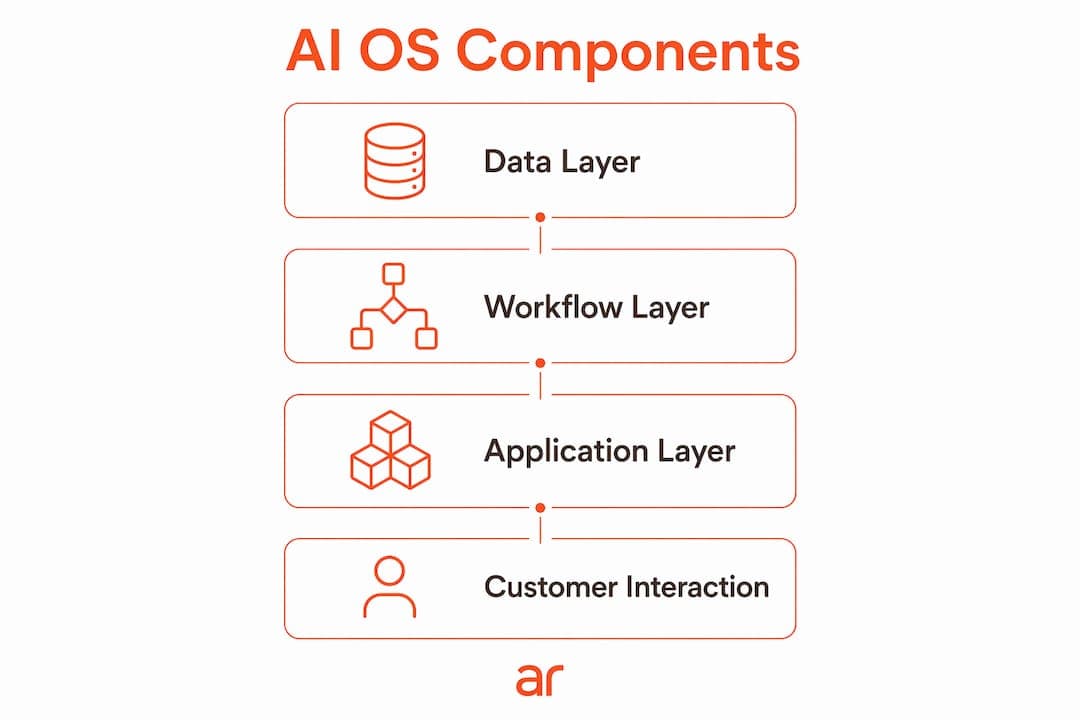
Modern AI OS architectures are built on three distinct layers that work together to create a unified operational environment. Each layer has a specific function, and removing any one of them breaks the system.
-
Data Layer. This layer pulls together records from your CRM, DMS, inventory feeds, service history, and marketing platforms into one unified data environment. Without this foundation, the AI has nothing reliable to act on. Garbage in, garbage out applies here more than anywhere else in dealership technology.
-
Workflow Layer. This layer handles decision logic and task routing. When a lead comes in at 11:00 PM, the workflow layer decides whether to send an automated response, flag it for a salesperson in the morning, or trigger a specific follow-up sequence based on the lead source and vehicle of interest. It is the rules engine that gives the AI OS its operational intelligence.
-
AI Agents Layer. This is where autonomous execution happens. AI agents carry out tasks across channels 24 hours a day, 7 days a week. They send follow-up texts, schedule service appointments, push recall notifications, and update customer records without any human input required. The system also provides granular attribution, tracing deal closures back to specific AI interactions so you know exactly what drove the sale.
These three layers work together in practice. A customer clicks a used-vehicle listing at 9:30 PM. The Data Layer identifies them as a previous service customer. The Workflow Layer triggers a personalized follow-up sequence. The AI Agents Layer sends a text within minutes. By the time your sales team arrives the next morning, the appointment is already booked.
Pro Tip: Before deploying any AI OS, audit your existing data sources for completeness and consistency. An AI OS is only as accurate as the data it ingests. Incomplete CRM records or duplicate DMS entries will produce unreliable outputs from day one.
How do AI dealership operating systems improve efficiency and customer experience?
The clearest benefits of AI in dealerships show up in three areas: speed of response, consistency of communication, and quality of decisions.
- Lead response automation. AI agents respond to inbound leads within seconds, regardless of time of day. Human response times average hours or longer. That gap in speed directly affects conversion rates.
- Service outreach and recall notifications. AI automates service follow-up, recall alerts, and equity nurturing with continuous customer context shared across departments. A service advisor sees the full sales history. A salesperson sees the service record. No one starts a conversation blind.
- Dynamic pricing and inventory decisions. AI analyzes multiple variables simultaneously for used-vehicle pricing and inventory management. That real-time adaptability outperforms static pricing models that rely on weekly manual reviews.
- CSI score improvement. Consistent, timely, and personalized communication directly lifts Customer Satisfaction Index scores. Customers who feel remembered and valued return for their next purchase and refer others.
- Competitive positioning. Dealerships running an AI OS respond faster, price more accurately, and retain customers longer than those relying on disconnected tools.
The compounding effect is what makes an AI OS different from a single automation tool. Each improvement reinforces the next. Faster lead response fills the service lane. A fuller service lane generates more equity mining opportunities. More equity mining drives repeat sales. The cycle runs continuously without manual intervention.
Pro Tip: Pair AI automation with a defined human escalation path. AI handles volume and speed. Your team handles nuance and relationship. Define exactly which triggers hand a conversation from AI to human, and train both sides of that handoff.
What challenges and misconceptions exist in deploying dealership AI?
The biggest misconception about an AI dealership operating system is that it works out of the box. It does not. AI must be trained like a new employee, requiring time and institutional knowledge before it performs reliably. Dealership managers who treat it as plug-and-play software will be disappointed within the first 90 days.
Several other pitfalls consistently derail AI OS deployments:
- Deploying customer-facing AI chatbots before building an internal AI knowledge base. The result is a bot that cannot answer basic questions about your inventory, pricing, or policies.
- Ignoring the AI-to-human handoff. The transition between AI automation and human interaction is the most common failure point in dealership AI programs. Customers notice the seam.
- Running fragmented AI tools instead of a unified AI OS. A chatbot here, an email automation there, and a pricing tool somewhere else creates data silos that undermine the value of each individual tool.
- Assuming AI is infallible. Human audit remains necessary for complex areas like financial fee explanations and sensitive customer communications.
“Dealers should aim for end-to-end automation by AI or fully human workflows. Partial, fragmented approaches create operational disconnect that customers experience as confusion and inconsistency.” — WardsAuto
The vendor relationship also requires scrutiny. AI tools must adapt to dealer workflows rather than forcing dealerships to reshape their business model around a vendor’s product. If an AI vendor tells you to change how you handle F&I to fit their system, that is a red flag.
Pro Tip: Implement in phases. Start with internal AI applications like HR screening, pricing analysis, and service scheduling before going customer-facing. Build your institutional knowledge base first, then expand outward.
What does real-world AI dealership operating system implementation look like?
Implementation follows a predictable sequence when done correctly. The first phase is data consolidation: connecting your CRM, DMS, inventory feeds, and service records into the AI OS data layer. The second phase is workflow configuration: defining the rules that govern how the AI routes tasks, triggers communications, and escalates to humans. The third phase is agent training: feeding the system your dealership’s specific policies, pricing logic, inventory preferences, and customer communication standards.
The use cases that deliver the fastest returns span every department:
Marketing: AI identifies which leads are most likely to convert based on browsing behavior, past purchases, and service history, then prioritizes outreach accordingly.
Service: AI schedules appointments, sends reminders, and follows up after visits. It also flags customers approaching lease-end or high-mileage thresholds for proactive outreach.
Used-vehicle pricing: AI monitors market data and adjusts prices in real time, reducing days-to-turn and protecting gross.
HR: AI assists with resume screening and role-specific interview question generation tailored to dealership culture. It also helps managers prepare for sensitive employee conversations with structured frameworks.
The table below shows how traditional workflows compare to AI OS-enhanced workflows across key dealership functions.
| Function | Traditional workflow | AI OS-enhanced workflow |
|---|---|---|
| Lead response | Manual follow-up, hours or days | Automated response within seconds, 24/7 |
| Service scheduling | Phone-based, staff-dependent | AI-driven booking with automated reminders |
| Used-vehicle pricing | Weekly manual review | Real-time multi-variable pricing adjustments |
| Customer context | Siloed by department | Unified record shared across all teams |
| HR screening | Manual resume review | AI-assisted screening and interview prep |
AI-driven operational insights also uncover hidden inefficiencies that manual reporting misses entirely. A dealership might discover that a specific lead source consistently produces low-gross deals, or that a particular service advisor’s customers have a significantly higher return rate. Those insights are invisible in a standard DMS report but surface immediately in an AI OS dashboard.
Pro Tip: Track ROI at the workflow level, not just the platform level. Measure lead-to-appointment rate, appointment-to-sale rate, and service retention separately. Compounding gains across all three is where the real return accumulates.
Key Takeaways
An AI dealership operating system delivers compounding operational gains only when its three layers, data, workflow, and AI agents, are fully integrated and continuously trained on dealership-specific knowledge.
| Point | Details |
|---|---|
| AI OS is not plug-and-play | It requires phased training and institutional knowledge, like onboarding a new employee. |
| Three-layer architecture | Data, Workflow, and AI Agents layers must all function together for the system to work. |
| Handoff design is critical | Define exactly when AI escalates to a human to avoid the most common failure point in deployment. |
| Internal AI comes first | Build your internal knowledge base before deploying any customer-facing AI tools. |
| Ownership protects ROI | Dealerships that own their AI data and workflows avoid vendor lock-in and retain long-term value. |
The case for building your AI foundation before buying another tool
The Arosplatforms team has worked across automotive, logistics, and healthcare, and the pattern is consistent: dealerships that rush to deploy customer-facing AI without an internal foundation waste both money and credibility. A chatbot that cannot answer a question about your own inventory does more damage than no chatbot at all.
The more uncomfortable truth is that most dealerships are not behind on AI tools. They are behind on AI architecture. They have chatbots, email automations, and pricing widgets. What they lack is a unified system that makes those tools share context and compound value over time. That gap is where the real competitive risk lives.
AI adoption pace is exponential, and the dealerships that invest in architecture now will hold an advantage that is genuinely difficult to replicate later. Institutional knowledge embedded in an AI OS accumulates over time. A competitor who starts two years after you cannot simply buy their way to the same depth of operational intelligence you have built.
The advice we give every dealership manager is this: own your data, own your workflows, and own your AI. Renting intelligence from a vendor means the moment you stop paying, the learning disappears. Build it internally, and it compounds indefinitely.
— Arosplatforms team
Arosplatforms builds AI operating systems for automotive dealerships
Dealership managers who want to move from fragmented AI tools to a unified AI OS for automotive operations have a clear starting point with Arosplatforms. The team specializes in building customized AI operating systems that embed directly into existing dealership workflows, connecting CRM, DMS, inventory, and service data into a single operational layer.

Arosplatforms clients typically see returns within twelve months and report an average of 82% faster turnaround on key operational tasks. The approach prioritizes full ownership of your AI system, so your institutional knowledge stays with your dealership, not with a vendor. For dealerships in the US market, AI consulting for US enterprises is available with automotive-specific expertise. Contact Arosplatforms to build a customized AI OS strategy for your dealership.
FAQ
What does an AI dealership operating system mean?
An AI dealership operating system is a centralized platform that unifies CRM, DMS, inventory, and service data, then uses AI agents to automate workflows and customer interactions across all departments. It acts as the operational layer connecting every dealership function in real time.
How is an AI OS different from standard dealership AI software?
Standard AI dealership software handles one function, such as lead response or pricing. An AI OS connects all functions into a single system where data, decisions, and actions flow continuously across departments without manual handoffs.
What are the biggest risks in deploying dealership AI?
The most common failure point is the AI-to-human handoff, where customers experience a jarring transition between automated and human interaction. Fragmented tools and insufficient training on dealership-specific knowledge are the other leading causes of poor outcomes.
How long does it take to see benefits of AI in dealerships?
Dealerships that implement in phases, starting with internal workflows before going customer-facing, typically see measurable efficiency gains within the first few months. Full ROI on a complete AI OS deployment generally materializes within twelve months.
Do dealerships need to change their workflows to use an AI OS?
No. AI tools must adapt to dealer workflows rather than forcing dealerships to restructure around a vendor’s product. A well-built AI OS fits your existing processes and improves them without requiring a business model overhaul.