Pilot 25–50 Leases to Keep AI Abstracts Current for Portfolio CRE Teams
Pilot 25–50 Leases to Keep AI Abstracts Current for Portfolio CRE Teams
AI lease abstraction works for portfolio-scale commercial real estate teams when it’s deployed with human validation and real integration, not as a standalone tool. Teams report manual review time dropping from hours to minutes, with accuracy landing high enough for underwriting and lease administration once reviewers check flagged fields. If you manage more than a few hundred leases, run a focused pilot on 25 to 50 documents before committing to a platform.
TL;DR:
- Automated lease abstraction typically reduces manual review time from hours to minutes but requires human validation for high accuracy.
- The process relies on four stages: OCR for digitizing, NLP/LLM for data extraction, confidence scoring, and human review, with errors often stemming from poor scans.
- Deployment options include SaaS, in-house, managed, and hybrid models, with choices driven by portfolio size, document complexity, and control preferences.
- Effective tools must offer source-linked audit trails, high-field coverage, integration capabilities, and proper handling of amendments to maintain data accuracy over time.
- Pilot projects should focus on challenging, heavily amended leases to validate extraction quality before full-scale deployment, with rapid ROI achievable through time savings.
Table of Contents
- What Is Lease Abstraction AI and How Does It Work?
- SaaS, In-House, or Managed: Which Deployment Model Fits?
- What to Look for When Evaluating a Lease Abstraction Tool
- How Accurate Is AI Lease Abstraction, Really?
- From Pilot to Production: Timeline, Roles, and ROI
- What We’ve Learned Building AI Operating Systems for Real Estate
- What Does AI Lease Abstraction Cost?
- Your Same-Day Checklist to Start Evaluating AI Lease Abstraction
- Arosplatforms Team Perspective: Priorities and Pitfalls
- Building a Lease Abstraction System That Actually Stays Current
- Sources
- FAQ
What Is Lease Abstraction AI and How Does It Work?
Lease abstraction, in its traditional form, means pulling key terms out of a lease document (rent schedules, renewal options, square footage, obligations) and organizing them into a structured record someone can actually use. Lease abstraction AI automates that extraction using optical character recognition and language models trained to read legal and financial documents. The industry term for the broader category is automated lease analytics, and it’s worth knowing that phrase because it’s what most enterprise software vendors and lease administration platforms call it in their documentation.
The pipeline runs in four stages, and skipping any one of them is where most implementations go wrong.
- Document ingestion and OCR. Scanned PDFs, executed leases, and amendment packets get converted into machine-readable text. Poor scan quality (faded signatures, handwritten margin notes) is still the single biggest source of extraction errors at this stage.
- NLP/LLM extraction. A language model identifies and pulls specific data points: commencement date, expiration date, base rent, escalation schedule, renewal options, CAM reconciliation terms, exclusivity clauses, and default provisions.
- Confidence scoring and validation. Each extracted field gets a confidence score. Low-confidence fields get flagged for a human reviewer instead of being pushed straight into your system of record.
- Human-in-the-loop review. A lease administrator or analyst checks flagged fields against the source document, corrects errors, and approves the record.
The output isn’t a summary paragraph. It’s structured data: a spreadsheet row, a JSON object, or a direct feed into your lease administration platform, with every field traceable back to the specific page and clause it came from. For CRE teams, the fields that matter most are term dates, rent and escalation structures, renewal and termination options, CAM and operating expense responsibility, and any co-tenancy or exclusivity obligations that affect leasing strategy elsewhere in the portfolio.
SaaS, In-House, or Managed: Which Deployment Model Fits?
There isn’t one right way to deploy lease abstraction AI. The choice depends on portfolio size, document volume, and how much control your team wants over the underlying system.
- SaaS platforms. These get you running fast, usually within weeks, with a subscription model and prebuilt extraction templates. The trade-off is limited customization: if your leases have unusual clause structures or you need a specific integration with a niche accounting system, you’re often stuck waiting on the vendor’s roadmap.
- In-house/custom builds. Building your own extraction pipeline gives you full ownership and lets you tune the model to your exact document types. It also requires real upfront investment in data science talent and infrastructure, which only makes sense for very large portfolios or firms with existing AI teams.
- Managed or consultancy-led deployments. A consultancy designs and builds the extraction system around your specific lease types, then integrates it with your existing lease admin and accounting stack. This tends to get you to production faster than an in-house build while still giving you a system tailored to your operation, rather than a generic template.
- Hybrid models. Many portfolio teams run a SaaS tool for routine leases and a managed or custom layer for complex, high-value, or heavily amended agreements. This makes sense when your portfolio has a long tail of standard retail or office leases alongside a handful of complex ground leases or sale-leasebacks that need more careful handling.
Amendment-heavy portfolios tend to push teams toward hybrid or managed models, since off-the-shelf SaaS extraction often treats each amendment as a brand-new document instead of a change to an existing record.
What to Look for When Evaluating a Lease Abstraction Tool
Marketing pages tend to blur together. The features that actually separate a usable system from an expensive spreadsheet generator come down to six things.
- Field coverage matched to your accounting needs. If your team reports under ASC 842 or IFRS 16, confirm the tool extracts the specific data points those standards require, like lease classification inputs and discount rate assumptions, not just basic rent and term data.
- Source-linked audit trail. Every extracted field should hyperlink back to the exact clause and page it came from. Without this, a reviewer has no fast way to verify a flagged field, and your auditors have no way to trace a number back to its source.
- Confidence scoring with a usable review workflow. Low-confidence extractions need to route to a human reviewer automatically, and the reviewer interface should show the source document side-by-side with the extracted field, not in a separate tab.
- Integration with your lease admin and accounting platforms. Check whether the tool exports directly into your systems of record or just spits out a CSV you’ll have to import manually every time.
- Security certifications. SOC 2 and ISO 27001 are the baseline for handling lease financials and tenant information at scale.
- Amendment handling. Ask specifically how the tool treats a new amendment against an existing abstract. Does it merge the change automatically, or create a disconnected duplicate record?
Pro Tip: Ask any vendor for their remediation SLA in writing before you sign anything. If a batch comes back with accuracy below your threshold, you want a contractual commitment to re-review and correct it at no extra cost, not a verbal promise.
How Accurate Is AI Lease Abstraction, Really?
Accuracy on standard fields (rent, dates, square footage) tends to run high once a human reviewer is checking flagged extractions. Where teams get burned is trusting raw model output on complex clauses without that review step.
The risk is real and well documented outside real estate too: Stanford research on legal language models found hallucination rates of approximately one in six or higher on benchmarking queries, meaning the model generated a plausible-sounding but incorrect answer. Lease documents are dense legal and financial text, so the same failure mode applies: a model can misread an escalation formula or misinterpret a conditional renewal clause and present it with the same confidence as a correct extraction.
The mitigation isn’t better prompting. It’s structural. Run periodic sample audits on a random slice of “approved” records, not just the flagged ones, since systematic errors can hide in fields the model reports as high-confidence. Track reviewer correction rates by field type so you know which clause categories need tighter scrutiny over time.
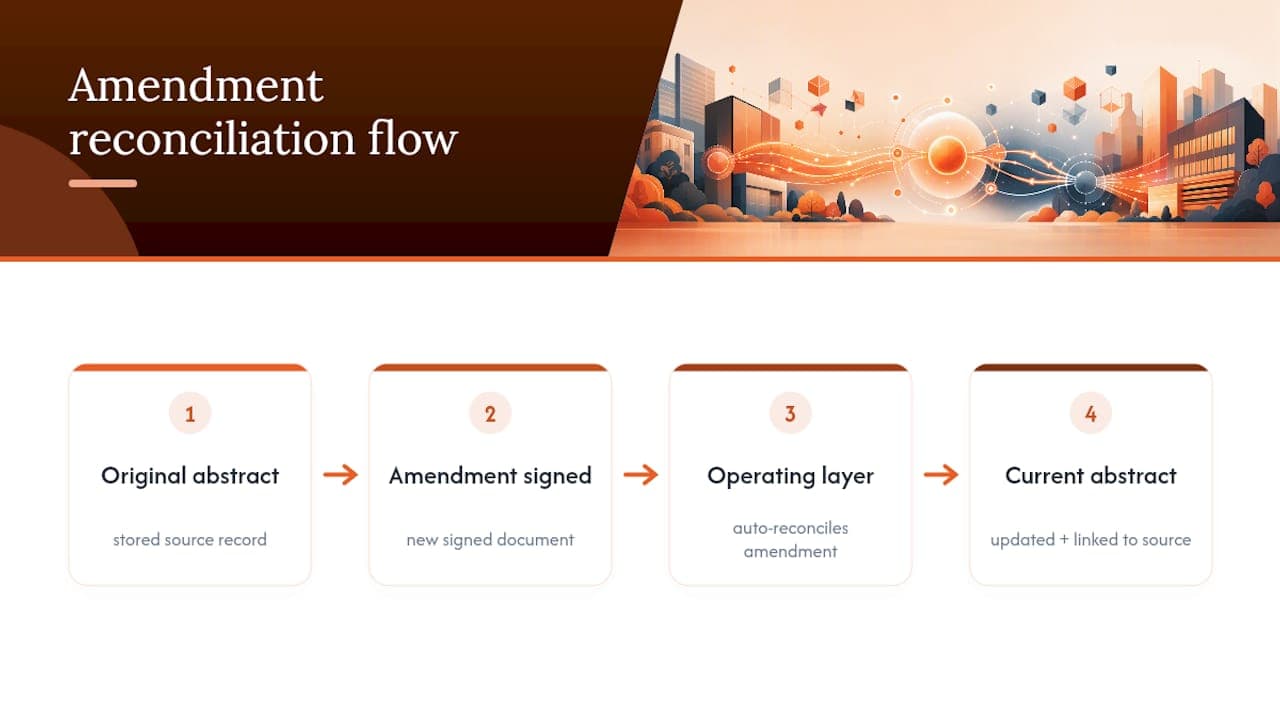
There’s a second, quieter risk: data decay. A lease abstract is accurate on the day it’s created and starts going stale the moment an amendment gets signed. Teams that treat abstraction as a one-time cleanup project end up right back where they started within a year or two. The fix is an operating-layer approach that reconciles amendments against the original abstract automatically instead of requiring someone to remember to update a spreadsheet.
From Pilot to Production: Timeline, Roles, and ROI
A pilot should never start with your entire portfolio. Start narrow, prove accuracy, then scale.
- Scope the pilot. Pick 25 to 50 leases that represent your real document mix, including a few messy or heavily amended ones, not just clean standard leases. Set a target pass threshold (most teams aim for 90%+ accuracy on core fields before scaling).
- Assign roles. Lease administrators review flagged fields. Operations owns the rollout plan. IT handles data connections to your lease admin and accounting systems. If you’re working with a consultancy, they typically own model tuning and integration build-out.
- Run the pilot and measure. Track extraction accuracy against a manually verified sample, reviewer time per document, and how many fields needed correction versus outright re-extraction.
- Train and scale. Once the pilot clears your threshold, train the broader team on the review workflow, connect remaining integrations, and phase in the rest of the portfolio in batches rather than all at once.
The ROI math is straightforward once you have pilot data. If manual abstraction takes a lease administrator roughly two hours per lease and AI-assisted review with human validation cuts that to 15–20 minutes, that’s more than 80% time savings per lease. Across a 500-lease portfolio, that difference is the equivalent of freeing up multiple full-time roles for higher-value underwriting and portfolio strategy work instead of data entry.
| Pilot stage | Typical duration | Primary owner |
|---|---|---|
| Scoping and document collection | 1–2 weeks | Operations |
| Extraction and initial review | 2–3 weeks | Lease admin + vendor/consultant |
| Accuracy validation and correction | 1–2 weeks | Lease admin, sampled by IT |
| Integration and rollout planning | 2–4 weeks | IT + consultant |
What We’ve Learned Building AI Operating Systems for Real Estate
Arosplatforms builds these systems as an operating layer, not a one-time extraction job. That distinction shows up in how we scope engagements from day one: the goal isn’t a clean spreadsheet delivered once. It’s a system that keeps abstracting new amendments as they land, with clients typically seeing rapid ROI, often within twelve months, and an average 82% faster turnaround on key lease tasks once the system is running.
The biggest lesson from real deployments is that ownership matters more than clients expect going in. Teams that insist on owning the model configuration and the validation workflow, instead of depending entirely on a vendor’s black box, adapt faster when their lease mix changes or a new accounting requirement lands.
The single most common failure pattern we see isn’t extraction accuracy. It’s teams treating the initial abstraction batch as “done” and never connecting it to the amendment pipeline that follows. Six months later, the abstract is stale and nobody trusts it anymore.
Validation automation, not just human review, is what keeps that from happening at scale.
What Does AI Lease Abstraction Cost?
Pricing varies more than most buyers expect, and the structure you pick shapes your incentives as much as the final number.
- Per-document pricing. You pay a flat rate per lease abstracted, which is simple to budget but doesn’t account for complexity differences between a five-page retail lease and a 200-page ground lease with a dozen amendments.
- Per-field pricing. Costs scale with how many data points you extract per lease. This rewards precision but can get expensive fast if you’re pulling extensive obligation and compliance fields.
- Subscription/platform fees. A flat monthly or annual fee covers a volume tier, typical of SaaS tools, with overage charges past a certain document count.
- Managed service fees. A consultancy charges a project fee for building and integrating the system, sometimes with an ongoing support retainer, structured around outcomes rather than per-document counts.
The biggest price drivers are document volume, how messy your lease language is, how often amendments hit your portfolio, and how much integration work is needed to connect outputs to your existing lease admin and accounting stack. When you’re comparing proposals, ask specifically for pilot pricing separate from full rollout pricing, a written accuracy SLA, and remediation terms for batches that fall below threshold. Vague promises about “high accuracy” without a number attached to a contract aren’t worth much.
Your Same-Day Checklist to Start Evaluating AI Lease Abstraction
You don’t need a six-month RFP process to get moving. Here’s what to do this week.
- Define scope and success metrics. Pick a target accuracy threshold and decide which fields matter most for your underwriting or admin workflow.
- Pull a representative document sample. Gather 25 to 50 leases that reflect your real mix, including a few messy ones, and map out every field you need extracted.
- Run a small pilot. Test extraction against those documents and validate the results manually against a known-correct sample.
- Map your integration needs. List every system the extracted data needs to flow into, from lease admin software to your accounting platform.
- Choose a delivery model and draft your SOW. Decide between SaaS, managed, or hybrid, and make sure the contract includes remediation clauses for underperforming batches.
Pro Tip: Run your pilot on the ugliest leases in your portfolio, not the cleanest ones. If a tool handles your worst-scanned, most heavily amended document well, it’ll handle everything else without surprises.
Arosplatforms Team Perspective: Priorities and Pitfalls
We keep seeing the same mistake: teams scope lease abstraction as a cleanup sprint instead of an operating system. That framing sets the wrong expectations from the start. An abstract that isn’t wired to your amendment pipeline starts decaying the day it’s finished, and nobody notices until a renewal deadline gets missed.
Integration isn’t a nice add-on you get to later. It’s the difference between a one-time project and a system your team can actually rely on for underwriting and audits years from now. If you’re running a pilot, prioritize traceability and validation workflows before you worry about extraction speed. A fast tool that produces untraceable data will cost you more in reviewer trust than it saves in hours.
— arosplatforms team
Building a Lease Abstraction System That Actually Stays Current
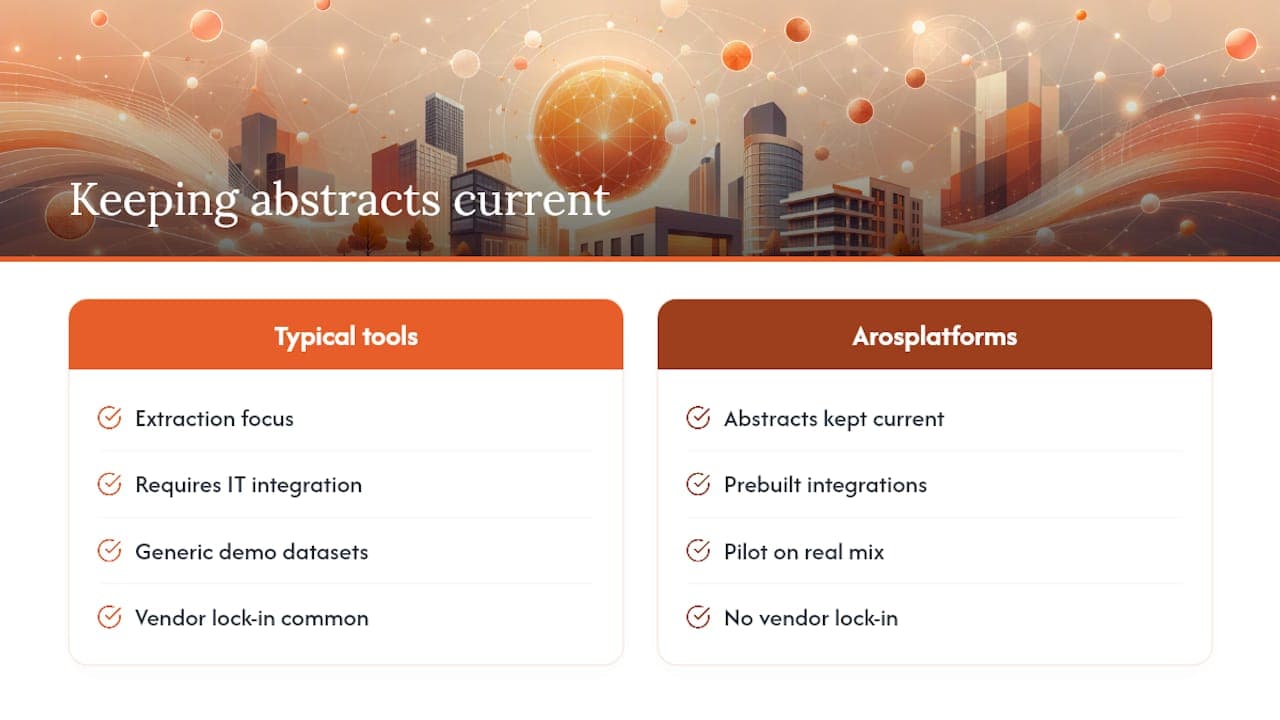
The tools compared throughout this piece, SaaS platforms, in-house builds, managed deployments, all solve the extraction problem. Fewer of them solve the harder problem: keeping abstracts connected to your lease documents as amendments keep arriving. That’s the specific gap Arosplatforms builds for. Rather than handing you a licensed tool and leaving integration to your IT team, we design the AI operating system around your actual lease mix, your accounting platform, and your review workflow, then hand you ownership of it. No vendor lock-in, no re-buying access every renewal cycle.
If you manage a portfolio where amendments outpace your team’s ability to keep abstracts current, request an AI readiness assessment and we’ll scope a pilot around your actual document mix, not a generic demo set.
Sources
The accuracy and hallucination figures in this article draw on Stanford HAI’s research into legal AI model reliability, the most rigorous public benchmarking available on legal-domain language models. Cost and time-savings figures come from Realcomm’s industry reporting on AI lease abstraction deployments. Integration and workflow examples reference Datagrid’s reporting on AI agents in commercial real estate. For broader context on cloud-based portfolio management trends, see this analysis of property management technology shifts.
- How AI Lease Abstraction Reduces Costs
- AI trial: legal models hallucinate 1 out of 6 or more benchmarking queries
FAQ
What is meant by lease abstraction?
Lease abstraction is the process of pulling key terms (rent, dates, options, obligations) out of a full lease document and organizing them into a shorter, structured record that’s faster to search and analyze.
How does AI lease abstraction work?
It combines OCR to digitize scanned documents with NLP or LLM models trained to extract specific data fields, assigns confidence scores to each field, and routes low-confidence extractions to a human reviewer before the data enters your systems of record.
Which AI solution is best for lease abstraction?
The right choice depends on your portfolio size and amendment volume: SaaS tools suit standardized, high-volume leases, while managed deployments like those Arosplatforms builds suit portfolios with complex documents that need tight integration with existing lease admin and accounting platforms.
Can ChatGPT abstract a lease?
A general-purpose model like ChatGPT can summarize a lease document, but it lacks the source-linked audit trail, confidence scoring, and integration pipeline that portfolio-scale teams need, and general legal language models carry meaningful hallucination risk on complex clause interpretation without a validation layer.