The Role of AI in Lease Management: 2026 Guide
The Role of AI in Lease Management: 2026 Guide

AI in lease management is defined as the use of machine learning, natural language processing, and automated workflows to extract, process, and act on lease data without manual intervention. Property managers who have adopted these tools report measurable gains in speed and accuracy across their portfolios. AI-assisted email drafting saves up to 11.9 hours per week, according to AppFolio data cited by the National Association of Realtors. That figure represents real capacity returned to your team every single week. The role of AI in lease management is not to replace professional judgment. It is to eliminate the repetitive, error-prone work that consumes hours your team should spend on higher-value tasks.
What is the role of AI in lease management?
AI in lease management covers two core functions: lease abstraction and workflow automation. Lease abstraction is the industry term for extracting structured data from unstructured lease documents. Workflow automation refers to AI handling communications, reminders, and reporting tasks that previously required manual effort.
Both functions depend on the same underlying technologies. Advanced optical character recognition (OCR) converts scanned documents into machine-readable text. Natural language processing (NLP) then interprets that text to identify clauses, dates, and financial terms. Semantic reconstruction techniques piece together meaning across multi-page documents where context spans several sections.

The practical result is that property managers can process lease portfolios faster and with fewer manual errors. AI technology in real estate has moved from experimental to operational in commercial and residential property management alike. The question for most teams is no longer whether to adopt AI, but how to do it without creating new risks.
What key lease data does AI extract and how does it improve accuracy?
AI extracts the lease fields that matter most to operations and accounting. These include critical dates such as lease commencement, expiration, and option exercise deadlines. AI also pulls rent escalation schedules, CAM reconciliation terms, renewal conditions, and landlord and tenant obligations.
Confidence scoring and human review are critical to making this extraction reliable. A confidence score tells you how certain the AI is about each extracted value. Page references let reviewers verify the source clause directly, rather than trusting the output blindly.
The failure points cluster around complex clauses. Rent escalations with caps, co-tenancy provisions, and clauses that cross-reference exhibits in other documents are the most common sources of AI error. Errors in escalation and co-tenancy terms can trigger missed renewals or costly misbillings with direct financial consequences. That is why human verification must focus specifically on renewal dates, rent escalations, CAM charges, and amendments.
- Critical dates: Commencement, expiration, option deadlines, and notice periods
- Financial terms: Base rent, escalation schedules, caps, and CAM reconciliation amounts
- Operational clauses: Maintenance obligations, permitted use, and subletting rights
- Cross-referenced exhibits: Attachments that modify base lease terms and require separate review
Pro Tip: Set your AI abstraction tool to flag any clause that references an exhibit or external document. These cross-references are where context breaks down and errors cascade into accounting.
Success in AI lease abstraction depends on combining AI output with human verification enabled by confidence scores and source citations. Accuracy benchmarks from vendors typically range from 90–97%, but complex clauses consistently fall below that range and require additional scrutiny.
How does AI automate lease workflows and what operational efficiencies result?
Workflow automation is where most property managers see the fastest return. AI handles the high-volume, repetitive communication tasks that consume staff time without requiring professional judgment.
- Lease renewal reminders: AI monitors expiration dates and sends timed notices to tenants and owners, eliminating manual calendar tracking.
- Inbound leasing inquiries: AI handles inbound leasing questions on availability, pricing, and amenities in real time, freeing staff for relationship-focused conversations.
- Tenant communications: AI drafts rent reminders, inspection notices, and maintenance updates for human review before sending.
- Owner reports: AI compiles portfolio performance data into structured reports, reducing the time managers spend on manual data assembly.
- Maintenance coordination: AI routes maintenance requests, assigns vendors, and sends status updates without staff involvement at each step.
Automating lease agreements and related communications reduces repetitive administrative work across all of these categories. The productivity gain is not theoretical. Teams that deploy these workflows report meaningful hours returned to staff each week.
Pro Tip: Start with outbound communications like rent reminders before automating inbound inquiry responses. Outbound workflows are lower risk and give your team confidence in AI output before handling live tenant conversations.
AI’s greatest near-term impact is freeing leasing teams from high-volume repetitive tasks so they can focus on resident experience and portfolio strategy. That shift in focus is where property managers build competitive advantage, not in answering the same email for the hundredth time.
What are the risks and limitations of using AI in lease management?
AI in property management carries real operational, legal, and technical risks. Understanding them before deployment prevents costly mistakes.
- Hallucinations: AI can generate plausible-sounding but incorrect lease data. A hallucinated renewal date or rent figure can cause a missed option or a billing dispute. Human review of every critical field is not optional.
- Bias in screening and leasing decisions: AI models trained on historical data can reflect past discriminatory patterns. Potential bias in AI leasing applications creates exposure under the Fair Housing Act. Legal counsel should review any AI tool used in tenant screening or leasing decisions.
- Data privacy: Tenant personal information entered into AI prompts is subject to data protection standards. Treat AI data inputs like secure email exchanges and anonymize sensitive tenant data before using it in any AI workflow.
- Regulatory exposure: The legal framework governing AI in real estate is still developing. Policies that seem compliant today may require adjustment as regulations evolve. Consulting legal counsel before deploying AI for leasing decisions is the standard practice.
- Overreliance on vendor accuracy claims: Vendor-cited accuracy benchmarks of 90–97% apply to standard clauses. Complex provisions consistently underperform those benchmarks.
A review-before-send policy for all AI-drafted tenant communications is the single most effective safeguard against accidental legal exposure or damaged tenant relationships. Build that policy into your workflow before you deploy, not after an incident forces you to.
How to implement AI effectively in lease management workflows?
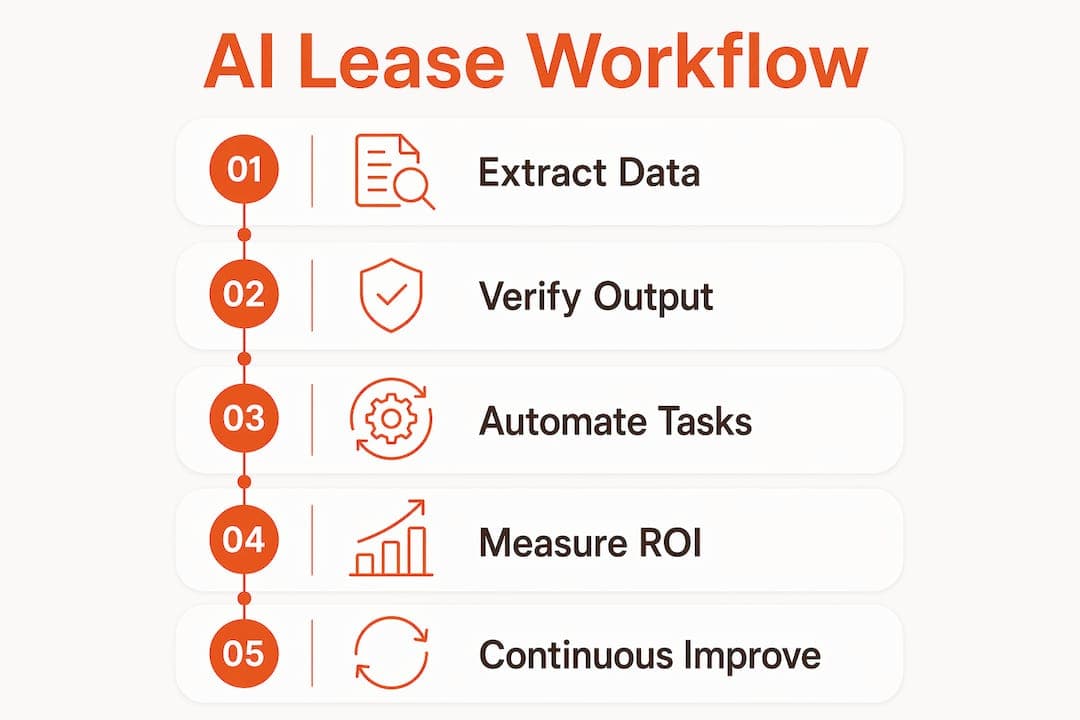
Effective implementation follows a structured sequence. Teams that skip baselining and jump straight to deployment cannot measure whether AI is actually improving performance.
Baseline your current operations first
Baselining pre-AI operational metrics such as hours per lease and error rates on a human-verified sample is the foundation of measurable ROI. Without a baseline, you cannot prove the AI is working. Measure time per lease abstraction, error rate on critical fields, and volume of tenant communications handled manually. Document these numbers before you change anything.
Deploy in bounded, verifiable phases
Deploy AI improvements with bounded workflows verified by humans at each critical step. A 90-day shipping and measuring cycle gives you enough data to validate time and accuracy gains without overcommitting. Start with one workflow, measure it, and expand only after you have confirmed the results.
Integrate with your existing platforms
AI tools that do not connect to your property management platform create data silos. Integration with your existing lease management software is a prerequisite, not a nice-to-have. AI portfolio intelligence tools that provide source-cited, verifiable answers over lease data are the standard for audit-ready operations.
| Implementation phase | Key action | Success metric |
|---|---|---|
| Baseline | Document hours per lease and error rates | Verified pre-AI benchmark |
| Pilot | Deploy AI on one workflow with human review | Time saved vs. baseline |
| Validate | Measure accuracy on complex clauses | Error rate on critical fields |
| Expand | Roll out to additional workflows | Portfolio-wide time and error gains |
Pro Tip: Assign one team member as the AI output reviewer for the first 90 days. Concentrated review builds pattern recognition for where your specific AI tool makes errors, which makes the entire team faster at verification.
Arosplatforms builds custom AI workflows for real estate teams using exactly this phased approach, with human verification built into every critical step and ownership of the system staying with the client.
Key takeaways
AI in lease management delivers measurable ROI only when human verification is built into every critical workflow step, not added as an afterthought.
| Point | Details |
|---|---|
| AI extracts structured lease data | OCR and NLP pull critical dates, rent terms, and CAM charges from unstructured documents. |
| Complex clauses require human review | Escalations with caps and cross-referenced exhibits are the most common AI error sources. |
| Workflow automation saves hours weekly | AI-assisted email drafting alone saves up to 11.9 hours per week per AppFolio data. |
| Legal risks require proactive safeguards | Fair Housing Act exposure and data privacy require legal review and anonymization practices. |
| Baseline before you deploy | Measuring pre-AI metrics is the only way to prove and sustain ROI from AI adoption. |
The honest case for going slow with AI in leasing
The property managers who get the most from AI are the ones who treat it as a productivity assistant, not an autonomous system. That distinction matters more than any feature list.
We have seen teams rush to automate tenant communications and lease abstraction simultaneously, only to discover that their AI tool was hallucinating renewal dates on 8% of leases. That error rate sounds small until you calculate the cost of a missed option on a commercial lease. The financial exposure from one missed renewal can exceed the entire annual cost of the AI tool.
The teams that succeed take a different approach. They baseline first, deploy one workflow at a time, and review AI output rigorously for the first 90 days. By the time they expand to a second workflow, they know exactly where their tool is reliable and where it needs a human check. That knowledge is worth more than any vendor accuracy benchmark.
AI in property management is genuinely useful. The benefits of AI in property leasing are real and measurable. But the professionals who build lasting advantage are the ones who maintain oversight, measure outcomes, and never let the tool make a critical decision without a human in the loop.
— Arosplatforms team
How Arosplatforms supports AI adoption in lease management
Property managers who want to move from manual processes to verified AI workflows need more than software. They need a deployment approach that fits their existing operations and delivers measurable results.

Arosplatforms builds custom AI systems for real estate teams, with a focus on bounded workflows, human verification protocols, and full client ownership of the resulting system. The approach is designed for teams that need real ROI within twelve months, not a multi-year implementation. Clients report an average of 82% faster turnaround on key tasks after deployment. Explore AI case studies from real estate teams to see how the approach translates to lease management operations.
FAQ
What is AI lease abstraction?
AI lease abstraction is the automated extraction of structured data from lease documents using OCR and NLP. It pulls critical dates, rent terms, escalation schedules, and CAM charges into a structured format for review and use.
How accurate is AI at reading lease documents?
Vendor-cited accuracy benchmarks typically range from 90–97% for standard clauses. Complex provisions like escalations with caps and cross-referenced exhibits consistently fall below that range and require human review.
Does AI replace property managers in lease management?
AI does not replace property managers. It handles repetitive tasks like drafting communications and extracting lease data, while property managers retain judgment-based roles in negotiations, compliance, and tenant relationships.
What are the Fair Housing Act risks of using AI in leasing?
AI models trained on historical leasing data can reflect past discriminatory patterns, creating exposure under the Fair Housing Act. Legal counsel should review any AI tool used in tenant screening or leasing decisions before deployment.
How long does it take to see ROI from AI in lease management?
Teams that baseline their operations, deploy in phases, and measure outcomes within 90-day cycles can validate time and accuracy gains quickly. Many Arosplatforms clients report measurable returns within twelve months of deployment.