60 Second Moat Test for Executives: Build or Buy AI Scorecard
60 Second Moat Test for Executives: Build or Buy AI Scorecard
Default to buying. For roughly 90 to 95% of AI use cases, the right move is a managed API or off-the-shelf platform, because foundation model economics now favor vendors over in-house builds in almost every scenario. Build only when you can finish this sentence without hedging: “We know something a major AI lab cannot learn in about 18 months.” Even then, you need an orchestration layer before scaling anything.
TL;DR:
- Building AI is only justified when proprietary data or unique operational quirks cannot be replicated or obtained through vendor solutions within 18 months.
- For workloads under 50,000 API calls per month, buying or using managed platforms is generally more cost-effective than building a custom system.
- The decision to build or buy should weigh data uniqueness, regulatory constraints, time-to-value needs, and internal ML capability, with a focus on sustaining long-term ownership.
- Vendor markets have consolidated, making model quality less decisive than integration support, compliance, and exit flexibility when choosing AI solutions.
- A phased, scorecard-based approach helps organizations validate the moat, scope narrowly, and sequence build and buy steps to minimize organizational and technical risks.
Table of Contents
- Build vs Buy AI: The 60-Second Readiness Check
- Which Layer of the AI Stack Should You Own?
- What Does It Actually Cost to Build AI vs Buy It?
- What Risks Come With Buying vs Building AI?
- How Do You Combine Buying and Building Without Losing Control?
- When Should You Build vs Buy AI? Three Real Scenarios
- Build Your Own Build vs Buy AI Scorecard
- How Arosplatforms Helps Teams That Choose to Build
- What Does the Vendor Market for AI Tools Actually Look Like?
- How Does Choosing Build vs Buy AI Affect Your Team?
- What Security and Compliance Issues Should You Plan For?
- Why Do Integrations With Legacy Systems Break AI Projects?
- Lessons From Watching Companies Get This Wrong
- Ready to Assess Whether You Should Build?
- Sources
- FAQ
Build vs Buy AI: The 60-Second Readiness Check
Before you assign an engineering team or sign a vendor contract, run this five-question filter. It takes less time than the meeting you’ll schedule to discuss it.
- Is this workflow a genuine moat? Would a competitor gain real advantage by copying it exactly?
- Is the underlying data unique to you? Not “proprietary” in the legal sense, but actually unreplicable by a competitor buying the same vendor tools.
- Is compliance or data residency unusually restrictive? Think regulated health records or government contracts, not generic privacy policy boilerplate.
- Do you need this live in under three months? If yes, that alone tilts hard toward buying.
- Do you have engineers who can maintain a production ML system for years, not just ship one?
Score three or more “build” answers and a custom build deserves serious consideration. Score fewer, and buying or a hybrid approach almost always wins on speed and cost.
Pro Tip: When the scorecard is close, don’t debate it in a conference room. Run a 60 to 90 day managed-service pilot and let real accuracy and cost numbers settle the argument.
Which Layer of the AI Stack Should You Own?
The build vs buy AI question gets easier once you stop treating “AI” as one decision and start treating it as four separate layers, each with different economics.
The stack breaks down roughly like this: the foundation model layer (GPT, Claude, Gemini and similar), the fine-tuning layer, the application layer where business logic lives, and the distribution layer where the product reaches users. You almost never build at the foundation layer. The capital and talent required to compete with frontier labs is not a rational bet for any company outside that narrow industry. Fine-tuning is also overused: prompting combined with retrieval-augmented generation outperforms fine-tuning in most cases, and fine-tuning only earns its cost when a base model can’t be reliably prompted into the behavior you need, or when latency and edge deployment constraints force it.
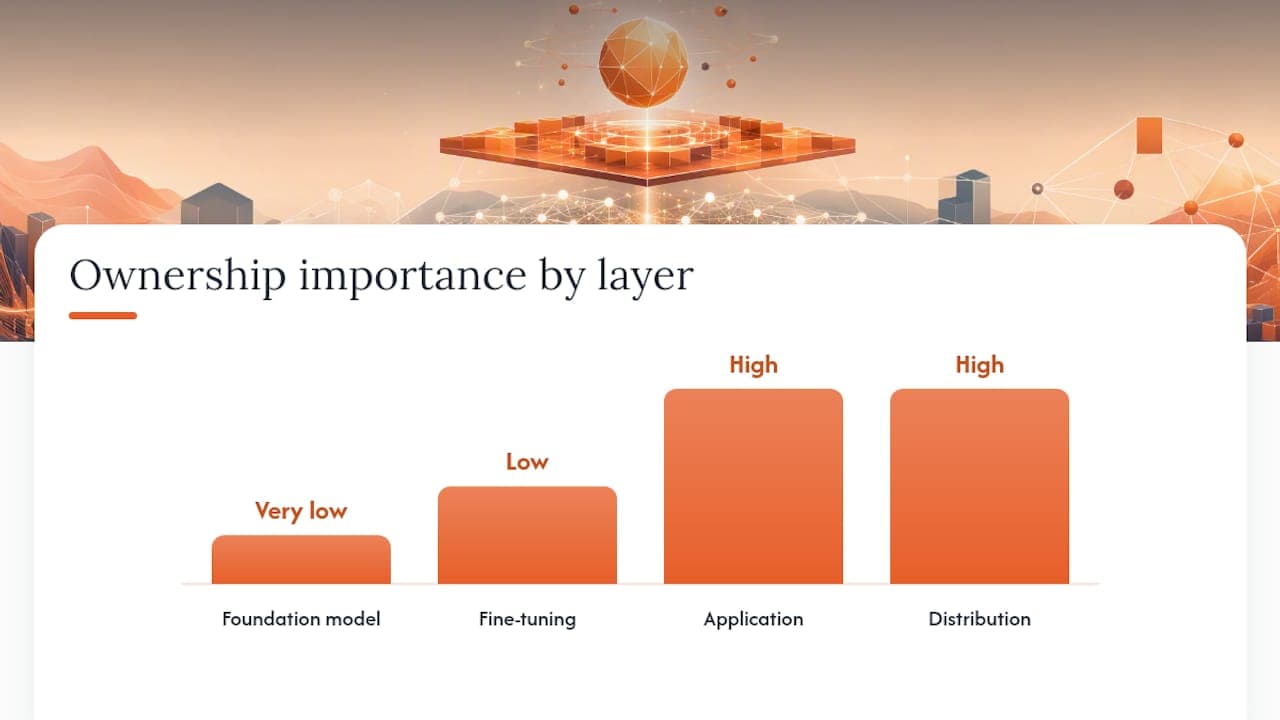
That leaves application and distribution as the layers where ownership actually matters, because that’s where your operational data and workflow context accumulate. This is also where the practical decision usually lives: build where domain data and feedback loops create real separation, buy where the market has already commoditized the function.
The one-sentence moat test decides it. Ask your team directly: what do we know that a competitor with the same vendor stack cannot learn within roughly a year and a half? If the honest answer involves proprietary transaction history, a workflow embedded in decades of operational quirks, or regulatory relationships nobody else has, you have a build case. If the answer is “we’d be faster” or “our team is smarter,” that’s not a moat. That’s a temporary lead a vendor update erases in a quarter.
To score candidates consistently, weight these dimensions rather than debating them from scratch each time:
- Strategic differentiation (weight 3x): does this function define how customers perceive you?
- Data uniqueness (weight 3x): could a rival buy the same result with the same vendor?
- Time-to-value required (weight 2x): weeks or quarters?
- Internal ML capability (weight 2x): do you have people who ship and maintain models, not just prototype them?
- Data residency and regulatory constraints (weight 2x): does law or contract dictate where data lives?
- Integration complexity (weight 1x): how many existing systems does this touch?
- Budget flexibility (weight 1x): can you absorb an 18-month payback window?
- Maintenance capacity (weight 1x): who owns this system in year three?
Multiply score by weight, sum it, and you get a number that replaces opinion with something closer to evidence.
What Does It Actually Cost to Build AI vs Buy It?
Numbers change this conversation faster than frameworks do. A proof of concept for a custom AI system typically runs a few weeks and a modest budget, mostly to validate that the idea works technically. The real commitment starts at MVP.
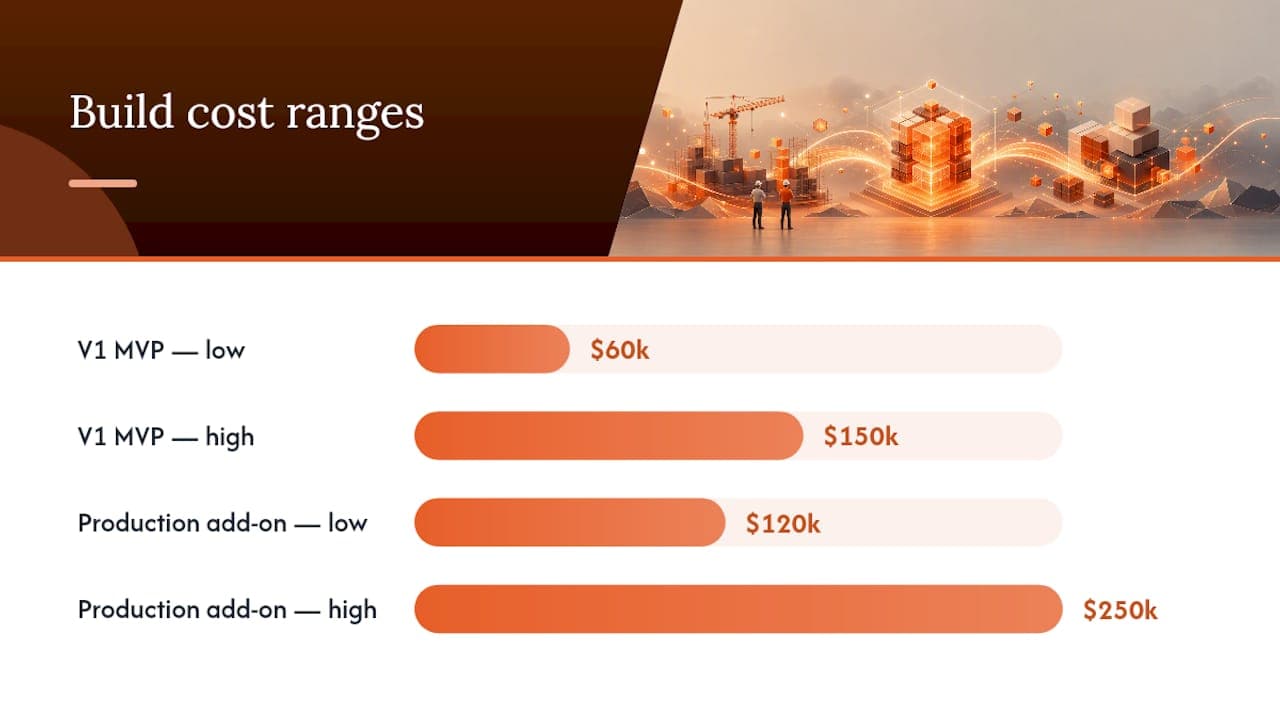
A V1 custom AI MVP typically costs $60,000 to $150,000 and ships in roughly 8 to 16 weeks. Moving that MVP into a production-grade system, with monitoring, retraining pipelines, and real uptime guarantees, generally runs another $120,000 to $250,000 on top. Buying, by contrast, gets you to production in days or weeks, usually for a subscription or usage fee that scales with volume.
Here’s where the math shifts: practitioners commonly use 50,000 to 100,000 API calls per month as the threshold where custom pipelines or self-hosting start beating managed API pricing on a per-unit basis. Below that volume, buying wins on cost almost every time. Above it, sustained, the build case gets financially real.
Over a three-year horizon, the trade-off usually looks like this:
- Buy-only: lower upfront cost, but per-seat or per-token pricing compounds, and vendor lock-in and hidden migration costs tend to surface around renewal time, not at signup.
- Build: higher upfront cost, but the marginal cost per transaction drops once volume clears the threshold, and you own the roadmap.
- Hybrid: moderate upfront cost, with the buy portion absorbing commodity risk and the build portion carrying only the differentiating slice.
Break-even reality check: across MVP and production cost bands, break-even against managed services commonly lands around 16 to 18 months, depending heavily on call volume, compute costs, and how much ongoing maintenance the system demands.
If your volume projection doesn’t clear that 50K to 100K monthly call range within a year, buying remains the financially disciplined choice, not the cautious one.
What Risks Come With Buying vs Building AI?
Every path carries risk, and the risks differ by category, not just by magnitude.
Buy-heavy strategies expose you to vendor roadmap changes, rate limits that throttle you at the worst moment, sudden shifts in model behavior after a silent update, latency variance you can’t control, and the compliance exposure that comes from routing sensitive data through a third party. Build-heavy strategies expose you to a different set: staffing risk, slower time-to-value, and the quiet cost of maintaining infrastructure nobody budgeted for past year one.
The mitigations look similar regardless of which side you lean toward:
- Run a multi-provider strategy so no single vendor outage or price change stalls your roadmap.
- Add an abstraction layer between your application logic and any specific model provider, so switching costs stay low.
- Invest in observability that tracks model drift and output quality over time, not just uptime. Tools built for data drift detection give you an early warning before a quiet model shift becomes a customer-facing failure.
- Assign identity and permissions to non-human actors (agents, automations) the same way you would a human employee, with audit logs attached.
- Build pause-and-rollback controls into any automated system before it touches production data, not after an incident forces the issue.
Analysts increasingly argue that orchestration rather than the build/buy choice itself is the upstream decision that determines success. Skip it, and both a purchased platform and a custom build can quietly fail to produce ROI, because nobody is watching what either one actually does in production.
Pro Tip: If you build or heavily customize a vendor model, budget 20 to 40% of your initial build cost annually for ongoing governance, monitoring, and retraining. Teams that skip this line item usually rediscover it as an emergency expense.
How Do You Combine Buying and Building Without Losing Control?
The sharpest operators don’t pick a side. They sequence the decision.
- Validate first, cheaply. Run a managed-service pilot for 60 to 90 days on the actual workflow you’re evaluating. Measure real accuracy, real cost per transaction, and where integration friction shows up. This pilot period doubles as a discovery exercise: you learn whether a vendor’s baseline is good enough before spending a dollar on custom infrastructure.
- Scope the build narrowly. Once the pilot tells you where the vendor falls short, build only that differentiating slice. Buy the foundation model, buy commodity features like OCR or transcription, and reserve engineering time for the layer that actually creates separation.
- Assign ownership before you scale. A platform team owns the orchestration layer. A product owner owns the roadmap for the custom piece. ML engineers own model performance. A governance owner, separate from both, owns risk and compliance sign off.
Enterprise guidance increasingly points to this exact sequence: buy the platform, build the differentiator, and invest early in the orchestration that lets both coexist without turning into five uncoordinated vendor contracts a year from now. Budgets and KPIs shift as you move through these phases. Pilot-phase KPIs are accuracy and cost per call. Build-phase KPIs are time-to-production and maintenance burden. Neither replaces the other.
When Should You Build vs Buy AI? Three Real Scenarios
Rules of thumb work better than abstract frameworks when you’re staring down an actual project deadline.
Build when: you’re sitting on proprietary data nobody else has access to, regulatory constraints make third-party data routing legally risky, your volume projection clears 50,000 calls a month with room to grow, time-to-value isn’t urgent, or the function is core enough to your product that outsourcing it would mean outsourcing your differentiation.
Buy when: the workload is commodity, meaning transcription, OCR, basic summarization, or standard chat interfaces; your timeline is measured in weeks, not quarters; your internal ML bench strength is thin; or a vendor’s existing fit is already strong enough that customization would just be reinventing a wheel that already rolls.
Three quick examples show how this plays out:
- A logistics company automating dock scheduling with a generic optimization API: buy. The workflow is common across the industry, and no competitor gains an edge from owning the underlying model.
- A healthcare provider building predictive readmission risk scoring from years of its own patient outcome data: build, or at minimum a heavy custom layer, because that historical dataset is genuinely unreplicable.
- A retail chain adding a customer service chatbot for order status questions: buy, almost without exception, because dozens of vendors already solve this exact problem well.
Build Your Own Build vs Buy AI Scorecard
Turn the weighted criteria from earlier into a live document your leadership team actually uses, not a slide that gets filed away after one meeting.
- List every candidate AI use case in a shared sheet.
- Score each against the eight weighted dimensions (strategic differentiation, data uniqueness, time-to-value, internal capability, regulatory constraint, integration complexity, budget flexibility, maintenance capacity).
- Multiply each score by its weight and sum the totals per use case.
- Sort by total score, highest first.
Interpretation bands typically shake out like this: low totals point toward buying outright, mid-range totals point toward a hybrid pilot, and high totals justify a scoped custom build. Run this as a focused one-hour workshop with finance, product, and engineering in the room together, not sequentially. Score three real use cases live, debate the outliers, and leave with a ranked list instead of a hunch.
How Arosplatforms Helps Teams That Choose to Build
When the scorecard points toward building, the execution risk shifts from “should we” to “can we do this without creating a maintenance nightmare.” Arosplatforms works inside client operations to design custom AI operating systems rather than handing over a black box, covering everything from custom AI development to ongoing managed services and team training.
The engagement model is built around ownership: your team runs the system afterward, with no dependency on the consultancy staying involved indefinitely. A first engagement typically starts with a scoped assessment mapping your specific moat, data readiness, and integration points, giving you a concrete build plan instead of a generic recommendation.
What Does the Vendor Market for AI Tools Actually Look Like?
The vendor landscape has consolidated faster than most buyers realize. Foundation model providers have converged on similar pricing and capability tiers, which is exactly why buying at the API layer has become the default for the large majority of use cases rather than a fallback option. Provider parity means the model you choose matters less than it did two years ago; the differentiation has moved to tooling, support, and integration ecosystem.
That consolidation creates a specific trap: vendors compete hard on breadth, offering generic features for marketing, customer service, and operations all inside one platform. Reviewing external primers on AI applications in areas like marketing personalization is a useful sanity check before assuming your use case is unique enough to justify a custom build. Many “unique” workflows turn out to be variations on problems a mainstream vendor already solved well.
The practical evaluation criteria that matter now: does the vendor support your compliance requirements natively, or does compliance become your problem after signing? Does pricing scale predictably as volume grows, or does it jump at usage tiers designed to surprise you? Can you export your data and switch providers without a multi-month migration? Vendors answer these questions very differently, and the answer often matters more than raw model quality, since most providers have reached rough functional parity at the model layer itself.
Evaluate vendors on integration depth and exit flexibility first. Model benchmarks come second.
How Does Choosing Build vs Buy AI Affect Your Team?
The technical decision is the easy part. The organizational fallout is where most AI initiatives quietly stall.
Buying an AI tool changes how teams work, but usually within existing job boundaries: people adopt a new interface, adjust workflows, and move on. Building triggers something bigger. It creates a new internal function, often a platform or ML team, that didn’t exist before and now sits between product, engineering, and operations. That team needs a reporting line, a budget, and a mandate, or it becomes a bottleneck everyone routes around.
Change management gets harder specifically because AI systems don’t behave like traditional software rollouts. A new CRM has a fixed feature set employees learn once. A custom AI system evolves, sometimes weekly, as models get retrained or vendor APIs update behavior underneath you. That means training isn’t a one-time event tied to launch. It’s an ongoing communication practice, closer to how a company handles policy updates than software onboarding.
Resistance tends to concentrate in two groups: frontline staff worried the tool replaces their judgment, and middle managers who lose visibility when a workflow becomes automated. Both concerns deserve a direct answer, not a reassurance email. Involve the people whose workflow is changing in the pilot phase, not just the rollout announcement, and let them flag failure modes before the system touches customers. Teams that skip this step consistently see higher shadow-workaround rates: people quietly reverting to the old process because nobody explained why the new one exists.
What Security and Compliance Issues Should You Plan For?
Security exposure differs sharply depending on which side of the build vs buy AI line you’re on, and treating them identically is a mistake.
Buying introduces third-party data exposure as the primary concern. Every request sent to an external API means your data, sometimes including customer PII, transits infrastructure you don’t control. Contract terms matter enormously here: does the vendor train on your data by default, and can you opt out? Where is data physically stored, and does that location satisfy your industry’s residency requirements? Regulated sectors like healthcare and finance often can’t answer these questions with a simple “yes,” which pushes some workloads toward build even when cost favors buying.
Building shifts the burden internally. You now own the full security posture: encryption at rest and in transit, access controls scoped to least privilege, and audit logging that satisfies whatever regulatory framework applies to your industry. You also inherit responsibility for keeping the underlying model and its dependencies patched against emerging vulnerabilities, a job vendors otherwise absorb on your behalf.
Compliance considerations apply with equal weight to both paths. If a build requires human oversight for high-stakes decisions, a comparably high-stakes buy decision, say, routing medical data through a third-party model, needs the same oversight requirement, not a lighter one just because a vendor handles the technical execution. Data residency rules, sector-specific regulations, and audit requirements don’t relax because you outsourced the infrastructure.
Why Do Integrations With Legacy Systems Break AI Projects?
Most AI project delays trace back to integration, not model quality. The model works fine in a demo. It fails against your actual data pipeline.
Legacy systems rarely expose clean APIs. Older ERP systems, on-premise databases, and decade-old CRM instances often require custom connectors just to get data flowing in a usable format, before the AI component does anything. That connector work frequently costs more engineering time than the AI feature itself, and it’s the line item most vendor demos conveniently skip.
Real-time versus batch processing creates another common mismatch. A vendor tool built around batch processing won’t satisfy a use case that needs sub-second responses, and discovering that gap after signing a contract is expensive to unwind. Data format inconsistencies across departments, where finance and operations store the same customer record differently, compound the problem further, forcing a normalization layer nobody scoped at the outset.
The fix isn’t more caution before signing anything. It’s mapping integration points before choosing between buy and build, not after. An enterprise AI platform approach that centralizes orchestration reduces this pain because new systems plug into one integration layer instead of each connecting separately to every legacy tool in your stack.
Lessons From Watching Companies Get This Wrong
The same three mistakes show up repeatedly. First, teams build before validating, skipping the vendor pilot that would have shown them a purchased tool was good enough. Run the 60 to 90 day pilot first, always.
Second, companies build the whole workflow instead of just the differentiating piece, absorbing maintenance cost on commodity features they should have bought. Scope narrowly.
Third, nobody staffs orchestration until after something breaks. Assign that ownership before launch, not after the incident review. The scorecard exists to force these conversations early, when they’re cheap.
— arosplatforms team
Ready to Assess Whether You Should Build?
If your scorecard points toward building or a hybrid approach, the next step isn’t a hiring plan. It’s a scoped assessment that tells you exactly what a custom system would need to outperform the vendor tools you’ve already priced out. We embed directly in your operations rather than handing over a proposal deck, mapping your data, your workflow, and your actual moat before recommending anything.
The first engagement typically clarifies three things: whether your use case clears the moat test, what a realistic timeline and budget look like given your data readiness, and whether a managed AI services arrangement fits better than a full internal build. You keep ownership either way. There’s no lock-in built into the model.
Start with an AI operating system assessment to see where your organization actually stands before committing budget to either path.
Sources
- Build vs Buy: A Practical Decision Tree for AI Products in 2026
- Enterprise Guide: Build vs. Buy AI Tools
FAQ
What Is Build vs Buy in the Context of AI?
Build vs buy AI is the decision between developing a custom AI system in-house versus adopting an existing vendor product, API, or platform. The right call depends on whether your use case represents a genuine competitive moat or a commodity function most vendors already handle well.
How Much Does It Cost to Build an AI System?
A custom AI MVP typically costs $60,000 to $150,000 and takes 8 to 16 weeks to ship, with production-grade deployment adding another $120,000 to $250,000. Break-even against managed alternatives commonly lands around 16 to 18 months, depending on call volume and maintenance needs.
Which AI Is Better to Buy vs Build?
Neither is universally better. Buying wins for commodity workloads, urgent timelines, and limited ML staffing, while building makes sense only when you have proprietary data or a workflow a competitor cannot replicate within roughly 18 months, per the moat test framework.
What Does “Building AI” Actually Mean?
Building AI means developing a custom model, fine-tuned system, or application layer in-house rather than licensing an existing vendor product. It typically requires dedicated ML engineering staff, ongoing infrastructure investment, and a governance layer to manage the system once it reaches production.
When Should a Company Choose a Hybrid AI Approach?
A hybrid approach fits when part of a workflow is commodity and part is genuinely differentiating. Buy the foundation model and standard features, then build only the narrow layer tied to proprietary data, after validating the split with a 60 to 90 day vendor pilot.