Show ROI in 90 Days With a Pilot First AI Integration Strategy
Show ROI in 90 Days With a Pilot First AI Integration Strategy
An AI integration strategy has to tie every project to a measured business result, whether that’s cutting cycle time or lifting revenue per customer, and it needs an owner from day one. The fastest path forward is picking one high-impact use case, running a short readiness check, and assigning a success metric before writing a single line of code. Everything below covers the roadmap, governance checklist, and measurement plan to get there.
TL;DR:
- Successful AI integration requires a clear owner, a focused high-impact use case, and a defined success metric from the start.
- Building a scalable AI system depends on assessing data readiness, designing composable integrations, and establishing robust governance with risk tiers.
- Effective scaling involves documenting templates, setting strict 90-day pilot expiration dates, and treating pilots as genuine business experiments.
- Organizations must prioritize ownership, organizational change, and infrastructure spending over just model development to ensure long-term adoption.
- Tracking outcomes such as cost reduction, cycle time, and revenue impact, using clear attribution methods, is crucial for demonstrating AI’s business value.
Table of Contents
- What Is an AI Integration Strategy, and Why Does It Matter?
- Core Components of a Robust AI Integration Strategy
- How Do You Build an AI Roadmap From Pilot to Scale?
- Integration and Data Foundations That Actually Hold Up
- Governance and Risk Controls You Need Before Scaling
- How Should You Structure Teams and Budget for AI?
- Measuring Impact: KPIs, Attribution, and ROI Timelines
- What Arosplatforms Has Learned From Operationalizing AI
- How Arosplatforms Turns This Roadmap Into a Working System
- Sources
- FAQ
What Is an AI Integration Strategy, and Why Does It Matter?
An AI integration strategy is a plan that names where AI gets applied inside your business, who owns each application, and how you’ll know it worked. That’s different from a pile of pilot projects scattered across departments with no shared measurement standard.
Integration means AI becomes part of a workflow, not a tool sitting next to it. A customer service model that only flags tickets for a human to re-read is a point solution. One that resolves tier-one tickets and routes exceptions automatically is integrated. The distinction matters because McKinsey’s 2025 global survey found 88% of organizations now use AI in at least one business function, yet only 44% have scaled it across the enterprise, and just 34% use it to actually change how their core business operates.
The gap between adoption and transformation comes down to a few recurring failures:
- Treating AI as a technology purchase instead of an operating model change
- Launching pilots with no defined owner or success metric
- Skipping the data and integration work that makes outputs usable
- Measuring activity (tickets touched) instead of outcomes (cost per resolution)
Core Components of a Robust AI Integration Strategy
Every AI program that survives contact with a budget review has the same skeleton underneath it. Skip a piece, and the program either stalls in pilot purgatory or scales into something nobody can govern.
The essentials break down into four categories:
- Vision and objectives: a specific KPI target, not a vague ambition like “become more data-driven”
- Data and architecture readiness: what data exists, where it lives, and how clean it is before a model ever touches it
- Governance and risk classification: mapped to a recognized framework so legal and compliance sign off once, not per project
- People and operating model: named ownership, whether that’s a fractional AI lead or a center of excellence, plus a skills plan
Leave out the governance piece and you’ll spend more time in review meetings than in production. Leave out ownership and the pilot dies the moment its champion changes jobs. The IMD research on AI strategy levers frames this correctly: leadership commitment, culture, capital, and talent decide outcomes more than the model architecture does.
How Do You Build an AI Roadmap From Pilot to Scale?
The sequence that actually works looks like this: assess readiness, prioritize one use case, decide build versus buy, run the pilot as a real experiment, then scale what proves out. Skipping steps to “move faster” is the single most common reason AI programs stall at the proof-of-concept stage.
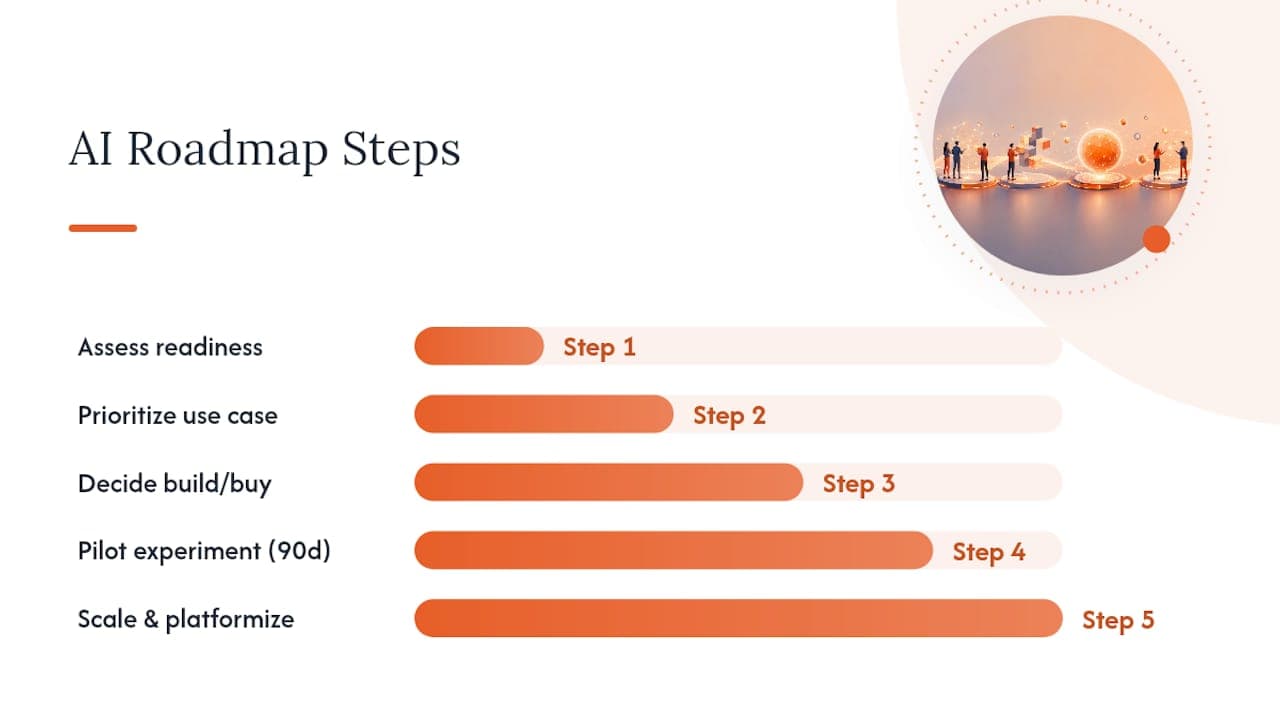
1. Run a targeted readiness assessment. Don’t audit your entire tech stack. Score three things for each candidate use case: data availability and quality, integration complexity with existing systems, and the skill level required to operate it. A seven-step strategy framework built around vision, readiness, prioritization, and governance gives you a repeatable structure instead of reinventing this for every project.
2. Prioritize by impact times effort. Score every candidate use case on a simple two-axis grid: business impact on one side, implementation effort on the other. The winner is high impact, moderate effort, not the flashiest idea in the room. A logistics company automating dispatch confirmations usually beats a company-wide predictive-maintenance rollout as a first pilot, purely because the data dependencies are simpler.
3. Decide build, buy, or partner for each use case separately. This isn’t a one-time company decision. A commodity capability like document extraction is often better bought. A workflow that touches proprietary data and a competitive process, like underwriting logic or dispatch optimization, usually justifies custom development. Architecture choices here (API-first versus embedded model versus agentic orchestration) should follow the use case, not a companywide technology mandate.
4. Design the pilot as a business experiment, not a demo. Assign a named owner, a defined data source, a success metric, and a hard deadline. Then build the milestone plan:
- Days 1 to 30: finalize scope, secure data access, stand up the integration path, define the baseline metric
- Days 31 to 60: run the pilot live with a limited user group, log every failure mode, adjust the model or workflow weekly
- Days 61 to 90: compare pilot results against baseline, document what broke, and make the go/no-go scaling call
5. Scale with a platformization mindset. The teams that scale successfully treat the first pilot as a template, not a one-off. That means documenting the integration pattern, the governance checkpoints, and the training materials so the second use case takes weeks instead of months. Stanford’s AI Index economy chapter notes that scaled agentic AI deployment is still rare across most business functions, which means the teams that build a repeatable scaling process now have a real head start over competitors still stuck on their first pilot.
Pro Tip: Give your pilot a hard 90-day expiration date with a scheduled go/no-go review. Open-ended pilots rarely die. They just quietly consume budget while nobody wants to be the one who kills them.
Integration and Data Foundations That Actually Hold Up
Point-to-point integrations feel fast in month one and become a maintenance nightmare by month six. Every new AI use case that connects directly to five other systems adds five more places that break when any one system updates, and the technical debt compounds faster than most teams expect.
The fix is composable integration: APIs, event-driven architectures, and an integration platform layer (iPaaS) that lets you plug in a new AI capability without rewiring the whole stack. Think of it like electrical wiring in a house. One extension cord per appliance works until you own fifteen appliances. At that point you want a panel.
A durable data and integration foundation covers:
- Feature stores so multiple models can reuse the same clean data inputs
- Data versioning and lineage tracking, so you know exactly which data version produced which output
- Quality gates that block bad data before it reaches a model, not after
- Observability and monitoring on latency, drift, and failure rates in production
- A documented rollback path for when a model update makes things worse, not better
Private AI investment and infrastructure spending rose sharply through 2025, with compute costs climbing across cloud providers. That’s the practical argument for buying integration infrastructure rather than building it from scratch for a single pilot. For technical teams building this layer, the deeper mechanics of pipeline integrity, versioning, and lineage are worth a closer look in this data pipeline integrity guide.
Governance and Risk Controls You Need Before Scaling
Every AI use case needs a risk tier assigned before it touches real customer or operational data, not after something goes wrong. A chatbot answering FAQ questions and a model influencing loan approval decisions do not belong in the same review process.
A working governance checklist covers:
- Risk classification: map each use case to a tier (low, moderate, high) based on decision impact and data sensitivity
- Minimum controls per tier: human validation on high-risk outputs, audit logging on everything, explainability requirements where decisions affect customers
- Named sign-off authority: someone specific approves each tier, not “the committee”
- Incident response plan: what happens and who’s notified when a model produces a bad output in production
- Framework alignment: map your tiers to the NIST AI Risk Management Framework or the EU AI Act’s risk categories where they apply, so your internal language matches what regulators and auditors expect
Board-level oversight matters here because governance failures tend to surface at the worst possible moment, usually in front of a customer or a regulator. Monitoring shouldn’t stop at launch. Set SLAs for model performance, schedule periodic bias and accuracy audits, and revisit risk tiers whenever a use case’s scope changes.
Pro Tip: Write your incident response plan before your first pilot goes live, not after the first incident. Teams that draft it reactively tend to spend the first 48 hours arguing about who’s in charge instead of fixing the problem.
How Should You Structure Teams and Budget for AI?
Ownership questions kill more AI programs than technology choices do. Someone specific needs to own AI outcomes, whether that’s a Chief AI Officer, a center of excellence, or a fractional lead who reports directly to operations. Skip this and every project becomes an orphan the moment its original champion moves on.
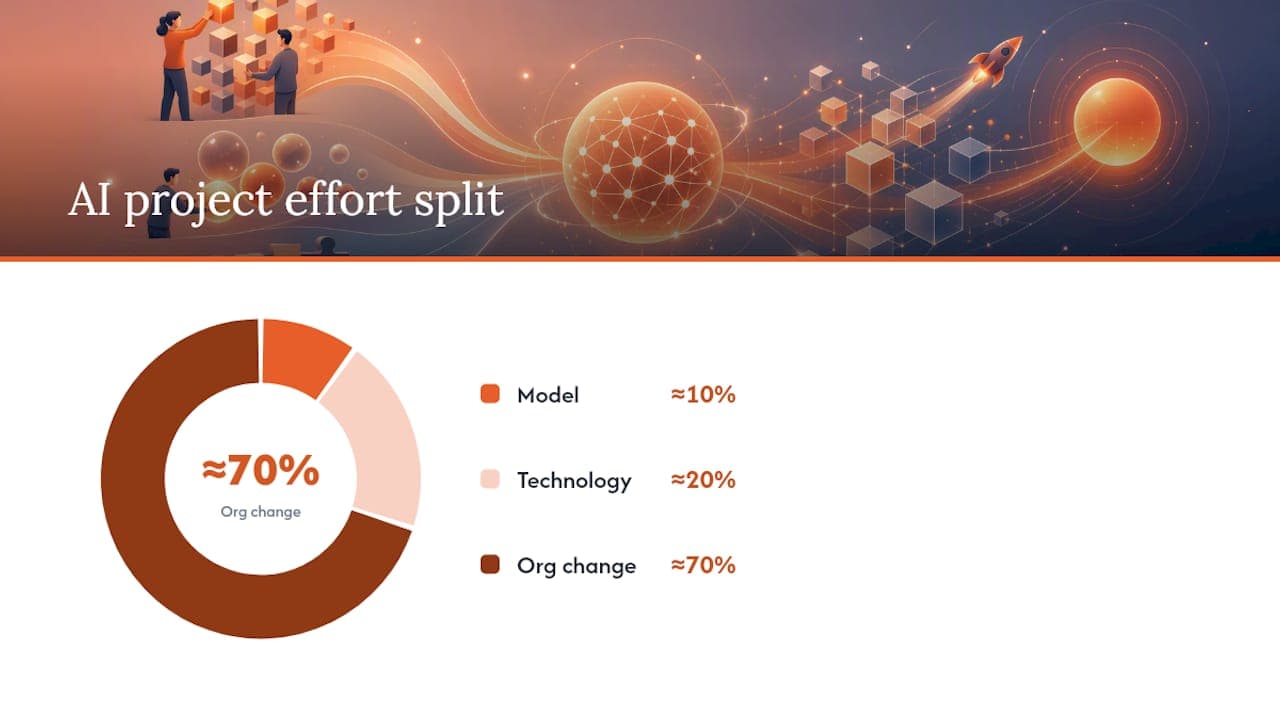
A widely cited practitioner heuristic suggests most of the effort in AI projects should go toward people and process rather than the algorithm itself. Roughly a tenth of the work is the model, a fifth is the surrounding technology, and the bulk is organizational change: training, workflow redesign, and adoption support. That roughly matches what shows up in successful pilots, where teams that skip change management ship a working model that nobody actually uses.
Budget accordingly:
- Weight spending toward data integration and infrastructure, not just model development
- Fund a real training and adoption program, not a single kickoff webinar
- Set incentives that reward using the new workflow, or employees will quietly route around it and build their own shadow AI tools with consumer apps nobody vetted
- Watch for red flags during scaling: usage dropping after the pilot’s initial excitement fades, or teams reverting to the old manual process when things get busy
Measuring Impact: KPIs, Attribution, and ROI Timelines
Track outcomes, not activity. Useful KPIs include cycle time, error rate, cost per transaction, revenue per customer, and, where you can isolate it, EBIT impact. A model that processes twice as many tickets but doesn’t reduce cost per resolution or improve customer satisfaction hasn’t actually delivered value yet.
Set a baseline before launch, then attribute change using an A/B test, a phased rollout across comparable teams, or a synthetic control group when a true A/B test isn’t feasible. Track total cost honestly: compute, integration work, and ongoing maintenance, not just the initial build.
Realistic ROI timelines vary by use case complexity, and given that only 44% of organizations have managed to scale AI enterprise wide, patience matters more than speed here.
- Assign metric ownership to a specific role, not “the team”
- Report on a fixed cadence, monthly at minimum during scaling
- Revisit baselines whenever the underlying process changes
- Separate pilot-phase metrics from steady-state production metrics
Solid attribution work here connects directly to how you explain AI automation ROI to a finance team that wants a number, not a narrative.
What Arosplatforms Has Learned From Operationalizing AI
Most AI failures we see don’t come from bad models. They come from AI that never gets wired into how work actually happens, sitting in a dashboard nobody checks or a tool the original champion forgot to hand off.
Custom AI operating systems are most effective when embedded directly inside a client’s existing workflows rather than dropped in as standalone tools. Ownership by the client’s team and the ability to run the system without constant vendor dependence help avoid vendor lock-in and support long-term adoption.
Engagements generally follow the same shape covered in this roadmap: a focused discovery phase to identify the highest-value use case, a pilot treated as a genuine business experiment with a named owner and defined success metric, then a build and hand-off phase that transfers real operating capability to the client’s team.
— arosplatforms team
How Arosplatforms Turns This Roadmap Into a Working System
You’ve seen what the roadmap requires: a readiness check, a prioritized pilot, integration architecture that won’t collapse under its own weight, and governance that satisfies both your board and your auditors. Doing all of that with an internal team stretched across other priorities is where most programs quietly slow down.
Some AI consultancies offer hands-on services rather than software licenses. This includes AI strategy advisory, AI operating system development, integration work connecting models to systems, and governance structures designed for specific industries rather than generic templates. The goal is a system your team owns and operates rather than a vendor relationship requiring indefinite renewals.
If you’re deciding where to start, the practical next step is a short discovery conversation to identify your highest-impact pilot candidate. You can also see how the AI operating system concept applies to your specific setup before committing to a scope.
Sources
For readers who want to check the numbers behind this roadmap directly, these five sources carry the most weight.
- The State of AI: Global Survey 2025 | McKinsey
- AI strategy is a journey — the levers that matter | I by IMD
- AI Index / Economy chapter (2026) — Stanford HAI
FAQ
What is the 30% rule in AI?
There’s no single, universally recognized “30% rule” in AI strategy. The figure sometimes circulates as a rough estimate of task automation potential within a role, but treat any specific percentage claim skeptically unless it comes from a study covering your exact industry and function.
What are examples of AI integration?
Common examples include automated ticket routing and resolution in customer service, predictive maintenance models that trigger work orders automatically, and underwriting systems that pull data from multiple sources to generate a risk score without manual re-entry. The common thread is that AI output feeds directly into an existing workflow instead of requiring a human to copy it over manually.
What are the three types of integration strategies?
Integration approaches generally fall into point-to-point connections, middleware or iPaaS-based integration, and event-driven architectures. Point-to-point is fastest to build and worst at scale; event-driven and iPaaS approaches cost more upfront but avoid the integration sprawl that breaks systems as use cases multiply.
What is the 10/20/70 rule for AI?
It’s a practitioner heuristic suggesting AI project effort should split roughly across the algorithm itself, the surrounding technology and data infrastructure, and the people and process work needed for adoption, with the largest share going to organizational change. Treat it as a directional guide rather than a fixed formula.
How long does it take to see ROI from an AI integration strategy?
Timelines vary by use case complexity and data readiness, but well-scoped pilots with clear success metrics often show measurable results within the first 90 days, with fuller returns depending on how quickly you scale beyond the pilot.