What Is AI Pipeline Management? A 2026 Business Guide
What Is AI Pipeline Management? A 2026 Business Guide

AI pipeline management is the systematic process of orchestrating and automating the stages that move data through AI model development and deployment, from raw ingestion to live production monitoring. Business professionals who understand this process gain a direct advantage: they can build AI systems that stay accurate, adapt to new data, and deliver measurable results without constant manual intervention. The industry term for this discipline is MLOps, short for machine learning operations, and it sits at the intersection of data engineering, model development, and operational governance. This guide covers the core stages, real-world applications in sales and operations, and the practical steps your team needs to get it right.
What is AI pipeline management, and why does it matter?
AI pipeline management is defined as the coordinated automation of five core stages: data ingestion, transformation, model training, deployment, and monitoring. Each stage feeds the next, creating a continuous loop that keeps AI models production-ready. These five stages form the backbone of any working AI system, whether it powers a fraud detection model in finance or a demand forecasting tool in manufacturing.
The distinction from traditional data pipelines is significant. A standard data pipeline moves data from point A to point B. An AI pipeline does that and also tracks model accuracy, detects when predictions degrade, and triggers retraining when needed. That added layer of intelligence is what makes AI pipelines operationally different and more demanding to manage.
For decision-makers, the business case is straightforward. A poorly managed pipeline produces stale predictions, missed alerts, and wasted compute costs. A well-managed one delivers consistent, trustworthy outputs that teams can act on. The pipeline is not a background technical concern. It is the engine behind every AI-driven decision your organization makes.
What are the key components and stages of an AI pipeline?
The five stages of an AI pipeline each serve a distinct function, and failure at any one stage cascades through the rest.
Data ingestion pulls raw data into the pipeline through APIs, streaming connections, or batch uploads. The method you choose depends on how time-sensitive your use case is. Real-time fraud detection needs streaming ingestion. Monthly financial reporting can use batch processing.
Transformation and preprocessing cleans, normalizes, and reshapes that raw data into a format the model can use. Feature engineering happens here, where raw variables get converted into signals the model can learn from. This stage is where most data quality problems surface, and fixing them early saves significant rework downstream.

Model training and indexing uses the prepared data to build or update the model. For predictive AI, this means fitting statistical models to historical patterns. For generative AI, it means indexing knowledge bases or fine-tuning foundation models on domain-specific content.
Deployment pushes the trained model into production. Pipeline architecture at this stage must accommodate both predictive and generative AI, with data lineage, access controls, and versioning built in for reproducibility. Without versioning, rolling back a bad model update becomes a manual nightmare.
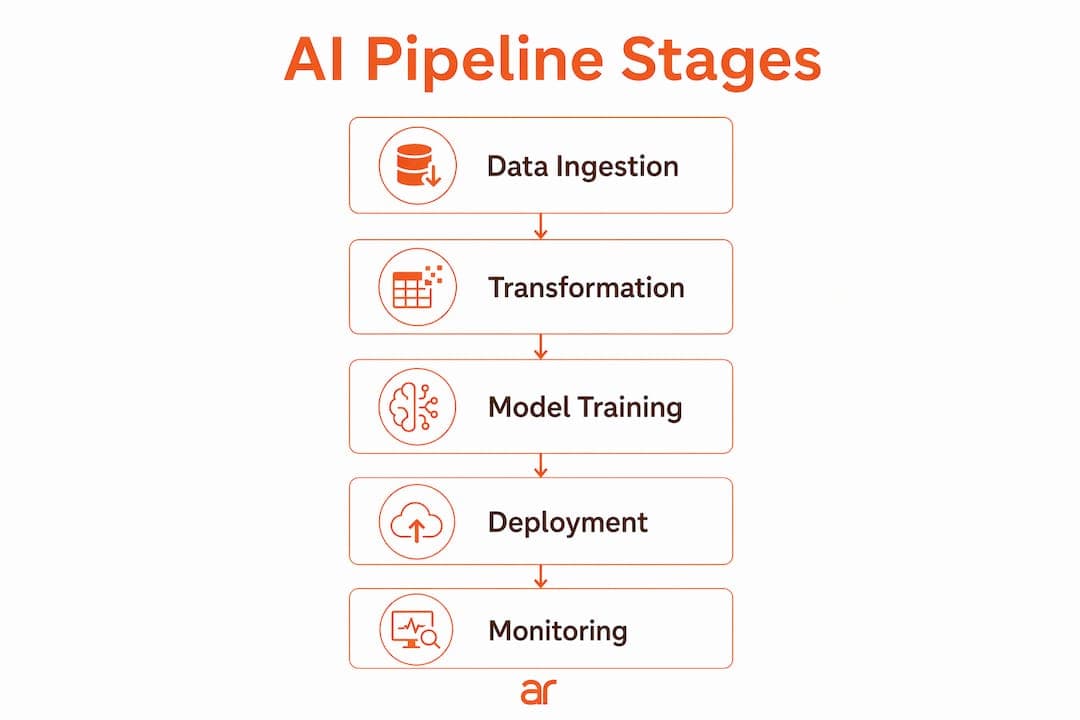
Monitoring closes the loop. Pipeline health checks and model drift detection run continuously to catch accuracy degradation before it affects business outcomes. Unlike traditional pipelines, AI pipelines can fail silently. The data keeps flowing, but the predictions quietly become wrong.
| Stage | Primary function | Key risk if skipped |
|---|---|---|
| Data ingestion | Pulls raw data via API, stream, or batch | Incomplete or delayed inputs |
| Transformation | Cleans and engineers features | Garbage-in, garbage-out model outputs |
| Training | Builds or updates the model | Stale predictions on new data patterns |
| Deployment | Pushes model to production | No versioning, no rollback capability |
| Monitoring | Tracks drift and pipeline health | Silent accuracy degradation |
Pipeline SLAs define the acceptable thresholds for ingestion latency, data freshness, and uptime. These are not optional formalities. They are the contractual link between your technical team and the business outcomes the pipeline is supposed to support.
Pro Tip: Set your monitoring alerts before you deploy, not after. Defining acceptable drift thresholds at deployment time forces your team to agree on what “good” looks like while the model is still fresh.
How does AI pipeline management transform sales and revenue processes?
AI pipeline management in B2B sales replaces intuition-based forecasting with continuous, real-time deal scoring. Revenue teams shift from reactive manual tracking to probabilistic forecasting built on composite scores and historical engagement data. The practical result is that sales managers stop asking “how does this deal feel?” and start asking “what does the model say, and why?”
The implementation follows a phased roadmap that most organizations can execute in sequence:
- Data foundation. Connect your CRM, email, calendar, and call recording tools into a unified data layer. Without clean, connected data, scoring models produce noise.
- Baseline scoring. Build an initial ideal customer profile (ICP) fit score using firmographic and behavioral signals. This gives the team a starting reference point before AI forecasting begins.
- AI forecasting. Layer in machine learning to generate close probability scores based on historical deal patterns, engagement intensity, and deal velocity.
- Proactive intervention. Configure automated alerts that fire when deals stall, when ICP alignment drops, or when engagement signals go cold.
AI pipeline prioritization ranks opportunities by deal size, close probability, fit, and engagement intensity. That ranking tells revenue teams exactly where to invest their time, rather than spreading effort evenly across every open opportunity.
Automation handles the operational layer. NLP analyzes call transcripts and emails to extract intent signals, and workflow triggers initiate follow-ups or internal notifications without manual input. A sales rep no longer needs to log every interaction. The pipeline captures it, scores it, and surfaces the next best action automatically.
Pro Tip: Start your sales AI pipeline with a 90-day historical data audit. Models trained on incomplete or inconsistently logged CRM data will produce scores that erode rep trust quickly. Fix the data first.
What are the practical benefits and challenges of implementing AI pipeline management?
The operational benefits of a well-run AI pipeline are concrete and measurable across industries.
- Improved forecast accuracy. Models trained on real engagement data outperform spreadsheet-based forecasts because they update continuously rather than at the end of each quarter.
- Reduced manual work. Automated ingestion and transformation eliminate repetitive data preparation tasks that previously consumed analyst time.
- Proactive risk detection. Drift monitoring catches model degradation before it produces bad decisions, which is especially critical in finance and healthcare where bad outputs carry regulatory consequences.
- Better resource allocation. In manufacturing, predictive maintenance AI uses pipeline outputs to schedule equipment servicing before failures occur, reducing unplanned downtime.
The challenges are equally real and deserve honest attention.
- Data quality. Pipelines amplify whatever is in your data. Inconsistent labeling, missing fields, and duplicate records produce unreliable model outputs at scale.
- Integration complexity. Connecting legacy systems, cloud platforms, and real-time data sources requires careful architecture work. Poorly integrated pipelines create data silos that undermine the whole system.
- Governance and compliance. Regulated industries need audit trails, access controls, and documented lineage for every data transformation. Building governance in after the fact is far more expensive than designing it in from the start.
Best practices that consistently separate successful deployments from failed ones:
- Define pipeline SLAs before launch, not after the first incident.
- Treat the pipeline as a live system that requires ongoing maintenance, not a one-time build.
- Run continuous monitoring with automated alerting, not periodic manual audits.
- Version every model and every significant data transformation for reproducibility.
- Assign clear ownership for each pipeline stage so accountability does not fall through the gaps.
What tools and strategies support effective AI pipeline management?
Effective AI pipeline management depends on three categories of capability: orchestration, monitoring, and governance. Each category requires deliberate choices about tooling and architecture.
Orchestration coordinates the sequence of pipeline tasks, handles dependencies between stages, and manages retries when a step fails. MLOps practices formalize this coordination by applying software engineering discipline to model development and deployment. Without orchestration, pipelines become fragile sequences of manual steps that break whenever a data source changes.
Monitoring and alerting cover both pipeline health and model performance. Pipeline health monitoring checks whether data is arriving on time and in the expected format. Model performance monitoring tracks prediction accuracy against ground truth labels as they become available. Anomaly detection tools flag unexpected shifts in input data distributions, which often precede model drift by days or weeks.
Governance and version control ensure that every model in production can be traced back to the exact data and code that produced it. Feature stores centralize the engineered variables that models depend on, preventing the situation where two teams build the same feature differently and get inconsistent results. Access controls and data lineage documentation satisfy regulatory requirements in finance, healthcare, and other governed industries.
The architectural strategy that matters most is designing pipelines to be modular. Each stage should be independently testable and replaceable. A monolithic pipeline that cannot be updated in parts becomes a liability as your AI use cases grow. AI infrastructure built for scale separates ingestion, transformation, training, and serving into distinct layers that teams can update without taking the entire system offline.
Key Takeaways
Effective AI pipeline management requires governance, monitoring, and modular architecture working together, not just a trained model sitting in production.
| Point | Details |
|---|---|
| Five core stages | Ingestion, transformation, training, deployment, and monitoring form every AI pipeline. |
| Pipeline SLAs matter | Define latency, freshness, and uptime thresholds before launch to align technical and business goals. |
| Sales pipelines benefit directly | AI scoring and NLP automation replace manual CRM tracking with real-time deal intelligence. |
| Silent failure is the main risk | Model drift degrades accuracy without triggering obvious errors, making continuous monitoring non-negotiable. |
| Governance must be built in | Access controls, data lineage, and version control are cheaper to design in than to retrofit later. |
The architecture is the product, not the model
Working with organizations across manufacturing, finance, and logistics, the Arosplatforms team has seen the same mistake repeated: leadership invests heavily in selecting and training a model, then treats the surrounding pipeline as a secondary concern. The model gets celebrated at launch. Six months later, it quietly stops working because the pipeline feeding it was never designed to handle data drift, schema changes, or volume spikes.
The uncomfortable truth is that pipeline architecture causes more production AI failures than model quality does. A mediocre model in a well-managed pipeline outperforms an excellent model in a fragile one. The pipeline is what keeps the model honest over time.
The teams that get this right treat their pipelines the way a manufacturer treats a production line. They define acceptable tolerances, monitor for deviations, and schedule maintenance proactively. They also build pipeline SLAs that connect technical metrics to business outcomes, so when something breaks, everyone understands what it costs.
The advice that consistently holds: start with a phased approach. Get your data foundation right before you build scoring. Get scoring stable before you add forecasting. Each phase teaches you something about your data that the next phase depends on. Rushing to the end state produces a system that looks impressive in a demo and fails in production.
— Arosplatforms team
How Arosplatforms approaches AI pipeline implementation
Arosplatforms works with business teams to design and deploy AI pipelines that are built for their specific operational context, not adapted from a generic template.

The approach covers the full stack: data architecture, MLOps infrastructure, model deployment, and ongoing monitoring governance. Industry-specific work spans financial services, manufacturing, energy, and beyond, with each engagement designed around the compliance requirements and data environments that sector demands. Clients see an average of 82% faster turnaround on key tasks, with many reaching positive ROI within twelve months. If your organization is ready to move from ad hoc AI experiments to a managed, production-grade pipeline, AI consulting for US enterprises is a practical starting point.
FAQ
What is AI pipeline management in simple terms?
AI pipeline management is the process of automating and overseeing the stages that move data through an AI system, from collection to model output. It keeps AI models accurate and production-ready without constant manual intervention.
How is an AI pipeline different from a traditional data pipeline?
A traditional data pipeline moves data between systems. An AI pipeline does that and also manages model training, deployment, and drift monitoring to maintain prediction accuracy over time.
What does model drift mean in an AI pipeline?
Model drift is the gradual degradation of a model’s prediction accuracy as real-world data patterns shift away from the patterns the model was trained on. Monitoring stages in the pipeline detect drift and trigger retraining.
How does AI pipeline management apply to sales teams?
AI-driven sales pipelines use machine learning to score deals in real time, automate follow-up workflows, and generate probabilistic revenue forecasts based on engagement signals rather than manual rep input.
What is an MLOps pipeline?
An MLOps pipeline applies software engineering practices, including version control, automated testing, and continuous deployment, to the machine learning lifecycle. It is the operational framework that makes AI pipeline management repeatable and auditable at scale.