AI Permitting Workflow Automation: A 2026 Professional Guide
AI Permitting Workflow Automation: A 2026 Professional Guide

AI permitting workflow automation is the use of machine learning, natural language processing, and agentic AI systems to autonomously manage every stage of the permit lifecycle, from application intake through final issuance. Unlike traditional rule-based automation, which breaks down the moment it encounters an unstructured PDF or an ambiguous zoning note, AI-driven systems parse complex documents, apply jurisdiction-specific code logic, and make context-aware decisions without human intervention at each step. The result is a process that AI workflow automation researchers describe as moving beyond static rules to intelligent, adaptive decision-making.
Core functions of AI permitting workflow automation include:
- Ingesting and parsing native CAD drawings, PDFs, and unstructured application documents
- Running code compliance checks against current local, state, and federal requirements
- Flagging violations with exact code citations for full traceability
- Routing applications, tracking status, and triggering resubmission workflows automatically
- Generating correction roadmaps and audit-ready records at every decision point
What are the key AI agents powering permitting automation?
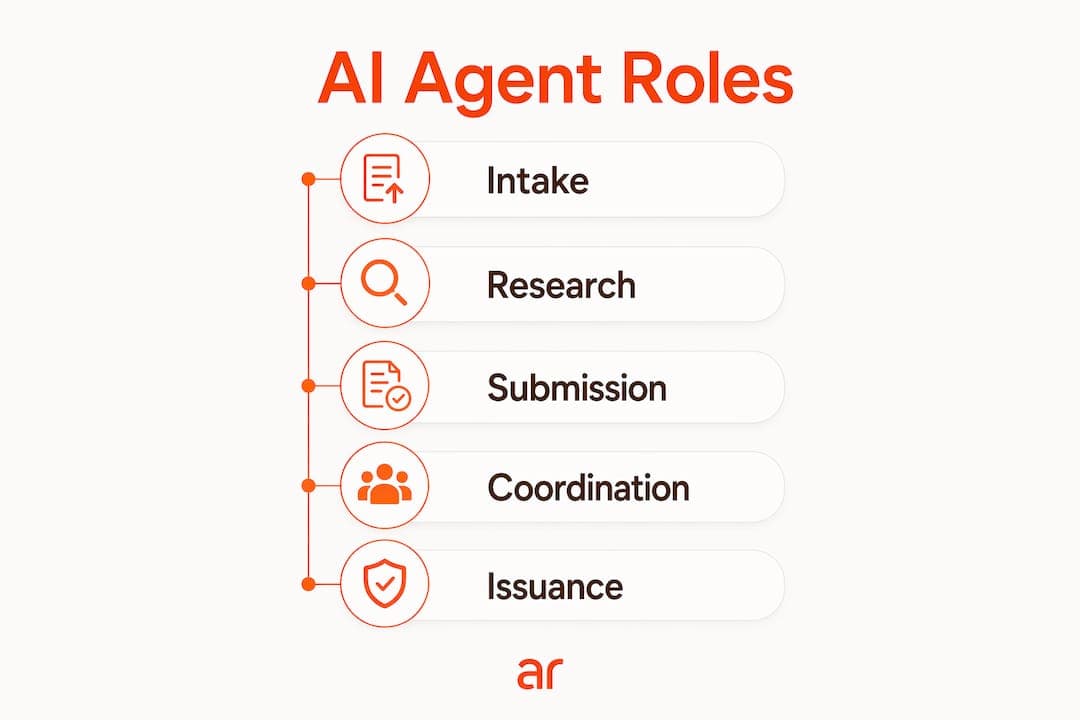
Five specialized agents typically divide the permitting workflow between them, each handling a distinct phase and passing structured data to the next. Understanding what each one does clarifies why AI agents in government workflows outperform a single monolithic automation script.
Intake Agent receives the application package, validates document completeness, checks for missing signatures, and converts raw files into structured, machine-readable data. It catches obvious gaps before any human reviewer sees the submission.
Research Agent queries up-to-date jurisdiction code databases to identify applicable regulations for the project type, location, and scope. AI platforms that maintain live code libraries can flag recent amendments automatically, reducing the risk of submitting against an outdated standard.
Submission Agent assembles the compliant package, formats it to the authority having jurisdiction (AHJ) requirements, and submits it through the correct portal or channel. It also logs submission timestamps and confirmation receipts.

Coordination Agent monitors the review queue, tracks reviewer feedback, manages resubmission cycles, and sends status updates to all stakeholders. When a correction request arrives, it routes the specific items back to the relevant team members rather than dumping the entire package on a project manager’s desk.

Issuance Agent confirms final approval conditions are met, triggers permit issuance, and archives the complete audit trail, including every AI finding, code citation, and human sign-off.
Pro Tip: Map your existing permitting workflow to these five agent roles before evaluating any platform. Gaps between your current process and the agent model reveal exactly where manual bottlenecks live and where AI will deliver the fastest return.
What tasks does AI actually automate in a permitting workflow?
The scope of automation splits cleanly into two levels, and conflating them is a common mistake that leads teams to underestimate what they are buying or building.
Document-level automation handles the surface layer: signature verification, form completeness checks, file format validation, and data entry from standard fields into permit management systems. Most basic workflow tools operate here. It is useful, but it does not touch code compliance.
Logic-level automation is where the real complexity lives. This layer verifies technical code compliance, including setback distances, load calculations, fire egress widths, and zoning use classifications, against the specific code edition adopted by the local jurisdiction. AI trained on local building codes can flag violations instantly and cite the exact section triggering each finding. The NEPA Text Corpus developed by Pacific Northwest National Laboratory demonstrates how structured datasets of historical permitting documents enable AI models to perform this kind of accurate, context-aware assessment at public-sector scale.
Common automated tasks across both levels include:
- Document completeness and signature verification
- Zoning classification and land-use compatibility checks
- Structural load and setback calculation validation
- Fire and life safety egress compliance review
- Automatic status tracking and deadline notifications
- Correction request parsing and resubmission routing
- Audit trail generation with timestamped, code-cited findings
What are the strategic benefits of AI in permit management?
The clearest benefit is time. Pre-submission AI auditing that catches package issues before city review can reduce approval time by up to 85% by eliminating correction-and-resubmittal cycles. That figure comes from avoiding the single biggest time sink in permitting: the back-and-forth between applicant and reviewer that drags a straightforward project across weeks or months.
85% reduction in permit approval time is achievable through AI pre-submission auditing, according to Permittable’s platform data, primarily by preventing multiple correction cycles before city review.
Beyond speed, the strategic outcomes stack up across several dimensions:
- Higher first-pass approval rates because submissions arrive complete and code-compliant
- Consistency across jurisdictions since AI applies the same logic regardless of which reviewer handles the file
- Audit readiness through traceable findings linked to exact code sections, satisfying compliance demands without manual documentation
- Workload redistribution that frees licensed professionals to focus on judgment calls rather than data entry
- Stakeholder satisfaction from predictable timelines and fewer surprise correction requests
Transforming siloed permitting data into structured, machine-readable format is itself a force multiplier. When historical approvals, rejections, and correction patterns feed back into the AI model, accuracy improves over time rather than staying static.
How do you build trust and manage risk in AI permitting systems?
The biggest obstacle to AI adoption in permitting is not technical. It is the black-box problem: reviewers and applicants need to know why the AI flagged something, not just that it did. Effective AI permitting tools provide full traceability by citing the specific local code sections that triggered each violation or change request, turning an opaque output into an auditable finding a licensed professional can verify in seconds.
Trust-building measures that matter in practice:
- Every AI finding links to the exact code section and edition, not a general category
- Human-in-the-loop oversight is preserved; licensed professionals provide final approval in most US jurisdictions
- The system logs every decision, revision, and approval with timestamps
- Training data includes jurisdiction-specific amendments, not just model codes
- Regular audits compare AI findings against actual reviewer outcomes to catch drift
Data privacy deserves its own attention. Permitting packages contain proprietary architectural drawings, site surveys, and owner information. Any AI platform handling this data must comply with applicable state privacy laws, use encrypted transmission and storage, and clearly define data retention and deletion policies. Teams should confirm whether the vendor processes data on shared infrastructure or offers dedicated environments for sensitive submissions.
Pro Tip: Ask any AI permitting vendor to show you a sample finding report before signing a contract. If the report does not cite a specific code section for every flagged item, the system is not providing the traceability your reviewers and auditors will require.
How PermitFlow applies AI to construction permitting
PermitFlow is a purpose-built AI platform for construction permitting, available through the Procore Marketplace, that targets the exact pain point most project teams know well: the correction cycle that turns a four-week permit into a four-month one.
| Capability | PermitFlow |
|---|---|
| AI capabilities | ML-based code compliance, CAD/PDF ingestion, violation flagging |
| Automation scope | Plan review, code checks, correction roadmaps, submission management |
| Compliance traceability | Exact code citations for every flagged violation |
| Industry focus | Construction project teams |
| Approval time reduction | Significant reduction via first-pass approval improvement |
PermitFlow ingests native CAD and PDF drawings directly, vectorizes them into a structured digital model, and runs code-trained AI against the applicable local building, fire, and zoning codes. Each flagged item comes with a detailed correction roadmap, not just a violation notice, so the design team knows exactly what to fix before resubmitting. The integration with Procore means project data flows into the permitting workflow without manual re-entry, which removes a common source of transcription errors.
Key operational benefits teams report:
- Faster first-pass approval rates by catching violations before AHJ review
- Correction roadmaps generated within hours of upload
- Code citations tied to the specific jurisdiction and current amendment cycle
- Reduced back-and-forth between design teams and permit offices
How does AI integrate with existing permitting systems?
Integration is where many AI permitting projects stall. Most jurisdictions still run permit management on legacy platforms, ranging from Accela and Tyler Technologies to custom-built municipal systems, and AI tools need to connect with these without requiring a full infrastructure replacement.
The practical path forward usually involves API-based connections that let the AI layer sit alongside existing systems rather than replacing them. The AI handles intake, compliance checking, and correction routing, while the legacy platform retains its role as the official record system. AI readiness assessments before deployment help teams identify data format mismatches, authentication gaps, and workflow handoff points that need configuration.
Three integration factors that determine success: whether the AI platform supports the file formats the jurisdiction accepts, whether it can authenticate with the permit portal for automated submission, and whether its output maps cleanly to the fields the existing system expects. Skipping the mapping exercise upfront creates manual cleanup work that erodes the time savings the AI was supposed to deliver.
Data privacy, security, and compliance in AI permitting workflows
Permitting data is more sensitive than it looks. Architectural drawings reveal building layouts, security systems, and structural details. Owner and applicant information is personally identifiable. In several states, including California, AI systems used in government decision processes face specific transparency and accountability requirements under state law.
At minimum, any AI permitting platform operating in the US should meet these standards:
- Encryption in transit and at rest for all uploaded documents and AI outputs
- Role-based access controls limiting who can view, edit, or export permit data
- Clear data retention policies with defined deletion timelines
- Audit logs that capture every access event, not just AI decisions
- Compliance with applicable state privacy statutes and any federal requirements tied to the project type
For federally permitted projects, the PermitAI framework developed by Pacific Northwest National Laboratory demonstrates how public-sector AI tools can be built with auditable, interactive refinement frameworks that keep subject matter experts in control of AI outputs while still accelerating review.
What comes next for AI in permitting workflow automation
The near-term trajectory points toward three developments that will reshape how permitting works across the US.
Predictive routing will move from reactive to proactive. Rather than flagging issues after a submission arrives, AI systems will analyze project parameters at the design stage and predict which code sections are likely to generate corrections, letting teams address problems before the drawings are finalized.
Multi-jurisdictional AI will become standard for large developers operating across state lines. Platforms that maintain live, amendment-aware code libraries for hundreds of jurisdictions simultaneously will replace the current practice of manually researching each locality’s requirements.
Agentic AI systems, where multiple specialized agents collaborate autonomously across the full permit lifecycle, are already in early deployment. The AI applications being built on top of large language models trained on permitting-specific corpora will handle increasingly complex judgment calls, though licensed professional oversight will remain a legal requirement in most US jurisdictions for the foreseeable future.
Arosplatforms builds AI operating systems for teams that want to own their permitting intelligence
If you are evaluating PermitFlow or similar platforms and wondering whether a packaged product fits your specific workflow, Arosplatforms offers a different path. Rather than subscribing to a fixed tool, you get a custom AI operating system built around your actual permitting process, your jurisdiction mix, and your existing software stack, with no vendor lock-in once it is deployed.

Arosplatforms embeds directly in client operations to map the workflow first, then builds AI agents that handle the specific tasks your team needs automated, whether that is pre-submission auditing, multi-jurisdiction code checking, or correction cycle management. Teams typically see a significantly faster turnaround on key tasks, and most reach positive ROI within twelve months. For organizations that need permitting AI tailored to their exact context rather than a general-purpose platform, that ownership model changes the economics considerably.
Key Takeaways
AI permitting workflow automation delivers its biggest gains by catching compliance issues before city review, not by speeding up the review itself.
| Point | Details |
|---|---|
| Pre-submission auditing wins | AI that flags violations before submission can reduce approval time significantly. |
| Five-agent architecture | Intake, Research, Submission, Coordination, and Issuance agents each own a distinct phase. |
| Traceability is non-negotiable | Every AI finding must cite the exact code section to satisfy auditors and licensed reviewers. |
| Human oversight stays | Licensed professionals provide final approval in most US jurisdictions regardless of AI involvement. |
| Arosplatforms alternative | Custom AI operating systems built by Arosplatforms give teams full ownership without vendor lock-in. |
FAQ
What is AI permitting workflow automation?
AI permitting workflow automation uses machine learning, natural language processing, and agentic AI to manage the full permit lifecycle, from intake and code compliance checking through submission, coordination, and issuance, without manual intervention at each step.
Which AI tools are best for construction permitting workflows?
PermitFlow is a leading purpose-built option for construction teams, offering native CAD/PDF ingestion and code violation flagging with exact citations through the Procore Marketplace. Permittable serves architects, engineers, and municipal governments with similar pre-submission auditing capabilities.
What does PermitFlow do?
PermitFlow analyzes construction drawings against local building, fire, and zoning codes, flags violations with specific code citations, and generates correction roadmaps to improve first-pass approval rates before submission to the authority having jurisdiction.
What is an example of AI automation in permitting?
A pre-submission audit where AI ingests a PDF drawing set, checks setback distances and egress widths against the current local code, and returns a prioritized correction list within hours is a concrete example of AI automation replacing a manual plan check.
Why does traceability matter in AI permitting systems?
Traceability lets licensed reviewers verify every AI finding against the actual code section that triggered it, satisfying audit requirements and preventing the black-box skepticism that stalls AI adoption in regulated environments.