What Is AI Bookkeeping Automation for Your Business?
What Is AI Bookkeeping Automation for Your Business?

AI bookkeeping automation is the use of machine learning and rules-based software to capture, categorize, match, and reconcile financial transactions without manual data entry, with 92% of accounting professionals now using AI in some form. Arosplatforms builds industry-specific AI operating systems that embed this automation directly into your general ledger (GL) and existing workflows, covering the full pipeline rather than isolated tasks. Businesses that deploy a connected pipeline typically see measurable time savings within the first month and ROI within twelve months.
Table of Contents
- What is AI bookkeeping automation and how does it work?
- What measurable benefits does AI bookkeeping deliver?
- What AI bookkeeping doesn’t replace — and common myths
- Implementation checklist before you pilot or buy
- How AI bookkeeping automation applies across industries
- How to evaluate vendors and ask the right questions
- Key Takeaways
- Why tailored AI operating systems outperform generic tools
- Arosplatforms builds AI operating systems for finance teams
- Useful sources
- FAQ
What is AI bookkeeping automation and how does it work?
The core architecture follows four layers: import, categorize, match, and report. Most off-the-shelf tools only address one or two of these. Covering all four is what separates a genuine automated bookkeeping solution from a glorified spreadsheet macro.
Here is how the connected pipeline flows in practice:
- Capture/OCR: Invoices, receipts, and bank feeds enter the system via email ingestion, API connections, or intelligent document capture. Optical character recognition extracts vendor names, amounts, and dates.
- ML categorization: A machine learning model trained on your historical transactions assigns each entry to a GL account. Unlike static rule-based automation, these per-client models improve with every correction.
- Matching and reconciliation: The system cross-references bank transactions against invoices and purchase orders, flagging discrepancies rather than silently posting them.
- GL posting and reporting: High-confidence entries post automatically. Low-confidence entries land in a review queue for a human to approve before they touch the ledger.
The distinction between machine learning and rule-based automation matters more than most vendors admit. Rule engines apply static logic (“if vendor = Staples, code to Office Supplies”). ML models learn from your company’s actual coding history, so a vendor you’ve recoded three times eventually gets categorized correctly without a manual rule update.
Confidence scores drive the whole governance model. Each transaction gets a probability score. You set a threshold — say, 90% confidence — above which entries post automatically. Below that, they queue for review. Start conservative and tighten the threshold as the model learns.
Pro Tip: Begin with your highest-volume, most-predictable transaction type, typically recurring vendor invoices. Clean historical data on that flow trains the model faster and keeps garbage data from corrupting the broader categorization logic.
What measurable benefits does AI bookkeeping deliver?
Practitioners often cite substantial time savings per year for small-business owners on routine bookkeeping tasks. Finance teams at larger organizations report that month-end close shrinks from a multi-day scramble to a review-and-sign-off step. Arosplatforms clients see significantly faster turnaround on key finance tasks after a tailored AI operating system goes live.

| Metric | Typical outcome |
|---|---|
| Auto-categorization rate | a majority of routine transactions |
| Hours saved per month | many hours for a mid-market finance team |
| Month-end close time | Reduced to review-only for auto-posted entries |
| ROI timeline | Within 12 months for most deployments |
| Error rate on coded transactions | Drops substantially vs. manual entry |
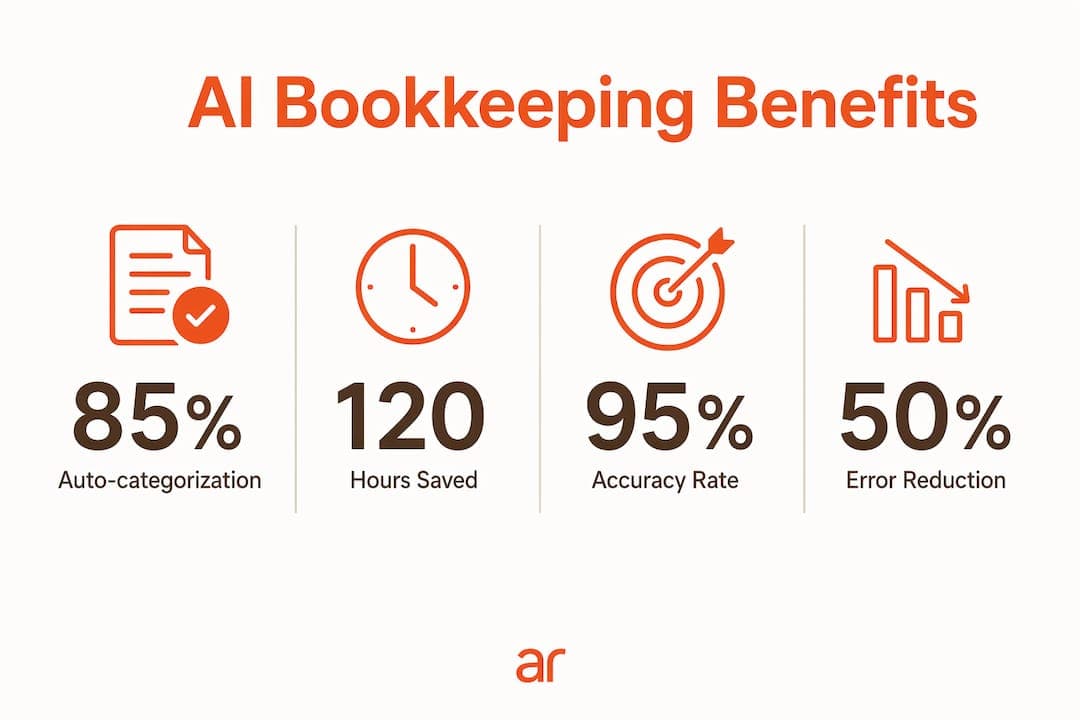
Beyond speed, the reporting granularity improves. When every transaction is coded consistently, accountants can focus on interpreting trends rather than correcting mislabeled entries. Cash flow visibility becomes near real-time instead of a monthly snapshot.
To measure ROI before and after a pilot, track three numbers: hours spent on bookkeeping tasks per week, the percentage of transactions that required manual correction, and the number of days to close each month. Those three baselines, measured over 60 days pre-pilot, give you a clean comparison point.
Adoption is broad but often fragmented. With 92% of accounting professionals using AI in some form, the gap is not adoption — it is depth. Most implementations automate isolated tasks rather than end-to-end pipelines, which is why many teams still feel the month-end crunch despite having “AI tools.”
What AI bookkeeping doesn’t replace — and common myths
The most persistent myth is that AI will replace accountants. It won’t, at least not the judgment-intensive parts of the job. What it replaces is the data-entry layer: coding, matching, and reconciling high-volume, low-ambiguity transactions.
- Myth: AI handles everything, including complex journal entries and tax events. Fact: First-time vendors, ambiguous transactions, and legal or tax events consistently require human review. The data layer is automated; professional judgment is not.
- Myth: Rule-based tools are AI. Fact: Many vendors market rule engines as AI. True AI bookkeeping requires per-client model training on historical data, not just static if-then logic.
- Myth: The system is a black box you can’t audit. Fact: Well-built systems expose confidence scores, review queues, and a full audit trail of every automated decision.
The practical shift is from data entry to interpretation. Accountants who previously spent 60% of their time coding transactions spend that time instead on variance analysis, forecasting, and advising on cash flow. That is a better use of a credentialed professional.
Implementation checklist before you pilot or buy
Run through these before signing a contract or starting a proof of concept.
- Audit your data access. Confirm you can connect bank feeds, export historical transaction data, and map existing GL accounts. Missing any of these stalls the pilot before it starts.
- Map your GL structure. The model trains on your chart of accounts. Inconsistent historical coding produces a weak model. Clean up obvious mislabels first.
- Check vendor and contract constraints. Some ERP agreements restrict third-party API access. Verify before you commit.
- Confirm security and compliance requirements. Healthcare organizations need HIPAA-compliant data handling. Any vendor processing financial data should hold SOC 2 Type II certification at minimum.
- Define your pilot scope. Pick one transaction type and one entity. Set a 6–12 week timebox with three success metrics: auto-categorization rate, error rate, and hours saved.
- Set confidence thresholds and a rollback plan. Start conservative (85–90% confidence for auto-post). Document the manual review SOP and the rollback procedure if accuracy drops.
- Assign ownership. Decide who owns the model, who reviews the queue daily, and who approves threshold changes. Governance gaps are the most common reason pilots stall.
- Plan for continuous learning. Every correction a reviewer makes should feed back into the model. Confirm the vendor supports this feedback loop, or build it into your AI pipeline monitoring plan.
Pro Tip: Automating email invoice capture first is the highest-leverage starting point for most businesses. It eliminates multiple hours of manual work per week and generates clean training data for the categorization model.
How AI bookkeeping automation applies across industries
The core pipeline is the same across sectors, but the configuration varies significantly. Here are the patterns that matter by industry, with examples from Arosplatforms industry use cases:
- Healthcare: PHI handling requires HIPAA-compliant data pipelines. Bookkeeping automation here focuses on insurance reimbursements, vendor payments, and multi-entity consolidation. Every automated decision needs a full audit trail for compliance reviews.
- Logistics: High transaction volumes from fuel cards, intercompany transfers, and carrier invoices make categorization the biggest pain point. ML models trained on freight-specific GL structures dramatically cut coding time. Matching purchase orders to carrier invoices is a natural second automation layer.
- Real estate: Rent rolls, lease accounting under ASC 842, and property-level reporting require dimensional coding that generic tools handle poorly. A tailored AI operating system maps transactions to property, lease, and cost center simultaneously.
- Retail and e-commerce: SKU-level cost of goods sold, returns processing, and multi-channel revenue reconciliation generate enormous transaction volumes. Automation here pays back fastest because the volume is highest.
- Financial services: Regulatory reporting requirements mean every automated posting needs explainability. AI underwriting automation patterns apply here, where confidence scores and audit trails are non-negotiable.
One pattern holds across all of them: the businesses that see the fastest ROI start with the transaction type that generates the most manual work per week, not the most complex one.
How to evaluate vendors and ask the right questions
Use this rubric when comparing approaches. Generic labels like “entry-level field apps” versus “enterprise platforms” matter less than these specific dimensions.
| Dimension | What to look for | Red flag |
|---|---|---|
| GL/ERP integration depth | Native API, bidirectional sync | CSV export only |
| Per-client model training | Trains on your historical data | One-size-fits-all model |
| Ownership and exportability | You own the model and data | No export, vendor lock-in |
| Security/compliance | SOC 2 Type II, HIPAA where relevant | Vague “enterprise-grade” claims |
| Confidence scores and audit trail | Visible per-transaction scores | Black-box posting |
| MLOps and monitoring support | Drift detection, retraining cadence | Set-and-forget |
Exact questions to ask during procurement:
- Who owns the trained model and the training data if we terminate the contract?
- Can we export our transaction history and model weights?
- How are confidence thresholds configured, and who controls them?
- What is the SLA for model retraining after we submit corrections?
- How does the system handle first-time vendors or ambiguous transactions?
- What audit trail does the system produce for every automated posting?
- Is your SOC 2 Type II report available for review?
- How do you handle GL schema changes on our side?
- What does rollback look like if accuracy degrades?
- How does your system distinguish between ML-based categorization and rule-based automation?
Watch for vendors who cannot answer the ownership and explainability questions clearly. A system that cannot tell you why it coded a transaction a certain way is a liability in an audit.
Key Takeaways
AI bookkeeping automation delivers real ROI only when it covers the full four-layer pipeline — import, categorize, match, and report — with per-client ML models, deep GL integration, and clear ownership of the trained system.
| Point | Details |
|---|---|
| Four-layer pipeline is the standard | Tools that cover only one layer create manual gaps; all four layers must be addressed. |
| ML beats static rules over time | Per-client models trained on historical data improve with every correction; rule engines don’t. |
| ROI within 12 months | Most deployments with a connected pipeline reach positive ROI within twelve months. |
| Confidence thresholds govern safety | Start at 85–90% for auto-posting; tighten as the model learns to reduce review queue volume. |
| Arosplatforms builds tailored AI OS | Arosplatforms embeds industry-specific pipelines with client data ownership and no vendor lock-in. |
Why tailored AI operating systems outperform generic tools
The conventional wisdom in this space is that any AI bookkeeping tool is better than none. That is only half right. A generic tool that automates categorization in isolation still leaves your team manually reconciling, manually posting to the GL, and manually chasing exceptions. The month-end close still hurts, just slightly less.
What actually changes the workload is a connected pipeline where every layer talks to the next, trained on your specific transaction history, mapped to your specific GL structure. That is not a product you buy off a shelf. It is a system you build, configure, and own.
The ownership piece is the part most vendors quietly avoid. When the model lives in a vendor’s cloud and you have no export rights, you are not automating your bookkeeping. You are renting someone else’s automation. The moment you switch vendors, you start over. Arosplatforms’s approach, building the AI operating system inside the client’s own infrastructure with full data and model ownership, is the practical answer to that problem.
Change management is the other underestimated factor. Finance teams that see the best results treat the review queue as a training tool, not a failure mode. Every correction improves the model. Teams that skip the feedback loop plateau at 70–75% auto-categorization and wonder why the system stopped improving.
Arosplatforms builds AI operating systems for finance teams
Most businesses already know they need to automate bookkeeping. The harder question is how to do it without creating a new dependency on a vendor who owns your data and your model.

Arosplatforms builds tailored AI operating systems for US enterprises that cover the full bookkeeping pipeline, from invoice capture through GL posting and reporting, configured to your industry’s specific GL structure, compliance requirements, and transaction patterns. Clients see an average of 82% faster turnaround on key finance tasks, with most reaching positive ROI within twelve months. You own the trained model and the data. No vendor lock-in, no renegotiation when you scale. If you want to see how a tailored AI OS applies to your finance workflows, explore Arosplatforms’ AI agents for financial services or contact the team directly to scope a pilot.
Useful sources
- Stanford GSB — AI Is Reshaping Accounting Jobs: Evidence for the human-role shift from data entry to advisory work; use for the misconceptions and benefits sections.
- Gennai — AI Bookkeeping Complete Guide: Practitioner-level pipeline architecture, adoption statistics, and invoice-capture sequencing guidance.
- Baldwin CPAs — The Future of Bookkeeping: ML vs. rule-based distinction and per-client model training rationale.
- FiscalInsights — What Is AI Bookkeeping: Concrete time-savings benchmarks including the 240 hours per year figure.
- Growthy — Best Bookkeeping Automation Software: Four-layer framework and tool coverage gaps.
- Growthy — What Is AI Bookkeeping: Confidence-threshold management and operational scaling guidance.
- Tekkr — The Real Role of AI in Business Operations: Enterprise AI productivity patterns and change management framing for adoption.
FAQ
What is AI bookkeeping automation in simple terms?
AI bookkeeping automation uses machine learning to capture, categorize, match, and reconcile financial transactions automatically, posting high-confidence entries to your GL and queuing exceptions for human review.
Does AI bookkeeping replace accountants?
No. AI automates the data layer — coding, matching, and reconciling routine transactions — while accountants retain judgment tasks like complex journal entries, tax events, and financial advisory work.
How long does it take to see ROI from AI bookkeeping?
Most businesses with a connected pipeline reach positive ROI within twelve months, with measurable time savings typically visible within the first month of a pilot.
What security certifications should an AI bookkeeping vendor hold?
SOC 2 Type II is the baseline for any vendor handling financial data; healthcare organizations should also require HIPAA-compliant data handling and a full audit trail for every automated posting.
What is the difference between rule-based and ML-based bookkeeping automation?
Rule-based systems apply static if-then logic that never improves on its own. ML-based systems train on your historical transaction data and get more accurate over time as reviewers correct exceptions.