Ways to Start AI Adoption: SMB Guide for 2026
Ways to Start AI Adoption: SMB Guide for 2026

AI adoption in small and mid-sized businesses is defined as the structured process of selecting, piloting, and scaling artificial intelligence tools within existing operations to reduce manual work and improve output quality. This ways to start ai adoption smb guide covers every step you need, from picking your first workflow to building a governance framework that keeps your team in control. 82% of small business employers have already invested in AI tools, with administrative automation and communication as the top use cases. That number tells you this is no longer an experiment reserved for large enterprises. Starter AI licenses typically run $20–$30 per user per month, with initial project setup costs ranging from $3,000 to $8,000 depending on integration complexity. The businesses that see real returns move deliberately, not fast.
What are the best ways to start AI adoption for SMBs?
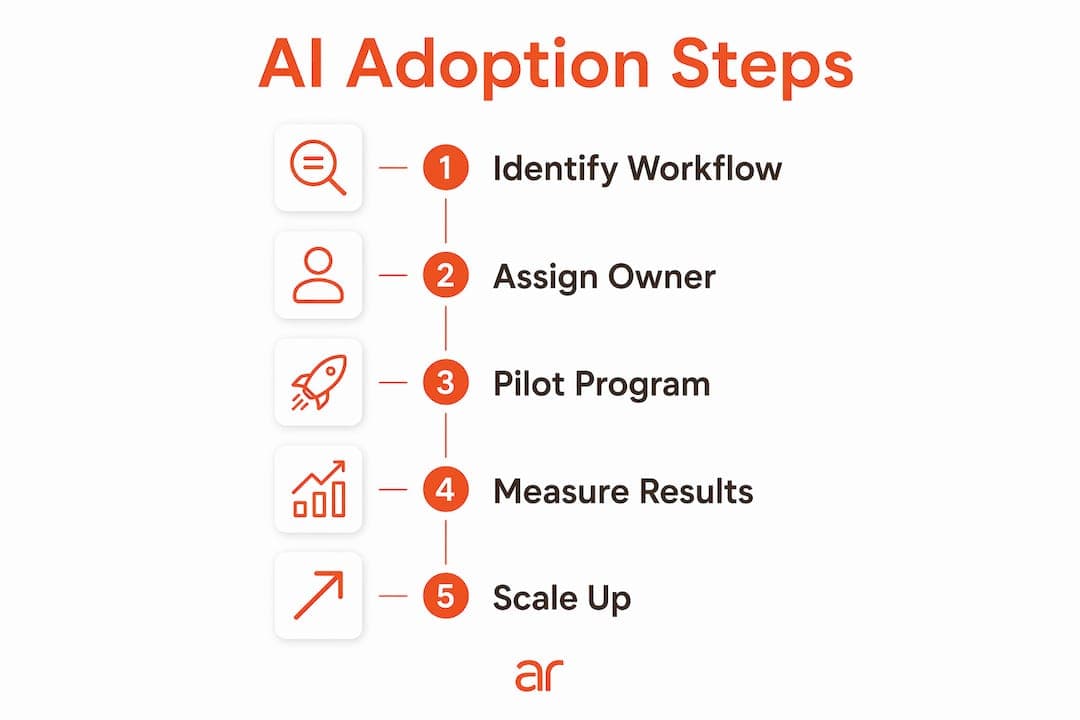
The single best starting point for AI adoption strategies for SMBs is identifying one high-volume, repetitive task with clear inputs and outputs. Most business leaders make the mistake of starting with the tool rather than the problem. The right sequence is always: workflow first, tool second.

The ideal first automation project has reliable inputs, easily verified outputs, and correction-friendly failure modes. That means if the AI gets it wrong, a human can catch and fix the error before it causes damage. Report generation, email triage, and lead routing all fit this profile well.
Strong candidates for your first AI pilot include:
- Report generation: Pulling data from your CRM or spreadsheet and formatting it into a weekly summary requires no judgment, just pattern recognition.
- Email triage: Sorting incoming inquiries by category and urgency is rule-based and easy to verify by spot-checking.
- Lead routing: Assigning inbound leads to the right sales rep based on territory or product type follows defined logic that AI handles accurately.
- Invoice processing: Extracting line items from vendor invoices and matching them to purchase orders is high-volume and low-risk.
- Inventory alerts: Triggering reorder notifications when stock drops below a threshold requires no creativity, only consistent monitoring.
Avoid starting with customer-facing workflows that require brand judgment or emotional nuance. Those come later, once your team has built confidence and your governance is in place.
Pro Tip: Log every repetitive task your team performs more than three times per week for two weeks. That list is your AI pilot shortlist. The task with the most hours logged and the clearest output definition is your starting point.
How do you build a structured AI adoption plan?
A structured AI adoption plan requires a designated owner, a written governance policy, and a training program before any tool goes live. Decentralizing AI strategy is the biggest mistake SMBs make, and it leads directly to security risks and fractured ROI. Central governance does not mean central control of every experiment. It means one person is accountable for the overall direction.
Your governance framework needs four written policies:
- Permitted tools list: Document which AI tools are approved for use, who approved them, and what data they are allowed to access.
- Data handling rules: Define what business data can be entered into external AI systems and what must stay internal.
- Review and escalation process: Specify when a human must review AI output before it is acted on, and who handles disputes.
- Adoption tracking: Set a baseline metric for each tool so you can measure whether it is actually saving time or creating new work.
Staff resistance generally comes from job security concerns, not from the technology itself. The most effective training reframes AI as a tool that removes repetitive tasks, not one that removes people. Show your team specific examples of work the AI will handle so they can redirect their attention to higher-value decisions.
Pro Tip: Assign your AI owner before you sign any vendor contract. That person should attend every vendor demo, review every data-sharing agreement, and own the adoption metrics from day one.
How to run your first AI pilot step by step
A well-structured 90-day roadmap covering assessment, pilot execution, and scaling is the most successful path for SMBs adopting AI. Most pilots take 8 to 12 weeks from scope to live minimum viable product. Rushing through the early phases produces poor adoption and unstable results.
Follow this sequence for your first pilot:
- Define the scope in writing. Document the exact workflow, the inputs the AI will receive, the outputs it will produce, and the human review step that follows.
- Select a small pilot team. Choose 3–5 people who use the workflow daily. They will catch edge cases faster than any QA process.
- Set a weekly feedback loop. Hold a 30-minute check-in every week to collect observations, log errors, and adjust prompts or rules.
- Measure three core metrics. Track daily active users, hours saved per week, and errors caught before output is used.
- Apply a human review gate. No AI output goes directly into a client deliverable or financial record without a human check during the pilot phase.
- Document everything. Record the prompts used, the review rules applied, the failure modes encountered, and how each was resolved.
The table below shows what a healthy pilot looks like at each checkpoint:
| Week | Focus | Success Signal |
|---|---|---|
| 1–2 | Setup and onboarding | All pilot users have access and have completed one full workflow |
| 3–4 | Active use and logging | Daily active user rate above 80% of pilot team |
| 5–6 | Error review and adjustment | Error rate declining week over week |
| 7–8 | Metric review | Hours saved per week measurable and positive |
| 9–12 | Decision point | Pilot team recommends expansion or identifies blockers |
What are the most common AI adoption pitfalls for SMBs?
Picking tools before identifying workflows is the leading cause of SMB AI project failure. The tool selection conversation feels productive, but it skips the step that determines whether the tool will actually be used. Every failed AI project Arosplatforms has reviewed shares this pattern.
Watch for these specific mistakes:
- Tool-first thinking: Signing a software contract before writing down the exact workflow it will support. The result is a tool that does not fit the process.
- Scaling a broken pilot: Moving to a company-wide rollout before the pilot metrics are positive. Scaling amplifies problems, not just successes.
- Shadow AI: Departments buying separate AI tools without central oversight creates security vulnerabilities and wastes budget through duplication. One team uses one tool for content, another uses a different one for the same task, and no one can measure the combined ROI.
- No human review gate: Trusting AI output without a verification step during the early months leads to errors that damage client relationships or financial records.
- Skipping failure documentation: Not recording how the AI failed and how the failure was caught means the same error repeats. Documentation is what turns a mistake into a process improvement.
The fix for all of these is the same: write the workflow down before you open a vendor website.
How do you scale AI adoption after a successful pilot?
Scaling AI adoption beyond the pilot phase requires using your pilot metrics as the business case for the next investment. SMB leaders prioritize AI pilots in data analytics, content generation, and inventory management because those functions produce measurable ROI quickly. Once your first pilot shows positive numbers, those numbers are your argument for the next phase.
Scaling well means integrating AI capabilities into the platforms your team already uses, such as your CRM, helpdesk, or project management tool. Adding a standalone tool creates adoption friction. Embedding AI into an existing workflow removes it.
Key principles for scaling without losing control:
- Keep the human-in-the-loop requirement in place for any new workflow until it has run for at least 60 days without a critical error.
- Update your governance policy every time you add a new tool or expand to a new department.
- Run a new training session for each team that joins the rollout. Do not assume the original training materials are sufficient for a different function.
- Review your AI use cases quarterly to identify which automations are delivering value and which need to be retired or redesigned.
Pro Tip: Before approving any new AI tool during the scaling phase, require the requesting team to submit a one-page brief: the workflow it will support, the metric it will improve, and the human review step it will include. This single requirement eliminates most bad tool decisions.
Key Takeaways
Structured AI adoption in SMBs succeeds when you define the workflow before selecting the tool, assign a single owner for governance, and measure pilot results before scaling.
| Point | Details |
|---|---|
| Workflow before tool | Define the exact process and its outputs before evaluating any AI software. |
| Assign one owner | One person must own tool approvals, vendor communication, and adoption metrics. |
| Pilot with a small team | Run 8–12 weeks with 3–5 users before committing to a company-wide rollout. |
| Measure three metrics | Track daily active users, hours saved, and errors caught to validate the pilot. |
| Govern Shadow AI | A written policy on permitted tools and data handling prevents security gaps and wasted spend. |
What we have learned from real SMB AI projects
The most common thing we see at Arosplatforms is business leaders who are impatient with the diagnostic phase. They want to skip the workflow audit and go straight to the demo. That impulse is understandable. Demos are exciting. Audits are not. But every project where we skipped or rushed the audit phase cost more time to fix than the audit would have taken.
The second pattern we see is underestimating staff resistance. It is rarely about the technology. It is almost always about job security. The teams that adopt AI fastest are the ones whose leaders were transparent early: “Here is what the AI will handle, here is what you will handle, and here is how your role gets better.” That conversation, held before the tool goes live, changes everything.
The third lesson is about governance. Centralized strategy does not mean slow decisions. It means one person has the authority to say yes or no to a new tool, and that decision takes a day, not a committee meeting. The AI strategy advisory work we do almost always starts here, because without that single point of accountability, every other step is harder.
The businesses that build AI adoption into their operating rhythm, rather than treating it as a one-time project, are the ones that compound their efficiency gains year over year. Patience in the first 90 days pays for itself many times over.
— Arosplatforms team
How Arosplatforms supports your SMB’s AI adoption
Arosplatforms builds customized AI operating systems designed for specific industries, so your team gets a system that fits your workflows rather than a generic tool that requires workarounds.
The Arosplatforms AI Operating System unifies tool management, governance tracking, and human-in-the-loop checkpoints into one operational layer. Clients see an average of 82% faster turnaround on key tasks, with many reaching positive ROI within twelve months. For SMB leaders who want to move from pilot to full adoption without losing control of data or quality, Arosplatforms provides the structure, the expertise, and the process automation support to make that happen without vendor lock-in.
FAQ
What is the first step in AI adoption for a small business?
The first step is identifying one repetitive, rule-based internal workflow with clear inputs and verifiable outputs. Define that process in writing before evaluating any AI tool.
How long does an SMB AI pilot typically take?
Most SMB AI pilots take 8 to 12 weeks from scope definition to a live minimum viable product. Rushing this phase leads to poor adoption and unstable results.
What is Shadow AI and why does it matter?
Shadow AI occurs when departments buy and use AI tools without central oversight. It creates security vulnerabilities, duplicates spending, and makes ROI impossible to measure across the organization.
How much does it cost to start AI adoption in a small business?
AI licenses typically cost $20–$30 per user per month, and initial project setup runs $3,000 to $8,000 depending on how complex the integration is with existing systems.
How do you get staff to accept AI tools?
Train staff by showing them specifically which repetitive tasks the AI will handle and how their role improves as a result. Framing AI as a productivity tool rather than a replacement reduces resistance and accelerates adoption.