Types of Logistics Process Automation: 2026 Guide
Types of Logistics Process Automation: 2026 Guide

Logistics process automation falls into three distinct categories: Physical Automation, Digital Process Automation, and Decision Automation. Each layer targets a different part of the supply chain, and the most effective operations combine all three rather than treating them as separate investments. Physical Automation handles the movement of goods through robots and conveyors. Digital Process Automation replaces repetitive data work with software. Decision Automation uses AI to handle planning, routing, and forecasting tasks that used to require a human analyst.
- Physical Automation: Automated Guided Vehicles (AGVs), Autonomous Mobile Robots (AMRs), and Automated Storage and Retrieval Systems (AS/RS) that move, sort, and store goods without manual labor.
- Digital Process Automation: Robotic Process Automation (RPA), workflow tools, and integration platforms that connect Warehouse Management Systems (WMS), Transportation Management Systems (TMS), and ERP platforms to eliminate manual data entry.
- Decision Automation: AI-driven route optimization, demand forecasting, and predictive ETAs that replace reactive human judgment with proactive, data-driven decisions.
The integration layer is what ties these categories together. Without a WMS, TMS, and ERP sharing a common data model, even the best physical robots and AI models will operate on stale or conflicting information.
What are the real benefits and challenges of logistics automation?
The business case for automating logistics processes is well established, but the path to getting there is rarely clean.
Key benefits:
- Operational speed: Robotic picking systems can run 24 hours a day without fatigue, dramatically increasing throughput compared to manual shifts.
- Accuracy: Automated data entry and barcode scanning reduce picking errors and invoice discrepancies that cost time and money to fix.
- Cost reduction: Fewer manual touchpoints across order processing, shipment booking, and inventory counting lower labor costs per unit shipped.
- Forecasting quality: AI-driven demand forecasting tools analyze historical patterns and external signals to reduce both stockouts and overstock situations.
- Scalability: Automated systems handle volume spikes, like peak season surges, without proportional headcount increases.
Common challenges:
- System integration complexity: Most logistics operations run on a mix of legacy platforms, carrier portals, and spreadsheets. Connecting them cleanly is the hardest part of any automation project.
- Data quality: Automation amplifies whatever is in your data. Dirty master data, outdated carrier rate tables, and inconsistent product codes cause automated workflows to fail or produce wrong outputs.
- Organizational change: Warehouse staff, dispatchers, and planners need retraining when their roles shift from doing tasks to supervising automated systems.
- Upfront investment: Physical automation in particular carries high capital costs, and the ROI timeline can stretch beyond what some finance teams expect.
- Scope creep: Teams often start with one automation use case and underestimate how many adjacent processes need to change to make it work.
The organizations that succeed treat automation as a process redesign initiative, not a technology install. That distinction separates the projects that deliver ROI from the ones that stall after the pilot.
1. Physical automation in logistics operations
Physical automation is the most visible layer of logistics technology. It covers every system that moves, sorts, stores, or retrieves goods without a person doing the work directly.
Core technologies:
- Automated Guided Vehicles (AGVs): Fixed-path vehicles that follow magnetic strips or embedded floor guides to transport pallets and totes between fixed stations. AGVs work well in predictable, high-volume environments like distribution centers with stable layouts.
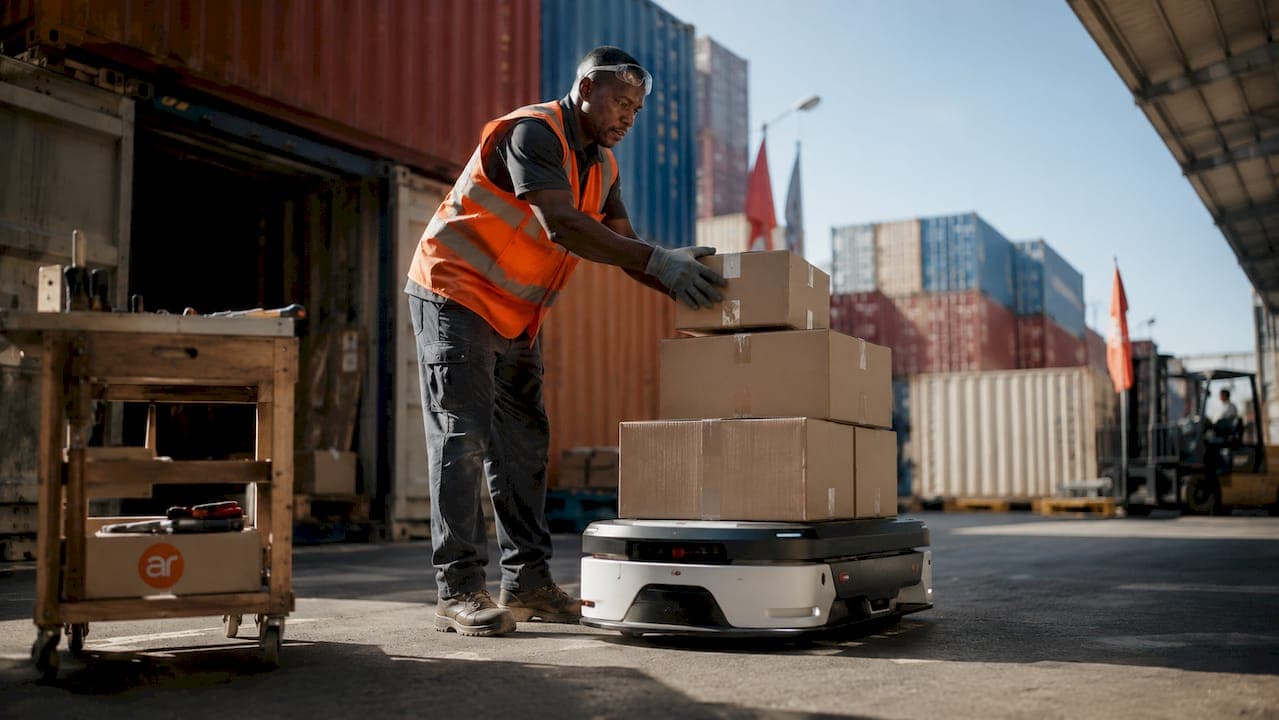
- Autonomous Mobile Robots (AMRs): Unlike AGVs, AMRs navigate dynamically using onboard sensors and maps. They can reroute around obstacles in real time, making them far more flexible in environments where layouts change or human workers share the floor.
- Automated Storage and Retrieval Systems (AS/RS): High-density racking systems paired with automated cranes or shuttles that store and retrieve inventory at speed. AS/RS installations are common in pharmaceutical distribution, cold storage, and e-commerce fulfillment where vertical space is valuable.
- Conveyor and sortation systems: High-speed belt and tilt-tray sorters that route packages by destination, carrier, or size without manual handling.
- Automated picking systems: Goods-to-person systems bring items to a stationary picker rather than sending workers walking through aisles. Robotic picking can exceed 600 items per hour with continuous 24/7 operation.
The efficiency gains from physical automation compound over time. A distribution center running AMRs for goods-to-person picking doesn’t just move faster. It also generates location and movement data that feeds inventory accuracy and demand planning systems downstream. The physical and digital layers are not independent.
2. Digital process automation in logistics management
Digital process automation targets the information flows that run alongside physical goods movement. Every shipment generates dozens of data events: booking confirmations, status updates, proof of delivery, invoices, and exception alerts. Handling those manually is slow and error-prone.
Core technologies and applications:
- Robotic Process Automation (RPA): Software bots that mimic human interactions with existing systems, logging into carrier portals, copying tracking numbers, updating TMS records, and reconciling invoices without human input. RPA is particularly useful for bridging legacy systems that lack modern APIs.
- Workflow automation platforms: Tools that trigger actions based on rules or events, such as automatically sending a delay notification to a customer when a shipment misses a checkpoint scan.
- Integration platforms: Middleware that connects WMS, TMS, ERP, and carrier systems so data flows automatically rather than being re-entered at each handoff.
- Document processing automation: AI-powered tools that extract data from bills of lading, customs documents, and invoices, eliminating manual keying and reducing processing time from hours to minutes.
- Shipment booking automation: Rules-based systems that select carriers, generate booking requests, and confirm shipments based on predefined criteria like cost, transit time, and service level.
The practical impact shows up in error rates and cycle times. When invoice reconciliation runs automatically against shipment records, discrepancies surface immediately rather than weeks later during a manual audit. That speed matters for cash flow and carrier relationships alike.
Pro Tip: Before deploying RPA on a workflow, map the process end-to-end first. Bots that automate a broken process just produce wrong outputs faster. Fix the logic, then automate it.
3. Decision automation and AI applications in logistics
Decision Automation is where the highest ROI in logistics automation tends to live, and it’s also the least understood of the three layers. Rather than moving boxes or processing forms, it automates the cognitive work: choosing routes, predicting demand, allocating capacity, and flagging exceptions before they become crises.
Core applications:
- AI route optimization: Algorithms that factor in traffic, weather, delivery windows, vehicle capacity, and fuel costs to generate optimal routes dynamically. These systems update in real time as conditions change, something a human dispatcher cannot do at scale.
- Demand forecasting: Machine learning models trained on historical sales, seasonal patterns, promotions, and external signals like weather or economic indicators. Better forecasts mean less safety stock and fewer emergency replenishment orders.
- Predictive ETAs: AI models that estimate arrival times based on current carrier performance, traffic data, and historical lane patterns, giving customers accurate delivery windows rather than static estimates.
- Carrier and mode selection: Systems that automatically assign shipments to the optimal carrier and transport mode based on cost, transit time, and service level requirements.
- Exception management: AI that monitors shipments in real time and proactively alerts teams to delays, capacity shortfalls, or compliance issues before they escalate.
The shift from reactive to proactive management is the real value here. A dispatcher manually reviewing 200 shipments each morning will miss the one that’s about to miss a delivery window. An AI exception management system flags it the night before, when there’s still time to act. Arosplatforms builds AI-driven logistics systems that embed this kind of decision intelligence directly into existing operations, rather than layering it on top as a separate tool.

4. Overcoming challenges through integration and process redesign
The most common reason logistics automation projects underdeliver is not the technology. It’s the data and process infrastructure underneath it. Automation failures most often trace back to poor integration and reactive exception handling rather than any flaw in the automation logic itself.
What effective integration looks like:
- A single source of truth across TMS, WMS, and ERP so that every system works from the same inventory positions, shipment statuses, and order data.
- Event-driven architecture where a status change in one system automatically triggers the appropriate response in connected systems, without manual intervention.
- Standardized data formats and master data governance so that product codes, carrier identifiers, and location references mean the same thing everywhere.
Process redesign is equally important. Automating a workflow that was designed for manual execution usually produces mediocre results. The better approach is to ask what the process would look like if it were designed from scratch for automation, and then rebuild it that way. That often means eliminating approval steps that exist only because humans needed checkpoints, consolidating data entry points, and standardizing exception handling rules.
The human side of this work gets underestimated. Dispatchers and planners whose jobs change from doing to supervising need clear new role definitions, not just training on a new tool. Cross-functional alignment between IT, operations, and finance is what makes integration projects stick.
Pro Tip: Assign a data stewardship role on every automation project. Someone needs to own the ongoing accuracy of look-up tables, carrier rate cards, and geographic references. Without that ownership, AI models and automated workflows degrade quietly over months until they start producing wrong outputs.
How should you choose the right logistics automation technology?
Not every automation investment fits every operation. The selection criteria that matter most depend on your current state, your volume, and where your biggest inefficiencies actually sit.
Start with process mapping. Before evaluating any technology, document the workflows you want to automate at a task level. Identify where errors occur, where delays accumulate, and where manual effort is highest. That analysis tells you which automation layer to prioritize.
Evaluate integration requirements early. The question is not just whether a system can do the job, but whether it can connect cleanly to your existing WMS, TMS, and ERP. A powerful AI routing tool that requires a six-month integration project to access your shipment data is a much larger investment than its license fee suggests.
Match technology to volume and variability. Physical automation like AS/RS and high-speed sorters delivers strong returns at high, predictable volumes. Lower-volume or highly variable operations often get better ROI from digital process automation and AI decision tools first, since those require less capital and can be deployed faster.
Consider total cost of ownership. Maintenance, software updates, staff retraining, and data stewardship all add to the ongoing cost of any automation system. Factor those in before committing.
Pilot before scaling. Run a contained proof of concept on one lane, one warehouse zone, or one document type before rolling out broadly. A pilot surfaces integration issues, data quality problems, and process gaps at a scale where they’re fixable without disrupting the whole operation.
Assess vendor lock-in risk. Proprietary platforms that make it difficult to export your data or switch providers create long-term dependency. Prioritize systems with open APIs and data portability. Arosplatforms specifically builds AI operating systems that clients own and can manage independently, avoiding the lock-in that plagues many enterprise automation deployments.
How does logistics automation change workforce roles and required skills?
Automation does not simply eliminate jobs in logistics. It changes what jobs look like, and that shift requires deliberate workforce planning.
The roles most affected by physical automation are repetitive, high-volume tasks: manual picking, packing, data entry, and basic inventory counting. These tasks get absorbed by robots and software. But the roles that emerge around those systems, such as robot fleet supervisors, automation technicians, and data quality analysts, require skills that most current warehouse workers don’t have yet.
Digital process automation shifts dispatcher and coordinator roles toward exception management and oversight. Instead of manually booking shipments or updating tracking records, those workers monitor automated workflows, investigate failures, and handle the edge cases that automation can’t resolve. The work becomes more cognitive and less repetitive.
Decision automation creates demand for people who can interpret AI outputs, challenge model recommendations, and govern the rules that drive automated decisions. That’s a new skill set for most logistics organizations, sitting somewhere between data analyst and operations manager.
The workforce evolution in supply chain automation is moving toward supervision, exception management, and governance rather than task execution. Organizations that invest in retraining programs alongside their automation deployments retain institutional knowledge while building the new capabilities the systems require. Those that don’t often find themselves with automated systems that nobody fully understands or trusts.
Case studies: logistics process automation across industries
Automation looks different depending on the industry, volume, and supply chain structure. These examples show how the three automation layers apply in practice.
E-commerce fulfillment
Large e-commerce operations were early adopters of physical automation. Goods-to-person AMR systems replaced the traditional model of workers walking miles of aisles per shift. The result is faster pick cycles, lower error rates, and the ability to scale throughput during peak periods without proportional headcount increases. Digital process automation handles order routing, carrier selection, and label generation automatically at the point of sale. AI decision tools manage inventory positioning across multiple fulfillment centers based on predicted regional demand.
Food and beverage distribution
Cold chain logistics adds a layer of complexity that makes automation particularly valuable. AS/RS systems in temperature-controlled warehouses maximize storage density while minimizing the time products spend outside optimal conditions. RPA handles the high volume of supplier invoices and delivery confirmations that flow through food distribution networks daily. AI forecasting models factor in promotional calendars, seasonal demand shifts, and supplier lead times to keep inventory levels tight without risking stockouts on fast-moving items.
Automotive parts supply chains
Automotive manufacturers run on just-in-time delivery schedules where a delayed parts shipment can halt an assembly line. AGVs handle internal plant logistics, moving components from receiving docks to assembly stations on precise schedules. AI-driven supply chain tools monitor supplier performance and flag potential disruptions before they reach the production floor. Digital process automation connects supplier portals, ERP systems, and carrier networks so that purchase orders, advance shipping notices, and invoices flow without manual re-entry.
Third-party logistics providers
Third-party logistics (3PL) providers face a unique challenge: they run automation across multiple client operations simultaneously, each with different systems, data formats, and service requirements. Integration platforms and AI-based document processing are particularly valuable here, normalizing data from dozens of client ERP systems into a single operational view. Decision automation helps 3PLs optimize carrier selection and load planning across their entire network rather than optimizing each client shipment in isolation.
What does the future of logistics automation look like?
The three-layer framework of Physical, Digital, and Decision Automation will remain the organizing structure, but the capabilities within each layer are advancing quickly.
Key trends shaping logistics automation through 2026 and beyond:
- Hyperautomation: The combination of RPA, AI, machine learning, and process mining to automate entire end-to-end workflows rather than individual tasks. Gartner identifies hyperautomation as one of the top strategic technology trends, and logistics is a primary application domain.
- Generative AI in operations: Large language models are beginning to appear in logistics for tasks like generating carrier communications, summarizing exception reports, and drafting responses to customer inquiries. The more significant near-term application is using generative AI to help operations teams build and modify automation rules without needing developer support.
- IoT and real-time visibility: IoT sensors and cloud platforms are enabling real-time tracking at the shipment, pallet, and item level. That data feeds AI models with higher-frequency signals, improving the accuracy of predictive ETAs and exception alerts.
- Autonomous vehicles in freight: Long-haul autonomous trucking is moving from pilot to early commercial deployment on specific corridors. The driverless truck will reshape last-mile and linehaul economics over the next decade, though regulatory and infrastructure timelines vary by state.
- Collaborative robots (cobots): Unlike fully autonomous systems, cobots work alongside human workers, handling the physically demanding or repetitive portions of a task while humans manage judgment-dependent steps. Cobots lower the capital barrier to physical automation for mid-size operations.
- Blockchain for supply chain transparency: Distributed ledger technology is being applied to multi-party supply chains where trust and data integrity across organizations are critical, particularly in food safety, pharmaceutical track-and-trace, and customs compliance.
The organizations that will lead in logistics automation are not necessarily those with the largest technology budgets. They’re the ones that treat automation as an ongoing capability, investing in data quality, integration architecture, and workforce development alongside the technology itself.
How Arosplatforms approaches logistics automation

Arosplatforms builds customized AI operating systems for logistics and supply chain operations, embedding directly within client teams rather than delivering a generic platform and walking away. The approach covers all three automation layers: physical system integration, digital workflow automation, and AI-driven decision tools for routing, forecasting, and exception management.
What sets Arosplatforms apart is the ownership model. Clients own the systems that get built, with no ongoing vendor dependency. Teams are trained to manage and modify their automation without needing to go back to a consultant for every change. Many clients see ROI within a year, achieving substantial reductions in turnaround time for key operational tasks.
For US enterprises looking to move beyond pilot projects and deploy automation at scale, Arosplatforms works with your team to build the integration architecture, data governance, and AI decision layer that makes automation actually stick.
Key Takeaways
Logistics process automation delivers the most durable results when all three layers, physical, digital, and decision, are integrated around a shared data foundation.
| Point | Details |
|---|---|
| Three automation layers | Physical, Digital Process, and Decision Automation each target a different part of the supply chain. |
| Decision Automation drives highest ROI | AI-based route optimization, forecasting, and exception management reduce reactive management more than physical robotics alone. |
| Integration is the critical dependency | Automation failures most often trace to poor integration across TMS, WMS, and ERP, not the automation logic itself. |
| Data stewardship prevents decay | Assigning ownership of look-up tables, rate cards, and geographic references keeps AI models accurate over time. |
| Workforce roles shift, not disappear | Automation moves logistics workers toward supervision, exception management, and governance rather than eliminating roles outright. |
FAQ
What are the main types of logistics process automation?
The three main types are Physical Automation (AGVs, AMRs, AS/RS), Digital Process Automation (RPA, workflow tools, integration platforms), and Decision Automation (AI route optimization, demand forecasting, predictive ETAs). Most mature logistics operations deploy all three layers in combination.
What are the four types of automation?
The four commonly cited types of automation are fixed (hard) automation, programmable automation, flexible automation, and cognitive (AI-driven) automation. In logistics specifically, these map to physical systems, RPA-based digital workflows, adaptive robotics, and AI decision tools respectively.
What are the five core logistics processes?
The five core logistics processes are procurement, production planning, inventory management, transportation, and demand management. Supply chain automation can be applied across all five, though transportation and inventory management typically see the earliest and most measurable automation gains.
How do you start automating logistics processes?
Start by mapping your highest-volume, most error-prone workflows at the task level, then identify which automation layer addresses the root cause. Most organizations get the fastest returns by automating digital data workflows first, since those require less capital than physical systems and deliver measurable accuracy and speed improvements within weeks.
What is the difference between RPA and AI in logistics automation?
RPA follows fixed rules to automate repetitive digital tasks like data entry and invoice processing, while AI learns from data to make judgment-based decisions like route selection and demand forecasting. The two technologies are complementary: RPA handles structured, rule-based work, and AI handles variable, prediction-dependent decisions.