The Role of Custom AI Systems for SMBs in 2026
The Role of Custom AI Systems for SMBs in 2026

Custom AI systems are purpose-built software that connects foundation models to a business’s own data, workflows, and processes to automate tasks that generic tools cannot handle. The role of custom AI systems for SMBs is to replace manual, high-volume work with intelligent automation that learns from proprietary data and delivers measurable time and cost savings. 76% of SMBs now use AI in some form, and the gap between businesses that use generic tools and those that build tailored systems is widening fast. For small and mid-sized business leaders, understanding when and how to go custom is the most consequential technology decision of 2026.
How do custom AI systems differ from off-the-shelf AI solutions for SMBs?
Custom AI solutions for small businesses are built around your specific workflows, data structures, and business rules. Off-the-shelf AI tools are built for the broadest possible audience, which means they handle common tasks well but struggle with anything unique to your operation. A logistics company with proprietary routing rules, or a healthcare practice with specialized intake workflows, will hit the ceiling of generic tools quickly.
The technical distinction matters here. Custom AI today means wiring foundation models into your business data and workflows through APIs, using patterns like Retrieval-Augmented Generation (RAG). RAG lets the AI pull from your internal documents, databases, and records before generating a response. That is fundamentally different from a generic chatbot that only knows what it was trained on publicly.

Off-the-shelf tools win on speed and cost for commodity tasks. Scheduling, basic email drafting, and standard customer FAQs are well-served by SaaS AI products. The problem is that most SMBs have at least a few workflows that are genuinely unique, and those are exactly the workflows that drive margin.
A hybrid AI portfolio mixing off-the-shelf tools for standard processes with custom-built AI for unique workflows delivers the best balance of cost and fit. This is not an all-or-nothing decision. The practical framework is simple: use SaaS for what is common, and build custom for what is yours.
Workflow fit by approach:
- Data entry and scheduling: Off-the-shelf tools handle these well at low cost.
- Customer verification with proprietary criteria: Custom AI trained on your rules outperforms generic tools.
- Compliance workflows tied to specific regulations: Custom AI with RAG patterns reads your policy documents directly.
- Margin-critical pricing or underwriting logic: Vertical AI built on your historical data produces far more accurate outputs.
What criteria should SMBs consider when investing in custom AI?
The decision to build custom AI comes down to three factors: volume, uniqueness, and data readiness. Get all three right, and the investment pays off. Miss one, and you will spend months building something that underperforms.
Volume is the clearest threshold. Custom AI is economically viable for SMBs handling up to roughly 10,000 AI calls per day, particularly when the workflow involves proprietary data. Below that threshold, a SaaS tool usually covers the need at lower cost. Above it, a custom system starts paying for itself through efficiency gains alone.
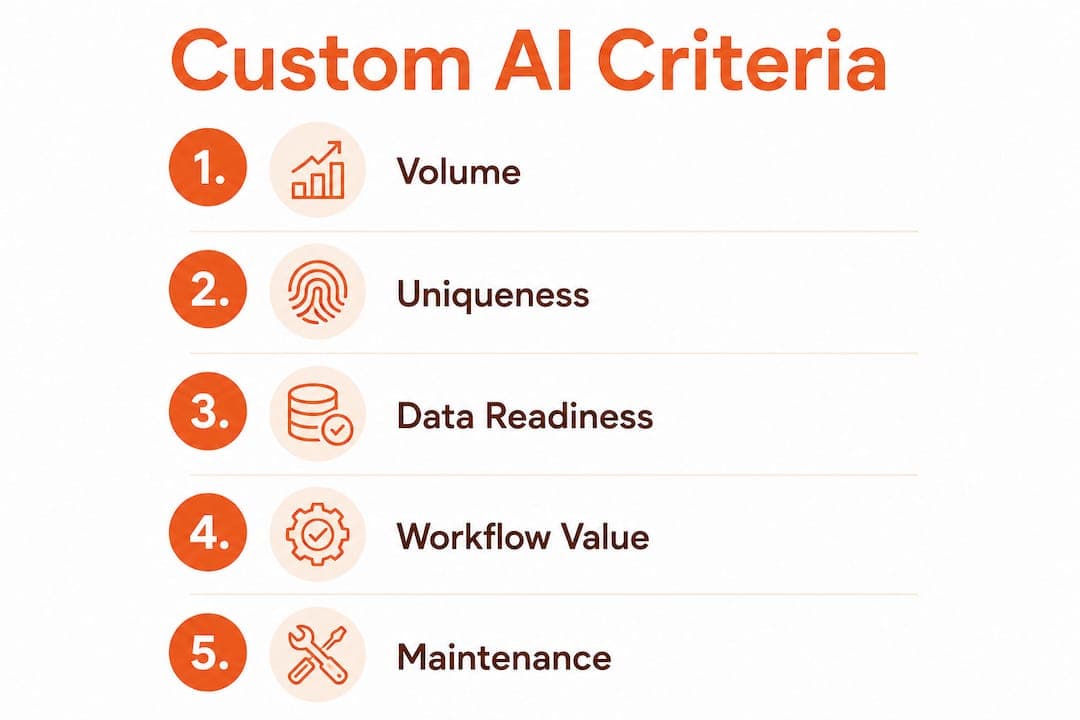
Uniqueness determines whether custom AI creates a real advantage. Custom AI is best reserved for workflows that are strategic, tied to your margins, or central to your customer experience. If a competitor can buy the same SaaS tool and get the same result, you have not built a competitive advantage. If your workflow reflects years of proprietary data and business logic, custom AI turns that into a durable edge.
Data readiness is where most SMBs underestimate the work. Successful custom AI depends on clean, structured, and unified data. Poor data preparation is the leading cause of delayed ROI and project failure. Before committing to a custom build, audit your data sources, check for consistency, and identify integration gaps.
A practical readiness checklist:
- Identify workflows with the highest manual time cost per week.
- Confirm those workflows use data you own and control.
- Audit data quality: is it structured, consistent, and accessible?
- Estimate call volume to confirm economic viability.
- Set a realistic ROI timeline of 12–18 months and budget accordingly.
Pro Tip: Start with one workflow that costs your team at least five hours per week and has clean data behind it. A focused first build delivers measurable ROI faster and builds internal confidence for larger investments.
What does the typical implementation process look like for SMBs?
Custom AI implementation follows a predictable sequence, and knowing the stages prevents the two most common mistakes: underestimating data work and skipping validation.
Discovery and workflow mapping comes first. This phase identifies which processes to automate, maps the data inputs and outputs, and defines success metrics. A well-run discovery phase takes one to two weeks and prevents expensive rework later.
Data preparation is the most underestimated stage. Integrating data from CRM systems, finance platforms, and operational databases takes time. Inconsistent formats, duplicate records, and siloed systems all add weeks to the timeline. Skipping this work does not save time. It guarantees poor model performance.
Development and integration follows. Custom AI implementations typically take 2–8 weeks for a focused workflow. That range reflects the difference between a single automated process and a multi-step agent that touches several systems. Arosplatforms, for example, reports an average 82% faster turnaround for key tasks after deployment, which reflects the compounding effect of well-scoped builds.
Testing, validation, and tuning is non-negotiable. Every custom system needs real-world testing against edge cases before it handles live workflows. This phase catches errors that clean test data never surfaces.
Post-launch monitoring is an ongoing commitment. AI models drift over time as business data changes. A maintenance plan that includes periodic retraining and performance review protects the initial investment.
| Implementation stage | Typical duration | Key output |
|---|---|---|
| Discovery and workflow mapping | 1–2 weeks | Scoped workflow and success metrics |
| Data preparation and integration | 2–4 weeks | Clean, unified data pipeline |
| Development and testing | 2–8 weeks | Deployed and validated AI system |
| Post-launch monitoring | Ongoing | Maintained model performance |
What are the practical benefits and risks of deploying custom AI in SMBs?
The business case for custom AI is grounded in time savings and decision quality. SMBs using AI save 5–15 hours weekly per employee on tasks like data entry and customer verification. That translates to $6,500 to $19,500 in annual value per employee. Across a team of ten, the numbers become a genuine budget line.
Internal AI copilots save staff 4–10 hours per week, which compounds across departments. The productivity gain is not just about speed. It is about redirecting human attention to work that requires judgment, relationships, and creativity. Explore practical AI use cases to see how this plays out across industries.
Custom AI acts as a force multiplier by automating the routine 80% of work, freeing your team to focus on the high-value 20% that actually moves the business forward. The goal is not to replace people. It is to make each person dramatically more effective at the work only they can do.
The risks are real and deserve equal attention. AI governance is a key risk area for SMBs. Exposing sensitive customer or financial data to public AI models creates compliance and security exposure. Every custom AI deployment needs a formal acceptable use policy, clear data handling rules, and IT oversight.
Compliance risk is especially acute in healthcare, financial services, and legal services, where data handling is regulated. A custom system built with proper data governance protects you. A poorly scoped one creates liability.
Pro Tip: Before launch, document exactly which data sources the AI can access and which it cannot. A simple data access policy prevents the most common governance failures and satisfies most auditor questions.
Key Takeaways
Custom AI systems deliver the strongest ROI for SMBs when they target high-volume, proprietary workflows backed by clean data and a realistic 12–18 month return timeline.
| Point | Details |
|---|---|
| Custom vs. off-the-shelf | Use SaaS for commodity tasks; build custom AI for workflows tied to your margins and proprietary data. |
| Volume and data readiness | Custom AI is viable at roughly 10,000 daily calls with clean, structured, and unified data behind it. |
| Implementation timeline | Focused custom builds take 2–8 weeks; budget 12–18 months for full ROI realization. |
| Time and cost savings | SMBs save 5–15 hours weekly per employee, worth $6,500 to $19,500 in annual value. |
| Governance is non-negotiable | Every deployment needs a formal data access policy and IT oversight to manage compliance risk. |
The case for treating custom AI as infrastructure, not an experiment
The Arosplatforms team has worked with SMBs across healthcare, logistics, and real estate, and the pattern is consistent: the businesses that get the most from custom AI treat it as infrastructure, not a pilot project. They pick one workflow, build it properly, measure the result, and then expand. The businesses that struggle try to automate everything at once or skip data preparation because it feels slow.
The most counterintuitive lesson is that the off-the-shelf tools are not the enemy. They are the right answer for a large portion of your workflows. The mistake is using them for the workflows where your proprietary data and business logic are the actual competitive advantage. That is where custom AI earns its cost.
Data readiness is the real barrier, not technology. Foundation models are capable enough for most SMB use cases right now. What holds projects back is messy, siloed, or inconsistent data. Investing in data quality before the AI build is not a delay. It is the build.
The businesses that will look back on 2026 as a turning point are the ones that stopped treating AI as a line item in the IT budget and started treating it as the operating layer their teams run on. That shift in framing changes every decision that follows.
— arosplatforms team
How Arosplatforms helps SMBs build custom AI that actually delivers
Arosplatforms builds customized AI operating systems for SMBs across healthcare, logistics, real estate, and beyond. The approach starts with deep workflow mapping, not a product demo, because the right system has to fit your data and your processes before it can deliver results.
Clients typically see ROI within twelve months, with an average 82% faster turnaround on key tasks after deployment. Arosplatforms prioritizes full ownership of the systems it builds, which means no vendor lock-in and no dependency on a third-party roadmap. Whether you are scoping a first prototype or scaling an existing AI workflow, custom AI consulting from Arosplatforms gives you a clear path from data readiness to production deployment. See how the approach applies across industries and sectors to find the right starting point for your business.
FAQ
What is custom AI automation for SMBs?
Custom AI automation for SMBs is the practice of building AI systems tailored to a specific business’s workflows, data, and rules rather than using generic off-the-shelf tools. It delivers measurably better results for high-volume or margin-critical processes that involve proprietary data.
How long does a custom AI implementation take for a small business?
A focused custom AI build typically takes 2–8 weeks for a single workflow, with full ROI expected within 12–18 months depending on data readiness and project scope.
When does custom AI make more sense than a SaaS tool?
Custom AI makes more sense when a workflow is unique to your business, involves proprietary data, and runs at sufficient volume, roughly 10,000 AI calls per day, to justify the build cost over a SaaS subscription.
What are the biggest risks of deploying custom AI in an SMB?
The biggest risks are data security exposure, compliance failures from poor governance, and delayed ROI caused by inadequate data preparation. A formal acceptable use policy and IT oversight address most of these risks before they become problems.
How much time can SMBs realistically save with custom AI?
SMBs typically save 5–15 hours per employee per week on automatable tasks, which translates to $6,500 to $19,500 in annual value per employee at standard labor rates.