The Role of AI in Vacancy Reduction for Property Managers
The Role of AI in Vacancy Reduction for Property Managers

AI is the most direct tool property managers have for cutting vacancy periods, with renters who engage with AI leasing assistants 43% more likely to apply and lease signings rising by 24%. The role of AI in vacancy reduction goes beyond simple automation. It reshapes how properties attract, convert, and retain tenants at every stage of the leasing cycle. This article covers the mechanisms that produce those results, from sub-10-minute lead responses to predictive tenant retention, and explains how integration maturity determines whether you see those gains or miss them entirely.
How does AI reduce vacancy periods in property management?
AI reduces vacancy periods by compressing the time between a prospect’s first inquiry and a signed lease. The two biggest levers are speed of response and quality of engagement. Both are areas where human leasing teams, stretched across multiple properties, consistently fall short.
28% of leasing calls go unanswered, and more than half of all inquiries arrive outside standard office hours. That means a significant share of high-intent prospects never hear back at the moment they are most ready to act. AI leasing assistants cover that gap by operating around the clock, answering questions, qualifying leads, and booking tours without human intervention.

Industry benchmarks set the bar clearly. Sub-10-minute lead response times are the target for AI-assisted properties, and tour-to-lease ratios above 25% are achievable in market-rate housing when AI handles the initial engagement. Those numbers reflect a simple truth: speed keeps prospect intent high, and high intent converts.
The practical result is a shorter vacancy window on every unit. Faster engagement means fewer prospects lost to competing properties, more tours booked, and a leasing cycle that moves at the speed of the prospect rather than the schedule of the leasing office.
Pro Tip: Set your AI leasing assistant to send a personalized follow-up message within five minutes of any missed call or unanswered inquiry. That single automation recovers a measurable share of leads that would otherwise go cold.
Key behaviors AI handles in the lead engagement phase:
- Instant response to web, text, and email inquiries at any hour
- Automated tour scheduling linked directly to leasing team calendars
- Lead qualification based on move-in date, budget, and unit preferences
- Follow-up sequences that keep prospects engaged until a decision is made
AI-generated 3D visualizations and virtual staging for faster leasing
The vacancy clock starts the moment a tenant gives notice, not the day the unit is empty. AI-driven pre-vacancy marketing with photorealistic 3D floor plans lets property managers list a unit and attract qualified applicants before the current tenant has moved out. Traditional photography requires the unit to be vacant, cleaned, and staged. AI visualization removes that dependency entirely.
Photorealistic 3D renders show accurate layouts, room dimensions, and finishes. Prospects arrive at viewings having already decided the unit fits their needs. Viewings become confirmations rather than exploration, which compresses time-to-sign and reduces the number of showings required per lease.
Pro Tip: Generate your AI 3D floor plan and virtual staging assets the same week a tenant submits notice. List the unit immediately with those assets. You gain two to four weeks of marketing time that would otherwise be lost waiting for the unit to turn.
The tenant self-selection effect is one of the most underappreciated benefits of AI visualization. When prospects can explore a unit in detail before visiting, unsuitable applicants filter themselves out. The result is a shorter applicant list made up of people who already want what the unit offers.
Practical advantages of AI 3D visualization for leasing teams:
- Units can be listed and marketed while still occupied
- Prospects arrive at showings with confirmed interest, not curiosity
- Leasing teams spend less time on unqualified viewings
- Virtual staging lets prospects visualize furnished spaces without physical staging costs
AI 3D floor plans also reduce the cost per lease. Fewer showings per signed lease means less staff time per unit. At scale, across a portfolio of 50 or 500 units, that efficiency compounds into a measurable reduction in operating cost per occupied unit.
How does AI improve tenant retention and reduce turnover?
Vacancy driven by tenant turnover is more expensive than vacancy from new leasing. Turnover costs include cleaning, repairs, marketing, and the gap between leases. AI addresses turnover at its root cause: resident dissatisfaction.
Digital convenience is a baseline expectation in 2026. Properties without mobile-first resident portals see higher turnover and lower renewal rates. Tenants expect to pay rent, submit maintenance requests, and communicate with management from their phones. Properties that deliver that experience track higher Net Promoter Scores and stronger renewal intent.
Predictive maintenance is one of the highest-impact AI applications for retention. When AI monitors building systems and flags issues before they become failures, tenants experience fewer disruptions. A tenant who never deals with a broken HVAC unit or a week-long maintenance backlog is far more likely to renew. Sentiment analysis tools can monitor resident communication patterns and flag dissatisfaction signals early, giving property managers a window to intervene before a tenant decides to leave.
“Properties that use AI to track resident satisfaction signals and automate renewal outreach consistently outperform those relying on manual processes. The data shows up in occupancy rates within two to three lease cycles.”
AI-powered retention tools that reduce turnover-driven vacancy:
- Mobile resident portals for rent payment, maintenance requests, and communication
- Automated renewal reminders timed to lease expiration windows
- Predictive maintenance alerts that prevent disruptive repair delays
- Predictive analytics models that identify at-risk tenants before they give notice
Higher NPS scores and renewal intent correlate directly with AI-powered communication and maintenance systems. That correlation is not coincidental. Residents who feel heard and served stay longer.
Integrating AI with property management systems for real results
AI tools deployed in isolation produce limited results. The difference between a property manager who sees a 5% occupancy improvement and one who sees 20% comes down to integration maturity. A standalone chatbot that does not connect to your property management system cannot book tours, update availability, or trigger follow-up workflows. It answers questions and stops there.
Integration maturity means your AI tools share data with your property management system in real time. When a prospect books a tour through an AI assistant, that booking appears on the leasing team’s calendar immediately. When a unit becomes available, AI triggers listing updates, marketing campaigns, and lead outreach automatically. That level of connection is what produces the sub-10-minute response times and 25%+ tour-to-lease ratios that define high-performing portfolios.
An enterprise AI platform built for real estate connects leasing, maintenance, resident communication, and reporting into a single operating layer. That architecture eliminates the manual handoffs between systems that slow down leasing teams and create gaps in the tenant experience.
Steps to build integration maturity in your property management AI:
- Audit your current tech stack and identify where data does not flow between systems.
- Prioritize integrations that affect lead response time and tour scheduling first.
- Connect your AI leasing assistant directly to your availability calendar and CRM.
- Add maintenance tracking and resident communication to the same platform layer.
- Use reporting dashboards that show occupancy, lead velocity, and renewal rates in one view.
Integrating AI across operational functions reduces friction for frontline staff and improves engagement, which carries indirect benefits for vacancy management. When leasing agents spend less time on manual data entry and follow-up, they focus on the high-value conversations that close leases.
Pro Tip: Before adding any new AI tool, ask the vendor one question: does this integrate natively with your existing property management system? If the answer requires a custom API build, factor that cost and timeline into your ROI calculation before committing.
Vertical AI solutions built specifically for real estate outperform generic automation tools because they are trained on leasing workflows, tenant communication patterns, and occupancy data. Generic tools require significant customization to deliver the same results.
Key takeaways
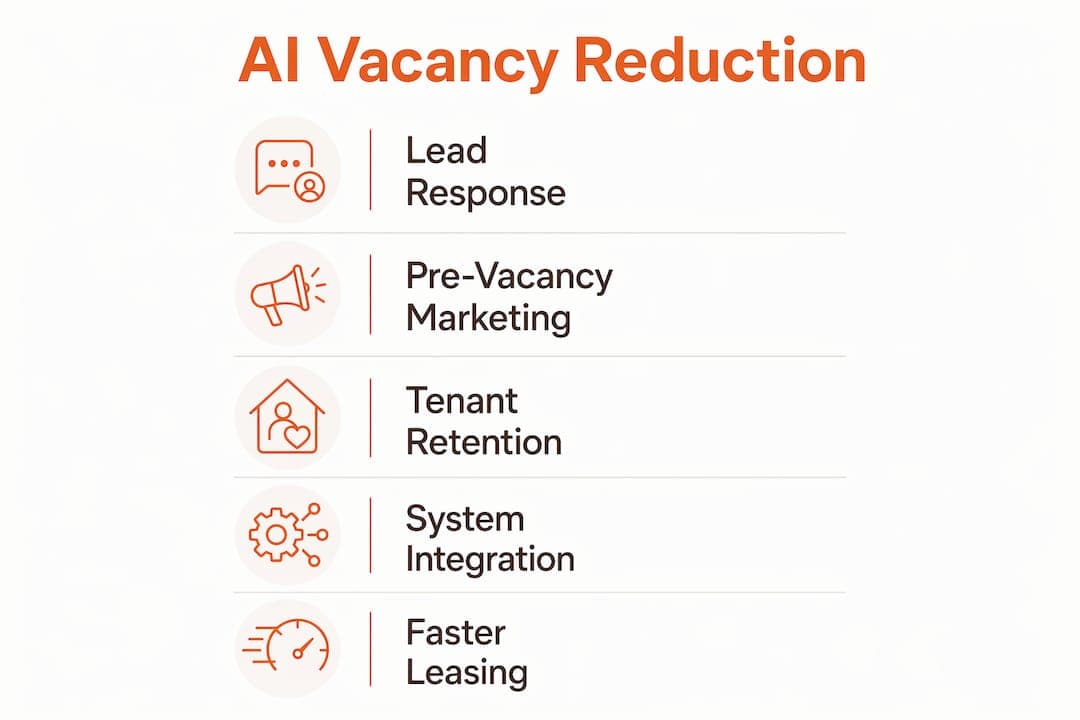
AI reduces vacancy periods most effectively when it combines fast lead response, pre-vacancy marketing, tenant retention tools, and full integration with your property management system.
| Point | Details |
|---|---|
| Speed drives conversion | AI response under 10 minutes keeps prospect intent high and increases tour bookings. |
| Pre-vacancy marketing cuts downtime | AI 3D visualizations let you list and market units before they are empty. |
| Retention reduces total vacancy cost | AI-powered portals and predictive maintenance lower turnover and improve renewal rates. |
| Integration maturity determines ROI | Standalone AI tools underperform. Connect AI to your PMS for full occupancy gains. |
| Self-selection improves lease quality | AI visualization filters unqualified applicants before the first showing. |
What the data gets right, and what most operators still miss
The Arosplatforms team works directly inside real estate operations, and the pattern we see most often is this: property managers adopt one or two AI tools, see modest results, and conclude that AI is overhyped. The real problem is almost never the technology. It is the gap between the tool and the workflow.
The 43% lift in applications from AI leasing assistants is real, but it assumes the assistant is connected to live availability data, can book tours without human approval, and follows up automatically when a prospect goes quiet. Most deployments we audit have at least one of those connections missing. That missing link is where the conversion gain disappears.
The retention side is even more underinvested. Property managers spend heavily on acquiring new tenants and almost nothing on the AI tools that would keep existing ones. A tenant who renews costs a fraction of what a new lease costs to acquire. The math is straightforward, but the operational priority rarely reflects it.
The future of vacancy management is not a better chatbot. It is a property-level AI operating system that connects leasing, maintenance, resident experience, and financial reporting into one layer. The operators building that architecture now will hold a structural occupancy advantage that is very difficult for competitors to close.
— Arosplatforms team
Arosplatforms AI solutions for property vacancy challenges
Real estate portfolios that treat AI as a single-point tool leave most of the occupancy gain on the table. Arosplatforms builds custom AI solutions for real estate that connect leasing automation, resident communication, and predictive maintenance into one operating layer. The approach is built around your existing systems, not around replacing them.

Arosplatforms embeds directly within client operations to map workflows, identify the highest-impact automation points, and deploy AI that your team owns and controls. Clients see an average of 82% faster turnaround on key operational tasks, with many reaching positive ROI within twelve months. For property managers ready to move beyond isolated tools, AI consulting for enterprises is the starting point for building an occupancy advantage that compounds over time.
FAQ
What is the role of AI in vacancy reduction?
AI reduces vacancy periods by automating lead response, enabling pre-vacancy marketing with 3D visualizations, and improving tenant retention through predictive maintenance and resident portals. The combined effect shortens the time between a unit becoming available and a new lease being signed.
How much does AI improve leasing conversion rates?
Renters who engage with AI leasing assistants are 43% more likely to apply, and lease signings increase by 24% compared to properties without AI-assisted engagement.
What is integration maturity in AI for property management?
Integration maturity means your AI tools share live data with your property management system, enabling automatic tour scheduling, real-time availability updates, and instant lead follow-up without manual handoffs between platforms.
How does AI help with tenant retention?
AI-powered resident portals, automated renewal outreach, and predictive maintenance reduce the friction that drives tenants to leave. Properties using these tools track higher Net Promoter Scores and stronger renewal rates.
Can AI market a unit before it becomes vacant?
AI-generated 3D floor plans and virtual staging allow property managers to list and market a unit while the current tenant is still in place, giving leasing teams a head start that can eliminate most or all of the gap between leases.