Scalable AI Systems Without Vendor Lock-In: 2026 Guide
Scalable AI Systems Without Vendor Lock-In: 2026 Guide

Vendor lock-in is defined as the state where switching AI providers requires months of code rewrites, data migrations, and contract negotiations. A proper guide to scalable AI systems without vendor lock-in starts with one principle: your application logic must never talk directly to a single AI provider’s API. Organizations that build model-agnostic architectures using abstraction layers and open standards like the Model Context Protocol (MCP) retain full control over their data, prompts, and workflows. Arosplatforms clients across healthcare, logistics, and real estate consistently achieve this by treating portability as a design requirement from day one, not an afterthought.
What architectural principles enable scalable AI systems without vendor lock-in?
A model router is the single most important component in any vendor-agnostic AI architecture. It sits between your application and every AI provider, translating requests into a unified interface. Switching AI models can be reduced from months to days when this abstraction layer exists. Without it, every provider change triggers a code rewrite.
The following principles form the foundation of a portable AI architecture:
- Model-agnostic interfaces. Use OpenAI-compatible APIs or MCP as your standard contract. Any model that speaks this protocol becomes a drop-in replacement.
- Data and prompt ownership. Store all prompts, logs, audit trails, and vector embeddings in infrastructure you control. Never let a vendor hold your training data or fine-tuned outputs.
- Portable formats. Use open formats for prompt templates, evaluation datasets, and vector indexes. Proprietary formats create invisible lock-in.
- Separation of orchestration from execution. Your orchestration layer (the logic that decides which model to call and when) must be independent of any model provider. Tools like LangGraph implement this pattern well.
- Cost and latency-based routing. A model router lets you send simple classification tasks to a cheaper model and complex reasoning tasks to a more capable one. You get freedom to switch providers and integrate new models without rebuilding your stack.
Pro Tip: Design your abstraction layer to accept a model identifier as a configuration variable, not a hardcoded string. Switching providers then becomes a one-line config change, not a deployment event.
Maintaining open standards like MCP and owning your prompts, logs, and audits prioritizes portability over purity. The goal is not to build everything from scratch. The goal is to ensure that nothing you build is trapped inside a vendor’s ecosystem.

How to implement scalable AI systems with phased tooling
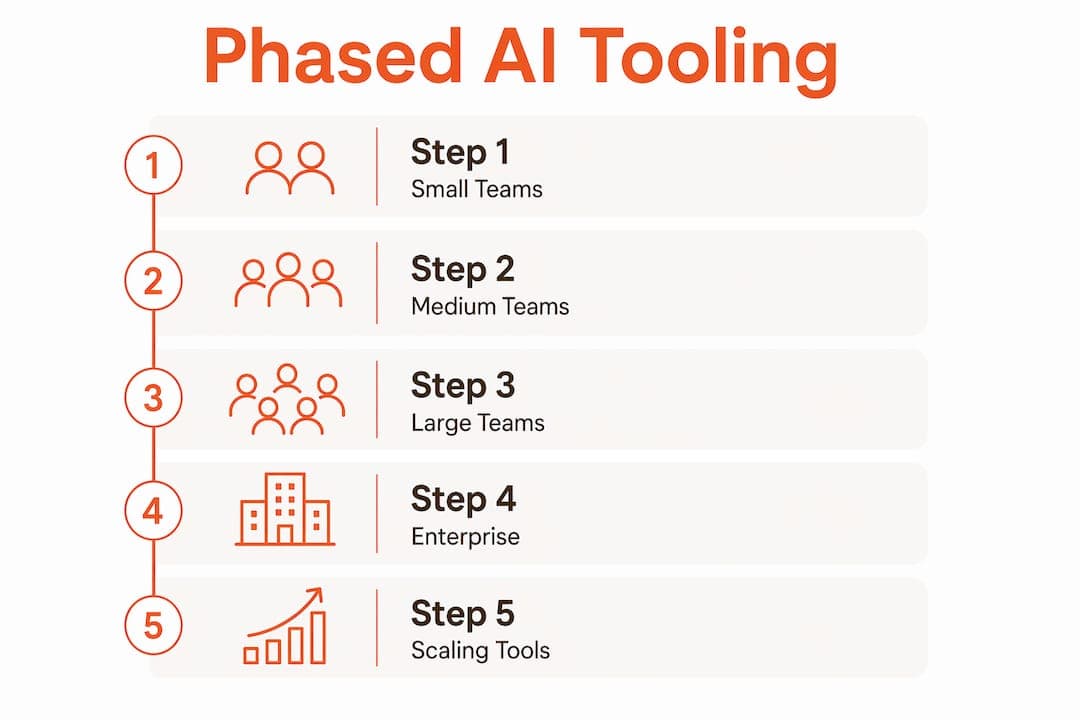
Over-architecting on day one is the fastest way to stall an AI program. Most production stacks start hybrid: commercial LLM APIs for model access, open-source orchestration for control logic. This combination gives you speed without sacrificing future flexibility.
A phased approach works as follows:
- Start with orchestration plus a commercial API. Wire LangGraph or an equivalent orchestration framework to a commercial LLM API through an abstraction layer. Do not call the provider directly from your application code.
- Add retrieval-augmented generation (RAG) for domain knowledge. RAG lets you inject proprietary data into model responses without fine-tuning. Your data stays in your vector database, not inside a vendor’s model.
- Integrate observability. Add tracing and logging before you go to production. You need visibility into latency, token costs, and failure modes across every model you use.
- Layer in safety controls. Input and output guardrails belong in your orchestration layer, not inside the model. This keeps safety logic portable across providers.
- Harden your infrastructure. Choose container-based deployment that matches your team’s actual size.
The infrastructure decision at step five deserves specific attention. The table below maps team size to the right level of infrastructure complexity.
| Team size | Recommended tooling | Why it fits |
|---|---|---|
| Under 50 employees | Docker Compose with a single vector DB | Low ops overhead, fast iteration |
| 50–500 employees | Docker Compose plus Portainer | Adds visibility without platform team cost |
| 500+ employees | Kubernetes with dedicated MLOps | Justified by scale and compliance needs |
For teams of 50–500 employees, Docker Compose and Portainer often suffice over complex Kubernetes deployments. Kubernetes adds real value at scale, but it demands a dedicated platform team. Mid-size organizations that deploy it prematurely spend more time managing infrastructure than building AI features.
Pro Tip: Pin your vector database schema and embedding model version in version control from the start. Changing embedding models later forces a full re-index of your knowledge base, which is expensive and time-consuming.
What operational best practices support flexibility and cost control?
Building production AI workflows tightly around a single vendor exposes organizations to price increases, rate limit changes, and model deprecations. Operational discipline is what keeps a vendor-agnostic architecture actually vendor-agnostic over time. Architecture decisions get you 60% of the way there. Operations get you the rest.
The following practices keep your AI stack portable and cost-controlled in production:
- Shadow test alternative models continuously. Shadow testing with 1–5% of live traffic verifies that a replacement model performs equivalently before you commit to a full switch. This removes the risk from migration decisions.
- Apply semantic caching. Semantic caching of AI responses using vector similarity can reduce costs by 30–60% in RAG and FAQ applications. Reusing cached outputs for semantically similar queries cuts API spend without degrading quality.
- Automate output evaluation. Build an automated eval suite that runs against every model you consider. Subjective comparisons are slow and inconsistent. Automated evals give you a repeatable, auditable quality signal.
- Use your vendor-agnostic stance as negotiation leverage. Vendors know that switching costs are their primary retention tool. When you can demonstrate that your architecture supports a migration in days, not months, contract negotiations shift in your favor.
- Monitor data retention and governance terms. Review every vendor’s data retention policy before sending production data. AI governance requirements differ by industry and region. Healthcare and financial services organizations face the strictest obligations.
“Owning your AI stack means owning innovation access, data governance, and the power to switch without delay or disruption. The organizations that treat portability as a first-class requirement are the ones that maintain competitive advantage as the model landscape shifts.”
Plan your exit strategy from day one. Document which data assets live where, which vendor-specific features you use, and what a migration would require. Teams that do this work upfront spend hours on migrations. Teams that skip it spend months.
What are common pitfalls when building vendor-agnostic AI systems?
Direct vendor API coupling leads to high migration costs and technical debt through proprietary data formats and fine-tuning dependencies. The cost of lock-in is not just migration labor. It is the accumulated technical debt from every shortcut taken when the abstraction layer was skipped.
Watch for these specific mistakes:
- Calling vendor APIs directly from application code. This is the single most common source of lock-in. Every direct call is a dependency that must be unwound during migration.
- Ignoring data ownership at the start. Fine-tuning a model on a vendor’s platform without exporting your training data creates a dependency that is nearly impossible to break cleanly.
- Deploying Kubernetes for a 30-person team. The operational burden of managing Kubernetes without a dedicated platform team slows development and creates fragility. Simpler orchestration tools are the right call at that scale.
- Skipping model interchange format verification. Not all models that claim OpenAI API compatibility implement it fully. Test your abstraction layer against every candidate model before committing to it.
- Confusing portability with purity. You do not need to avoid all commercial tools. You need to ensure that no single commercial tool becomes a structural dependency.
Pro Tip: Run a quarterly “portability audit.” Pick one component of your AI stack and ask: if this vendor disappeared tomorrow, how long would migration take? If the answer is more than two weeks, you have a lock-in risk worth addressing.
Model-agnostic AI platforms enable use of open-source and commercial models interchangeably, which future-proofs implementations. The teams that build this way spend less time reacting to vendor changes and more time shipping features.
Key Takeaways
Scalable AI systems without vendor lock-in require an abstraction layer, open data standards, phased infrastructure growth, and continuous operational discipline to stay portable as the model market evolves.
| Point | Details |
|---|---|
| Use an abstraction layer | A model router reduces provider switching from months to days with no code rewrites. |
| Own your data and prompts | Store all prompts, logs, and vectors in infrastructure you control, not inside a vendor’s platform. |
| Phase your infrastructure | Match tooling complexity to team size; Docker Compose often beats Kubernetes for mid-size teams. |
| Shadow test before migrating | Route 1–5% of live traffic to alternative models to verify performance before full switches. |
| Apply semantic caching | Caching semantically similar responses can cut API costs by 30–60% in RAG applications. |
What we have learned building model-agnostic AI systems
The most common mistake we see is treating vendor-agnostic architecture as a future concern. Teams ship fast using a single provider’s SDK, accumulate six months of direct API calls, and then face a migration that touches every layer of their codebase. The abstraction layer is not extra work. It is the work that makes all future work cheaper.
The second lesson is that portability and pragmatism are not opposites. We have seen teams refuse to use any commercial model because of lock-in concerns, then spend a year building infrastructure that a commercial API would have provided in a week. The right frame is: use commercial tools freely, but always through an interface you control.
The third lesson is about negotiation. When a vendor knows you can migrate in days, the conversation about pricing and terms changes immediately. Vendor-agnostic architecture is not just a technical choice. It is a business position. The enterprise AI platform teams that internalize this early consistently get better contract terms and faster support escalations than those who are visibly dependent on a single provider.
Phased implementation is the only approach that works in practice. Organizations that try to build the complete vendor-agnostic stack before shipping anything end up with neither a product nor a portable architecture. Start with orchestration, add RAG, add observability, and let the architecture grow with your actual requirements.
— Arosplatforms team
How Arosplatforms approaches vendor-agnostic AI implementation
Arosplatforms builds customized AI operating systems for organizations that need to own their stack without rebuilding it from scratch. Every engagement starts with an architecture review that identifies existing lock-in risks and maps a phased path to a model-agnostic design.

For enterprises in the US, UK, EU, and across APAC and the Middle East, Arosplatforms provides AI consulting by region that accounts for local compliance requirements, data residency rules, and industry-specific constraints. Whether your team is in healthcare, logistics, or manufacturing, the underlying architecture principles are the same. The implementation details are not. Arosplatforms specializes in both. Explore custom AI development options tailored to your industry and scale.
FAQ
What is scalable AI without vendor lock-in?
Scalable AI without vendor lock-in is an architecture where your application communicates with AI models through an abstraction layer rather than directly through a single vendor’s API. This design lets you switch providers, add new models, or scale usage without rewriting application code.
How does an abstraction layer prevent vendor lock-in?
An abstraction layer translates your application’s requests into a standard interface, so switching providers requires only a configuration change. Switching AI models can be reduced from months to days when this layer is in place.
What is semantic caching and why does it reduce AI costs?
Semantic caching stores AI responses and retrieves them for queries that are semantically similar to previous ones. This approach can reduce API costs by 30–60% in RAG and FAQ applications by reusing outputs instead of generating new ones.
When should a team use Kubernetes for AI infrastructure?
Kubernetes is justified for teams of 500 or more employees with a dedicated platform team. Smaller organizations typically get better results from Docker Compose and Portainer, which deliver container orchestration without the operational overhead.
How do I verify that my AI architecture is truly portable?
Run a quarterly portability audit by selecting one stack component and estimating how long migration would take if that vendor became unavailable. Shadow testing alternative models with 1–5% of live traffic is the most reliable way to confirm that switching is actually feasible.