Dataverse or Data Cloud? Salesforce vs Dynamics 365 for Enterprises
Dataverse or Data Cloud? Salesforce vs Dynamics 365 for Enterprises
If your organization runs on Microsoft 365 and Azure and wants AI grounded in the same data estate as your ERP, Dynamics 365 usually fits best. If you need the deepest CRM marketplace and the most flexible ecosystem, Salesforce typically wins. The real decision now hinges less on feature checklists than on where your customer data lives and how Copilot or Agentforce gets fed, with total cost of ownership shifting hard once you factor in bundle economics.
TL;DR:
- Organizations already invested in Microsoft 365 or Azure will typically find Dynamics 365 less costly due to existing licensing agreements.
- Salesforce’s extensive marketplace and partner ecosystem remain advantageous for companies with complex, heterogeneous tech stacks.
- Effective AI grounding depends on where customer data resides, making data architecture a critical factor in platform selection over feature comparisons.
- Total cost of ownership is heavily influenced by negotiation, implementation, and integration costs, which vary significantly between platforms.
- A vendor-neutral data readiness assessment helps organizations identify the most cost-effective and scalable solution before making a final decision.
Table of Contents
- Salesforce vs Dynamics 365: How Each Platform Is Built
- Salesforce vs Microsoft CRM: Where Features Actually Diverge
- Salesforce vs Dynamics Pricing: What Actually Drives Total Cost
- How Ecosystem Fit Changes Integration Cost
- What Implementation Actually Looks Like
- How to Choose Between Salesforce and Dynamics 365
- Why AI Grounding Decides More Than Feature Lists
- Salesforce vs Dynamics 365 at a Glance
- What We’d Tell a Client Choosing Today
- Get a Vendor-Neutral Read Before You Commit
- Sources
- FAQ
Salesforce vs Dynamics 365: How Each Platform Is Built
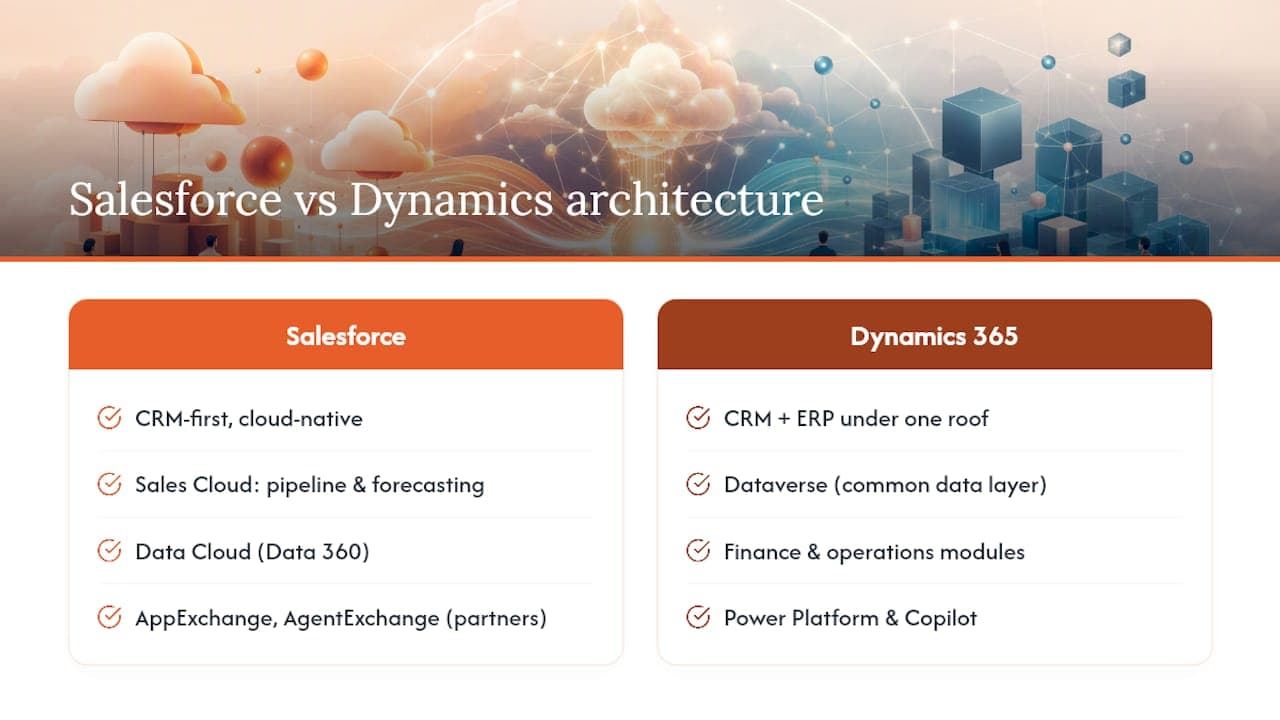
Salesforce built its business as a cloud-native CRM from day one. Sales Cloud handles pipeline and forecasting, Salesforce Data Cloud (branded Data 360) unifies customer records across systems, and the AppExchange plus the newer AgentExchange give buyers access to thousands of prebuilt apps and AI agents from outside vendors.
Microsoft took a different path. Dynamics 365 Sales sits inside a broader suite that includes finance and operations modules, all built on Dataverse, the common data layer that also powers Power Platform apps, Power Automate flows, and Copilot. Dynamics 365 Customer Insights, split into Journeys and Data components, functions as Microsoft’s customer data platform and marketing engine.
This is the core split TechTarget describes well: Dynamics 365 behaves like CRM plus ERP under one roof, while Salesforce stays CRM first and leans on partners for adjacent functions. Salesforce still holds the largest share of the global CRM applications market, according to Statista, and both platforms show up regularly in Gartner’s enterprise CRM evaluations.
Salesforce vs Microsoft CRM: Where Features Actually Diverge
Run a checklist comparison and the two platforms look nearly identical. Both handle lead scoring, opportunity management, quote generation, case routing, and email campaigns without much daylight between them. The differences show up in packaging, extensibility, and where AI gets its data.
Where the platforms genuinely differ:
- AI packaging. Copilot in Dynamics 365 draws directly on Dataverse records and Microsoft 365 context (email threads, Teams chats, calendar data), which makes it strong at drafting follow-ups and summarizing account history inside tools sellers already use. Einstein and Agentforce on Salesforce pull from Data Cloud and can act autonomously across workflows, but the deeper agent capabilities often carry separate licensing tiers.
- Extensibility model. Microsoft’s Power Platform lets business users build apps and automations with low-code tools, with .NET and Azure Functions available for pro-code work. Salesforce’s Apex and Lightning Platform lean more toward professional developers, though Flow Builder covers a lot of low-code ground too.
- Analytics and CDP architecture. Customer Insights connects to Microsoft Fabric and OneLake, giving Microsoft-anchored teams a single lake for CRM, ERP, and BI data. Data Cloud pairs with Tableau for visualization and positions itself as a universal ingestion layer regardless of source system.
- Vertical products. Microsoft ships dedicated Dynamics 365 modules for field service, finance, and supply chain that share the same data model as sales. Salesforce covers verticals largely through Industries Clouds and AppExchange partners, which adds flexibility but also more integration points.
- Mobile and offline. Both offer native mobile apps with offline caching for field reps, though Dynamics 365’s offline sync tends to feel tighter for organizations already running Power Apps in the field.
Crm frames Salesforce’s marketplace depth and developer talent pool as its most durable edge when ecosystem breadth is the deciding factor. That edge matters most to companies planning to bolt on dozens of specialized apps over time rather than consolidate around one vendor’s stack.
Salesforce vs Dynamics Pricing: What Actually Drives Total Cost
List prices tell you almost nothing useful. Microsoft publishes Dynamics 365 module pricing openly, and Salesforce publishes tiered Sales Cloud pricing too, but neither number reflects what large organizations actually pay after negotiation.
Here is what actually moves the total bill:
- Enterprise agreement effects. Organizations already running a Microsoft Enterprise Agreement or a Microsoft Azure Consumption Commitment often see Dynamics 365 licensing costs absorbed into existing spend commitments, which can make the effective price meaningfully lower than the sticker price.
- Salesforce’s negotiation patterns. Salesforce deals typically involve per-seat discounting tied to contract length and add-on consumption (Data Cloud credits, Agentforce conversations), so the final number depends heavily on how well procurement negotiates multi-year terms.
- Implementation and middleware costs. Integration tooling, ISV app subscriptions, and admin staffing frequently outweigh the software license itself over a three-year horizon, regardless of which platform you pick.
- Discount benchmarking. Third-party pricing benchmarks show that negotiated enterprise pricing narrows the gap between vendors considerably compared to list price, which means comparing sticker prices alone can lead procurement teams to the wrong conclusion.
- When each vendor tends to be cheaper. Microsoft-anchored organizations that can fold Dynamics 365 into an existing EA commitment usually land at a lower effective cost. Organizations without that Microsoft leverage, or ones needing extensive ISV functionality, often find Salesforce’s negotiated pricing competitive once volume discounts kick in.
Ask for a three-year TCO model from both vendors before comparing anything else. A one-year quote hides the bundle effects that decide the real winner.
How Ecosystem Fit Changes Integration Cost
The ecosystem you already run shapes integration cost more than any feature on a spec sheet. Organizations standardized on Microsoft 365 gain real advantages with Dynamics 365: native Entra ID for identity management, direct Teams and Outlook embedding, and Power Platform automations that read and write Dataverse without middleware.
Salesforce’s advantage runs the opposite direction. The AppExchange and MuleSoft combination gives buyers access to a wider bench of prebuilt connectors and specialized apps, which matters more for companies with a sprawling, heterogeneous tech stack rather than a Microsoft-centric one.
Practical integration patterns worth knowing:
- Data gravity favors whichever platform holds your primary customer record; grounding AI models against a system that constantly needs syncing from elsewhere adds latency and cost.
- Many enterprises run a coexistence model: one platform as the primary CRM of record, the other as a satellite for a specific business unit or acquired company.
- Every integration point between two systems is a maintenance obligation, not a one-time setup cost. Each connector needs monitoring, versioning, and a break-fix budget.
- Teams that skip this analysis often end up paying an ongoing “integration tax” that dwarfs the original licensing decision within two years.
What Implementation Actually Looks Like
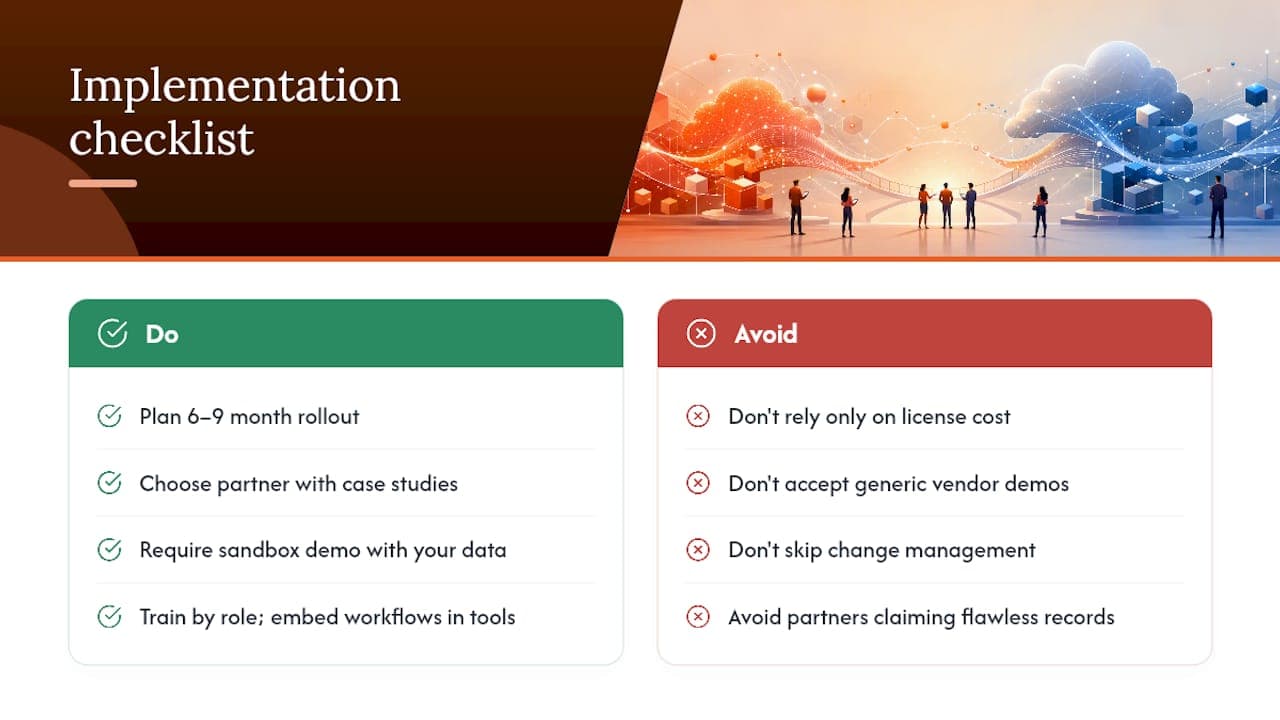
Plan for six to nine months on a mid-sized rollout, and closer to a year or more for organizations replacing an entrenched legacy CRM with heavy customization. Data migration, third-party integrations, systems integrator fees, and role-based training are where budgets actually get spent, not the software license.
Choosing an implementation partner matters as much as choosing the platform. Look for a partner with named case studies in your industry, not just a generic list of certifications, and ask them to walk through a past project’s timeline versus its original estimate. A partner who admits where a past project ran long is more trustworthy than one who claims a flawless record.
Pro Tip: Insist on a working sandbox demo using your own sample data before signing anything. A vendor demo built on clean, generic data hides the exact friction points that will slow your rollout.
Adoption tactics that consistently work: build workflows into the tools people already use daily rather than a separate portal, train by role instead of running one generic session for everyone, and get a visible executive sponsor who uses the system publicly. Pipedrive’s comparison notes that both platforms demand real implementation investment. Skipping change management is the single most common reason ROI arrives late.
How to Choose Between Salesforce and Dynamics 365
Run through this checklist before you sign anything:
- Stack alignment. Are you already committed to Microsoft 365, Azure, and an EA, or do you run a mixed or Google-centric stack?
- AI grounding. Where does your customer data actually live today, and which platform requires the least data movement to feed AI models?
- TCO horizon. Have you modeled three-year costs including implementation, middleware, and admin staffing, not just license fees?
- Partner maturity. Does your shortlisted implementation partner have verifiable case studies in your specific industry?
- Vertical fit. Does either vendor ship a purpose-built module for your industry, or will you assemble one from marketplace apps?
Ask vendors and integrators directly: What does AI functionality cost beyond the base license? What’s the sandbox and testing strategy before go-live? Can you show a sample TCO model from a comparable client? How is the data model structured for our specific use case?
Red flags to watch for: a proposal that skips implementation costs entirely, a vendor unwilling to share a real reference client, or a TCO estimate with no line item for ongoing integration maintenance.
Why AI Grounding Decides More Than Feature Lists
The feature-parity debate misses the point. Where your AI models get grounded, meaning which system holds the canonical customer record they draw from, determines both your architecture and your long-term cost more than any sales automation feature ever will. Dataverse paired with Fabric and OneLake gives Microsoft-anchored enterprises a single analytics plane with less cross-system integration tax. Data Cloud offers a similar promise, but its value depends on how much of your data already sits outside Salesforce.
The durable question isn’t “which platform has more features.” It’s “where should customer data and AI grounding live, and how much integration tax will we pay to keep it there.” Vendor-neutral, engineering-first assessments exist precisely because that answer changes by organization, not by vendor marketing.
A short readiness assessment, run before any platform commitment, typically surfaces which data sources need consolidation and which AI use cases justify the migration effort. That framing shows up in how we approach CRM next-best-action decisions with clients: scope the data architecture question before scoping the software contract.
Salesforce vs Dynamics 365 at a Glance
| Dimension | Salesforce | Microsoft Dynamics 365 |
|---|---|---|
| Best for | Organizations wanting the deepest CRM marketplace and broadest ISV options | Organizations standardized on Microsoft 365/Azure wanting native integration |
| Pricing shape | Per-seat tiers with negotiated multi-year discounts | Per-seat module pricing, often folded into EA/MACC commitments |
| Integration/ecosystem | AppExchange, AgentExchange, MuleSoft connectors | Native Entra ID, Teams, Outlook, Power Platform, Dataverse |
| AI packaging | Einstein and Agentforce grounded in Data Cloud | Copilot grounded in Dataverse and Microsoft 365 context |
| Extensibility | Apex, Lightning Platform, Flow Builder | Power Platform low-code, .NET and Azure Functions pro-code |
| Deployment/governance | Salesforce-managed cloud, org-level sandboxes | Azure-hosted, integrates with existing Entra ID governance |
| TCO considerations | Discounting tied to contract length and add-on consumption | EA bundle effects can lower effective cost for Microsoft shops |
What We’d Tell a Client Choosing Today
We’d tell a client to stop comparing feature lists and start mapping data flow. If your customer data already lives in Microsoft’s ecosystem, Dynamics 365 will almost always cost less to ground AI against. If it’s scattered across a dozen specialized tools, Salesforce’s marketplace absorbs that mess more gracefully. When the answer isn’t obvious, a short readiness assessment beats another six months of vendor demos.
Get a Vendor-Neutral Read Before You Commit
Choosing between Salesforce and Dynamics 365 isn’t really a software decision. It’s a data architecture decision wearing a software decision’s clothes, and getting it wrong means paying an integration tax for years. Arosplatforms runs vendor-neutral AI readiness assessments that map exactly where your customer data should live and what a proof of concept would actually cost before you sign a multi-year CRM contract. We scope custom AI development and PoC work around your existing stack, not a vendor’s roadmap, so you keep ownership of whatever gets built and avoid getting locked into one ecosystem’s AI pricing. If you’re staring down a Salesforce versus Dynamics 365 decision right now, start with a readiness assessment scoped to your actual data estate before the next vendor demo.
Sources
- Microsoft Dynamics 365
- Statista — CRM applications market share
- Gartner research (CRM / Sales Force Automation)
- Microsoft Dynamics 365 vs Salesforce: How do they differ (TechTarget)
FAQ
Is Microsoft Dynamics 365 Being Discontinued?
No. Microsoft continues active development on Dynamics 365, with regular feature releases across Sales, Customer Insights, and Dataverse documented on its official product pages. Microsoft has invested heavily in tying it to Copilot and the Power Platform, which signals long-term commitment rather than a wind-down.
Why Is Salesforce Stock Falling?
Stock price swings reflect broader market and investor sentiment factors, including growth expectations and competitive pressure in the CRM market, not a decline in product adoption. Salesforce still holds the largest share of the global CRM applications market according to Statista.
Who Is Salesforce’s Largest CRM Competitor?
Microsoft Dynamics 365 is widely considered Salesforce’s largest direct competitor in the enterprise CRM space, particularly among organizations already invested in the Microsoft ecosystem. HubSpot competes heavily in the small and mid-market segment, but at the enterprise level the comparison consistently comes back to Salesforce vs Dynamics 365.
What Is the Number One CRM Platform?
By market share, Salesforce ranks as the leading CRM platform globally, according to Statista’s vendor tracking. “Best” still depends on your existing tech stack. Microsoft-anchored organizations often get better real-world results from Dynamics 365 despite Salesforce’s larger overall footprint.
How Do I Know Which Platform Fits My Organization?
Start by mapping where your customer data already lives and how much of your stack runs on Microsoft 365 or Azure versus a mixed environment. A structured readiness assessment that examines your data architecture before the licensing conversation typically gives a clearer answer than a feature-by-feature checklist.