Field Service AI Operating System: What It Means
Field Service AI Operating System: What It Means

A field service AI operating system is defined as a software platform that uses artificial intelligence to automate and coordinate key field service workflows, including scheduling, dispatch, routing, and customer communication, through a unified operational intelligence layer. Unlike traditional field service management software, this system learns continuously from operational data and makes decisions that improve over time. Understanding what does field service AI operating system mean is the first step toward knowing whether your business is ready to move beyond manual coordination. Arosplatforms builds these systems as customized solutions for specific industries, with clients reporting an average of 82% faster turnaround for key tasks.
What does a field service AI operating system mean?
A field service AI operating system is the operational hub that connects your CRM, dispatch tools, billing systems, and communication channels into one AI-driven platform. Traditional field service management software assigns jobs based on static availability. An AI operating system assigns jobs by weighing technician skill, real-time location, SLA priority, and parts availability simultaneously, then learns from each decision to get better over the next one.
The term “AI operating system” is the recognized industry phrase for this architecture. You may also hear it called an AI-powered FSM platform or an intelligent field service platform. All three phrases describe the same core idea: a system where AI agents handle routine decisions and escalate exceptions to humans, rather than simply displaying data for humans to act on manually.

The field service AI definition matters because it sets expectations. This is not a scheduling tool with a chatbot added on top. It is a coordinated system where every module, from dispatch to invoicing, shares the same data context and responds to the same AI logic.
How does a field service AI operating system work?
The technology inside a field service AI OS combines several AI disciplines working together. Machine learning, predictive analytics, and natural language processing each handle different parts of the workflow. Machine learning optimizes dispatch decisions. Predictive analytics forecasts equipment failures before they happen. Natural language processing powers automated customer communication agents that send updates, handle rescheduling requests, and draft job closeout summaries.
Supervised AI agents are the operational layer that makes this practical. These agents:
- Triage incoming service requests by urgency, job type, and customer history
- Assign and dispatch technicians based on skill match, proximity, and workload balance
- Send automated customer updates at each job stage without human intervention
- Draft billing summaries and close-out reports for human review before sending
- Flag exceptions that require a manager decision, such as a job that exceeds estimated time
The shared context intelligence layer is what separates an AI OS from a collection of disconnected tools. Unified operational intelligence means scheduling data, inventory levels, customer records, and technician status all feed into the same decision engine. When a part is out of stock, the dispatch agent knows before assigning the job. When a technician is running late, the customer communication agent updates the client automatically.
Pro Tip: Before evaluating any AI OS platform, map your current data sources. If your scheduling tool, inventory system, and CRM do not share data today, your first project should be connecting them. An AI OS built on fragmented data produces fragmented decisions.
What are the measurable benefits of using an AI OS in field service?
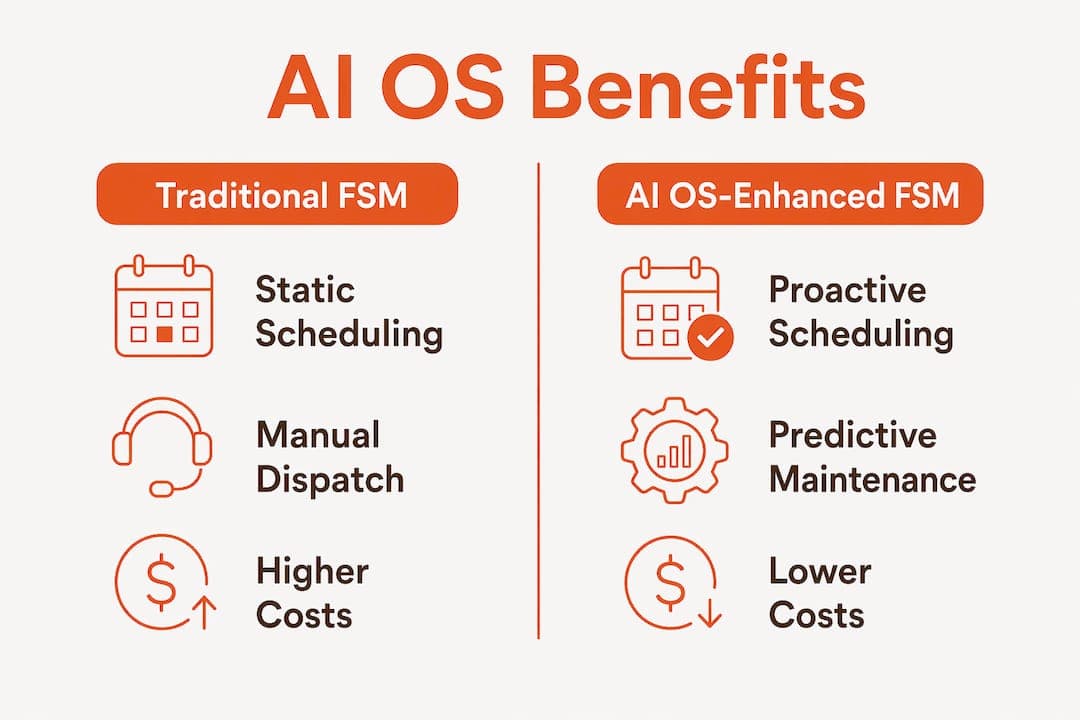
The performance gains from field service AI are well documented as of Q2 2026. Organizations using AI-powered field service management report 30–40% improvements in operational efficiency, 25–50% increases in first-time fix rates, and 15–35% growth in technician productivity. These are not marginal gains. A 25% improvement in first-time fix rates means fewer return visits, lower fuel costs, and measurably higher customer satisfaction scores.
“Proactive scheduling and predictive models help avoid breakdowns and reduce emergency repairs, directly improving both customer satisfaction and operational profitability.” — Field service AI research, 2026
The contrast with traditional FSM software is significant when you look at specific metrics:
| Metric | Traditional FSM | AI OS-Enhanced FSM |
|---|---|---|
| Scheduling method | Static availability-based | Skill, location, SLA, and parts-aware |
| First-time fix rate | Baseline | 25–50% higher |
| Operational efficiency | Baseline | 30–40% higher |
| Technician productivity | Baseline | 15–35% higher |
| Maintenance approach | Reactive | Proactive and predictive |
| Customer communication | Manual updates | Automated at each job stage |
Proactive scheduling and predictive maintenance also reduce emergency repair costs. When the system detects that a piece of equipment is trending toward failure, it creates a work order before the customer calls. That shift from reactive to proactive service changes the economics of field operations entirely.
The benefits of field service AI extend to profitability as well. Fewer repeat visits mean lower labor costs per job. Automated communication reduces the volume of inbound status calls. Faster job closeout through AI-drafted billing summaries shortens the cash collection cycle.
What deployment strategies work best for adopting a field service AI OS?
The most common mistake businesses make when adopting a field service AI OS is trying to replace everything at once. Big-bang migrations create adoption fatigue, surface integration problems at scale, and delay the moment when the system starts delivering value. A phased, workflow-focused approach produces faster results and builds team confidence.
The Express Pod MVP model is the most effective starting point. Here is how it works in practice:
- Identify one high-volume, high-friction workflow. Dispatch triage and job assignment are the most common starting points because they are repetitive and data-rich.
- Build a focused AI agent for that workflow only. The agent handles the routine decisions. Humans review exceptions.
- Ship within 4–6 weeks. Express Pod MVPs deliver a working automation in this window, giving your team a concrete result to evaluate.
- Measure the impact. Track first-time fix rates, dispatch time, and technician utilization before and after.
- Add the next workflow pod. Once the first pod is stable and measured, layer in the next one, such as automated customer communication or predictive maintenance alerts.
This incremental approach mirrors how Arosplatforms structures its AI OS engagements. Rather than selling a platform and walking away, Arosplatforms embeds within client operations to build each pod in sequence, ensuring the system fits the actual workflow rather than forcing the workflow to fit the system.
Pro Tip: Assign one internal champion for each workflow pod. This person owns the policy settings, reviews AI exceptions, and communicates results to the broader team. Without a named owner, adoption stalls even when the technology works.
How can businesses apply a field service AI OS to specific workflows?
The practical applications of an AI operating system for field service cover every stage of the job lifecycle. The most impactful use cases are:
- Dispatch optimization. AI-powered dispatch assigns jobs by matching technician expertise, current location, travel time, and job complexity simultaneously. This replaces the dispatcher’s manual judgment with a decision that considers more variables more consistently.
- Automated customer communication. AI agents send appointment confirmations, technician-on-the-way alerts, and post-job satisfaction surveys without any human input. This reduces inbound call volume and improves the customer experience at the same time.
- Predictive maintenance triggers. The system monitors equipment sensor data and usage patterns, then creates proactive work orders when failure probability crosses a threshold. This is the same approach Arosplatforms applies in manufacturing AI OS deployments, where predictive maintenance directly reduces unplanned downtime.
- Real-time technician guidance. AI-powered mobile assistants give technicians access to job history, equipment manuals, and parts availability in the field. The technician arrives with context, not just an address.
- Field data integration for continuous learning. Every completed job feeds data back into the system. Job duration, parts used, resolution method, and customer feedback all improve the AI’s next dispatch and scheduling decision. The system gets more accurate the longer it runs.
AI agents handling these workflows do not replace technicians or managers. They handle the repetitive coordination tasks so that skilled people can focus on the work that actually requires human judgment.
Key takeaways
A field service AI operating system delivers measurable efficiency gains by replacing static, manual coordination with AI-driven decision-making across dispatch, maintenance, and customer communication.
| Point | Details |
|---|---|
| Core definition | An AI OS integrates scheduling, dispatch, billing, and communication into one shared intelligence layer. |
| Performance gains | AI-powered FSM delivers 30–40% efficiency gains and up to 50% higher first-time fix rates. |
| Start with one workflow | Express Pod MVPs ship in 4–6 weeks and build adoption before scaling to additional workflows. |
| Shared data is the foundation | Disconnected systems produce disconnected decisions; unified data is what makes AI decisions reliable. |
| Proactive beats reactive | Predictive maintenance and proactive scheduling reduce emergency costs and improve customer satisfaction. |
The Arosplatforms view on where field service AI is heading
The businesses that will get the most from field service AI are not the ones that buy the biggest platform. They are the ones that start with the clearest problem. Every engagement we run at Arosplatforms begins with the same question: which single workflow, if automated today, would have the most immediate impact on your operations? The answer is almost always dispatch or triage, because those are the decisions made dozens of times a day with the most room for error.
What surprises most teams is how quickly the shared context layer becomes the real asset. After six months of running an AI OS, the accumulated operational data, what jobs took longer than estimated, which technicians resolve certain fault types faster, which customers reschedule most often, becomes more valuable than the AI models themselves. The models improve because the data improves.
The next wave of field service AI will push further into prescriptive decision-making. The system will not just recommend the best technician for a job. It will recommend renegotiating an SLA, restructuring a service territory, or retiring a product line based on field data patterns. That is a fundamentally different kind of operational intelligence, and the businesses building their shared context layers now will be positioned to use it.
Human judgment still matters. The AI OS handles the volume. Managers handle the judgment calls. The goal is not to remove people from the process. It is to make sure people are spending their time on decisions that actually require them.
— Arosplatforms team
Arosplatforms builds field service AI OS solutions for your operations
Arosplatforms specializes in building customized AI operating systems for field service and adjacent industries. Every engagement starts with a focused workflow pod, ships within weeks, and expands incrementally based on measured results. Teams retain full ownership of their systems with no vendor lock-in.

If your business is ready to move from manual dispatch coordination to AI-driven field operations, Arosplatforms offers AI consulting for enterprises across the United States and Canada. The starting point is always a single workflow. The result is a system that gets better with every job it processes. Explore the full AI OS definition and framework to see how the architecture applies to your specific operational context.
FAQ
What does field service AI operating system mean?
A field service AI operating system is a software platform that uses AI to automate and coordinate field service workflows, including dispatch, scheduling, and customer communication, through a unified data layer that learns from every job.
How is an AI OS different from standard field service management software?
Standard FSM software assigns jobs based on static availability. An AI OS assigns jobs by weighing skill, location, SLA priority, and parts availability simultaneously, then improves its recommendations over time as it accumulates operational data.
What is the fastest way to adopt a field service AI OS?
The Express Pod MVP approach automates a single workflow such as dispatch or triage and typically ships within 4–6 weeks, giving teams a working result to measure before expanding to additional workflows.
What are the main benefits of field service AI?
Organizations using AI-powered field service management report 30–40% improvements in operational efficiency, 25–50% higher first-time fix rates, and 15–35% growth in technician productivity as of Q2 2026.
What workflows benefit most from a field service AI OS?
Dispatch optimization, predictive maintenance, automated customer communication, and real-time technician guidance are the highest-impact starting points for most field service businesses adopting an AI OS.
Recommended
- AI OS for Non-profits: Donor, Grant & Program Operations AI | arosplatforms
- AI OS for Logistics & Shipping: Load Planning, Dispatch & Tracking AI | arosplatforms
- AI OS for Healthcare: Ambient Documentation, Prior Auth & Intake AI | arosplatforms
- AI OS for Manufacturing: Predictive Maintenance, Visual Quality & OEE AI | arosplatforms