CRM Next Best Action in 5 Steps: Engineering First and Vendor Neutral
CRM Next Best Action in 5 Steps: Engineering First and Vendor Neutral
CRM next best action is the capability that scores every possible move on a customer record and surfaces the single one with the highest expected payoff, right when a rep, marketer, or service agent needs it. Done well, it turns scattered follow-up guesswork into a repeatable, measurable habit that lifts conversion and cuts response time. This piece covers the decisioning architecture, the data foundation, a five-step build checklist, and how to measure whether it actually worked.
TL;DR:
- Effective next best action systems require a unified customer profile, labeled event streams, a detailed action catalog, and a scoring engine with clear inputs and outputs.
- Most CRM teams should start with simple rules-based logic before layering in propensity scores, contextual bandits, or foundation-model agents for better decisioning.
- Implementing randomized control tests to measure conversion lift and acceptance rates is crucial for accurately assessing NBA performance and avoiding bias.
- Organizational staffing, especially experts in data engineering and causal inference, is typically the main obstacle to scaling NBA beyond initial pilots.
- Integrating recommendations directly into workflows and continuously logging rejections with reasons are key for reliable, actionable NBA deployment.
Table of Contents
- What Is Next Best Action, and Why Does It Matter?
- How Next Best Action Works: The Decisioning Stack and Models
- What Data and Components Does NBA Need Inside a CRM?
- 5 Steps to Implement Next Best Action in Your CRM
- Sales, Marketing, and Service: Where NBA Shows Up First
- How Do You Measure Whether NBA Is Actually Working?
- Why Staffing, Not Technology, Usually Stalls NBA Programs
- How Do Engineers Wire NBA Recommendations Into a CRM?
- How decisioning systems can be approached in NBA-style projects involves embedding them inside the client’s actual workflows, rather than bolting them on as a separate dashboard. That means the action catalog, the scoring logic, and the governance rules get built around how a specific team already works, not around a generic template.
- Author Perspective: Start Small, Stay in the Loop
- Sources
- FAQ
What Is Next Best Action, and Why Does It Matter?
Next best action (NBA) is a decisioning layer inside a CRM that looks at everything known about a customer, weighs the available options, and recommends one specific move: call this lead now, offer this discount, escalate this ticket, send this article. It is not a dashboard full of scores. It is a single, ranked answer.
Picture a sales rep with 40 open opportunities. A propensity model might tell her that 12 of them are “high value.” That’s useful but not actionable. NBA goes further: it tells her which one deal to call in the next hour, and why, based on recent activity, stage velocity, and how similar deals closed in the past.
That distinction separates NBA from two capabilities people often confuse with it:
- Predictive scoring ranks records by likelihood (this lead will convert, this customer will churn) but stops short of recommending an action.
- Next-best-offer picks the best product or promotion to show, which is really one narrow category of action inside a broader NBA system that can also recommend calls, emails, escalations, or content.
Teams that implement NBA correctly tend to see a consistent set of outcomes:
- Faster time-to-first-touch on hot leads, because the system flags urgency instead of waiting for a rep to notice.
- Higher acceptance rates on recommendations than on generic task lists, since the suggestion is tied to real context.
- More consistent execution across a team, so results depend less on which rep happens to be paying attention that day.
- Fewer manual triage hours spent deciding what to work on next.
The value isn’t the AI. It’s the compression of “what should I do right now” into one answer a person can act on in seconds.
How Next Best Action Works: The Decisioning Stack and Models
Modern NBA systems are built in layers, and understanding each one matters if you’re deciding how far to build versus how far to buy. BCG’s research on agent-native NBA programs describes this as a three-layer stack: propensity and uplift scoring, contextual bandits, and foundation-model agents. Each layer solves a different problem, and most CRM teams don’t need all three on day one.
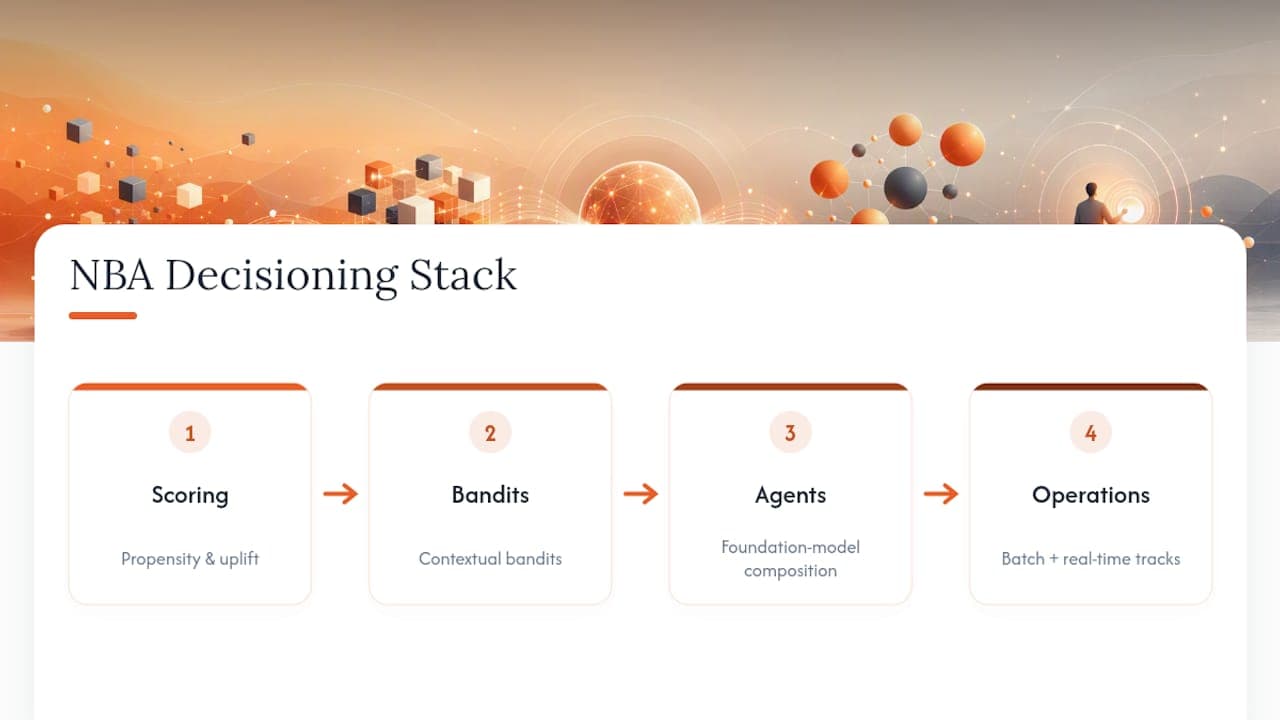
Layer one: propensity and uplift scoring. This is the workhorse layer, and it’s usually where teams start. A propensity model predicts the likelihood of an outcome, like churn or purchase. An uplift model goes a step further and predicts the incremental effect of an action, isolating what a specific intervention actually changes rather than what would have happened anyway. Uplift matters because a high-propensity customer who was going to convert regardless doesn’t need an intervention wasted on them; a borderline customer who responds strongly to a nudge is where the action creates real value.
Layer two: contextual bandits. Static models go stale. Contextual bandits solve that by continuously testing which action works best in which context, balancing exploitation (keep doing what’s proven) against exploration (try something new on a small slice of traffic to see if it beats the incumbent). This is how the system adapts without a full model retrain every time customer behavior shifts.
Layer three: foundation-model agents. This is the newest and most advanced layer, where large language models reason across multiple signals and compose actions rather than just selecting from a fixed menu. A study on reinforced coupled recurrent neural networks demonstrated how sequence models can track a customer’s evolving state over time and learn action-value functions that optimize for long-term reward rather than the next single interaction. That’s the theoretical groundwork underneath agent-native NBA: instead of picking the best action for this moment, the system learns which sequence of actions maximizes lifetime value.
Underneath all three layers, most CRM platforms score recommendations against something like a UICE framework: Urgency, Impact, Confidence, and Effort. Each candidate action gets scored on those four dimensions, and the highest composite score wins the recommendation slot. Confidence scores and short explanations of “why this action” are what get reps and agents to actually trust and act on the suggestion, rather than ignoring it as a black box. BCG also flags a structural requirement most teams miss early: production NBA needs a two-track architecture, one track for batch model optimization and a separate, faster track for real-time serving, because the two workloads have completely different latency and compute demands.
What Data and Components Does NBA Need Inside a CRM?
Before any model runs, four foundational pieces need to exist, and skipping any one of them is the most common reason pilots stall.
- A unified customer profile. Whether it’s a proper customer data platform or a well-built CRM object model, the system needs one place where identity, behavior, and history resolve to a single record. Fragmented profiles produce fragmented recommendations.
- Event streams with outcome labels. The model needs to see not just what happened (email sent) but what resulted (opened, clicked, ignored, converted). Without labeled outcomes, there’s nothing to train against.
- An action catalog. Every recommendable action needs metadata: what it is, who’s eligible for it, what flow it triggers, and what business rule constraints apply (compliance holds, contact frequency caps, channel preferences).
- A scoring engine with defined inputs and outputs. This is the part that actually runs the model, but it also needs monitoring and logging attached, because a scoring engine with no visibility into what it’s recommending and why is nearly impossible to debug when acceptance rates drop.
The Recommended Actions API in Dynamics 365 is a useful reference point here: Microsoft’s documentation lays out the Dataverse tables, required fields, and scoring pipeline needed to integrate a custom recommendation agent, which gives engineering teams a concrete template even if they’re not building on that platform.
Pro Tip: Log every rejected recommendation with a reason code, not just the accepted ones. Rejection data is what tells your model where its confidence scores are wrong, and most teams throw that signal away by only tracking acceptances.
5 Steps to Implement Next Best Action in Your CRM
Building an NBA capability from scratch doesn’t require a data science team on day one. It requires sequencing the work correctly.
- Centralize and label your data. Pull activity history, outcomes, and profile data into one accessible store. Most models need several months of labeled history before scores are reliable, depending on your sales or service cycle length.
- Define goals, metrics, and your action catalog. Decide up front what “success” means (conversion lift, faster resolution, higher retention) and build out the finite list of actions the system is allowed to recommend, with eligibility rules attached to each.
- Start rules-based, then layer in scoring. Practical implementation guidance consistently points to starting with simple if-this-then-that logic to get a working closed loop, then replacing static rules with propensity or uplift scores once you have enough data, and only piloting bandits or agentic layers after that foundation holds.
- Wire acceptance and rejection into your flows. An accepted recommendation should trigger the actual workflow automatically. A rejected one needs to log a reason code that feeds back into retraining, not disappear.
- Test with control groups and iterate. Hold out a control segment that gets no recommendation, or a random action, and compare it against the treated group. Without that holdout, you can’t tell whether performance gains came from the model or from a broader trend.
Teams that skip step five are the ones who end up unable to answer the one question leadership always asks: is this actually working, or did the market just get better? A randomized holdout is the only clean way to answer that.
Sales, Marketing, and Service: Where NBA Shows Up First
NBA earns its keep fastest in the three functions with the highest volume of repetitive judgment calls.
- Sales uses NBA to flag the best time and channel to follow up on a stalled deal, to catch deals at risk of going quiet before they actually die, and to route accounts to a manager when a deal’s signals cross an escalation threshold.
- Marketing uses it for personalized re-engagement of lapsed customers, sequencing cross-sell offers so the second touch doesn’t cannibalize the first, and picking the channel (email, SMS, in-app) a given customer actually responds to instead of blasting all three.
- Service uses it to trigger proactive outreach before a customer files a complaint, to surface the right knowledge-base article to an agent mid-call, and to auto-escalate tickets that are drifting toward an SLA breach.
The common thread across all three: the recommendation only has value if it arrives inside the workflow the person is already using, not as a separate report they have to remember to check.
How Do You Measure Whether NBA Is Actually Working?
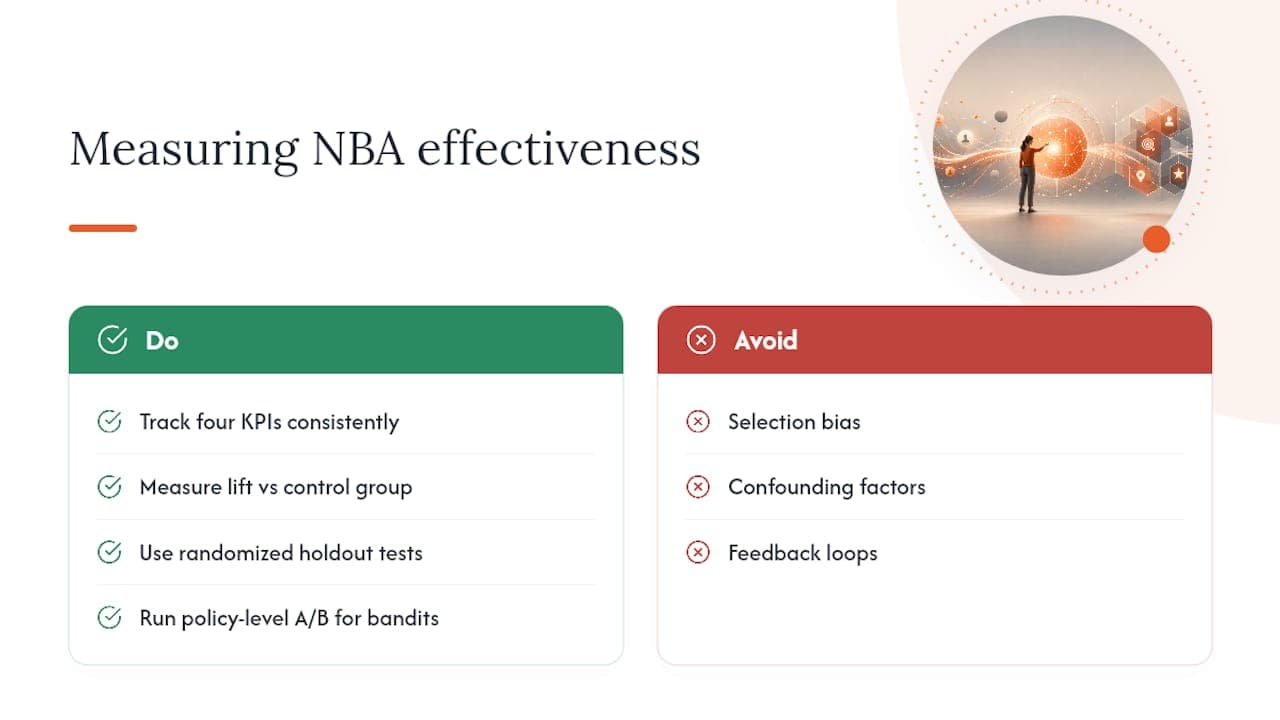
Four KPIs matter more than the rest: conversion lift on the recommended action versus a control group, acceptance rate (how often reps or agents actually take the suggestion), time-to-action from recommendation to execution, and revenue or resolution outcome per contact.
The evaluation design matters as much as the metric. A randomized holdout, where a slice of records gets no recommendation or a random one, is the only reliable way to isolate the model’s actual contribution. For bandit-driven systems, you need policy-level A/B testing, comparing the exploring policy against the current best, not just comparing individual actions.
Three pitfalls sink most evaluations. Selection bias creeps in when reps only act on recommendations for accounts they already liked. Confounding shows up when an external factor, like a seasonal demand spike, gets credited to the model. And feedback loops compound quietly: if the model only ever sees outcomes from accounts it already recommended actions for, it stops learning about the accounts it’s ignoring, and its blind spots get wider over time instead of narrower.
Why Staffing, Not Technology, Usually Stalls NBA Programs
The biggest barrier to scaling NBA past a pilot is rarely the tech stack. BCG’s analysis of next-best-action programs points to organizational readiness, specifically a shortage of reinforcement learning and causal inference expertise, as the more common failure point.
Most teams need at least three roles to move beyond a rules-based pilot: a data engineer to maintain the unified profile and event pipeline, a causal inference or ML practitioner to build and validate uplift models, and a cross-functional owner (often a revenue operations or CRM lead) who governs the action catalog and arbitrates conflicting recommendations across departments.
Hire in phases. Get the rules-based loop stable first, add scoring expertise once labeled data is reliable, and only bring in bandit or agent specialists once the production system can safely absorb experimentation without breaking core flows.
How Do Engineers Wire NBA Recommendations Into a CRM?
Three integration patterns cover most real-world builds: an in-page recommendation card fed by a strategy engine that scores in real time, a scheduled digest email summarizing top actions for reps who don’t live in the CRM UI, and a pure API push pattern where an external agent injects recommendations directly into CRM records.
Whichever pattern you choose, the action push contract needs a consistent set of fields. Dynamics 365’s documented contract is a solid reference: a deterministic actionId for deduplication, a sourceAgentId identifying which model or agent generated the suggestion, a targetEntityId pointing to the specific record, an actionReason for explainability, an optional uiPayload for rendering, and prioritization data the scoring engine uses to rank competing actions.
- Validate that every pushed action resolves to a real, permitted record before it renders.
- Test the full loop end to end, from push to display to accept/reject logging, before trusting the pipeline in production.
- Monitor push volume and rejection rate as a leading indicator that something in the model has drifted.
How decisioning systems can be approached in NBA-style projects involves embedding them inside the client’s actual workflows, rather than bolting them on as a separate dashboard. That means the action catalog, the scoring logic, and the governance rules get built around how a specific team already works, not around a generic template.
In NBA-style projects specifically, contributions tend to focus on three fronts: data engineering to unify fragmented profiles, building production agents that survive contact with real edge cases, and governance frameworks that keep humans accountable for what the model recommends. The custom AI development work in real estate shows what that embedded approach looks like when applied to a specific vertical.
Teams that want the exploration layer without building bandit infrastructure from scratch sometimes lean on orchestration partners like Interval AI for the model layer, while execution channels like Sendmux handle the actual email delivery and tracking once an action gets accepted.
Author Perspective: Start Small, Stay in the Loop
Pick one high-impact use case, run a time-boxed pilot, and resist the urge to build all three decisioning layers at once. Keep a human reviewing edge cases early. Rejected recommendations are your fastest signal for what’s broken. Only move to bandits or agentic layers once the rules-based loop has run clean for a full quarter.
— arosplatforms team
Sources
- Recommended Actions API (Dynamics 365) | Microsoft Learn
- Automated next-best action recommendation using reinforced coupled recurrent neural networks | PLOS One
- Next best action: definition, benefits and guide | Pipedrive
Ready to move from pilot to production? Arosplatforms designs and builds custom AI operating systems that embed next-best-action decisioning directly into your existing workflows, with your team retaining full ownership once the build is done.
FAQ
What Are the Next Best Actions in Salesforce?
Salesforce’s Einstein Next Best Action surfaces recommendations directly on a record page, triggered by rules or predictive models, and executes a flow automatically when a user accepts the suggestion, logging rejections for retraining.
Do You Really Need a CRM in 2026?
Yes for any team managing more than a handful of customer relationships. A CRM is also the prerequisite for next best action, since NBA depends on the unified profile and activity history a CRM centralizes.
What Are the Key CRM Trends Heading Into 2026?
Agent-native decisioning is the dominant shift: CRMs are moving from static predictive scores toward layered systems combining propensity models, contextual bandits, and foundation-model agents that reason across sequences of actions.
What’s the Future of CRM?
CRM is shifting from a system of record into a decisioning layer that actively recommends and executes actions, with foundation-model agents increasingly handling reasoning that used to require a human analyst.