Automated Offer Management Explained for Business Leaders
Automated Offer Management Explained for Business Leaders

Automated offer management is a digital system that governs the full lifecycle of a commercial offer, from creation and approval through delivery and acceptance, using predefined workflows and AI-enhanced decision support. The industry term for this capability is “offer management automation,” and it sits at the intersection of enterprise AI platforms and commercial strategy. Businesses that adopt it report approval times cut from days to hours, fewer manual errors, and faster responses to market shifts. For decision-makers evaluating where AI delivers the clearest return, automated offer management is one of the most direct answers available.
What is automated offer management, and why does it matter?
Automated offer management is defined as the use of digital workflows, rules engines, and AI decision modules to create, route, approve, deliver, and track commercial offers without manual handoffs at each stage. The core functions include template-based offer creation, multi-layered approval routing, digital delivery, real-time acceptance tracking, and audit trail generation. Together, these functions replace the fragmented email chains and spreadsheet-based processes that slow most sales teams down.
The business case is direct. Multi-layered digital approval workflows include real-time notifications and automated reminders, which means approvers act on time rather than letting requests stall in inboxes. That speed translates into shorter sales cycles and fewer deals lost to competitor response times. For organizations managing high offer volumes across multiple client segments, the efficiency gain compounds quickly.

Offer management should be understood as a coordinated capability system, not a single software module. It sits at the intersection of technology and commercial decision intelligence, requiring alignment between sales strategy, pricing logic, and technical workflow design. Leaders who treat it as a software purchase alone consistently underestimate the change required.
How do automated offer management systems work?
The architecture of an automated offer management system has four distinct layers working in sequence.
- Offer creation layer. Sales teams or AI modules generate offers using structured templates that enforce pricing rules, bundle configurations, and compliance requirements. This removes ad hoc formatting and ensures every offer meets internal standards before it moves forward.
- Approval routing layer. The system routes each offer through a predefined chain of approvers based on deal size, discount level, or client segment. Automated reminders and notifications keep the process moving without manual follow-up.
- Digital delivery and acceptance layer. Offers are sent through digital channels with tracked delivery and electronic acceptance. This creates a time-stamped record of every client interaction.
- Audit and compliance layer. Every action in the offer lifecycle is logged. Real-time tracking of offer acceptance provides transparency and supports regulatory compliance across industries.
The table below shows how each layer maps to a business outcome.
| System layer | Primary business outcome |
|---|---|
| Offer creation | Consistent, compliant offers at scale |
| Approval routing | Faster decisions, fewer bottlenecks |
| Digital delivery | Reduced time to client acceptance |
| Audit and compliance | Regulatory readiness and error reduction |
Pro Tip: Map your current offer approval chain before selecting any platform. Teams that document their existing workflow first configure automation rules in a fraction of the time.
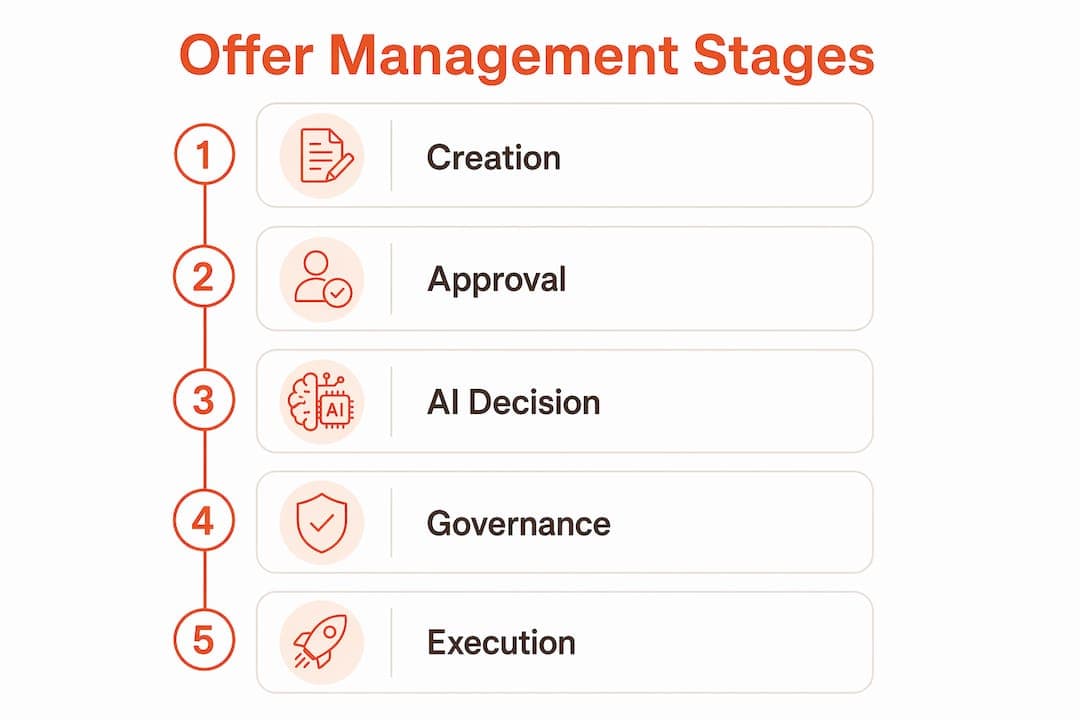
AI workflow automation connects these layers by triggering actions based on data signals rather than human prompts. When a deal crosses a discount threshold, the system automatically escalates to the next approver. When a client opens an offer without responding, the system flags it for follow-up. These micro-automations remove the cognitive load from sales teams and direct their attention to decisions that genuinely require judgment.
What role does AI play in offer management automation?
AI accelerates pattern recognition and decision support within offer management, but it does not replace core commercial strategy. That distinction matters. Leaders who expect AI to set pricing strategy without human input consistently see margin erosion. AI works best as a recommendation engine that surfaces options for human decision-makers to act on quickly.
The most valuable AI functions in offer management include:
- Demand pattern analysis. AI identifies which offer structures perform best by client segment, time of year, or deal stage, then recommends configurations that match current conditions.
- Psychographic offer calibration. Offers built on deep psychographic research and objection resolution frameworks consistently outperform offers built by mimicking competitor pricing. AI can process behavioral data at a scale no analyst team can match.
- Willingness-to-pay detection. AI models analyze engagement signals, purchase history, and segment data to estimate price sensitivity and recommend the right offer tier for each client.
- Rapid testing and learning. AI enables A/B testing of offer structures across live campaigns and feeds results back into the recommendation engine within hours, not weeks.
“Offer structures aligned to buyer psychology improve conversion significantly compared to standard pricing models built on competitor mimicry.” — Pinnora.ai research on AI-driven offer creation
Modular offer architecture supports this AI layer by separating pricing, guarantees, bundles, and urgency mechanisms into distinct components. AI can then recombine these components based on segment data without requiring engineering changes. The result is a system that personalizes at scale while keeping commercial logic under business control. For teams exploring AI-driven e-commerce personalization, this modular approach is the same principle applied to offer design.
Governance and control: how do you prevent offer complexity from breaking your margins?
Governance is the layer that prevents automated offer management from creating more problems than it solves. Without it, automated systems generate uncontrolled offer stacking, where multiple discounts apply simultaneously and erode margins faster than any manual process could. Centralized governance decouples commercial configuration from technical implementation, which means business teams can launch and adjust campaigns without waiting for engineering sprints.
The critical design principle is technical separation. Separating offer mechanics from eligibility rules prevents hardcoded combinations that break as campaigns scale. Offer mechanics define what the discount or bundle does. Eligibility rules define who qualifies. Keeping these as independent modules means you can update one without breaking the other.
Pro Tip: Build a single source of truth for all active offers. Teams that maintain a centralized offer register catch stacking conflicts before they reach clients, not after.
The governance checklist below identifies the controls every business leader should verify before scaling offer automation.
| Governance control | Why it matters |
|---|---|
| Single source of truth for active offers | Prevents conflicting discounts from stacking unintentionally |
| Separation of mechanics and eligibility | Allows safe updates without system failures |
| Business-controlled configuration layer | Removes engineering dependency for campaign changes |
| Audit trail for every offer action | Supports compliance and post-campaign analysis |
| Margin floor rules in the approval workflow | Stops discounts from breaching acceptable thresholds |
Offer automation also requires a cultural shift from static spreadsheet planning to real-time, modular decisioning. That shift is as critical as the technical implementation. Teams accustomed to quarterly pricing reviews resist systems that expect daily configuration decisions. Leadership must set the expectation that offer management is a continuous activity, not a periodic one.
What are the practical benefits of automated proposal management?
The benefits of automated offers operate at three levels: operational, commercial, and strategic.
Operational benefits:
- Approval cycle times drop from days to hours, freeing sales teams to focus on client conversations rather than internal process management.
- Error rates fall because template-based creation enforces pricing and compliance rules at the point of offer generation.
- Digital acceptance tracking provides a complete audit trail, reducing disputes and supporting contract management.
Commercial benefits:
- Personalized offers based on behavioral and psychographic data improve conversion rates compared to generic pricing.
- Promotional bundles and localized campaigns launch in hours instead of weeks, giving sales teams a real competitive advantage in fast-moving markets.
- Real-time engagement data feeds back into offer design, so underperforming structures are identified and replaced quickly.
Strategic benefits:
- Business teams control commercial configuration without engineering dependency, which means faster responses to competitive pressure.
- Consistent offer governance protects margins as deal volume scales.
- AI decision support surfaces patterns across thousands of offers that no analyst team could process manually.
Industries with high offer volumes see the sharpest gains. Logistics, healthcare, real estate, and subscription-based businesses all operate in environments where offer speed and personalization directly affect revenue. Vertical AI approaches that embed industry-specific logic into offer workflows amplify these gains further by applying sector-relevant rules rather than generic automation templates.
Key Takeaways
Automated offer management delivers measurable efficiency and commercial gains only when governance, AI decision support, and cultural alignment work together as a system.
| Point | Details |
|---|---|
| Approval speed | Automated workflows cut approval cycles from days to hours, reducing lost deals. |
| AI as decision support | AI recommends offers based on behavioral data but does not replace commercial strategy. |
| Governance prevents margin erosion | Separating offer mechanics from eligibility rules stops uncontrolled discount stacking. |
| Cultural shift required | Moving from spreadsheet planning to real-time decisioning is as critical as the technology. |
| Modular architecture scales | Independent pricing, bundle, and eligibility modules allow safe, fast campaign updates. |
The governance gap most leaders miss
Working with organizations across healthcare, logistics, and real estate, Arosplatforms sees the same pattern repeatedly. Leadership invests in offer automation technology, achieves early wins on approval speed, and then hits a wall six months in. The wall is almost never technical. It is governance.
The teams that struggle have one thing in common: they built their automation on top of existing commercial chaos. Discount rules lived in three different spreadsheets. Eligibility criteria were tribal knowledge held by two senior sales managers. When the system tried to automate those rules, it automated the inconsistency too.
The organizations that succeed treat governance as the first deliverable, not the last. They map every active offer type, document the mechanics and eligibility separately, and establish a single owner for the configuration layer before a single workflow is built. That groundwork feels slow. It pays back in months, not years.
The other pattern worth naming is the AI expectation gap. Leaders often expect AI to generate commercial strategy. It does not. AI finds patterns in data that humans cannot process at scale. The commercial judgment about which patterns to act on still belongs to your team. The best implementations Arosplatforms has seen treat AI as a fast analyst, not a decision-maker. That framing keeps accountability where it belongs and keeps the system trusted by the people using it.
— Arosplatforms team
How Arosplatforms builds automated offer management into your operations
Arosplatforms designs and deploys customized AI operating systems that embed directly into your commercial workflows, including offer creation, approval routing, and real-time decisioning. The approach prioritizes business ownership of configuration so your teams control offer logic without engineering dependency.
Clients across the US, UK, EU, and beyond report an average of 82% faster turnaround on key commercial tasks after deployment, with many reaching positive ROI within twelve months. Whether you are building offer automation from scratch or fixing a governance problem in an existing system, Arosplatforms works inside your operations to get it right. Explore AI consulting for US enterprises or review consulting services for UK businesses to see how the engagement model works for your region.
FAQ
What is automated offer management?
Automated offer management is a digital system that handles the full lifecycle of a commercial offer, from creation and approval to delivery and acceptance, using predefined workflows and AI decision support. It replaces manual email-based processes with governed, trackable automation.
How does offer management automation reduce approval times?
Automated systems route offers through predefined approval chains with real-time notifications and reminders, cutting approval cycles from days to hours. This removes the email bottlenecks that delay most manual offer processes.
What is the difference between offer mechanics and eligibility rules?
Offer mechanics define what a discount or bundle does, while eligibility rules define who qualifies for it. Keeping these as separate modules prevents uncontrolled offer stacking and allows safe updates as campaigns scale.
Does AI replace commercial strategy in offer management?
AI provides decision support by analyzing demand patterns and recommending offer configurations, but it does not set commercial strategy. Human judgment remains responsible for which recommendations to act on and why.
What industries benefit most from automated proposal management?
Logistics, healthcare, real estate, and subscription businesses see the sharpest gains because high offer volumes and fast market conditions amplify the speed and personalization advantages that automation delivers.