Automated Claims Data Extraction Explained for Insurance & Healthcare Ops
Automated Claims Data Extraction Explained for Insurance & Healthcare Ops

Automated claims data extraction converts raw claim documents — CMS-1500s, UB-04s, EOBs, medical records, prior auth forms — into structured, system-ready data without manual keying. For insurance and healthcare operations teams, that means faster adjudication, fewer transcription errors, and a measurable lift in straight-through processing (STP) rates. The technology stack typically combines OCR, intelligent document processing (IDP), NLP, and confidence-based routing to handle the heterogeneous document mix that defines real claims workflows.
The operational impact is concrete:
- STP lift: Automating high-confidence fields removes the manual bottleneck on clean claims, pushing more volume through without adjuster intervention.
- FTE reallocation: Transcription work shifts to exception handling, freeing staff for judgment-intensive reviews.
- Faster reconciliation: Structured EOB outputs feed directly into billing systems, cutting the lag between payment posting and account resolution.
- Compliance readiness: HIPAA-compliant pipelines with audit logs and encryption satisfy PHI handling requirements from day one.
Your immediate next step: pull a sample of claims documents across your highest-volume document types and assess field-level variability. That dataset becomes the foundation for any pilot or vendor evaluation.
Table of Contents
- What does automated claims data extraction actually do?
- Which technologies power claims extraction, and where do they fall short?
- How does a production extraction pipeline actually work?
- Which documents should you prioritize, and what fields matter most?
- What does a production-ready implementation actually require?
- What KPIs should you track, and what does good look like?
- What goes wrong in production, and how do you fix it?
- Should you build, buy, or hire a consultancy?
- Key Takeaways
- The gap between what extraction promises and what actually ships
- How Arosplatforms accelerates claims extraction from pilot to production
- Useful sources
- FAQ
What does automated claims data extraction actually do?
Automated data extraction turns unstructured or semi-structured source documents into structured records a claims system can act on. It is not adjudication, payment posting, or full workflow automation. The extraction layer handles one specific job: reading a document and producing a reliable, field-level output.
In claims and healthcare billing, that means handling three document categories:
- Structured forms: CMS-1500 (HCFA), UB-04, NCPDP pharmacy transactions — fixed layouts with defined field positions.
- Semi-structured documents: EOBs, remittance advices, prior auth responses — consistent field semantics but variable layouts across payers.
- Unstructured sources: Discharge summaries, clinical notes, operative reports, photos, repair estimates — free text requiring NLP or LLM-assisted extraction.
What extraction does not do is equally worth stating. It does not decide whether a claim is payable. It does not post payments to a ledger. It does not replace a claims management system. It feeds those systems with clean, validated data so they can do their jobs faster.
High-value extraction targets for insurers and provider billing teams include:
- Claim numbers, member IDs, and group policy numbers
- Dates of service, admission, and discharge
- CPT, ICD-10, HCPCS, and revenue codes
- Billed, allowed, and paid amounts at the line-item level
- NPI numbers (rendering and billing providers)
- Diagnosis codes and DRG assignments
- Prior authorization numbers and approval status
Which technologies power claims extraction, and where do they fall short?
| Technology | Primary claims use case | Practical limits |
|---|---|---|
| OCR (optical character recognition) | Digitizing scanned CMS-1500s, UB-04s, and paper EOBs | Degrades below 200 DPI; struggles with handwriting and dense tables |
| Layout analysis | Locating fields by position on structured forms | Breaks when payer redesigns form layout |
| NLP / named-entity recognition | Extracting diagnoses, provider names, and dates from clinical notes | Requires domain-specific training; ambiguous clinical language reduces accuracy |
| IDP / ML models | Template-free extraction across variable payer EOBs and remittance files | Needs labeled training data; accuracy varies by document quality |
| LLMs (e.g., GPT-4 class models) | Summarizing clinical narratives, resolving ambiguous fields | Hallucination risk on numeric fields; cost per page is higher |
| RPA | Logging into payer portals, submitting 837 transactions, retrieving 835 files | Brittle against UI changes; not a substitute for IDP on unstructured docs |
| Connectors / APIs | Pulling EDI 837/835, HL7, FHIR feeds from payers and EHRs | Requires auth token management and schema-drift monitoring |
The practical decision between template-based and semantic extraction comes down to document variability. Template approaches work well for CMS-1500s where field positions are standardized. For EOBs, where each payer uses different column labels for the same logical fields, semantic extraction reads field meaning rather than position, producing stable outputs even when a payer updates their remittance layout. That distinction matters most when you are processing dozens of payers simultaneously.
Handwriting is the hardest problem in the stack. Even the best models lose significant accuracy on handwritten fields, which is why confidence-based routing to human review remains non-negotiable for any field that drives payment decisions.
How does a production extraction pipeline actually work?
A well-designed pipeline follows six stages, each with its own failure modes and monitoring requirements.
Ingest and classify: Documents arrive via portal upload, email attachment, SFTP drop, EDI feed, scanned mail, or mobile photo. The classifier assigns a document type (CMS-1500, UB-04, EOB, clinical note) and routes accordingly. Misclassification here propagates errors downstream, so classifier accuracy deserves its own measurement track.
Extract and normalize: The extraction model pulls field values and normalizes them — converting date formats, standardizing CPT and ICD-10 codes against current CMS code sets, resolving currency to USD. Normalization is where raw extraction becomes operationally useful.
Validate and enrich: Extracted values are cross-checked against policy data, provider NPI registries, and fee schedules. Enrichment adds context the source document does not contain: contract rates, member eligibility status, prior auth linkage.
Route by confidence: Fields above a confidence threshold post automatically. Fields below threshold, or those flagged by business rules (duplicate claim number, out-of-range billed amount, SIU triggers), route to a human review queue. Bounding-box grounding — linking each extracted value back to its exact location in the source image — lets reviewers confirm a value in seconds rather than re-reading the entire document.
Store with audit trail: Final structured records write to the claims system with a full audit log: source document hash, extraction model version, confidence scores, reviewer ID if touched, and timestamp. This satisfies HIPAA audit requirements and supports downstream dispute resolution.
Observe and alert: Key pipeline metrics — field-level accuracy, exception rate, throughput, and processing latency — feed a monitoring dashboard. Schema-drift detection alerts the team when a payer changes their EOB layout before that change silently corrupts extraction outputs.
Which documents should you prioritize, and what fields matter most?
| Document type | High-value fields to extract | Primary operational use |
|---|---|---|
| CMS-1500 / HCFA | Claim #, DOS, CPT codes, ICD-10 dx, billed amount, rendering NPI, referring NPI, place of service | STP, fee schedule matching, fraud screening |
| UB-04 | Claim #, admission/discharge dates, revenue codes, DRG, total charges, attending NPI, condition codes | Inpatient adjudication, DRG validation, reserve calculation |
| EOB / remittance | Claim #, CPT, billed/allowed/paid/patient responsibility, adjustment reason codes (CARC/RARC) | Reconciliation, denial management, secondary billing |
| Itemized bill | Line-item service description, revenue code, unit count, unit charge, total charge | Audit, cost containment, fraud detection |
| Discharge summary | Admit/discharge dates, primary/secondary diagnoses, procedures, attending physician | Clinical validation, DRG audit, prior auth matching |
| Prior auth form | Auth number, approved CPT/HCPCS, approval dates, approved units, requesting provider | Auth-to-claim matching, denial prevention |
| NCPDP pharmacy | Rx number, NDC, days supply, quantity, ingredient cost, dispensing fee, plan paid | Pharmacy reconciliation, formulary audit |
Line-item extraction on itemized bills deserves special attention. A single inpatient bill may carry hundreds of line items, and the fraud and cost-containment signal lives at the line level, not the claim total. Multi-page document handling — splitting, page-order reconstruction, and associating line items with their header claim data — is a pipeline capability to verify explicitly during vendor evaluation.
What does a production-ready implementation actually require?
Getting to reliable, production-grade extraction means building controls at every layer, not just training a model and hoping for the best.
Testing and validation checklist:
- Build a labeled test set of at least 500 documents per document type, stratified by payer, scan quality, and document age.
- Run unit tests on individual field extractors and end-to-end tests on full pipeline runs before each model update.
- Implement retry logic with exponential backoff for API and connector failures; log every retry for observability.
- Set up schema-drift alerts on all payer EDI feeds and EOB templates so layout changes trigger review before they corrupt production data.
- Rotate auth tokens on a defined schedule and store credentials in a secrets manager, not in pipeline config files.
Human-in-loop controls: Set field-level confidence thresholds, not a single document-level threshold. A claim number extracted at 98% confidence needs no review. A billed amount extracted at 71% confidence on a handwritten itemized bill absolutely does. Pre-populated edit screens that show the extracted value alongside its bounding-box highlight let reviewers work through exception queues efficiently. Every manual correction feeds back into the training loop.
HIPAA and security controls: PHI must be encrypted in transit (TLS 1.2 minimum) and at rest (AES-256). Role-based access control (RBAC) limits who can view raw documents versus structured outputs. Audit logs must capture every access event and be retained per your covered-entity retention policy. AI governance controls for insurance deployments should include a documented data processing agreement with every vendor touching PHI.
Change management: Start with the three to five fields that drive the most downstream value — claim number, DOS, and primary CPT code are almost always the right starting point. Phased rollout by document type lets review teams build confidence before the pipeline handles full claim volume. Train reviewers on the exception queue UX before go-live, not after.
Pro Tip: Automate billed amounts and procedure codes first. These two fields account for the largest share of adjudication errors and carry the highest ROI per hour of reviewer time saved.
What KPIs should you track, and what does good look like?
The KPIs that matter for claims extraction fall into four categories: accuracy, throughput, cost, and quality.
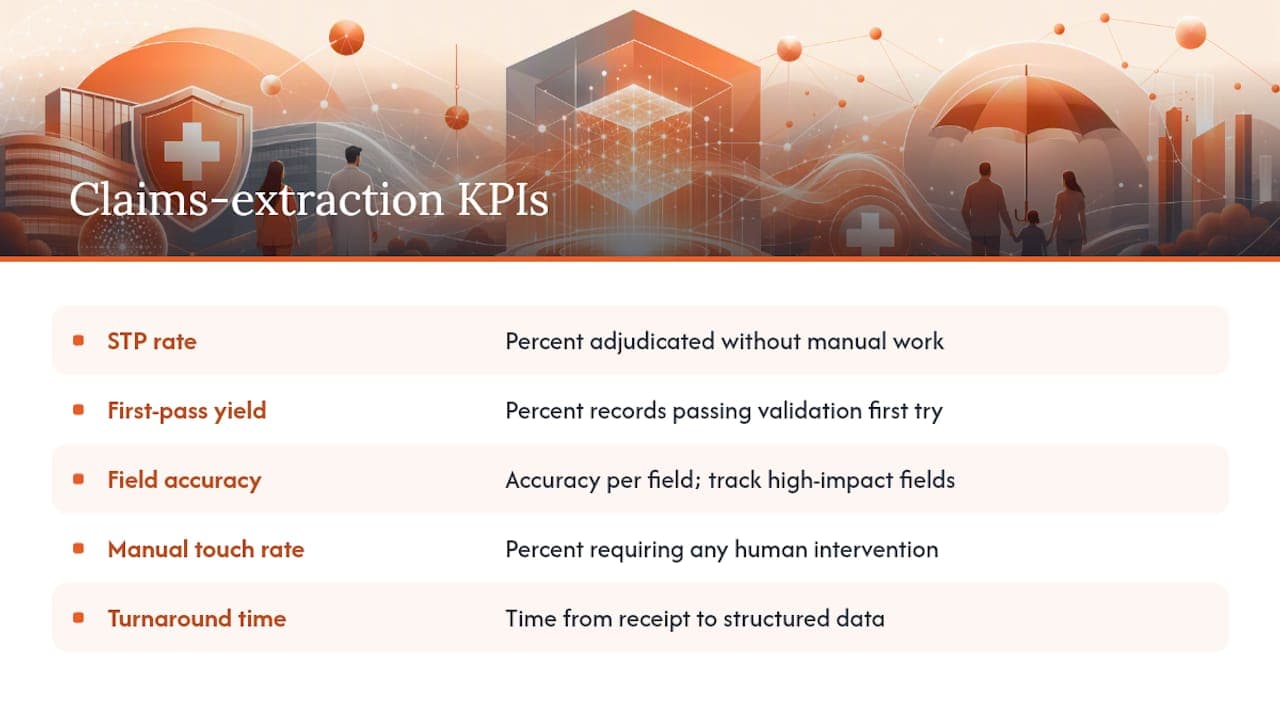
Straight-through processing (STP) rate: The percentage of claims that complete adjudication without any manual intervention. Measure it before and after extraction automation to isolate the extraction contribution. A meaningful pilot should show STP movement within 60–90 days.
First-pass yield (FPY): The percentage of extracted records that pass all validation rules on the first attempt. Low FPY signals either model quality issues or validation rules that are too strict — both are fixable, but you need the metric to know which problem you have.
Field-level accuracy: Measure accuracy per field, not per document. A document can be “mostly correct” while containing an error in the billed amount — the field that matters most. Track accuracy separately for high-impact fields (procedure codes, billed amounts, NPI) versus low-impact fields (free-text notes).
Manual touch rate: The percentage of claims requiring any human intervention in the extraction pipeline. This is the inverse of STP and the most direct measure of automation effectiveness.
Turnaround time (TAT): Time from document receipt to structured data available in the claims system. Extraction automation typically compresses TAT from days to minutes on clean documents.
ROI framework: Multiply FTE hours saved per month by fully loaded hourly cost. Add error-avoidance savings (rework cost per transcription error × error rate reduction). Add speed-to-payment gains (interest or penalty avoidance on faster reconciliation). That three-part model gives you a defensible business case without inflated assumptions.
Global data volumes are growing rapidly, and claims document volumes are growing with them. Operations teams that build extraction infrastructure now are positioning for a document load that will be substantially larger in three to five years.
For A/B testing a pilot: run the extraction pipeline on a randomly sampled 20% of incoming claims volume while the remaining 80% follows the existing manual process. Compare STP rate, FPY, TAT, and error rate across both cohorts after 30 days. That comparison gives you statistically grounded evidence for a full rollout decision.
What goes wrong in production, and how do you fix it?
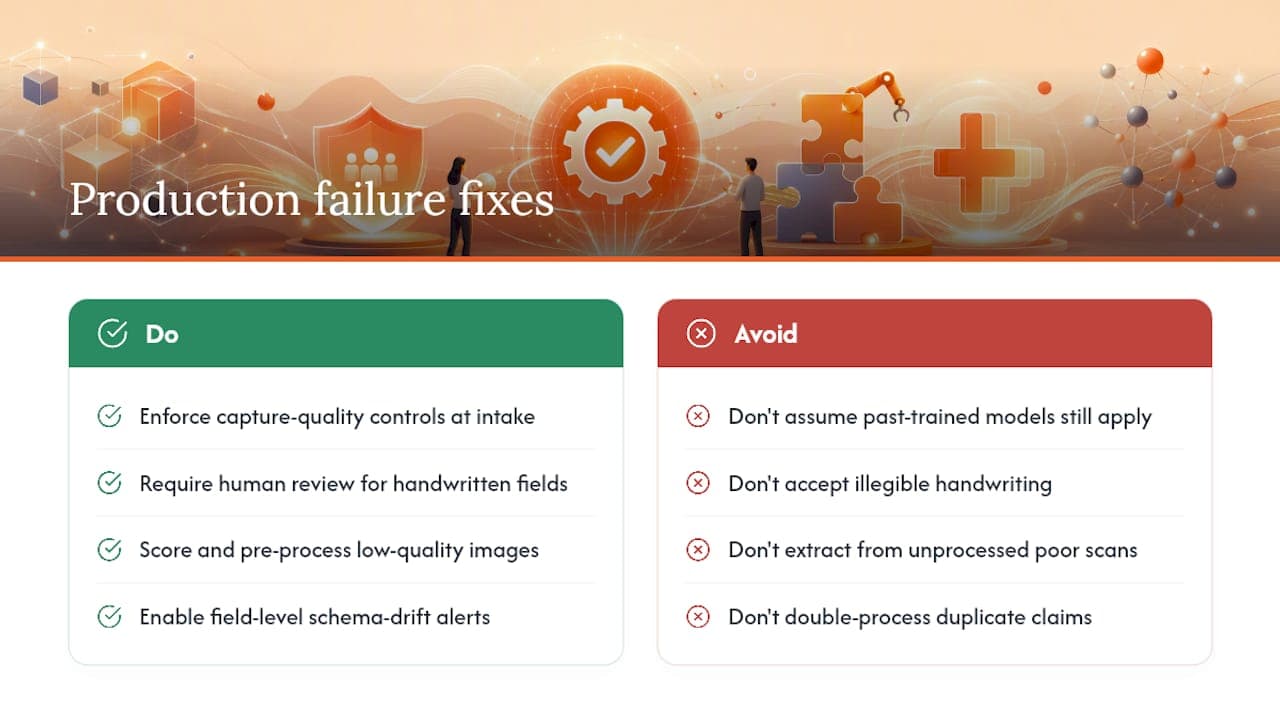
The most common failure mode in claims extraction is not model accuracy — it is the assumption that a model trained on last quarter’s documents will handle this quarter’s payer layout changes without intervention. Schema drift is silent until it is expensive.
Handwriting: Handwritten fields on paper claims and prior auth forms are the single biggest accuracy drag. The mitigation is not a better model — it is capture-quality controls at intake (minimum DPI requirements, rejection of illegible uploads) combined with mandatory human review for any handwritten field that drives payment.
Low-quality scans: Faxed documents, photocopies of photocopies, and mobile photos taken in poor lighting all degrade OCR accuracy. Implement image quality scoring at ingest and route low-quality documents to a pre-processing step (deskew, denoise, contrast enhancement) before extraction.
Payer layout changes: EOB and remittance layouts change without notice. Semantic extraction reduces but does not eliminate this risk. Schema-drift alerts on field-level extraction confidence — not just document-level — catch layout changes before they produce silent errors in production.
Mixed digital and paper streams: Many operations receive the same claim type via EDI 837 and paper simultaneously. Deduplication logic at the ingest layer, keyed on claim number and DOS, prevents double-processing.
Ambiguous semantics in clinical notes: “Patient denies chest pain” and “patient presents with chest pain” require NLP models trained on clinical negation patterns. General-purpose models miss this. Domain-specific models trained on clinical text — or LLMs with explicit negation prompting — handle it better, but always route clinical extraction outputs for physician or coder review on high-stakes fields.
For fraud detection integration, extracted line-item data feeds SIU routing rules directly. Anomaly signals — unbundled CPT codes, duplicate claim numbers, billing patterns outside provider norms — are far easier to detect from structured extraction outputs than from raw documents. Automation’s role in fraud prevention has expanded significantly as extraction accuracy has improved, with modern pipelines routing suspicious patterns to SIU queues automatically.
Should you build, buy, or hire a consultancy?
| Dimension | Build in-house | Off-the-shelf platform | Custom AI consultancy |
|---|---|---|---|
| Typical timeline to production | 12 months or more | 2–6 months | 3–9 months |
| Up-front cost | High (ML team, infra, labeling) | Low to medium (SaaS fees) | Medium (engagement fee) |
| Maintenance burden | Fully internal | Vendor-managed | Shared or handed off |
| Customization | Maximum | Limited to platform features | High, built to your workflows |
| Strategic control | Full | Low | High (you own the system) |
| Best for | Large enterprises with mature ML infra | Standard EOB/CMS forms, small volume | Complex integrations, custom rules, governance needs |
Off-the-shelf platforms make sense when your document mix is standard — mostly CMS-1500s and UB-04s from a small payer panel — and your volume is low enough that per-page pricing stays manageable.
They get you to a working pilot fast.
Build in-house only when you have an existing ML engineering team, labeled training data, and a multi-year timeline. Most mid-sized insurers and health systems do not meet all three criteria simultaneously.
A custom AI consultancy fits when your document mix is complex, your integration requirements are specific (proprietary claims system, legacy EDI infrastructure, custom business rules), or you need a governance framework built alongside the extraction pipeline rather than bolted on afterward. The consultancy model also transfers ownership to your team, which matters if vendor lock-in is a concern. AI claims automation engagements that embed into existing operations tend to reach production faster than internal builds because the consultancy brings pre-built components and domain-specific training data.
Key Takeaways
Automated claims data extraction delivers the highest ROI when you prioritize high-impact fields first, validate with a labeled test set, and build human-in-loop controls before scaling to full volume.
| Point | Details |
|---|---|
| Start with high-impact fields | Automate claim number, DOS, and primary CPT/ICD codes first to maximize STP lift per hour of effort. |
| Pilot on at least 500 documents | A stratified sample across document types and payer sources gives statistically meaningful accuracy benchmarks before full deployment. |
| Require field-level confidence scores | Per-field confidence, not document-level, is the only basis for a defensible human-in-loop routing policy. |
| Track STP rate and FPY as primary KPIs | These two metrics directly measure whether extraction automation is producing adjudication-ready data at scale. |
| Arosplatforms for complex deployments | Arosplatforms embeds into claims operations to design, build, and hand off custom extraction pipelines with HIPAA-conscious governance built in. |
The gap between what extraction promises and what actually ships
The procurement conversation around claims extraction almost always focuses on accuracy percentages. Vendors lead with headline numbers — “99% field accuracy on CMS-1500s” — and operations leaders understandably anchor on them. The problem is that headline accuracy on clean, structured forms tells you almost nothing about how the system will perform on your actual document mix, which includes faxed prior auths, handwritten itemized bills, and EOBs from thirty different payers with thirty different layouts.
What actually determines whether an extraction deployment succeeds is the quality of the exception-handling design. A pipeline that routes a majority of claims straight through and handles the remaining cohort with a well-designed human review queue is operationally superior to one that claims high accuracy but produces silent errors on the claims it gets wrong. Silent errors in billed amounts or procedure codes are the ones that create downstream disputes, compliance exposure, and rework costs that dwarf the original automation savings.
The other underestimated factor is change management. The technology is rarely the bottleneck after go-live. The bottleneck is review teams who do not trust the system, adjudicators who re-key values they could confirm in two seconds, and governance processes that were not designed alongside the pipeline. Operations leaders who invest in reviewer training and exception-queue UX before go-live consistently see faster adoption and better FPY than those who treat it as a post-launch problem.
Realistic timelines: a well-scoped pilot on a single document type with a defined field set can reach production-grade accuracy in 60–90 days. Full deployment across a heterogeneous document mix with custom business rules and legacy system integration typically takes six to nine months. Anyone promising production-ready results in two weeks on a complex document mix is selling you the demo, not the deployment.
How Arosplatforms accelerates claims extraction from pilot to production
Claims extraction deployments that stall usually do so at the same two points: integration with legacy claims systems and governance sign-off on PHI handling. Arosplatforms addresses both by embedding directly into client operations rather than delivering a platform and stepping back.
A typical engagement covers extraction pipeline design, MLOps infrastructure, HIPAA-conscious data governance, and a full handover to the client’s team — with no vendor lock-in on the underlying models or training data. Clients retain ownership of their labeled datasets and extraction rules from day one. Many see measurable ROI within twelve months, with a significantly faster turnaround on key extraction tasks compared to their prior manual process.
For US insurance and healthcare operations teams ready to move from evaluation to execution, the right starting point is an AI readiness assessment that maps your document mix, integration requirements, and compliance posture before any build decision is made. Request a pilot scoping engagement with Arosplatforms to define your extraction scope, establish baseline KPIs, and get a realistic timeline for your specific environment.
Useful sources
- Worldwide data created | Statista
- Data extraction automation | Fivetran
- What is data extraction? And how to automate the process | Zapier
- Automated data extraction | Parseur
- Data extraction | Automation Anywhere
- Automating insurance claims intake document processing | Landing AI
- Document AI for claims: Extracting facts from forms without manual keying | Hacker9
- What is EOB data extraction? | ImageToTable
- Insurance claims processing automation | VantagePoint
- 5 Key Benefits of Claims Process Automation | Appian
FAQ
What is automated claims data extraction?
Automated claims data extraction uses OCR, IDP, and NLP to convert claim documents — CMS-1500s, UB-04s, EOBs, clinical notes — into structured, system-ready data without manual keying. The goal is faster adjudication and fewer transcription errors.
How accurate is claims extraction automation?
Accuracy varies by document type. Structured forms like CMS-1500s reach very high field accuracy with well-trained models, while unstructured clinical notes require domain-specific models and ongoing correction loops to maintain reliable outputs.
What HIPAA requirements apply to extraction pipelines?
Any vendor or system touching PHI must operate under a signed Business Associate Agreement, encrypt data in transit and at rest, implement RBAC, and maintain audit logs per covered-entity retention policies.
How do you measure whether a pilot is working?
Track STP rate, first-pass yield, field-level accuracy on high-impact fields, and manual touch rate. Run the pilot on a randomly sampled document cohort and compare those metrics against your pre-automation baseline after 30–60 days.
When does a custom AI consultancy make more sense than an off-the-shelf platform?
When your document mix is complex, your integration requirements are specific to a proprietary claims system, or you need governance and ownership of the pipeline rather than a SaaS dependency, a custom consultancy engagement like Arosplatforms typically reaches production faster and with lower long-term risk.