Automated Business Process Management Basics: 2026 Guide
Automated Business Process Management Basics: 2026 Guide

Automated business process management (BPM) is defined as the discipline of designing, executing, monitoring, and continuously improving business workflows through technology integration. Known formally as BPM, this practice combines process management strategy with tools like robotic process automation (RPA), AI, and low-code platforms to align operations with organizational goals. Gartner recognizes BPM as a structured management approach, while NIST and Boise State University research confirm that effective process management creates repeatable, adaptable foundations rather than rigid workflows. For business professionals exploring automated business process management basics, the core insight is this: technology amplifies good processes and magnifies bad ones. Getting the discipline right before selecting tools is the difference between operational gains and expensive failure.
What are the key components and lifecycle stages of automated BPM?
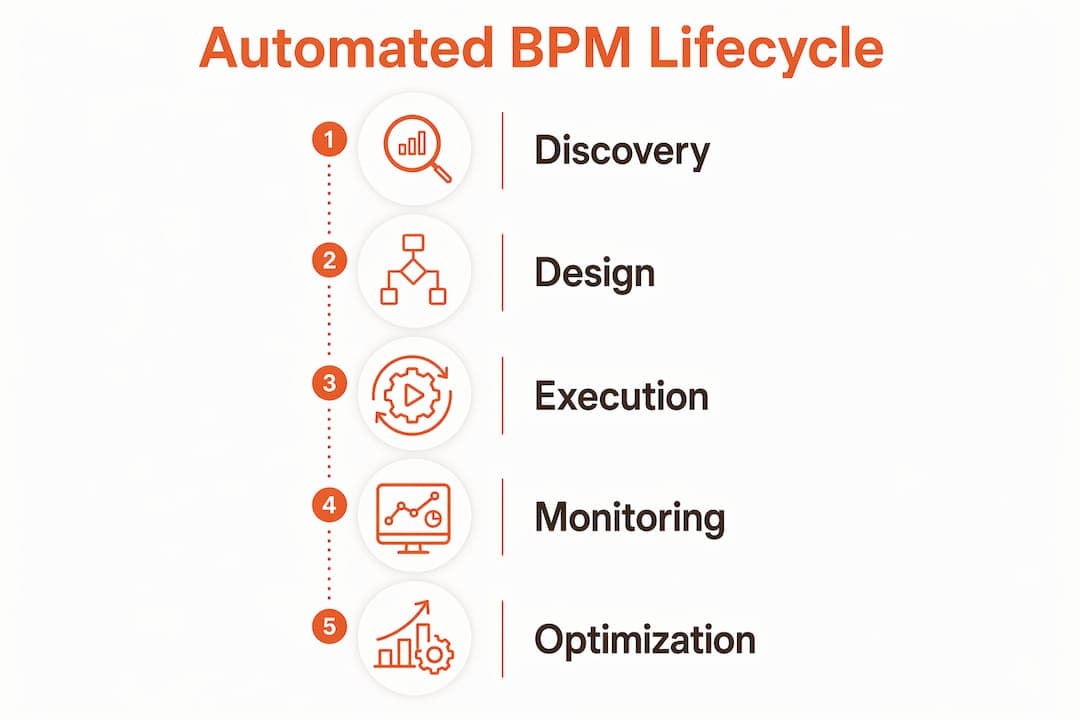
The BPM lifecycle is iterative, not linear. BPM lifecycle stages include process discovery and design, execution, monitoring, analysis, and continuous optimization. Each stage feeds the next, creating a feedback loop that drives sustained improvement rather than a one-time fix.
Process identification and design is where teams map existing workflows, identify bottlenecks, and define the ideal future state. Process modeling tools like BPMN (Business Process Model and Notation) give teams a shared visual language for documenting how work actually flows. Skipping this stage is the most common reason automation projects fail.

Execution is where the designed process goes live, supported by BPM software suites, workflow engines, or RPA tools. Monitoring runs in parallel, capturing real-time data on how the process performs against defined targets. Analysis then converts that data into insight, identifying where the process drifts from design.
Continuous optimization closes the loop. Teams use findings from analysis to refine process design, adjust automation rules, or retrain AI models. This phase is what separates BPM from a one-off software implementation.
| Lifecycle stage | Main activities | Primary objective |
|---|---|---|
| Discovery and design | Process mapping, stakeholder interviews, BPMN modeling | Define the ideal workflow and identify inefficiencies |
| Execution | Deploy workflows via BPM suite, RPA, or low-code tools | Run the process consistently at scale |
| Monitoring | Real-time dashboards, alert triggers, data capture | Track performance against defined KPIs |
| Analysis | Root cause analysis, bottleneck identification | Understand why gaps between design and reality exist |
| Optimization | Process redesign, rule updates, model retraining | Improve performance and adapt to changing conditions |
How does automated BPM differ from business process automation (BPA)?
BPM and BPA are related, but distinct. BPM is the management discipline covering strategy, design, governance, and continuous improvement. BPA is the execution strategy that applies technology to automate specific workflows within that framework. Confusing the two leads to costly mistakes.
BPA focuses on replacing manual effort with technology-driven execution. It integrates people, applications, and data across departments to remove friction from specific tasks. BPM provides the governance layer that decides which processes to automate, in what order, and how to measure success.
The practical risk of ignoring this distinction is significant. Teams that deploy automation tools without a BPM governance layer often automate broken processes. The result is faster errors, not faster results. Automating flawed processes perpetuates bottlenecks at machine speed.
| Feature | BPM | BPA |
|---|---|---|
| Primary focus | Strategy, design, governance | Execution and task automation |
| Scope | End-to-end process lifecycle | Specific workflows or task sequences |
| Objective | Align processes with business goals | Replace manual effort with technology |
| Ownership | Cross-functional leadership | IT and operations teams |
| Timeframe | Ongoing and iterative | Project-based with defined scope |
Pro Tip: Before selecting any automation tool, document the process as it currently runs. If you cannot explain every decision point in the workflow, you are not ready to automate it.
What are best practices for starting and scaling automated BPM initiatives?
The most effective starting point is a high-pain, rule-based manual process. Data entry, invoice approvals, employee onboarding checklists, and compliance reporting all share the same profile: repetitive steps, clear rules, and high volume. These are the processes where automation delivers fast, measurable returns.
NIST 2025 guidance confirms that a phased automation approach consistently outperforms isolated tool deployments. Starting with one well-mapped process, proving ROI, and then scaling that model across the organization reduces risk and builds internal confidence. Jumping to enterprise-wide automation without this foundation is a common and expensive mistake.
Follow this sequence when launching a BPM automation initiative:
- Identify the target process. Choose a process with clear rules, high frequency, and measurable business impact. Approval workflows and data handoffs between departments are strong candidates.
- Map the current state. Document every step, decision point, and exception. Use BPMN or a simple flowchart. This step reveals inefficiencies that technology cannot fix.
- Clean the process before automating it. Remove redundant steps, clarify ownership, and resolve ambiguities. Automation amplifies whatever exists in the process design.
- Select technology aligned with process complexity. Simple rule-based tasks suit RPA. Complex decisions with variable inputs require AI or intelligent automation. Low-code platforms work well for approval workflows and form-based processes.
- Engage stakeholders early. Employee resistance due to job insecurity is the largest adoption hurdle in BPM projects. Involving teams 3–6 months before deployment, and framing automation as reducing busywork rather than replacing jobs, directly reduces this risk.
- Define success metrics upfront. Cycle time, error rate, and cost per transaction give you a baseline. Without a baseline, you cannot prove improvement.
- Review and iterate after go-live. The first deployment is a hypothesis. Real-world performance data will reveal gaps that no amount of pre-launch planning can anticipate.
Pro Tip: Target what Zapier researchers call “administrative potholes” first. These are the small repetitive frictions between departments, like manual data handoffs and status update emails, that consume hours weekly without anyone noticing.
Scaling BPM automation follows the same logic. Each successful automation becomes a template. Document what worked, replicate the governance model, and apply it to the next process. Organizations that treat each automation project as a learning asset build compounding operational advantages over time.
What technologies and tools support effective automated BPM?
The technology stack for automated BPM has four core layers. Understanding each layer helps decision-makers select tools that fit their actual process complexity rather than chasing the most advanced option available.
- BPM software suites provide the modeling, execution, and monitoring environment for end-to-end process management. These platforms support BPMN-based design, workflow routing, and real-time dashboards in a single interface.
- Robotic process automation (RPA) handles high-volume, rule-based tasks by mimicking human interactions with software systems. RPA excels at data extraction, form filling, and system-to-system transfers without API integration.
- Intelligent automation (AI-enhanced RPA) adds machine learning and natural language processing to handle unstructured data and variable decision points. This layer is appropriate for processes like document review, customer inquiry routing, and AI-powered workflows that require judgment, not just rules.
- Low-code and no-code platforms allow operations and business teams to build and modify workflows without deep technical expertise. These tools accelerate deployment and reduce dependency on IT backlogs for process changes.
- Integration middleware and APIs connect automation tools with existing enterprise systems like ERP, CRM, and HRIS platforms. Without this layer, automation creates data silos rather than eliminating them.
Selecting the right tools requires matching tool capability to process complexity, integration requirements, and the technical capacity of the team managing the system. An enterprise-grade BPM suite is overkill for a ten-step approval workflow. An RPA bot alone cannot handle a process with fifty exception types.
How can organizations measure and optimize automated business processes continuously?
Measurement is what converts automation from a cost center into a performance asset. KPIs such as cycle time, error rate, and throughput give teams a factual view of whether an automated process is performing as designed. Without these metrics, teams rely on anecdote to make improvement decisions.
Process mining tools analyze event log data from enterprise systems to reconstruct how processes actually run, not how they were designed to run. This distinction matters. Process mining frequently reveals that real-world execution diverges significantly from the documented workflow, exposing hidden bottlenecks and unauthorized workarounds.
| KPI | What it measures | Why it matters |
|---|---|---|
| Cycle time | Time from process start to completion | Identifies delays and measures throughput speed |
| Error rate | Frequency of incorrect outputs | Signals process design flaws or data quality issues |
| Throughput | Volume of completed process instances per period | Measures capacity and scalability of the automated workflow |
| Cost per transaction | Total cost divided by process volume | Quantifies financial impact of automation improvements |
Regular process reviews, conducted quarterly at minimum, prevent performance drift. Automated processes degrade when business rules change but automation logic does not. Scheduling structured reviews keeps the automation aligned with current operational reality.
Pro Tip: Cross-departmental review sessions surface inefficiencies that single-team monitoring misses. The handoff between departments is where most process failures originate. Bring both sides of the handoff into the same room.
Key takeaways
Automated BPM succeeds when organizations prioritize process design and governance before selecting technology, then measure performance continuously to drive iterative improvement.
| Point | Details |
|---|---|
| BPM precedes BPA | Establish process governance and design before applying automation tools. |
| Start with rule-based processes | Target high-volume, manual, rule-based tasks for the fastest and clearest ROI. |
| Clean before automating | Remove inefficiencies from a process before deploying automation or you amplify the problem. |
| Engage employees early | Involve teams 3–6 months before deployment to reduce resistance and improve adoption. |
| Measure and iterate | Track cycle time, error rate, and throughput, then use process mining to find hidden gaps. |
What the Arosplatforms team has learned about BPM adoption
The most persistent misconception we encounter is that BPM creates rigidity. Decision-makers worry that documenting and standardizing processes will make their organizations slower to adapt. The opposite is true. Standardized processes are the ones you can change deliberately and quickly. Chaotic, undocumented processes change constantly but unpredictably, and no one knows what broke when something goes wrong.
The second lesson is harder to sell: the people dimension of BPM is more important than the technology dimension. We have seen well-funded automation projects collapse because the team running the process was never involved in designing the automation. They found workarounds on day one. Conversely, we have seen modest automation tools deliver strong results because the team understood why the change was happening and helped shape it.
Start smaller than you think you need to. One well-automated process that your team trusts is worth more than five partially automated processes that nobody uses correctly. Build the template, prove the model, then scale it. That sequence is not cautious. It is the fastest path to durable operational improvement.
— Arosplatforms team
How Arosplatforms approaches process automation for your industry
Arosplatforms builds customized AI operating systems designed around the specific workflows of your industry, from healthcare intake and logistics dispatch to legal contract review. Rather than deploying generic tools, the team embeds within your operations to map processes, identify automation targets, and build systems your team owns without vendor lock-in. Clients report an average of 82% faster turnaround on key tasks, with many reaching ROI within twelve months.

Explore industry-specific AI solutions across healthcare, logistics, manufacturing, financial services, and more. For teams ready to move from process mapping to full automation deployment, Arosplatforms provides the consulting and technical depth to get there without the guesswork of generic software rollouts.
FAQ
What is automated business process management?
Automated business process management is the discipline of designing, executing, monitoring, and improving business workflows using technology tools like RPA, AI, and BPM software suites. It combines strategic process governance with technology-driven execution to align operations with organizational goals.
How does BPM differ from business process automation?
BPM is the management discipline covering strategy, design, and governance across the full process lifecycle. BPA is the targeted application of technology to automate specific workflows within that BPM framework.
Where should a company start with process automation?
Start with a high-volume, rule-based manual process such as invoice approvals or data entry, map it fully, clean out inefficiencies, then apply automation tools. NIST 2025 guidance confirms this phased approach delivers better ROI than deploying isolated tools first.
What KPIs measure BPM success?
Cycle time, error rate, throughput, and cost per transaction are the primary KPIs for measuring automated BPM performance. These metrics establish a baseline before automation and track improvement after deployment.
Why do BPM automation projects fail?
The most common causes are automating flawed processes without first cleaning them, selecting tools before mapping workflows, and failing to involve employees in the design phase. Employee resistance due to job insecurity is the single largest adoption barrier in BPM projects.