Enterprise AI Governance: Map NIST's Four Functions to Action
Enterprise AI Governance: Map NIST’s Four Functions to Action
An AI governance framework is the set of policies, roles, and controls that let an organization manage AI risk while it scales AI use. The practice rests on three reference points: the NIST AI RMF, OECD’s principles and Governance Playbook, and the emerging ISO/IEC 42001 standard. This article walks through how those map to enterprise pillars, a working roadmap, and a real implementation example from Arosplatforms.
TL;DR:
- Most organizations should start by inventorying existing AI systems, classifying them by risk tier, and piloting full governance on one high-impact use case before scaling.
- Implementing controls such as human-in-the-loop, procurement screening, and ongoing monitoring are essential for day-to-day governance effectiveness.
- External standards like the EU AI Act impose binding legal obligations for high-risk AI, requiring organizations to prioritize compliance early in their governance efforts.
- Using frameworks such as the NIST AI RMF, OECD Principles, and ISO/IEC 42001 helps organizations create a structured, scalable governance program aligned with external requirements.
- Building governance into the AI operating system itself, with automation and embedded controls, enables faster, more effective risk management for industries with rapid AI deployment needs.
Table of Contents
- Top AI Governance Frameworks and Standards at a Glance
- How Do NIST’s Core Functions Map to Enterprise Pillars?
- What Is the Step-by-Step Roadmap for Implementing AI Governance?
- What Operational Controls Keep AI Governance Running Day to Day?
- How Do You Align Internal Governance With External Standards and Regulation?
- What Artifacts and Metrics Should Governance Programs Report?
- How Arosplatforms Implements Governance in Practice
- Editorial Perspective: Governance as Strategic Capability
- How Arosplatforms Can Help Implement Your Governance Program
- Sources
- FAQ
Top AI Governance Frameworks and Standards at a Glance
Five names dominate every serious governance conversation right now, and each one answers a different question. Knowing which one to reach for saves months of wasted committee time.
- NIST AI RMF 1.0: a voluntary, four-function structure (GOVERN, MAP, MEASURE, MANAGE) built to raise the trustworthiness of AI systems across their lifecycle. It’s the closest thing the United States has to a common vocabulary for AI risk, and it comes with a companion playbook and crosswalks that map its functions to specific practices, including a generative AI profile.
- OECD AI Principles and the CAIG Playbook: the OECD Principles set the ethical baseline (fairness, transparency, accountability), and the AI Governance Playbook turns those principles into directives across strategy, risk and compliance, workforce readiness, and day-to-day operations.
- ISO/IEC 42001: an emerging management system standard for AI, structured the way ISO 27001 structures information security. It gives organizations an actual certification path covering risk management and bias mitigation, which matters if procurement teams start asking vendors for proof of governance maturity.
- EU AI Act: not a voluntary playbook. It’s binding law that tiers AI systems by risk and imposes hard legal obligations, documentation duties, and conformity assessments on “high-risk” uses. Any organization touching EU markets needs to treat this one differently than the others, because ignoring it carries fines rather than reputational risk alone.
- UNESCO Recommendation on the Ethics of AI: a global ethics reference many national policies draw from, useful when you need a values baseline that isn’t tied to a single jurisdiction.
Most enterprises end up running a blend. NIST provides the operating structure, OECD supplies the strategic and workforce lens, ISO 42001 offers a certifiable target, and the EU AI Act sets the legal floor wherever it applies. Arosplatforms’s AI governance glossary breaks down how these roles and definitions typically get assigned inside an organization.
How Do NIST’s Core Functions Map to Enterprise Pillars?
The NIST AI RMF’s four functions sound abstract until you attach them to a department and a deliverable. Here’s the practical translation.
- GOVERN sits above the other three. It’s the cross-cutting function that infuses risk management culture, accountability, and policy into every stage of the AI lifecycle, rather than one step in a sequence. Inside an enterprise, GOVERN becomes leadership and strategy: an executive sponsor, a governance committee, and a documented risk appetite.
- MAP is where teams identify context and classify risk. This becomes data and model governance in practice: building an AI system inventory, tagging use cases by risk tier, and producing model cards that document intended use, training data, and known limitations.
- MEASURE turns into MLOps and infrastructure work: instrumenting systems to track accuracy, drift, fairness metrics, and performance against the baselines set during mapping.
- MANAGE becomes security, privacy, and operational response: access controls, deployment gates, incident response procedures, and the ongoing decision of whether to fix, retrain, or retire a model.
A fifth pillar, policy and legal, threads through all four. This is where the EU AI Act’s documentation requirements, ISO 42001 certification prep, and internal AI use policies live side by side.
The artifacts each pillar owns are what auditors and executives actually look for: a policy catalog, a live AI inventory, model cards for every production system, and access logs proving deployment controls are enforced, not just written down. Enterprise guidance consistently points to centralized standards with federated execution as the model that scales, meaning one governance function sets the rules while business units execute them with local context.
Pro Tip: Don’t try to govern everything at once. Pick one high-impact, moderate-risk use case, run it through all four NIST functions end to end, and use that as your template. It’s far easier to scale a working pattern than to design a perfect one on paper.
What Is the Step-by-Step Roadmap for Implementing AI Governance?
Governance programs stall for a predictable reason: they try to build the whole system before proving any of it works. A phased sequence avoids that trap.
- Secure executive sponsorship and set risk appetite. Governance without a named executive owner dies in committee. Get a C-suite sponsor to formally define how much AI risk the organization is willing to accept, tier by tier, before writing a single policy document.
- Appoint an AI governance owner or committee. This is often a single AI governance officer supported by a small cross-functional group, legal, security, data science, and a business unit representative at minimum. Define a RACI matrix that specifies who’s responsible, accountable, consulted, and informed for approvals at each risk tier.
- Inventory existing systems and classify risk. You cannot govern what you cannot see. Catalog every AI system in production or pilot, then tier each one by potential impact, similar to how the EU AI Act separates minimal, limited, high, and unacceptable risk.
- Require evidence per tier. Low-risk tools might need only a lightweight registration. High-risk systems, anything touching hiring, credit, healthcare, or safety, should require a full risk assessment, a model card, and documented human oversight before deployment.
- Design approval gates and monitoring workflows. Build checkpoints into the development pipeline itself, not as a separate review that happens after the system ships.
- Roll out in phases. Pilot with one business unit, refine the process based on friction points, then scale.
Several operational details separate programs that survive contact with reality from ones that don’t:
- Human-in-the-loop requirements for any high-risk automated decision, with a named human accountable for override authority.
- Procurement due diligence that screens third-party AI tools and vendors before they’re purchased, not after.
- Resource sizing that assumes governance work is ongoing, not a one-time project, roughly one dedicated governance staffer per every few dozen production AI systems is a reasonable starting ratio for mid-sized enterprises.
- A documented escalation path so nobody has to improvise when something goes wrong during the pilot phase.
Arosplatforms’s AI risk assessment guidance walks through how these gates typically get structured for real production systems, including how risk tiers connect to specific documentation requirements.
What Operational Controls Keep AI Governance Running Day to Day?
A governance framework is only as good as the controls that run underneath it once the policy documents are signed off. This is where most programs either prove their worth or quietly stop mattering.
Risk assessment methods generally fall into three camps. Qualitative assessments (expert review, checklists) work for lower-risk, well-understood use cases. Quantitative methods, statistical testing for bias, performance benchmarking against known baselines, fit high-stakes systems where a wrong answer has measurable cost. Most mature programs use a mixed approach: qualitative screening to triage, then quantitative testing for anything that clears a risk threshold.
Monitoring needs specific, trackable signals rather than a vague commitment to “keep an eye on things.” Useful KPIs include:
- Model drift (how much output distributions shift from training baselines).
- Fairness metrics across demographic subgroups where relevant.
- Security signals, such as unusual query patterns that might indicate prompt injection or data exfiltration attempts.
- Uptime and latency against service-level commitments, especially for customer-facing AI.
Incident response deserves its own playbook, separate from general IT incident response. The strongest programs treat the response plan itself, not the initial risk score, as the thing that actually protects trust after something breaks. That plan needs rollback criteria defined in advance, communication templates ready before an incident happens, and clear escalation paths so nobody’s improvising who to call at 2 a.m. Government adoption guidelines, including the District of Columbia’s AI/ML usage policy, reinforce this same pattern, with governance boards, procurement screening, and monitoring built in from the start rather than bolted on later.
Document everything that a future audit, or a future incident, will ask for: a risk register, model cards for every production system, evaluation records showing test results over time, and audit logs proving that approval gates were actually followed and not just documented.
Pro Tip: Treat your incident response plan like a fire drill, not a filing cabinet document. Run a tabletop exercise once a quarter with the actual people who’d be involved. Plans that have never been rehearsed rarely work when they’re needed.
How Do You Align Internal Governance With External Standards and Regulation?
The honest answer: not every framework carries the same weight, and treating them all as equally mandatory wastes effort where it isn’t needed.
NIST’s AI RMF and the OECD Playbook are voluntary. They’re best used as structuring tools, ways to organize your internal policy and prove maturity to customers or partners, not legal requirements you’re forced to comply with. ISO/IEC 42001 sits in between: adopting it is optional, but achieving certification against it can become a competitive or contractual requirement, especially in vendor relationships where a client wants third-party proof of governance discipline. The EU AI Act is the one entry on this list that creates binding legal obligations, and it applies based on where your AI system is used or who it affects, not just where your company is headquartered.
A practical alignment approach looks like this:
- Use NIST’s crosswalks and specialized profiles, including the generative AI profile, to prioritize which controls matter most for your specific use cases rather than trying to implement the entire framework uniformly.
- Treat the OECD Playbook’s four categories (strategy, risk and compliance, workforce readiness, operations) as a gap-check against your existing program.
- Map any EU-facing AI system against the AI Act’s risk tiers early, since conformity assessments and technical documentation take real time to prepare.
- Maintain a single crosswalk document showing which internal policy or control satisfies which external requirement, this becomes invaluable during procurement reviews and regulatory inquiries alike.
The White House’s National Policy Framework for Artificial Intelligence signals where U.S. federal policy is heading, and it’s worth tracking even though it isn’t binding law yet. Organizations that build their crosswalk habit now will have an easier time adapting when firmer regulation arrives.
What Artifacts and Metrics Should Governance Programs Report?
Executives and auditors don’t want a philosophy statement. They want proof the system works, delivered on a predictable schedule.
The minimum artifact set includes a policy catalog (what’s allowed, what needs approval, what’s prohibited), a live AI system inventory tagged by risk tier, model cards for every production system, documented risk assessments for anything above the lowest tier, and monitoring logs showing the KPIs above are actually being tracked, not just defined on paper.
For dashboards, keep the metric count small and meaningful:
Key metrics could include the share of AI systems with risk assessments, monitoring of drift and fairness metrics, tracking of open incidents and resolution times, and progress in closing audit findings over time.
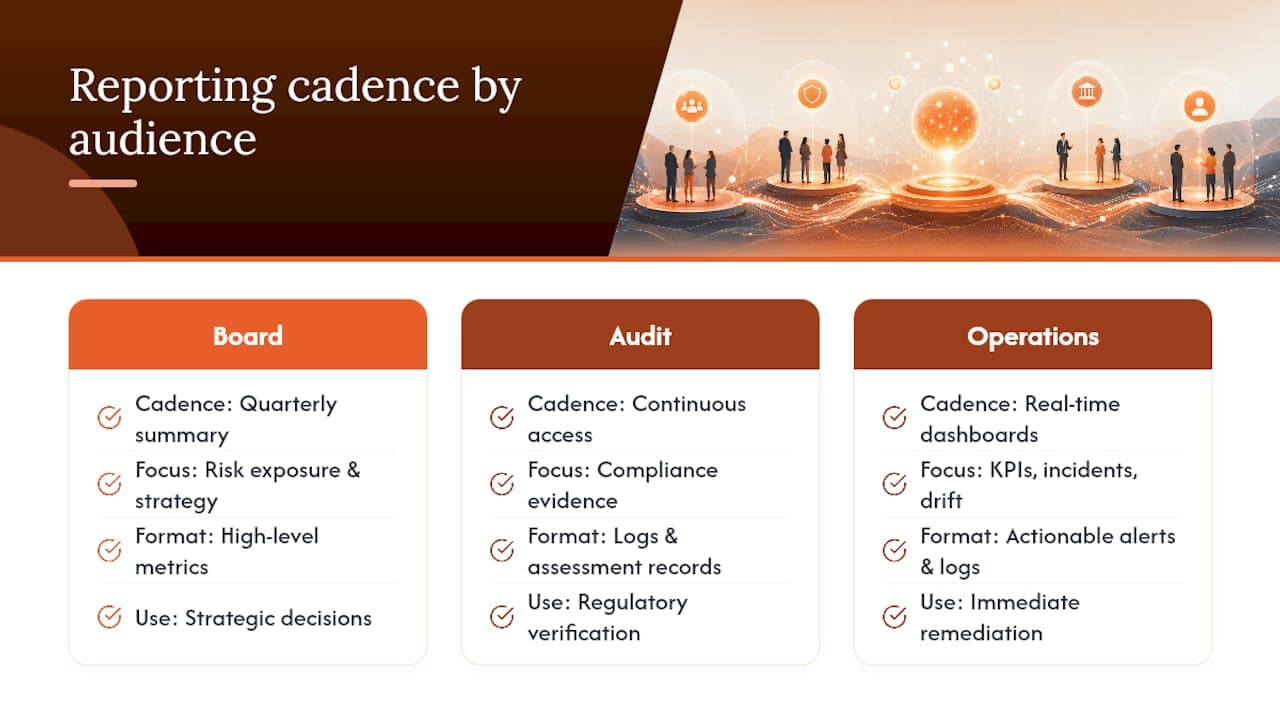
Reporting cadence should match the audience. Boards typically want a quarterly summary tied to risk exposure and strategic decisions. Audit and compliance functions need continuous access to logs and assessment records, not a periodic report. Operational teams need real-time dashboards they can act on immediately. Demonstrating continuous improvement, closing prior audit findings, tightening drift thresholds over time, expanding coverage of the AI inventory, is usually what separates a governance program that satisfies regulators from one that merely exists on paper.
How Arosplatforms Implements Governance in Practice
Some AI consultancies build governance directly into the custom AI operating systems they design for clients, rather than treating it as a separate compliance layer bolted on afterward. One approach centers on embedding controls into the operating system itself so clients retain ownership and can manage the system without depending on a vendor indefinitely.
Typical governance deliverables in an Arosplatforms engagement include:
- A live AI system inventory tied to the client’s specific operational workflows, not a generic template.
- Policy automation that enforces approval gates and access controls at the infrastructure level, using AI policy management tools rather than manual review chains.
- Monitoring enablement covering drift, performance, and security signals specific to the client’s industry, whether that’s healthcare, logistics, or real estate.
- Documentation packages, model cards, risk assessments, audit trails, built to withstand both internal review and external audit.
For organizations considering a partner-led build, the realistic sequence is an initial assessment of current AI exposure, a pilot on one high-value use case, then a scaled rollout once the pattern is proven.
Editorial Perspective: Governance as Strategic Capability
Most organizations treat AI governance as a compliance checkbox, and that’s the mistake. The OECD’s own framing gets this right: governance sticks when it’s tied to corporate strategy and workforce literacy, not when it’s a document legal signs off on once a year.
The failure patterns are consistent. Shadow AI spreads because employees find ungoverned tools faster than IT can approve sanctioned ones. Single-owner governance collapses the moment that person leaves or gets overloaded. And most programs skip incident response planning entirely, assuming risk assessment alone will prevent every problem, when a rehearsed response plan is often what actually preserves trust after something breaks.
None of this requires waiting for perfect regulation. Inventory what you have, tier it by risk, and pilot one use case through the full governance cycle before scaling. That’s the whole first move.
— arosplatforms team
How Arosplatforms Can Help Implement Your Governance Program
Building all of this internally takes months most leadership teams don’t have, and hiring a full governance function before proving ROI is a hard sell to any board. Arosplatforms works as a direct implementation partner instead of a checklist vendor: the team embeds within your operations to design an AI operating system that has governance, risk tiering, and monitoring built into its foundation rather than added as an afterthought.
That approach fits organizations that need governance to move at the same speed as the AI systems it’s supposed to control, industries like healthcare, logistics, and manufacturing where a slow governance rollout means the AI use cases pile up ungoverned in the meantime.
Browse real AI use cases to see how governance gets built into production systems, or start with an assessment of your current AI inventory and risk exposure to scope what a pilot would look like.
Sources
- NIST AI RMF: Core functions (GOVERN, MAP, MEASURE, MANAGE)
- Oecd
- A Practical AI Governance Framework for Enterprises - Databricks
- AI Risk Management Framework | NIST
FAQ
What Is an AI Governance Framework?
It’s the combination of policies, roles, and technical controls an organization uses to manage AI risk across the system lifecycle, typically anchored to references like the NIST AI RMF or ISO/IEC 42001.
Is the NIST AI RMF Mandatory?
No, it’s voluntary for most organizations, though federal agencies and their contractors increasingly treat it as a baseline expectation, and it’s widely used as a structuring reference even where compliance isn’t legally required.
How Is ISO/IEC 42001 Different From the EU AI Act?
ISO/IEC 42001 is a voluntary management system standard offering a certification path, while the EU AI Act is binding law that imposes legal obligations on high-risk AI systems used in or affecting the EU market.
Who Should Own AI Governance Inside a Company?
A named AI governance officer or cross-functional committee, backed by executive sponsorship and a documented RACI matrix, works better than assigning governance to one department alone; Arosplatforms builds this ownership structure directly into the client’s AI operating system during implementation.
What’s the First Step in Building an AI Governance Program?
Inventory every AI system currently in use or in pilot, classify each one by risk tier, and run one high-impact use case through a full governance cycle before trying to scale the program organization-wide.