AI Dealership CRM Automation: What Managers Must Know
AI Dealership CRM Automation: What Managers Must Know

AI dealership CRM automation is defined as the use of artificial intelligence to independently manage lead handling, customer communication, and sales workflows inside automotive dealership CRM systems. The industry term for the most advanced form is agentic CRM, which goes beyond basic automation by executing tasks end to end across multiple dealership systems without human intervention. Understanding what is ai dealership crm automation matters now because three distinct AI tiers shape every buying decision in 2026: generative AI, predictive AI, and agentic AI. Each tier delivers a different level of operational impact, and choosing the wrong one costs dealerships real revenue.
What is AI dealership CRM automation and how does it work?
AI dealership CRM automation is the integration of artificial intelligence into a dealership’s customer relationship management platform to handle lead capture, qualification, follow-up, and appointment scheduling with minimal staff involvement. A standard dealership CRM organizes buyer conversations and tracks opportunities. An AI-powered version does that work automatically, around the clock, across every lead channel.
The system connects to your dealership management system (DMS), scheduling tools, and lender platforms. When a lead arrives at 11 PM on a Sunday, the AI responds immediately, qualifies the buyer, and books a test drive, all without a salesperson touching the record. AI-powered CRM systems integrate multiple lead channels, automate messaging, and support service-to-sales workflows in a single connected environment.

The result is a system that does not sleep, does not forget to follow up, and does not send inconsistent messages. That consistency is what separates AI-driven dealership automation from the manual CRM processes most stores still rely on.
What are the types of AI used in dealership CRM automation?
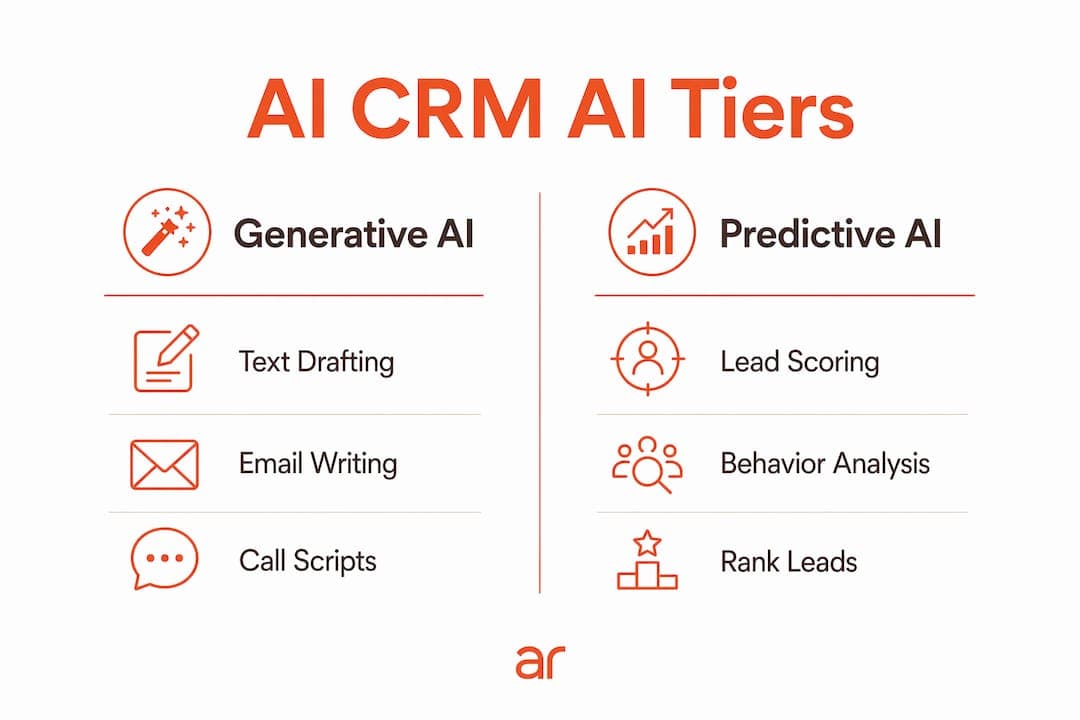
Industry analysts categorize 2026 AI CRM technology into three tiers, each with a distinct role in dealership operations. Understanding these tiers helps you evaluate any platform with clarity.
Generative AI
Generative AI drafts text. It writes follow-up emails, summarizes customer conversations, and produces call scripts. This tier saves time for sales staff but does not execute tasks on its own. A salesperson still reviews and sends every output. Generative AI is useful, but it is the lowest-impact tier for dealership revenue.
Predictive AI
Predictive AI scores and ranks leads. It analyzes buyer behavior, browsing history, and CRM data to tell your team which prospects are most likely to buy this week. Predictive analytics lets sales managers prioritize outreach instead of working every lead with equal effort. The limitation is that predictive AI still requires a human to act on its recommendations.
Agentic AI
Agentic AI is the tier that actually does the work. Agentic AI handles autonomous qualification, appointment booking, and task execution across CRM, DMS, and scheduling systems without waiting for human input. It does not just suggest the next step. It takes it. This is the tier that drives measurable reductions in lead response time and manual workload.
| AI tier | Primary function | Requires human action? | Operational impact |
|---|---|---|---|
| Generative AI | Drafts text and summaries | Yes, for every output | Low to moderate |
| Predictive AI | Scores and ranks leads | Yes, to act on scores | Moderate |
| Agentic AI | Executes tasks end to end | No, for routine workflows | High |
Pro Tip: When evaluating platforms, ask vendors to demonstrate a full lead lifecycle from web form submission to confirmed appointment. If a human must intervene at any point, the platform is not truly agentic.
Why is CRM and DMS integration critical for dealership automation?
CRM effectiveness depends on real-time DMS data. Without tight synchronization between your CRM and your DMS, automation workflows break down at the exact moments they matter most. A lead that triggers an automated follow-up based on stale inventory data creates a bad customer experience and a wasted opportunity.
The DMS is the system of record for vehicle inventory, deal status, and customer history. The CRM is the system of engagement. When these two platforms share data in real time, the AI can make accurate decisions automatically. When they do not, staff end up doing manual data entry to fill the gaps, which defeats the purpose of automation entirely.
Common integration pitfalls dealership managers encounter include:
- OEM restrictions that limit what data third-party CRM platforms can access
- Nonstandard DMS configurations that require custom API work to connect properly
- Audit trail gaps where automated actions are not logged in a tamper-evident format
- Partial integrations that sync some data but miss deal status or service history
Technical debt from nonstandard DMS setups frequently undermines AI automation. Early assessment and vendor transparency can prevent prolonged operational problems. Ask every vendor to show you their DMS integration documentation before you sign anything.
Pro Tip: Request proof of signed event records during your platform demo. Agentic AI produces auditable signed events that create tamper-evident logs of every automated action. If a vendor cannot show you this, their audit trail is incomplete.
How does AI CRM automation improve sales processes and customer experience?
The most direct benefit of AI CRM for dealerships is speed. Agentic CRM systems respond immediately to leads 24/7, qualifying buyers, booking appointments, and sending follow-ups without any delay. A buyer who submits a form at midnight gets a response in seconds, not the next morning when a competitor has already called them.
The data on lead response speed is striking. 51% of dealers now deliver multichannel lead responses within 15 minutes, a 100% increase over five years. That improvement tracks directly with the adoption of automated CRM workflows. Dealers who respond within 15 minutes convert at significantly higher rates than those who respond hours later.
The practical improvements AI automation delivers across a dealership’s sales process include:
- 24/7 lead qualification that routes hot buyers to salespeople immediately during business hours
- Automated appointment scheduling that fills the calendar without phone tag
- Consistent follow-up sequences that do not depend on individual salesperson habits
- Service-to-sales workflows that identify upgrade opportunities from service records
- Standardized messaging that protects brand voice across every customer interaction
Automation amplifies human sales staff by handling repetitive tasks around the clock, which lets your team focus on high-value conversations and closing deals. The AI handles the volume. Your salespeople handle the relationship.
What are best practices for implementing AI dealership CRM automation?
Selecting the right platform starts with one question: does this system execute tasks, or does it only assist with them? The distinction between agentic AI and basic AI assistants is the difference between a system that works while your team sleeps and one that creates more work for them.
- Evaluate agentic capabilities first. Request a live demo of a full lead lifecycle. Identify every point where a human must intervene. That intervention count is your baseline for comparison across platforms.
- Audit your DMS integration depth. Ask vendors for their specific integration documentation for your DMS. Confirm that the CRM treats the DMS as the system of record and syncs in real time.
- Assess your technical debt early. OEM restrictions and nonstandard DMS configurations complicate integration and create automation failures. Identify these before you commit to a platform.
- Train staff on handoff protocols. Automation handles qualification and scheduling. Your salespeople need to know exactly when and how the AI hands a buyer to them, and what context the CRM provides at that moment.
- Verify governance and audit trails. Signed events create tamper-evident records that protect your dealership’s operational integrity. Confirm your platform logs every automated action in a format you can audit.
The emerging direction for AI CRM in automotive is deeper multi-system automation. Platforms are moving toward connecting CRM, DMS, lender portals, and OEM incentive systems into a single AI dealer operations layer that manages the entire customer lifecycle. Dealerships that build this infrastructure now will have a structural advantage over those that wait.
Pro Tip: Automation should increase the time your salespeople spend on genuine conversations, not reduce it. If your team feels the AI is replacing their role, your handoff protocols need adjustment. The goal is more qualified conversations, not fewer human interactions.
Key Takeaways
AI dealership CRM automation delivers measurable results only when it combines agentic AI execution, real-time DMS integration, and clear human handoff protocols across the full sales lifecycle.
| Point | Details |
|---|---|
| Three AI tiers exist | Generative, predictive, and agentic AI each serve different functions; agentic AI drives the highest operational impact. |
| DMS integration determines success | Real-time CRM-DMS synchronization is the foundation of reliable automation; gaps cause workflow failures. |
| Speed converts leads | Dealers responding within 15 minutes convert at higher rates; agentic CRM makes that speed consistent. |
| Agentic AI executes, not just assists | Platforms that only summarize or suggest still require manual work; true automation executes tasks end to end. |
| Audit trails protect operations | Signed event records from agentic AI create tamper-evident logs that support compliance and accountability. |
The case for going agentic before your competition does
The Arosplatforms team has worked with dealerships that spent years on CRM platforms they described as “AI-powered” and saw almost no change in lead conversion. The common thread was always the same: the system summarized work instead of doing it. Salespeople still had to log updates, manually send follow-ups, and chase leads that went cold over the weekend.
The shift that actually moved the needle was moving to agentic AI, the kind that acts across systems, books appointments, and creates a signed record of every action. That is not a minor upgrade. It changes the operational model of the dealership. Your team wakes up Monday morning with a calendar that filled itself and a CRM that already qualified every lead from the weekend.
The uncomfortable truth about most dealership AI tools is that they are sold as automation but function as assistants. They make existing work slightly faster. Agentic AI eliminates entire categories of manual work. The AI readiness assessment step matters here because dealerships with legacy DMS configurations often discover integration gaps that would have caused expensive failures post-deployment. Knowing your technical baseline before you buy is not optional. It is the difference between a system that works on day one and one that takes six months to stabilize.
— Arosplatforms team
How Arosplatforms builds AI CRM automation for automotive dealerships
Arosplatforms builds customized AI operating systems for automotive dealerships, with a focus on agentic AI that executes tasks across CRM, DMS, and scheduling platforms without manual intervention.

The approach starts with a deep operational assessment to identify integration gaps, DMS compatibility issues, and workflow bottlenecks before any build begins. Arosplatforms then develops a custom AI OS for automotive dealerships that connects your existing systems and automates the full lead lifecycle. Clients typically see returns within twelve months, with an average of 82% faster turnaround on key tasks. Dealerships in the US can explore AI consulting for US enterprises to see how this applies to their specific market and scale.
FAQ
What is AI dealership CRM automation?
AI dealership CRM automation is the use of artificial intelligence to manage lead handling, customer communication, and sales workflows inside a dealership’s CRM platform with minimal human involvement. The most advanced form, agentic CRM, executes tasks end to end across CRM, DMS, and scheduling systems autonomously.
What is the difference between predictive AI and agentic AI in a dealership CRM?
Predictive AI scores and ranks leads to guide salesperson decisions, but a human must still act on those scores. Agentic AI takes action directly, qualifying leads, booking appointments, and updating records without waiting for staff input.
Why does DMS integration matter for AI CRM automation?
Without real-time synchronization between the CRM and the DMS, automated workflows break down and staff must fill data gaps manually. DMS integration quality is the primary factor that determines whether AI automation delivers consistent results.
How fast should an AI CRM respond to dealership leads?
Agentic CRM systems respond to leads immediately, regardless of the time of day. Data shows that 51% of dealers now deliver lead responses within 15 minutes, and dealers who hit that threshold convert at significantly higher rates.
What are signed events in agentic CRM systems?
Signed events are tamper-evident records that agentic AI creates each time it completes an automated action across dealership systems. They provide an auditable log that protects operational integrity and supports compliance requirements on the dealership floor.